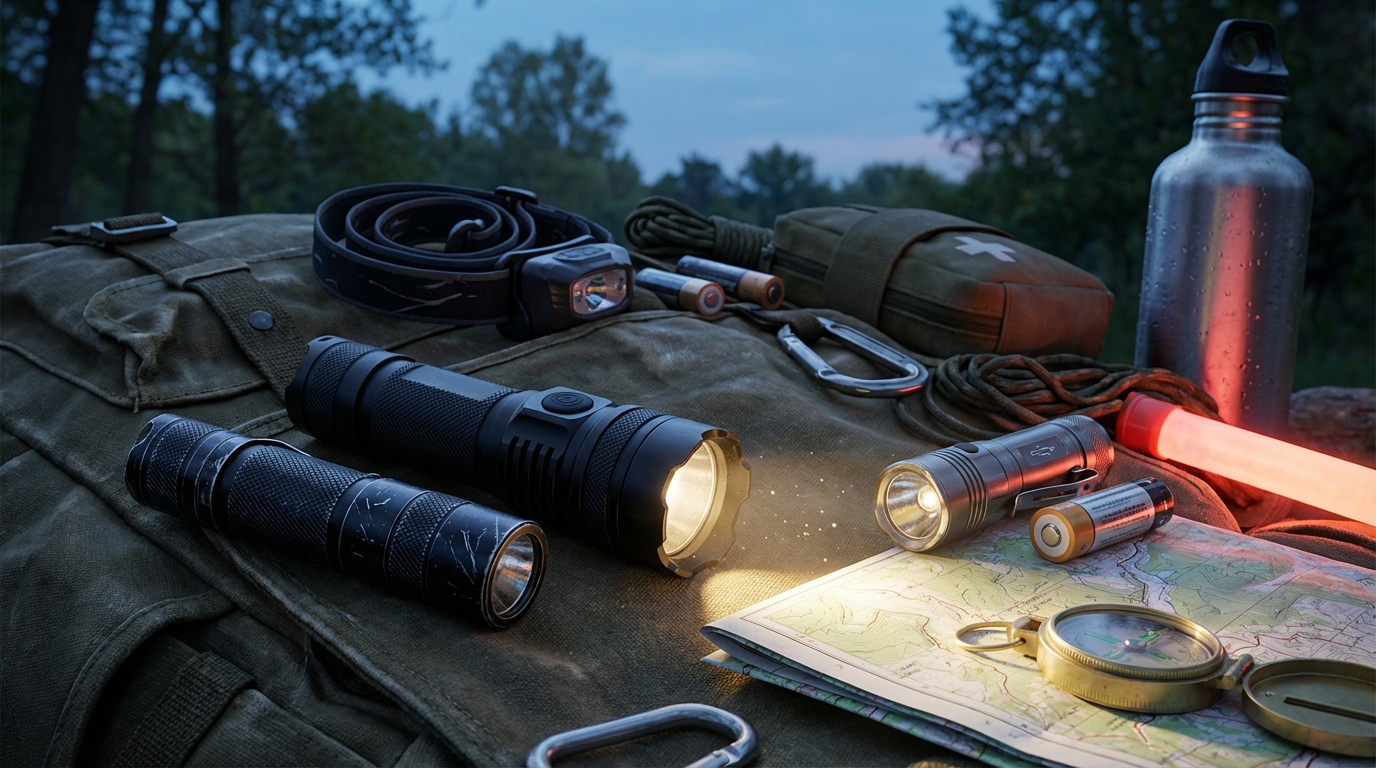
Best Survival Flashlights for Your Emergency Kit
Quick answer — top survival flashlight picks:
- Fenix PD36R Pro — rechargeable powerhouse for primary carry
- Streamlight ProTac 2L-X — compact dual-fuel field workhorse
- SureFire G2X Pro — bombproof simplicity with disposable cells
- Sofirn BLF LT1 — camp lantern for area illumination
- Black Diamond Spot 400-R — rechargeable hands-free headlamp
- Coast PX22 — affordable AA backup for every kit
As a FEMA-trained Wilderness First Responder, I’ve carried and relied on flashlights during Pacific Northwest search operations, winter storm responses, and backcountry evacuations over the past 12 years. These picks for the best survival flashlights reflect what I’ve tested in real conditions — in rain, below freezing, and through multi-day power outages — not just spec sheets. Every recommendation here has earned its place in my own gear rotation.
Why a Flashlight Belongs Near the Top of Your Prep List
During a February ice storm response near the Columbia River Gorge, I watched a family of four try to navigate a pitch-black stairwell with a phone screen at two percent battery. The father slipped on the third step and fractured his wrist. That moment cemented something I already knew from years of WFR deployments: a reliable light source isn’t a luxury — it’s the tool that keeps everything else functional.
The CDC reports that fall injuries spike during extended power outages, particularly among older adults navigating unfamiliar darkness. A dependable emergency flashlight lets you move safely, treat injuries, read medication labels, perform repairs, and signal for help. It integrates with every other piece of gear in your kit. You can’t apply a tourniquet, read a map, or find a breaker panel if you can’t see.
That’s why when I help people start building a 72-hour emergency kit, a flashlight is one of the first three items I recommend — right alongside water and a first aid kit. Small, lightweight, and immediately useful, a survival flashlight delivers more preparedness value per ounce than almost anything else you can carry.
How I Evaluate the Best Survival Flashlights
I don’t rely on manufacturer claims alone. My evaluation process starts with the ANSI FL1 standard — the industry-accepted testing protocol that defines how lumens, runtime, beam distance, impact resistance, and water resistance are measured. When I compare lights, I look at ANSI FL1-rated specs first, then verify them against my own field use and community runtime tests.
Here’s what that looks like in practice: I run each flashlight on its stated low mode and time it until output drops below useful levels. I’ve done drop tests onto concrete from meter height. I’ve submerged lights in creeks. I’ve used them in driving rain on SAR callouts and in sub-freezing conditions on Mt. Hood. The picks below survived all of that.
Core Criteria
- Lumens: Total visible output measured per ANSI FL1. More lumens means more brightness — and usually shorter runtime.
- Candela and beam distance: Measures intensity in one direction. If you need to scan trails or roadsides, prioritize throw.
- Runtime: Always check the low-mode runtime. That’s what matters during a multi-day power outage. Ten hours minimum; 30-plus is better.
- IP ratings: IPX7 means temporary submersion. IP68 means prolonged submersion plus complete dust sealing. Read the fine print.
- Battery type: AA/AAA are universally available. CR123A cells are compact and long-lasting. 18650 and 21700 are high-capacity rechargeables. USB-C charging simplifies everything.
Brightness and Beam Types in Practice
Here’s what lumens actually look like in real use, because numbers without context are meaningless:
- 50–100 lumens: Enough to read, navigate a hallway, or find items in a bag. This is your extended-runtime mode.
- 200–400 lumens: Solid working light. You can illuminate a room, walk a trail, or perform first aid comfortably.
- 600–1,000 lumens: Powerful throw for scanning large areas, signaling, or outdoor navigation across open ground.
- 1,000+ lumens: Impressive but battery-hungry. Useful in bursts for search tasks, but you won’t sustain this for hours.
For most survival scenarios, I spend 90 percent of my time on the 50–200 lumen setting. The turbo mode is there when I need it, but discipline on brightness is what keeps your light running through the night.
Key Features for the Best Survival Flashlights
Required
- Brightness: At least 200 lumens on medium. Between 300 and 1,000 lumens covers everything from close-up repairs to distance scanning.
- Runtime: Prioritize long low-mode runtime — 10 to 50-plus hours depending on the light and battery.
- Water resistance: IPX7 or better. Non-negotiable for any light going into a survival kit.
- Durability: Anodized aluminum or reinforced polymer body, proper O-ring seals, and a reliable switch mechanism.
Recommended
- Power flexibility: A rechargeable primary cell (18650 or 21700) paired with the ability to accept disposable backups (AA or CR123A).
- Simple controls: A single-button or clear mode cycle you can operate with cold, wet, or gloved hands — under stress.
Useful Extras
- USB-C charging port, tail-stand capability, pocket clip, and a dedicated SOS or strobe mode.
Top Picks for the Best Survival Flashlights
Each recommendation below has been through my hands. I’ve carried, tested, or deployed every one of these in field conditions. Prices are approximate street prices as of early 2026 — confirm current pricing before purchasing.
Fenix PD36R Pro — Best Primary Survival Flashlight
~$100 | 2,800 lumens max | USB-C rechargeable | IP68 | ~115g
This is my go-to recommendation for a primary rechargeable survival flashlight. The PD36R Pro runs on a single 21700 cell, recharges via USB-C, and delivers a genuinely useful 150-lumen low mode that runs for over 20 hours. I carried one during a three-day winter storm outage in 2024 and never had to swap cells. The tail switch is decisive and easy to find by feel. The build quality is outstanding — I’ve dropped mine on rock multiple times with nothing more than cosmetic scratches. Con: At $100, it’s the priciest pick on this list. Best for: Primary handheld in your home kit, bug out bag, or bedside.
Streamlight ProTac 2L-X — Best Compact Field Light
~$55 | 500 lumens max | Dual-fuel (CR123A or 18650) | IPX7 | ~113g
I carried the ProTac 2L-X on a 14-hour SAR callout near Mt. Hood in January and it ran reliably in 22°F conditions on a single CR123A cell. The dual-fuel design is the key selling point — it accepts both disposable CR123A batteries and rechargeable 18650 cells, giving you real flexibility in extended emergencies. The programmable switch lets you set it to high-only, low-first, or strobe-first. I leave mine on low-first. Con: The interface takes a minute to learn. Best for: Compact all-rounder for EDC, car kit, or jacket pocket. A strong tactical flashlight for survival use.
SureFire G2X Pro — Most Reliable Disposable-Cell Light
~$75 | 600 lumens max | CR123A | Weather resistant | ~122g
SureFire’s reputation in law enforcement exists for a reason. The G2X Pro is dead simple — two modes, a click tailcap, and a polymer body that shrugs off abuse. I keep one in my SAR pack as a loaner and backup. It’s run flawlessly every single time, including one callout where it sat in a wet external pocket for six hours of steady rain. The two-stage output (15 lumens low / 600 lumens high) is practical. Con: CR123A batteries are expensive and less common than AA. No recharging option. Best for: A rugged prepper flashlight that works every time with zero complexity.
Sofirn BLF LT1 — Best Lantern for Area Illumination
~$50 | 600 lumens max | USB-C rechargeable (26650 or 21700) | IP67 | ~280g
This is the light that competitors keep recommending for a reason. The BLF LT1 is a camp lantern, not a handheld, and it fills a gap that most survival flashlight lists ignore: area illumination. During power outages, you don’t need a focused beam — you need a room lit up so your family can eat dinner, play cards, or just feel safe. The LT1 delivers warm, adjustable-color-temperature light for up to 50 hours on low. I’ve used it through two multi-day outages and it’s replaced candles entirely in my home kit. Con: Too large for a pocket or pack side pocket. Best for: Home power outage preparedness, base camp, family shelter.
Black Diamond Spot 400-R — Best Survival Headlamp
~$50 | 400 lumens max | Rechargeable + AAA compatible | IPX8 | ~75g
Hands-free lighting isn’t optional — it’s essential. Every time I’ve treated an injury in the field, I’ve needed both hands. The Spot 400-R delivers solid output, runs on a rechargeable battery pack or three AAA cells (critical redundancy), and the IPX8 rating means it handles full submersion. The red night-vision mode preserves your dark adaptation. I’ve worn this headlamp on every SAR callout for the past two years. Con: The touch-dimming interface is fiddly with thick gloves. Best for: First aid, repairs, cooking, navigating hands-free.
Coast PX22 — Best Budget Backup Light
~$12 | 315 lumens max | AA | IPX4 | ~85g
At this price, you can put one in every room, every vehicle, and every kit without hesitation. The PX22 runs on a single AA cell — the most universally available battery on the planet. Output is modest but genuinely useful, and the focus ring lets you adjust between flood and spot. I buy these in three-packs and scatter them. Con: IPX4 is splash-resistant, not submersible. Aluminum body is thin. Best for: Budget backup for every location. Ideal survival kit flashlight for beginners.
Quick Comparison Table
Last verified: April 2026. Specs reflect manufacturer ANSI FL1 ratings where available. Josh re-verifies pricing and specifications quarterly.
| Model | Type | Max Output | Low-Mode Runtime | Power Source | Water Rating | Weight | Approx. Price | Best Use |
|---|---|---|---|---|---|---|---|---|
| Fenix PD36R Pro | Handheld | 2,800 lm | ~20 hrs | USB-C / 21700 | IP68 | 115g | $100 | Primary survival light |
| Streamlight ProTac 2L-X | Handheld | 500 lm | ~12 hrs | CR123A / 18650 | IPX7 | 113g | $55 | Compact all-rounder |
| SureFire G2X Pro | Handheld | 600 lm | ~9 hrs | CR123A | Weather resistant | 122g | $75 | Rugged simplicity |
| Sofirn BLF LT1 | Lantern | 600 lm | ~50 hrs | USB-C / 21700 | IP67 | 280g | $50 | Home/camp illumination |
| Black Diamond Spot 400-R | Headlamp | 400 lm | ~8 hrs | Rechargeable / AAA | IPX8 | 75g | $50 | Hands-free tasks |
| Coast PX22 | Handheld | 315 lm | ~3 hrs | AA | IPX4 | 85g | $12 | Budget backup |
What Flashlights Do First Responders Use?
This is one of the questions I get asked most — and it’s one I can answer from direct experience. As a certified Wilderness First Responder working alongside fire, EMS, and search-and-rescue teams in the Pacific Northwest, I see the same brands show up repeatedly in the field.
Streamlight dominates fire and EMS. Models like the Streamlight Stinger series and the ProTac line are standard issue for many departments because they’re durable, reasonably priced, and available through institutional purchasing channels. The tail-switch activation is critical — first responders need one-handed, instant-on capability.
SureFire is the brand most associated with federal law enforcement and military use. When people ask “what flashlight does the FBI use?” — the answer has historically been SureFire, particularly models in the G2 and Fury series. SureFire’s reputation is built on absolute reliability and their use of CR123A lithium cells, which perform well in extreme cold and have a 10-year shelf life.
Pelican makes intrinsically safe lights rated for hazardous atmospheres — think fuel spills, gas leaks, or confined spaces. You’ll see these on fire apparatus and in industrial rescue kits.
The common threads among first responder flashlights are: tail-switch activation (operable with one hand, even in gloves), CR123A or 18650 power (reliable performance across temperatures), and IPX7-minimum water resistance. These aren’t marketing features — they’re operational requirements. I’ve built my personal recommendations around the same principles.
Best Emergency Flashlight for Your Car
Your car kit has unique demands that your home kit doesn’t. A glovebox in direct sun can hit 140°F in summer. A trunk in January in Montana can drop below -20°F. Your emergency flashlight for your car needs to handle both extremes.
My recommendation: Store a Streamlight ProTac 2L-X or SureFire G2X Pro loaded with lithium primary CR123A cells. Lithium primaries (not lithium-ion rechargeables) tolerate temperature extremes from -40°F to 140°F and hold their charge for 10 years in storage. That matters because you might not touch your car flashlight for months or years — until you need it at 2 AM on the highway shoulder.
Important warning: Do not store lithium-ion rechargeable cells (18650, 21700) in a hot vehicle without precautions. High temperatures accelerate degradation and, in rare cases, can cause thermal events. Disposable lithium primaries are the safe choice for glovebox storage.
Look for these extras in a car emergency flashlight:
- Magnetic base: Stick it to the roof or hood for hands-free roadside illumination.
- Built-in glass breaker or seatbelt cutter: Some tactical models include these. The Streamlight ProTac doesn’t, but dedicated escape tools are cheap and worth adding separately.
- Compact size: It needs to fit in a glovebox or center console alongside your other bug out bag essentials.
I keep a loaded ProTac 2L-X in each of our family vehicles, zip-tied inside a small dry bag with two spare CR123A cells. I’ve checked them every quarter for three years — they fire up instantly every time.
Best Emergency Flashlight for Home Power Outages
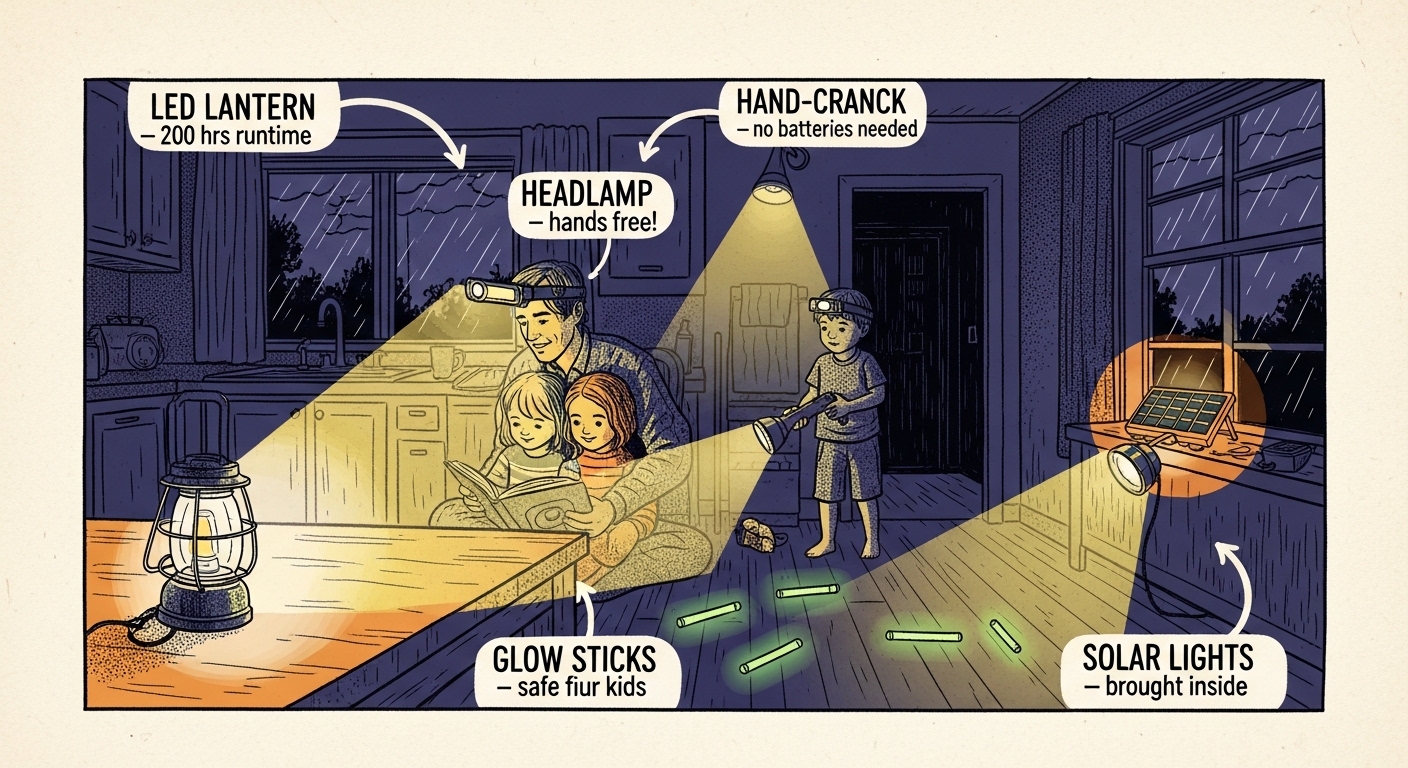
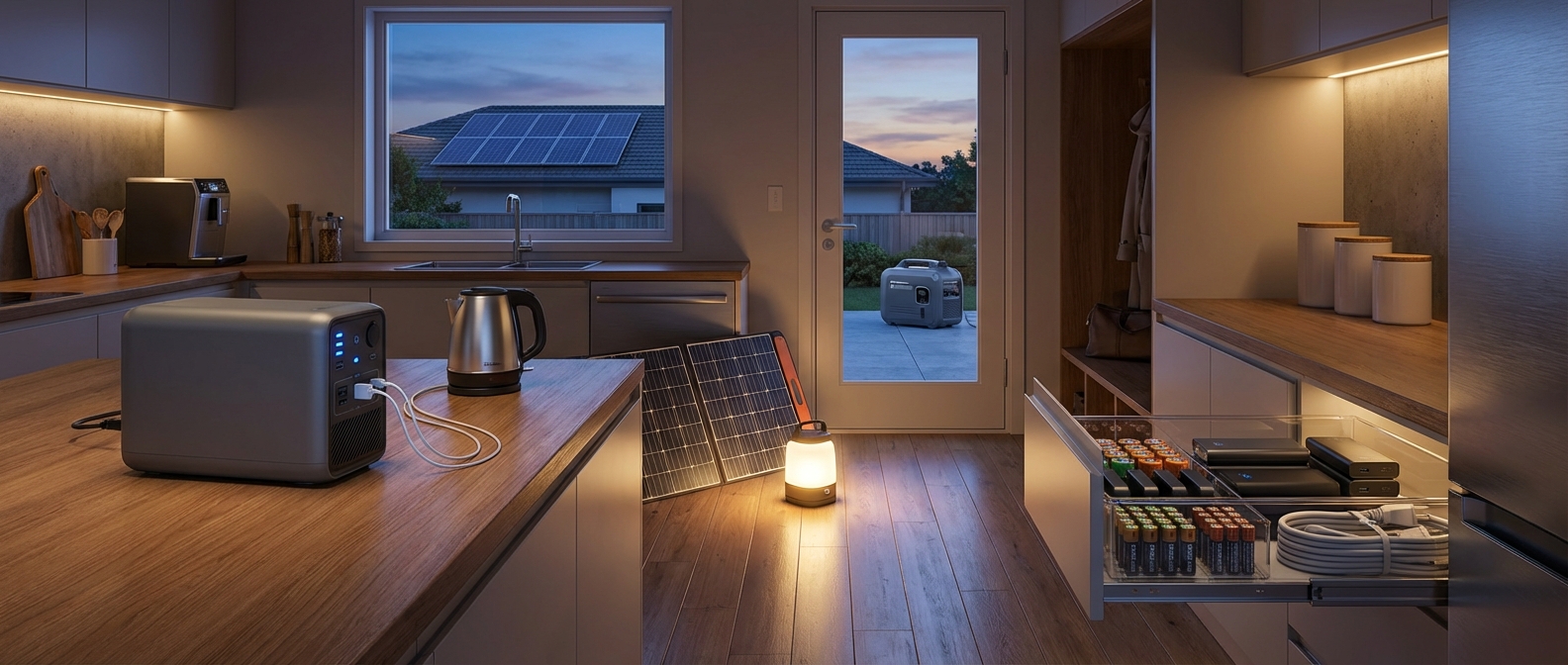
Home power outages require a different approach than fieldwork. You’re not scanning a trail — you’re illuminating a kitchen, a hallway, or a room where your family is gathered. This is where lantern-style lights like the Sofirn BLF LT1 outperform any handheld.
My home setup, refined over several Pacific Northwest storm seasons:
- Sofirn BLF LT1 lantern in the living room or kitchen for ambient area light. One charge lasts multiple evenings on a comfortable low setting.
- Fenix PD36R Pro at the bedside for directed light when I need to check the breaker panel, inspect the exterior, or navigate between rooms.
- Coast PX22 backups at the kitchen drawer, the breaker panel, and each bedroom.
I also recommend nightlight-style emergency lights that plug into standard outlets and activate automatically when power drops. Brands like Snappower and Echogear make models under $15 that illuminate hallways instantly during an outage — no fumbling for a flashlight at 3 AM.
The combination of a lantern for area illumination plus a handheld for directed tasks is far more practical than two handhelds. If you’re building a power outage preparedness plan, start with this pairing.
Place flashlights at key locations before you need them. Bedside, kitchen, breaker panel, and near every exterior door. When the lights go out, you won’t be searching — you’ll be reaching.
Hand-Crank and Solar Survival Flashlights: No Batteries Needed
I’m going to be straight with you: hand-crank and solar flashlights have real limitations. But they also fill a specific niche — the scenario where every battery is dead, every power bank is drained, and you still need light.
What to Expect
Hand-crank dynamo flashlights typically produce 20–50 lumens after sustained cranking — enough to navigate a hallway but nowhere near a real working light. One minute of cranking might yield 3–5 minutes of dim output. Solar-charged models perform better if you have consistent sun exposure, but recharge times are measured in hours for modest runtimes.
Models Worth Considering
The Goal Zero Torch 500 combines solar, hand-crank, and USB charging in one package. It’s a hybrid that works as a backup lantern and can even charge a phone in a pinch. Output is modest — around 500 lumens maximum with the built-in rechargeable battery fully charged — but the multi-source charging gives it genuine survival value.
Cheaper crank-only models from brands like RunningSnail work for basic navigation lighting and often include a small radio, which adds real utility during emergencies.
My Honest Assessment
A survival flashlight that needs no batteries sounds perfect in theory. In practice, I’ve found the mechanical components in hand-crank lights are the failure point — gears strip, dynamos weaken, and the output rarely matches claims. I carry a Goal Zero Torch in my extended kit as a tertiary backup, but it has never been my primary or even secondary light.
Use these as your absolute last line of defense. Not your first choice, not your only choice — your backup’s backup. Your primary should always be a quality rechargeable, with disposable-cell backups for redundancy.
Batteries and Charging — Practical Rules for Survival Flashlights
Battery strategy is as important as the flashlight itself. Here’s the system I’ve refined over 12 years of field use.
Battery Shelf Life
- Lithium primaries (CR123A, lithium AA): 10+ year shelf life. These are your long-term storage champions.
- Alkaline (AA, AAA): 5–7 years depending on brand and storage conditions. Energizer and Duracell are consistently reliable.
- NiMH rechargeables (Eneloop, etc.): Self-discharge rate of ~1% per month. Expect to top them off every 6 months to keep them ready.
- Lithium-ion rechargeables (18650, 21700): Store at 40–60% charge in a cool location. Check voltage every 6 months. Buy from reputable vendors — counterfeit 18650 cells are a genuine safety risk. Stick with brands like Samsung, Sony/Murata, LG, and Panasonic from authorized dealers.
Cold Weather Performance
This matters enormously in the Pacific Northwest and anywhere winter temperatures drop below freezing. Lithium cells (both primary and rechargeable) significantly outperform alkalines below 32°F. I’ve watched alkaline-powered lights dim to near uselessness at 20°F while my CR123A-powered Streamlight ran at full output. If you live in a cold climate, prioritize lithium chemistry across the board.
Building a Field Charging Chain
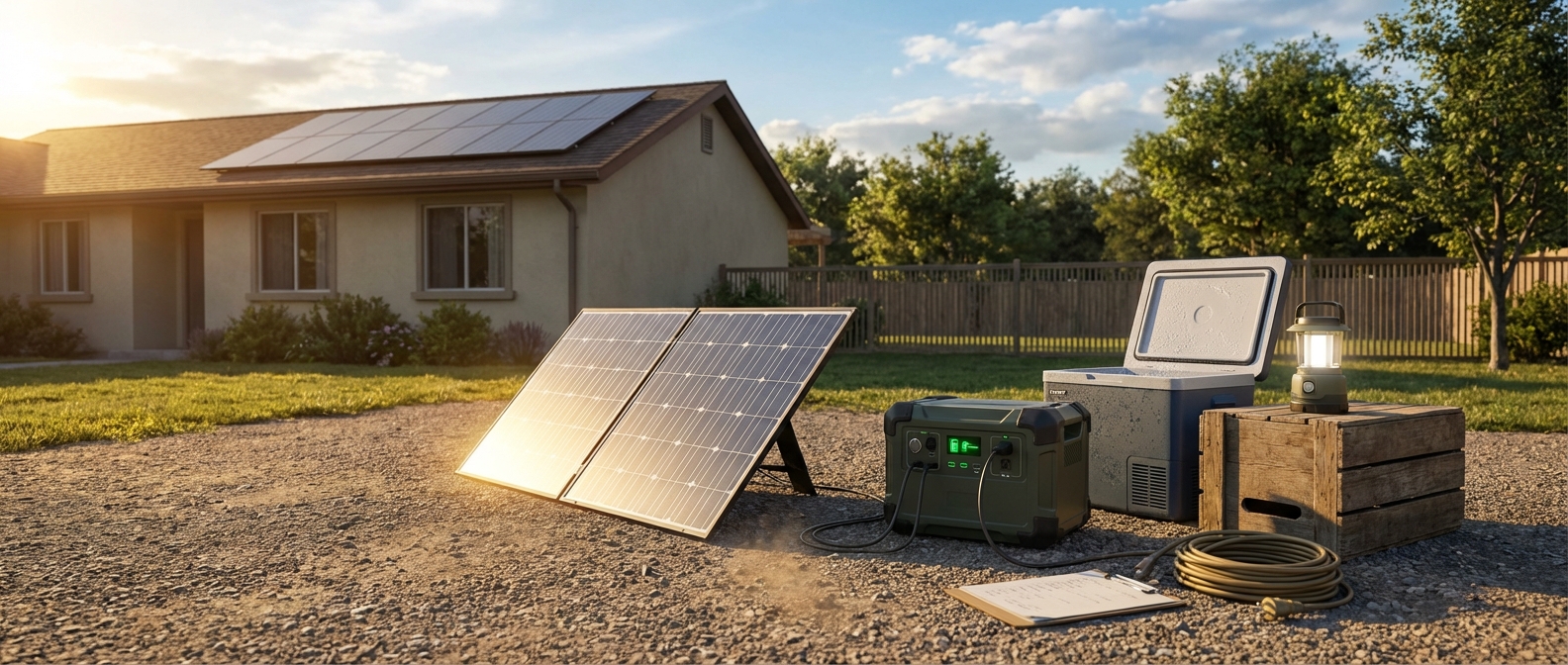
For extended outages, I run this setup: solar panel → USB power bank → USB-C flashlight. A 20W folding solar panel (like the Nekteck 21W or similar) charges a 10,000mAh power bank in roughly a day of decent sun. That power bank recharges my Fenix PD36R Pro about three times. For deeper detail on solar options, check our guide to solar power for emergency preparedness.
The Redundancy Principle
FEMA’s Ready.gov recommends flashlights as essential emergency kit items — and specifically advises against relying on a single light source. My rule: rechargeable for daily use, disposable lithium for long-term storage, and the ability to scavenge common AA batteries as a last resort. That three-tier approach has never left me in the dark.
How to Test and Rotate Your Emergency Flashlights
Gear you don’t test is gear you can’t trust. I run through this protocol every quarter — it takes about 15 minutes for all the lights in my household.
Quarterly Testing Checklist
- Switch function: Cycle through every mode on every light. Confirm momentary, constant-on, strobe, and SOS all work.
- Battery voltage: Use a digital multimeter or dedicated battery tester. A healthy 18650 should read 3.6–4.2V. A fresh CR123A reads about 3.0V. Alkaline AA should be 1.5V or above.
- O-ring inspection: Remove the tailcap and head (if user-serviceable). Check O-rings for cracking, flattening, or debris. Replace if damaged. Apply a thin film of silicone grease per the manufacturer’s instructions.
- Contact cleaning: Wipe battery contacts and spring terminals with a dry cloth or electronic contact cleaner. Corrosion on contacts is the number one cause of “my flashlight doesn’t work” that I see.
- Lens check: Clean the lens. Inspect for cracks that could compromise water resistance.
- Charge rechargeables: Top off any lithium-ion cells that have dropped below 3.6V.
Battery Rotation Schedule
| Battery Type | Check Interval | Replace Interval |
|---|---|---|
| Lithium primary (CR123A) | Annually | Every 10 years |
| Alkaline (AA/AAA) | Every 6 months | Every 2–3 years |
| NiMH rechargeable | Every 3 months | Every 3–5 years |
| Li-ion rechargeable (18650/21700) | Every 3 months | Every 3–5 years or when capacity noticeably drops |
I keep a simple spreadsheet with install dates for every battery in every light. Overkill? Maybe. But I’ve never reached for a dead flashlight in an emergency.
Maintenance Kit
Keep a small bag with your stored flashlights containing: spare O-rings, a small tube of silicone lubricant, a microfiber cloth, a compact multimeter, an extra USB-C cable, and spare cells in each chemistry you use.
Recommended Kit for Most New Preppers
- Primary: Fenix PD36R Pro or equivalent — rechargeable handheld with USB-C, 21700 cell, 200+ lumens, and 20+ hour low-mode runtime. (~$100)
- Hands-free: Black Diamond Spot 400-R or equivalent headlamp for first aid, repairs, and cooking. (~$50)
- Home lantern: Sofirn BLF LT1 for area illumination during extended power outages. (~$50)
- Backup: Coast PX22 or similar — one per vehicle, one per bedroom. (~$12 each)
- Power spares: Four to eight spare disposable lithium cells, a compact USB power bank, and a folding solar panel.
Budget breakdown: You can build a complete, professional-grade lighting kit for about $275. Start with just the primary handheld and one backup — that’s $112 and covers 90% of scenarios. Add the headlamp and lantern as budget allows.
Frequently Asked Questions
What is the best flashlight for emergencies?
The best flashlight for emergencies depends on the scenario, but for most people I recommend the Fenix PD36R Pro as a primary and the Sofirn BLF LT1 as a home lantern. Together, they cover directed and area lighting, recharge via USB-C, and deliver marathon runtimes on low settings. Pair them with a cheap AA-powered backup like the Coast PX22 for true redundancy. The best emergency flashlight is one you’ve tested, charged, and placed where you can reach it in the dark.
What flashlights do first responders use?
In my experience working alongside fire, EMS, and SAR teams, the most common brands are Streamlight, SureFire, and Pelican. Streamlight dominates fire and EMS with the Stinger and ProTac series. SureFire is standard in federal law enforcement. First responders prioritize tail-switch activation, CR123A compatibility for temperature resilience and shelf life, and a minimum IPX7 water resistance rating. These aren’t theoretical preferences — they’re hard-earned requirements from people who bet their safety on their gear.
Which flashlight does the FBI use?
The FBI has historically issued SureFire flashlights, particularly models in the 6P, G2, and Fury families. SureFire’s combination of absolute reliability, compact size, high output, and compatibility with CR123A lithium cells makes them a standard choice for federal law enforcement agencies. While specific issued models change over time, SureFire’s quality and durability remain the benchmark.
How many lumens do you need for a survival flashlight?
A minimum of 200 lumens handles most emergency tasks — navigating indoors, performing first aid, and reading printed materials. Between 300 and 1,000 lumens is the practical sweet spot for survival use, covering everything from room illumination to outdoor trail navigation. Going above 1,000 lumens provides impressive throw for search tasks but drains batteries fast. In my experience, a light with a solid 50-lumen low mode and a 600-lumen high mode gives you the best balance of endurance and capability.
What is the best rechargeable flashlight for an emergency kit?
The Fenix PD36R Pro is my top pick for a rechargeable survival flashlight. It offers USB-C charging, runs on widely available 21700 cells, delivers over 20 hours on low mode, and carries an IP68 rating. The key advantage of a rechargeable emergency preparedness flashlight is the ability to top it off from a solar panel or power bank during extended outages — but always carry disposable lithium backups for when recharging isn’t an option.
Next Steps
- Start with one quality handheld. A Fenix PD36R Pro or Streamlight ProTac 2L-X covers the vast majority of emergency scenarios. Don’t overcomplicate it.
- Add a headlamp for hands-free capability. You’ll thank yourself the first time you need to use both hands in the dark.
- Place cheap backups everywhere. One in the car, one at the bedside, one by the breaker panel. A $12 Coast PX22 in the right spot is worth more than a $200 light you can’t find.
- Build your battery redundancy. Rechargeable primary, disposable lithium backup, and the ability to use common AA as a last resort.
- Test quarterly. Put it on your calendar. Fifteen minutes every three months prevents the worst possible surprise — a dead flashlight when the lights go out.
Conclusion: Build Your Best Survival Flashlight Kit Today
After 12 years of carrying flashlights through Pacific Northwest storms, SAR operations, and backcountry emergencies, I can tell you this with certainty: the best survival flashlights aren’t the most expensive or the brightest — they’re the ones that work reliably when you actually need them. That means tested, maintained, charged, and placed within arm’s reach.
The system I’ve outlined here — a rechargeable handheld, a headlamp, a home lantern, disposable-cell backups, and a quarterly maintenance routine — isn’t theoretical. It’s the exact setup I run in my own home and carry in my own pack. It’s what I recommend to every student in my preparedness classes.
You don’t need to buy everything today. Start with a single quality waterproof survival flashlight and a pack of batteries. Put it on your nightstand tonight. Then build from there — add the headlamp, the lantern, the car kit, and the charging chain as your budget allows.
Darkness is the one emergency condition that’s guaranteed to happen. Be ready for it.