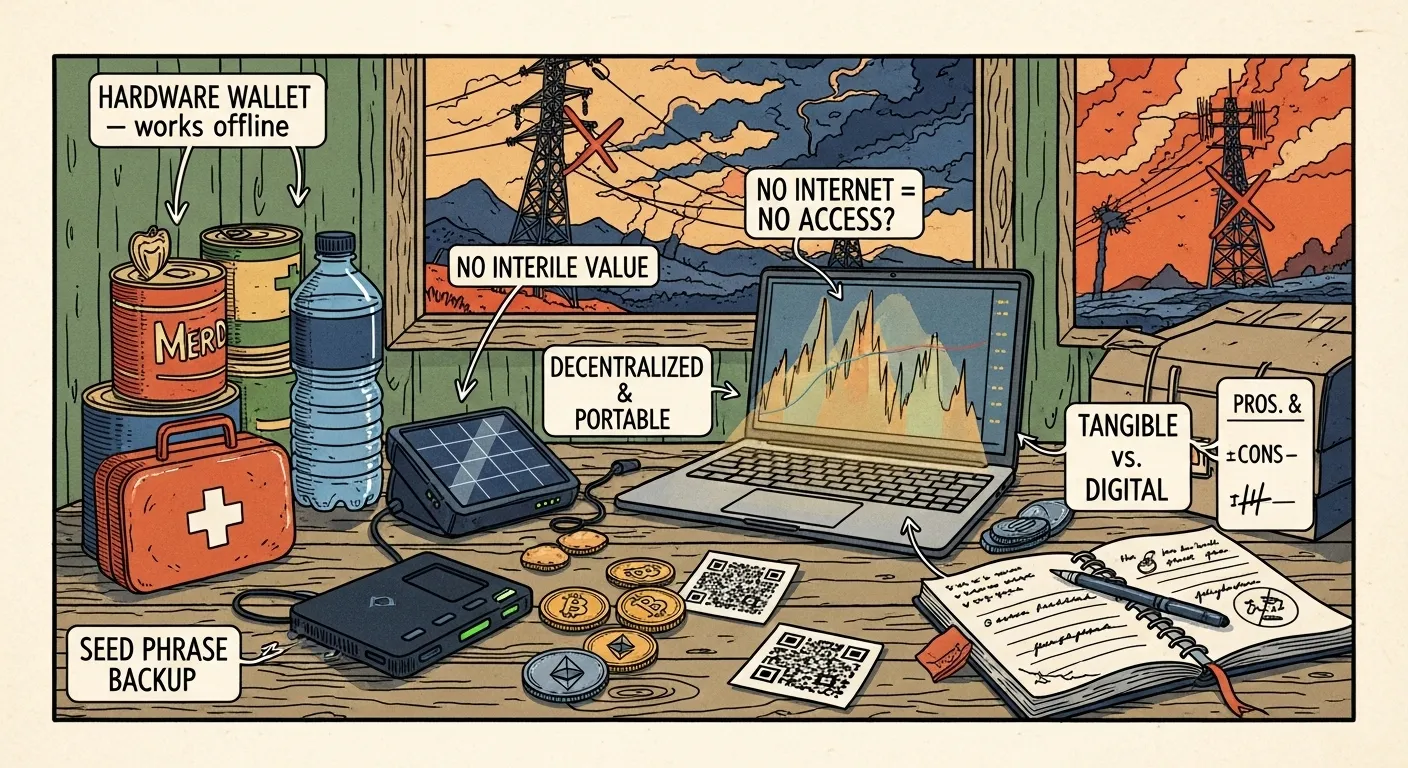
Cryptocurrency can be part of a prepping strategy because it offers decentralized, portable, and potentially private access to funds during some types of emergencies. However, beginners should use it cautiously because crypto is volatile, technically complex, and dependent on electricity and digital infrastructure.
Key Takeaways
- Cover water, food, shelter, and physical cash first — crypto is a redundancy layer, not a foundation.
- Only allocate what you can afford to lose completely while you're still learning custody basics.
- Move funds off exchanges onto an audited hardware wallet like a Ledger or Trezor within days of buying.
- Etch your seed phrase onto metal backup plates and split storage across two separate fireproof locations.
- Do a full test restore on a low-value wallet before you trust your backup process with real money.
Prepping with Cryptocurrency: Pros, Cons, and Practical Steps
Cryptocurrency comes up often in prepping discussions, and the core answer stays consistent: crypto can be a smart addition to a prepping plan, but only after you’ve got the boring stuff handled. Water, food, shelter, cash, first aid. Getting that order backwards is a common mistake.
This isn’t a “buy Bitcoin, save your family” article. It’s a straight look at what cryptocurrency actually does well in a crisis, where it falls apart, and how to add it to your plan without creating new problems for yourself.
Quick Summary
- Cryptocurrency adds portability and a possible way to move value if banks freeze accounts or borders get restrictive — it does not replace your core supplies.
- Price volatility, power/internet dependency, and irreversible human error are the three biggest risks you need to plan around.
- Self-custody with a hardware wallet beats leaving funds on an exchange, but it puts the entire security burden on you.
- Start small — treat any crypto allocation as money you could lose completely while you learn the tools.
- Check your local legal and tax status before you rely on crypto for anything beyond curiosity.
What You’re Actually Working With
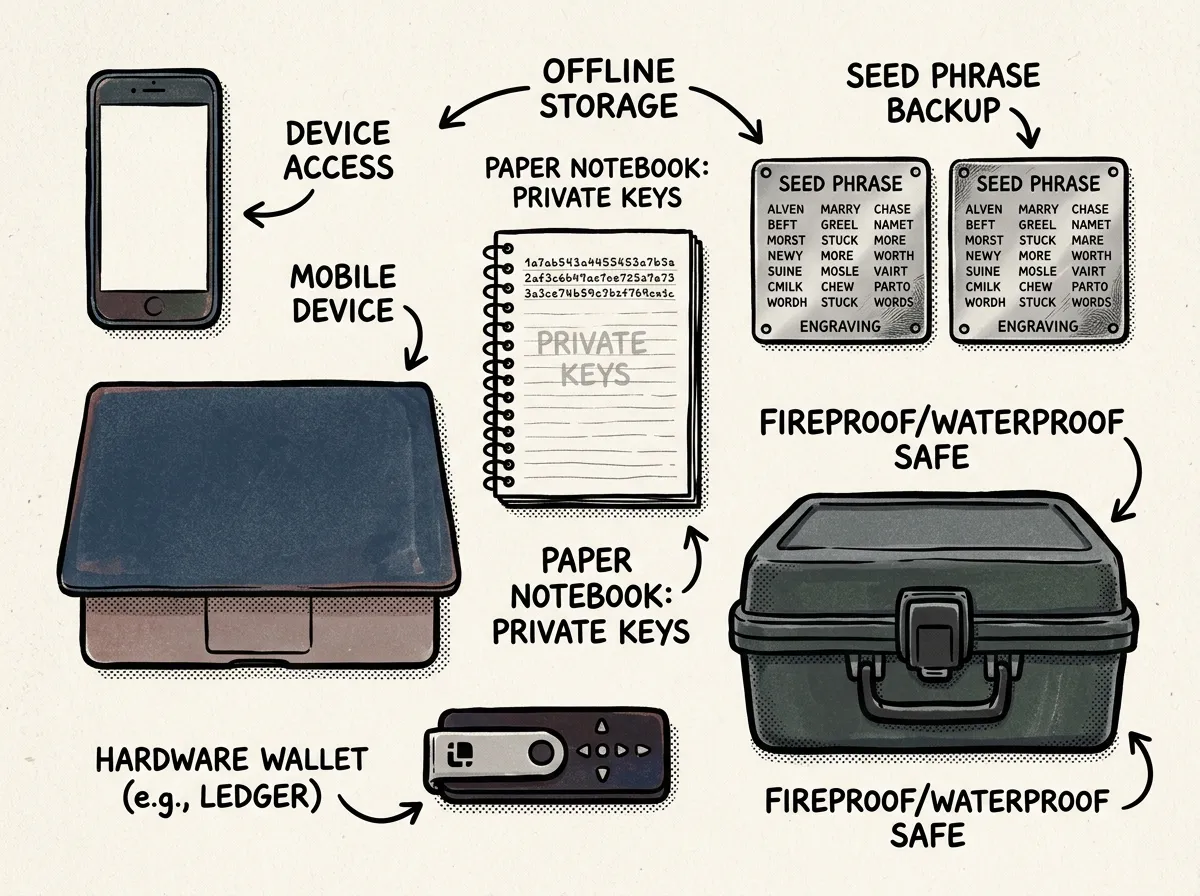 Core cryptocurrency prepping tools and components
Before we get into pros and cons, let’s define the pieces, since much of the confusion around this topic comes from these terms being mixed up.
Cryptocurrency is digital money secured with cryptography and recorded on a blockchain — Bitcoin and Ethereum are the two most people have heard of. Blockchain is just the shared, distributed ledger that records every transaction across a network of computers instead of one bank’s server. A stablecoin, like USDC or USDT, tries to hold a steady 1:1 value against the dollar. It’s not risk-free — you’re trusting whoever issues it to actually hold the reserves they claim.
A hardware wallet is a small physical device — Ledger and Trezor are the two big names — that stores your private keys offline, away from internet-connected devices that can get hacked. And self-custody means you, not an exchange, control those keys. That’s real freedom, but it also means there’s no customer service line to call if you lose them.
Why Crypto Earns a Spot in Some Prepping Plans
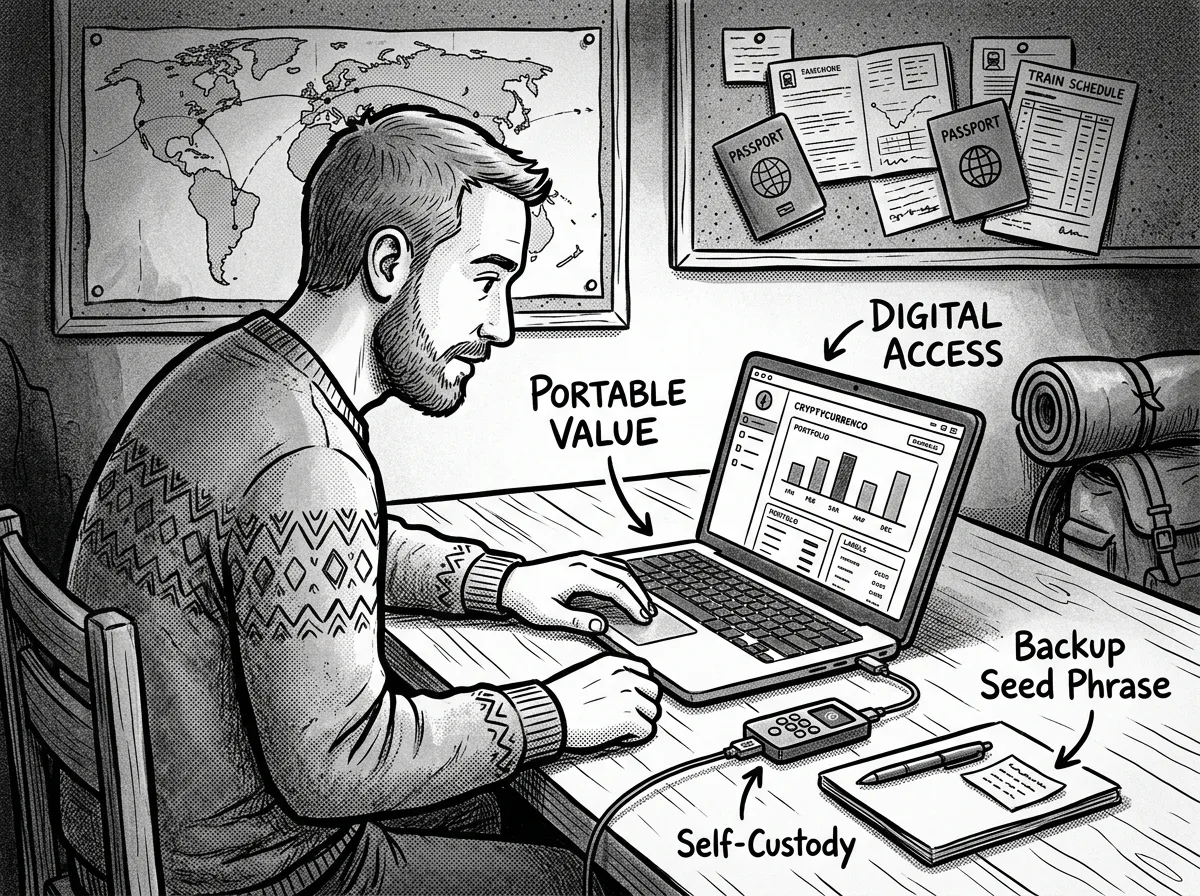 Crypto as a portability and access tool during financial constraints
Here’s the case for it, and it’s a legitimate one:
If a bank freezes accounts — which has happened during currency controls, sanctions events, and regional banking crises — cryptocurrency can keep moving as long as the network is up and you’ve got a way to convert it to something spendable. A seed phrase, which is just a string of 12-24 words, can represent a large amount of value in something you can memorize or carry on a slip of paper. Try doing that with the equivalent in gold or cash.
Cross-border transfers are another strength. Crypto can move value between countries without going through correspondent banks, provided there are usable on-ramps and off-ramps wherever you’re landing. And some coins and tools genuinely improve privacy — though I’ll flag right now that public blockchains are traceable by default. Privacy is the exception, not the rule.
During currency crises abroad, bank closures and ATM shortages have left people without access to cash for weeks, while those holding even a small amount of cryptocurrency with a working phone had additional options. Even so, crypto should be treated as a backup to other emergency funds — not as primary emergency cash.
Where It Falls Apart
Now the part people skip past because it’s less exciting.
Price volatility makes crypto a bad choice for anything you need to be worth a specific amount next week. Bitcoin has swung more than 15% in a single day during major news events. That’s fine if you’re holding for years. It’s a disaster if you’re counting on it to buy groceries during an emergency.
You also need devices, power, and often internet access to actually use it. In a real grid-down scenario — like the widely modeled Cascadia subduction zone earthquake affecting the Pacific Northwest — your phone might be dead, cell towers might be down, and your crypto might as well not exist for weeks. Plan for offline signing and don’t count on connectivity being there when you need it most.
Human error is one of the most common causes of loss. Send funds to the wrong address, and there’s no bank to call and reverse it. Lose your seed phrase, and your funds are gone forever — not stuck, not frozen, just gone. Paper backups that faded, got wet, or were thrown out during a move account for a common share of these losses. Exchanges and wallet apps are also constant targets for hacks and scams, and laws around crypto shift by jurisdiction, sometimes overnight.
Pros and Cons at a Glance
Pros:
- Reduces single points of failure tied to one bank or currency
- Extremely portable — a seed phrase or small hardware wallet can represent significant value
- Fast, low-fee transfers possible with Bitcoin’s Lightning Network or similar layer-2 tools
- Full self-sovereign control through hardware wallets and multisig setups
Cons:
- Volatile pricing makes it unreliable for predictable short-term needs
- Requires devices, power, and often internet — a real problem in grid-down scenarios
- Irreversible errors: wrong address or lost keys usually means permanent loss
- Ongoing target for hacks, scams, and phishing
- Legal, tax, and merchant-acceptance rules vary widely and change often
Building Crypto Into Your Prepping Plan
If you’ve decided crypto earns a place in your plan, here’s a recommended order to work through it.
- Learn wallet basics, key custody, and common scam patterns before you buy anything
- Start with a small amount you could lose entirely without changing your life
- Buy through a reputable exchange, then move funds off it fast
- Secure a hardware wallet and back up your seed phrase on durable, offline media
- Create a documented succession plan so a trusted person can access funds if something happens to you
- Test a full restore on a low-value wallet before trusting the process with real money
Choosing Your Tools
For fiat on-ramps and off-ramps, stick with reputable, established exchanges — this isn’t the place to save a few bucks using some sketchy platform you found through an ad. For actual storage, an audited hardware wallet is non-negotiable. The Ledger Nano and Trezor models run roughly $60-$150 depending on the version, and both have solid track records.
A common beginner mistake is photographing a seed phrase “just in case” before deleting the original. Any photo synced to a cloud backup is a photo a hacker could eventually find. Writing the phrase by hand on paper is safer, and upgrading to a metal backup plate protects against the fire, water, and time damage that paper is vulnerable to. It’s a small cost for what it protects.
Securing Your Backups
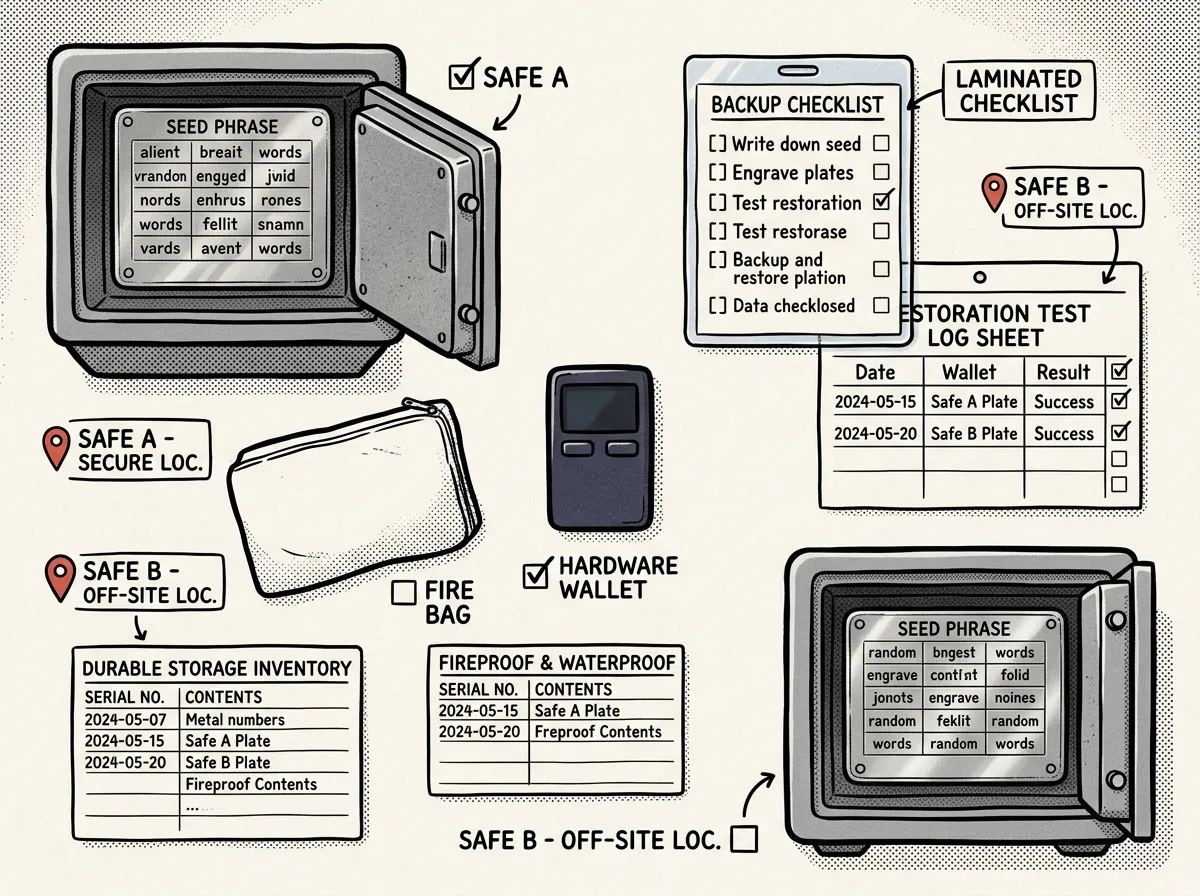 Multi-location backup and recovery kit setup
Paper seed phrase backups fade, tear, and burn. Even backups that survive water exposure are often damaged enough to become unreadable, which is why metal backups are recommended over paper. Metal backup plates run around $20-$50 and are fire- and water-resistant in a way paper never will be. Store at least two copies in separate fireproof, waterproof safes — not two copies in the same house, in two different rooms of the same house.
Never store a digital photo or plain text file of your seed phrase anywhere connected to the internet — cloud backups, email drafts, and phone notes are all fair game for hackers who specialize in exactly this.
Immediate Action Checklist
If you’re starting from zero today, here’s the short version.
- Buy a small, affordable amount through a reputable exchange
- Move it to a hardware wallet you fully control within a few days
- Write two seed phrase backups on durable media
- Store backups in separate fireproof, waterproof locations
- Practice a full restore using a non-critical wallet
- Document a succession plan for a trusted person
Matching the Right Tool to the Right Scenario
Not every crypto tool fits every situation, and choosing the wrong one for a given scenario is a common mistake.
Your bank accounts get frozen or access is restricted during a regional financial crisis, and you need to move value to family in another country quickly. A liquid cryptocurrency like Bitcoin or Ethereum, paired with a pre-vetted exchange or peer-to-peer service on the receiving end, gives you a route that doesn’t depend on correspondent banking relationships.
For local, short-term purchases where merchants accept it, stablecoins or straight cash still make more sense than a volatile coin. For cross-border transfers, liquid coins like BTC or ETH with pre-vetted on/off ramps work best. For peer-to-peer or barter situations, pre-arrange trusted over-the-counter channels with people you actually know — not strangers on a forum.
Crypto is a tool for moving value, not a substitute for having enough of it in the first place.
Practical Examples Worth Knowing
Fast, low-fee payments: Bitcoin plus the Lightning Network. It requires setting up payment channels and managing liquidity, which isn’t beginner-friendly, but once it’s running, transactions settle in seconds for pennies.
Programmable transfers and stable value: Ethereum plus stablecoins like USDC handle more complex transactions, though you’re taking on issuer risk with any stablecoin — you’re trusting the company behind it holds the reserves it claims.
Stronger privacy: Monero (XMR) offers real on-chain privacy that Bitcoin doesn’t. That said, privacy coins face more regulatory scrutiny and, in some places, outright restrictions — check your local laws before you touch one.
Long-term portable value: Bitcoin is the common default here, mainly for its liquidity and network size. You’re still exposed to price swings, so this is a “hold for years, not weeks” strategy.
Warnings Worth a Second Read
Check your local regulatory and tax treatment before relying on crypto for anything beyond curiosity — this varies enormously by country and even by state. Privacy tools can create legal exposure in some jurisdictions. Stablecoins carry issuer and reserve risk that most people underestimate. And layer-2 systems like Lightning lower fees but add real operational complexity you’ll need to manage yourself, not hand off to a bank.
Frequently Asked Questions
Is cryptocurrency a good option for emergency preparedness? Cryptocurrency can be a useful supplementary layer in an emergency plan, but it should not replace cash, food, water, or medical supplies. It works best as a redundancy that adds portability and an alternative way to move value if banks or borders are constrained.
How do you safely store cryptocurrency for a survival situation? Use a hardware wallet like a Ledger or Trezor for self-custody and write your seed phrase on durable media such as metal backup plates. Store at least two offline backups in separate fireproof, waterproof locations and practice restoring from your backup before an emergency.
What are the biggest risks of prepping with cryptocurrency? The main risks include price volatility, the need for devices, power, and internet access to transact, and the irreversibility of human errors like sending to a wrong address or losing private keys. Exchange hacks, scams, and changing legal regulations by jurisdiction also create significant concerns.
Which cryptocurrency is best for preppers? Bitcoin is widely used by preppers for its network liquidity and portability, especially with Lightning Network for fast, low-fee payments. Stablecoins like USDC offer more predictable value for short-term needs, while Monero provides stronger privacy, though you should verify local legal requirements for any coin you choose.
Where This Leaves You
Crypto adds real portability and a genuine redundancy layer to a prepping plan, but it comes with volatility and technical risk that plenty of people underestimate until it’s too late. Build your core capabilities first — water, food, shelter, cash on hand, and the skills to use all of it. If crypto still makes sense for your situation after that, add a modest, well-secured layer and write down your access and recovery process somewhere you’ll actually find it when you need it.
The Complete
Prepper's Reference.
149 articles synthesized into one comprehensive PDF — twelve chapters covering water, food, shelter, first aid, comms, and scenario-specific preparedness. Free with your email.
Unsubscribe anytime · We never share your email
You're in. Check your inbox.
Keep Reading
Meal Prepping Ideas That Build Long-Term Food Security
Meal prepping ideas that go past Sunday batch-cooking — build rotating stockpiles, cut costs, and prep for real emergencies. See how.
National Emergency Preparedness Month: 30-Day Plan
Use this 30-day National Emergency Preparedness Month challenge to go from unprepared to fully ready. One simple 15-minute task per day. Start now.
Emergency Preparedness Merit Badge: A Parent's Guide
Use the Emergency Preparedness merit badge framework to teach your kids real survival skills at home. Step-by-step activities for each requirement.