Best Emergency Blankets: Top Picks and How to Choose (New Prepper’s Guide)
Quick Answer / TL;DR
The best emergency blankets depend on how you plan to use them. Buy inexpensive Mylar multipacks to stock several kits. Keep one heavy-duty or bivy-style blanket in your primary bag or vehicle. Add a wool or insulated blanket for comfort at home. Prioritize adult-size coverage, reinforced edges for reuse, and compact storage.
Summary
Emergency blankets reduce heat loss, block wind and moisture, and serve for signaling and improvised shelters. For most new preppers, a practical kit looks like this: a multipack of basic aluminized PET (Mylar) sheets for distribution, one reusable heavy-duty or bivy-style blanket for your main kit, and one wool or insulated blanket for longer-term comfort. Choose by material, size, durability, and how you plan to store and deploy the blanket.
What is an emergency blanket?
An emergency blanket, also called a space blanket, is a thin sheet that reflects radiant heat and blocks wind and moisture. Most are made from aluminized PET, commonly called Mylar, or reinforced variants. They do not produce heat. They slow heat loss. Use them with dry clothing, insulation, and shelter.
How they work
- The metallic surface reflects some body heat back toward you.
- The material reduces convective heat loss from wind and provides a moisture barrier.
- Effectiveness depends on layering, shelter, and the blanket’s construction.
Key features to evaluate
Use this checklist when comparing options.
-
Material and construction
- Mylar (aluminized PET): ultralight, very reflective, low cost, often single-use.
- Reinforced or ripstop Mylar: louder, but reusable and harder to tear.
- Polyethylene or reinforced fabrics: heavier and more durable for repeated field use.
- Wool or fleece-backed options: bulkier and warmer for comfort.
-
Size and coverage
- Make sure a blanket will fully wrap an adult. Typical minimum: about 52 x 82 in (130 x 210 cm).
- Larger sizes help for sharing or building shelters.
-
Durability and reusability
- Look for reinforced edges, ripstop material, and grommets if you plan reuse or shelter-building.
-
Portability and packaging
- Vacuum-sealed or individually folded packs are easiest to store and distribute.
-
Visibility and noise
- Two-tone designs, such as silver and orange, improve signaling. Classic Mylar is crinkly.
-
Price and value
- Use inexpensive multipacks for wide distribution and add one or two higher-quality pieces for your primary gear.
Top picks by use case
These categories match a blanket to common needs rather than promote specific brands.
-
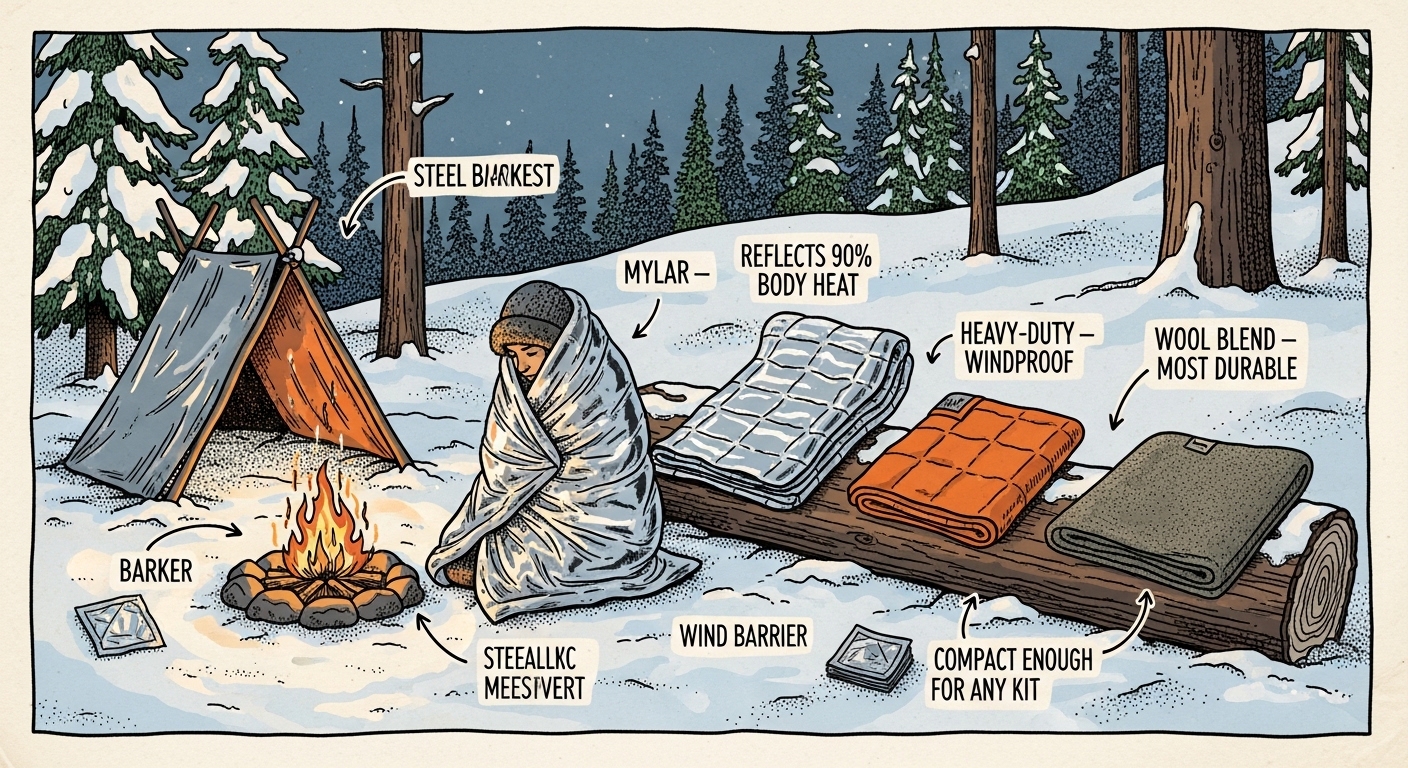
Basic Mylar emergency blanket multipacks. Best for stocking multiple kits.
- Pros: ultra-compact, very low cost.
- Cons: thin, noisy, limited reuse.
-
Heavy-duty reusable emergency blankets. Best for repeated field use.
- Pros: thicker, quieter, tear-resistant.
- Cons: heavier and bulkier.
-
Blankets with grommets or tie points. Best for shelter-building.
- Pros: doubles as a tarp or lean-to, easier to secure.
- Cons: more weight and cost.
-
Bivy-style emergency sleeping bags. Best for overnight exposure.
- Pros: encloses the body and reduces convective loss. Often waterproof.
- Cons: less versatile and can trap condensation.
-
Wool-blend or insulated survival blankets. Best for comfort and extended outages.
- Pros: warmer and more comfortable for long-term use.
- Cons: heavier and bulkier.
-
High-visibility two-tone blankets. Best for signaling.
- Pros: heat retention plus rescuer visibility.
- Cons: typically pricier than plain Mylar sheets.
Practical combination for most preppers: one multipack for distribution, one heavy-duty or bivy option for your main bag, and one comfort blanket for home or vehicle.
Quick selection checklist (copyable)
- Will the blanket fully wrap an adult? Check dimensions.
- Does the material match single-use or multiple-use needs?
- Are reinforced edges or grommets included if you plan to build shelters?
- Is it compact enough for your bag or kit?
- Is it two-tone or high-visibility if signaling matters?
- Do manufacturer claims (waterproof, temperature-rated) match your needs?
Storing and maintaining emergency blankets
- Store them where you will need them: go-bags, car kits, home bins, or office drawers.
- Keep blankets in zip-top bags, dry bags, or small pouches to protect against moisture and abrasion.
- Avoid sharp tools or rough cargo; inspect for punctures before packing.
- Check seasonally to confirm packaging integrity and that nothing is missing.
- Practice once with an inexpensive blanket so you know how it behaves in wind and cold. Try building a simple shelter and wrapping up.
- Reuse guidance: thin aluminized PET is often single-use. Reinforced and bivy-style blankets usually tolerate multiple deployments if undamaged.
FAQ
Q: What are emergency blankets and how do they work? A: They are reflective sheets, typically aluminized PET, that reduce radiant heat loss, block wind, and add a moisture barrier. They reflect some body heat back but do not create heat.
Q: Do emergency blankets really keep you warm? A: They help retain your existing heat. Combine them with dry clothing, insulation, and shelter for best results.
Q: Which features should beginners prioritize? A: Material (Mylar versus reinforced), coverage (adult-size), durability (reusable versus single-use), and packed size. A multipack plus one durable blanket makes a practical starter kit.
Q: How should I store them? A: Keep them dry and accessible in sealed pouches within car kits, go-bags, or home emergency boxes. Inspect them seasonally.
Claims to check before buying
- “Waterproof”: many blankets are water-resistant but not designed for repeated submersion. Check the specifications.
- Temperature ratings: these depend on layering, wind, and clothing. Treat ratings as rough guidance.
- “Reusable”: confirm reinforced edges, ripstop material, and grommets before assuming multiple uses.
Choosing the best emergency blankets for your needs
Balance portability, durability, and coverage for the role you expect the blanket to play. Start with a multipack for distribution, add a heavy-duty or bivy-style blanket for your primary kit, and include a wool-blend or insulated option for home comfort. Pair blankets with dry clothing, shelter options, fire or heat sources, water, and a basic first-aid kit. Practice deployment so you can use them quickly and effectively in an emergency.