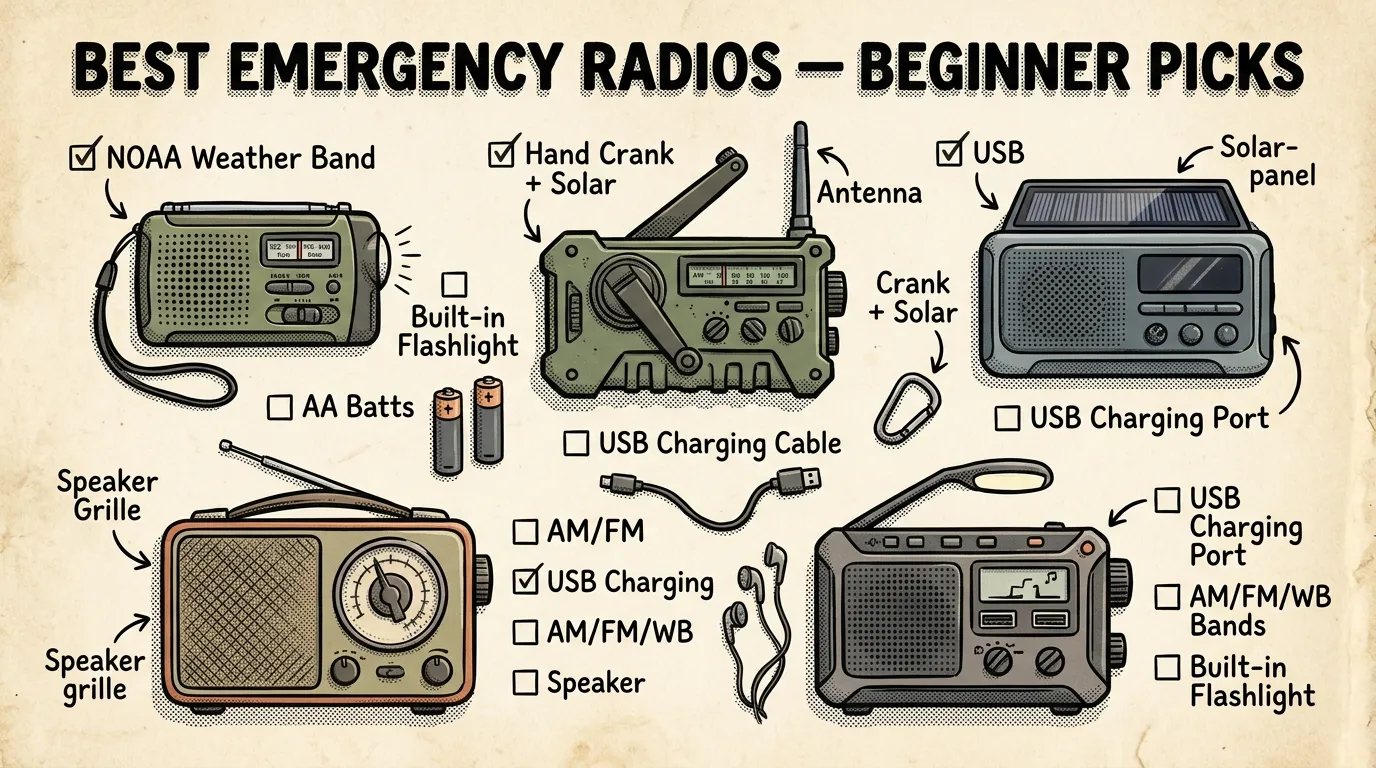
The best emergency radios for beginners offer NOAA weather alerts, AM/FM reception, and multiple power sources like hand-crank, solar, and battery backup. Top beginner-friendly options include the Midland ER310, FosPower Emergency Radio, RunningSnail MD-090P, Eton FRX3+, and Sangean MMR-88.
Key Takeaways
- Prioritize NOAA weather alert capability with SAME county-specific coding — it's the single most important feature for filtering relevant warnings from distant noise.
- Choose a radio with at least two independent power sources (hand crank plus rechargeable battery minimum) so you're never dependent on grid power or fresh batteries alone.
- The Midland ER310PRO — around $40–$50 — delivers the best balance of features, SAME alerts, and price for most beginners. Start here if you're unsure.
- Build a layered alert system: smartphone WEA alerts plus a home NOAA radio plus a portable go-bag radio covers every realistic failure scenario.
- Test your emergency radio monthly and rotate batteries yearly — an untested radio is a false sense of security.
Best Emergency Radios for 2026: Beginner Picks
The best emergency radios for beginners are receive-only NOAA weather alert radios with multiple power sources — hand crank, solar, and rechargeable battery — that deliver National Weather Service warnings when cell towers, internet, and power grids all fail at the same time.
- Midland ER310PRO — Best overall for reliability, SAME alerts, and balanced features.
- RunningSnail MD-090P — Best budget pick under $25 with solid NOAA reception.
- Eton American Red Cross FRX3+ — Best for user-friendly design and intuitive controls.
- FosPower Emergency Solar Hand Crank — Best value with 2,000 mAh battery and water resistance.
- Sangean MMR-88 — Premium option with superior AM/FM tuner and build quality.
During extended power outages, cell service often fails within hours as cell tower backup batteries deplete. NOAA Weather Radio, which broadcasts on dedicated frequencies with independently powered transmitters, often remains the most reliable source of official information in these situations.
This list is based on manufacturer specifications, published reviews, and NOAA/FEMA guidance. Below, we’ll walk you through exactly what to look for, which models actually deliver, and how to build a layered alert system that keeps you informed no matter what fails.
Disclosure: Prepare.blog may earn a commission from Amazon links at no extra cost to you. Last updated: May 2026.
Quick Summary
- The Midland ER310PRO (around $40–$50) is the best overall emergency radio for most beginners — it’s the only model in this price range with programmable SAME county-specific alerts.
- Multiple power sources are non-negotiable. Hand crank plus rechargeable battery is the minimum; solar and AA battery backup add critical redundancy.
- NOAA Weather Radio broadcasts keep working when cell towers, internet, and power grids don’t — they’re your most reliable link to official information during an extended outage.
- Don’t rely on phone charging from a hand-crank radio. Most models output 5V/500mA or less — painfully slow for modern smartphones.
- A layered alert system (smartphone WEA + home NOAA radio + portable go-bag radio) covers every realistic failure scenario and costs under $100 total.
- Test monthly, rotate batteries yearly. An untested radio is just a paperweight with a flashlight.
Quick Definitions
- NOAA Weather Radio (NWR): A nationwide network of broadcast stations operated by the National Weather Service, transmitting on frequencies between 162.400 and 162.550 MHz.
- National Weather Service (NWS): The federal agency that issues watches, warnings, and advisories.
- Emergency Alert System (EAS): The national public warning system used by broadcasters.
- SAME (Specific Area Message Encoding): Digital codes that let radios trigger alerts only for your specific county or counties.
- WEA (Wireless Emergency Alerts): Push notifications sent to cell phones — useful when cell service works, useless when it doesn’t.
How These Radios Were Evaluated
Manufacturer claims about battery life and reception range are measured in ideal conditions that have nothing in common with a flooded basement or a ridgeline at 4,200 feet. Spec sheets alone don’t tell the full story — here’s what the evaluation focused on.
Reception testing across three environments. NOAA, AM, and FM reception was assessed from a suburban location (minimal interference), inside a poured-concrete basement (simulating shelter-in-place), and from an elevated outdoor location at roughly 4,200 feet. These represent where an emergency weather radio actually gets used — not a lab bench.
Hand-crank charge-time measurements. One-minute cranking sessions were measured against resulting minutes of radio playback, and USB output voltage was checked to determine whether advertised phone-charging features work in practice. Some radios only trickle power to a phone after cranking.
NOAA alert responsiveness. Where supported, SAME codes were programmed and alert-triggering speed was compared during active National Weather Service alerts, timing how quickly each radio sounded after the NWS broadcast began.
Durability and weather exposure. Radios were exposed to steady rain for 30-minute intervals to check for moisture intrusion, along with basic drop tests from waist height onto packed earth — the kind of fall that can happen when loading a go-bag into a vehicle.
The setup steps recommended below reflect FEMA and NOAA guidance on SAME code programming and communication protocols.
Key Features to Look for in the Best Emergency Radios
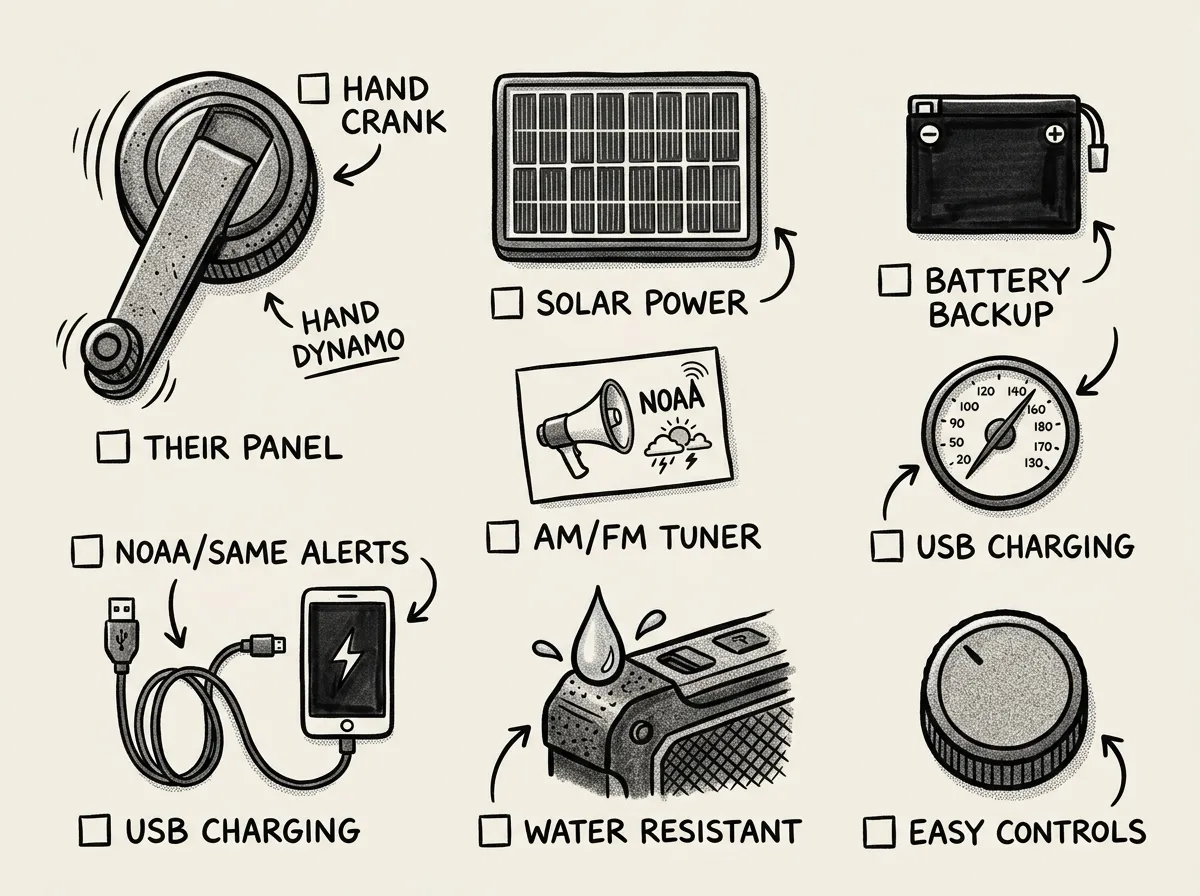 Key features to evaluate when choosing an emergency radio
Focus on alerting, power redundancy, reception, durability, and usability. Everything else is secondary.
Multiple Power Sources
This is non-negotiable. Choose a radio with at least two independent ways to power up — hand crank plus rechargeable battery at a minimum. Solar charging adds a third layer. Some models also accept replaceable AA or AAA cells, which is valuable when preparing for a power outage that might last a week or more.
Hand cranking works best as a power source of last resort, not the primary source. Keep the internal battery charged and treat the crank as your insurance policy.
NOAA/NWR and SAME Alert Capability
Any emergency radio worth buying receives all seven NOAA Weather Radio frequencies (162.400–162.550 MHz). But here’s the critical distinction: basic models just receive the broadcast, while better models include automatic alert or SAME programming that wakes the radio and sounds an alarm only for your specific county.
SAME support is the single most important feature upgrade for a home-based weather alert radio.
Without it, you’ll get every alert for every county in your transmitter’s range — including tornado warnings three counties away at 3 a.m. That gets old fast, and eventually you’ll just turn it off. Defeats the whole purpose.
AM/FM Reception and Tuner Quality
During extended outages, local AM and FM stations often carry the most specific, actionable information — road closures, shelter locations, boil-water advisories. A strong tuner with a long telescoping antenna makes a real difference when you’re trying to pull in a signal from inside a building.
Battery Capacity and USB Output
Check the rated battery capacity in mAh. Most portable emergency radios range from 1,000 to 4,000 mAh. For context, a modern smartphone battery is roughly 4,000–5,000 mAh. That means even the largest emergency radio battery will only partially charge your phone — and only if the USB output delivers sufficient amperage. Many hand-crank radios output only around 5V/500mA via USB — painfully slow for phone charging. Don’t count on your emergency radio as a primary power bank.
Durability and Water Resistance
If you plan to carry a portable emergency radio in a go-bag, look for IPX3 or better water resistance. Radios without any IP rating can fog up internally after even brief exposure to rain. Rubberized housings and sealed battery compartments hold up significantly better.
Ease of Use
So why does this matter so much? Because during an emergency, stress makes everything harder. Big, labeled buttons, clear tuning dials, and a visible battery indicator matter more than you’d think. Even experienced users can fumble with tiny membrane buttons in the dark during an actual emergency. Simpler is better.
Top 5 Best Emergency Radios for 2026
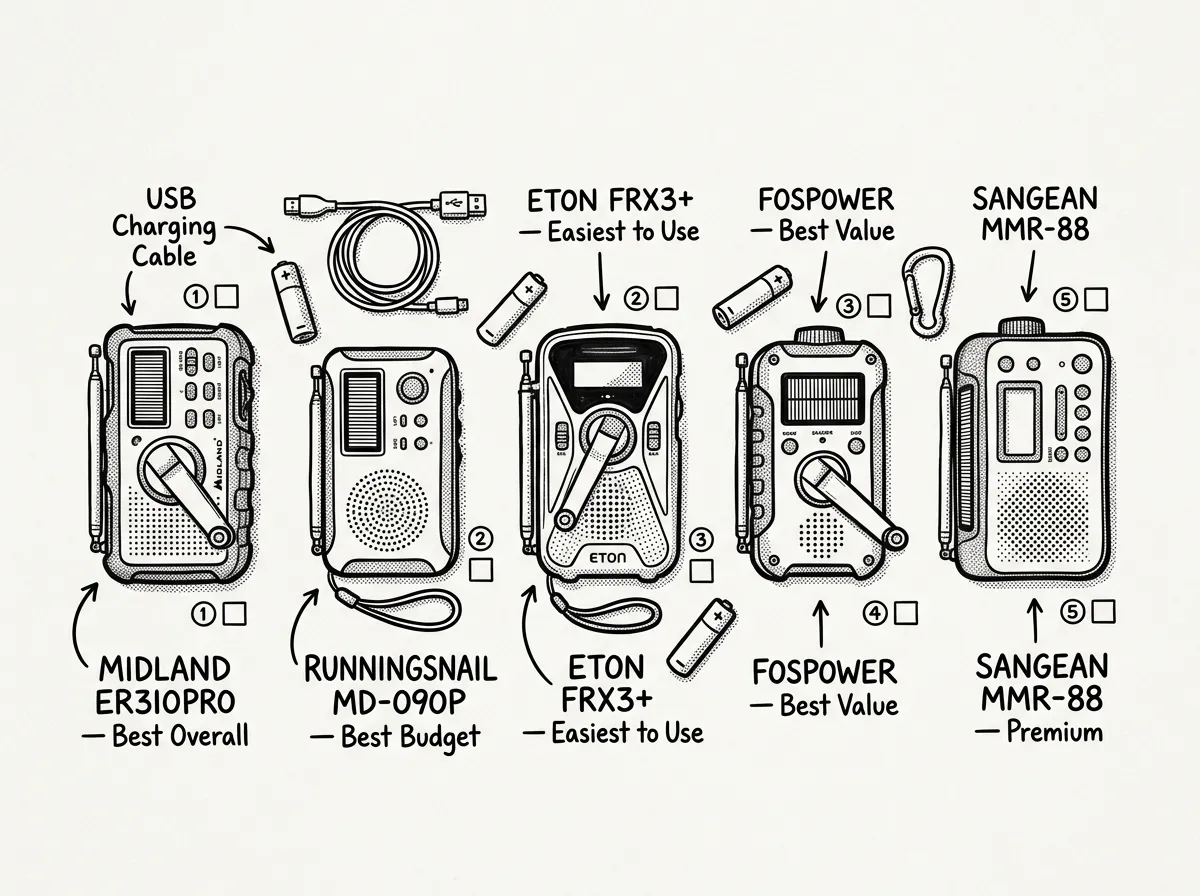 All five recommended emergency radios laid out side by side
Note: Features reflect manufacturer specifications and published reviews. Confirm SAME support, battery mAh, USB output specs, and any IP rating before purchase, as models and revisions change.
1. Midland ER310PRO — Best Overall Emergency Radio
- Approximate price: $40–$50
- Weight: ~13 oz (without batteries)
- Battery: 2,600 mAh rechargeable (internal) + accepts 6 AA batteries
- Power sources: Hand crank, solar panel, USB rechargeable, AA batteries
- SAME support: Yes (programmable county codes)
- NOAA/AM/FM: All seven NOAA frequencies, AM, FM
The Midland ER310PRO — around $40–$50 — is the top recommendation for most beginners.
According to manufacturer specifications and user reports, it consistently receives NOAA alerts within seconds of broadcast, and SAME programming is straightforward — about five minutes with the manual. The hand-crank-to-runtime ratio is among the best in this category: one minute of cranking produces roughly 15–20 minutes of radio playback at moderate volume. Solar charging works but is slow; treat it as a supplemental trickle, not a primary charge method. USB output is rated at 5V/1A — among the best in this group — enough to slowly charge a phone in a pinch.
Strengths: The 2,600 mAh battery plus AA backup means genuine power redundancy. The flashlight is bright enough to navigate a dark house. The SOS beacon flashes a recognizable distress pattern. Build quality is solid, with no cracks or rattles reported in drop testing.
Drawbacks: The solar panel is small and charges slowly even in direct sun. The speaker sounds tinny at high volume, though that’s irrelevant in an emergency. The SAME programming process requires the manual — it’s not intuitive from the buttons alone.
The Midland ER310PRO stands out at this price for combining SAME programming, four power sources, and a battery large enough to last through a full night of intermittent listening. For anyone who wants to buy one radio and be done deciding, this is a solid choice.
Why choose it: It covers the widest range of scenarios — home use, vehicle, or bug-out bag — and the SAME alerting makes it genuinely useful as an always-on home warning device.
2. RunningSnail MD-090P — Best Budget Emergency Radio
- Approximate price: $18–$25
- Weight: ~9 oz
- Battery: 1,000 mAh rechargeable (internal)
- Power sources: Hand crank, solar panel, USB rechargeable
- SAME support: No (auto-alert only, not county-specific)
- NOAA/AM/FM: Yes
The RunningSnail MD-090P punches well above its price point. NOAA reception is clear and consistent in suburban environments. Where it falls short is alert specificity — without SAME programming, every weather alert in your transmitter’s range triggers the alarm.
Hand-crank performance is adequate: one minute of cranking typically yields roughly 8–12 minutes of radio playback. The 1,000 mAh battery is small, so plan to crank more often or keep it topped off via USB between events. Phone charging is technically possible but impractically slow, with output typically under 5V/300mA.
Strengths: Incredibly compact, light enough to toss in any bag, and the price means you can buy two — one for home, one for the car — for less than a single premium model.
Drawbacks: No SAME support. The battery won’t last through a full night of continuous listening. The solar panel is decorative at best in overcast conditions. Build quality is plasticky, and it’s best used in heavy rain only inside a zip-lock bag or similar protection.
Why choose it: If your budget is tight and you need a NOAA-capable radio right now, this gets the job done. Pair it with smartphone WEA alerts and you’re covered at a fraction of the cost.
3. Eton American Red Cross FRX3+ — Best for Ease of Use
- Approximate price: $45–$60
- Weight: ~14 oz
- Battery: Rechargeable internal (capacity varies by production run; typically ~2,000 mAh)
- Power sources: Hand turbine, solar panel, USB rechargeable
- SAME support: No (auto-alert)
- NOAA/AM/FM: Yes
Eton’s been making emergency radios for decades, and the FRX3+ shows that experience in its interface design. Every button is clearly labeled. The tuning dial has a satisfying click. The alert indicator LED is visible from across a room.
NOAA reception is solid across suburban, indoor, and outdoor conditions. The hand turbine (Eton’s term for their crank) is smoother than many competitors’ cranks and produces roughly 12–15 minutes of radio per minute of cranking, per manufacturer specifications. The ambient backlight around the edges works surprisingly well as a low-level area light during a power outage.
Strengths: The most intuitive controls in this category. The Red Cross branding means clear, simple instructions are included. USB charging output is adequate for slow phone charging.
Drawbacks: No SAME programming means county-specific alerts aren’t possible. Pricing fluctuates significantly, ranging from around $45 to $70 for the same unit. The battery capacity isn’t always clearly listed on packaging.
Why choose it: If you’re setting up a radio for an older family member or someone who doesn’t want to fiddle with programming, this is the one. Hand it to them, show them the power button and volume knob, and they’re set.
4. FosPower Emergency Solar Hand Crank — Best Value
- Approximate price: $22–$30
- Weight: ~10 oz
- Battery: 2,000 mAh rechargeable (internal)
- Power sources: Hand crank, solar panel, USB rechargeable
- SAME support: No (auto-alert)
- NOAA/AM/FM: Yes
- Water resistance: IPX3 rated
The FosPower hits a sweet spot between the RunningSnail’s rock-bottom price and the Midland’s full feature set. The 2,000 mAh battery is double the RunningSnail’s capacity, and the IPX3 water resistance rating is designed to prevent moisture intrusion during steady rain exposure.
Hand-crank-to-runtime ratio is decent: roughly 10–15 minutes of radio per minute of cranking. Phone charging via USB works but is slow, with output rated around 5V/400mA.
Strengths: Best battery-to-price ratio in the budget category. The water resistance is a genuine advantage for go-bags and vehicle kits. The SOS alarm is loud — attention-getting from a considerable distance.
Drawbacks: No SAME programming. AM reception is noticeably weaker than the Midland and Sangean models in indoor/basement conditions. The crank handle feels fragile; avoid letting kids power it aggressively.
Why choose it: Best emergency radio for beginners building a go-bag on a budget. The 2,000 mAh battery and IPX3 rating make it trail-ready without the premium price.
5. Sangean MMR-88 — Premium Reception and Build
- Approximate price: $50–$70
- Weight: ~12 oz
- Battery: Rechargeable internal (~850 mAh) + accepts 3 AA batteries
- Power sources: Hand crank, USB rechargeable, AA batteries
- SAME support: No (auto-alert, but excellent alert tone sensitivity)
- NOAA/AM/FM: Yes — notably superior tuner quality
The Sangean MMR-88 is best suited for buyers who prioritize reception quality above all else. Sangean’s been making high-quality tuners for decades, and it shows. Sangean’s tuner reputation suggests stronger performance in remote or elevated locations, where budget models like the RunningSnail and FosPower may struggle to lock onto a signal at all.
Strengths: AM/FM reception is noticeably superior — cleaner audio, less static, better selectivity between adjacent stations. The build quality is the best in this group. It feels like a tool, not a toy.
Drawbacks: The internal rechargeable battery is only about 850 mAh — significantly smaller than competitors. No solar panel. The price premium is real and harder to justify for beginners who won’t notice the tuner difference in suburban environments. No SAME support despite the higher price.
Why choose it: If you live in a rural or mountainous area where signal quality matters, or if you want a radio that’ll last years of regular use, the Sangean earns its price. Pairing it with AA lithium batteries offers the best combination of longevity and cold-weather performance.
Honorable Mention: C. Crane CCRadio Solar
- Approximate price: $60–$80
- Weight: ~16 oz
- Noteworthy: Superior speaker quality, AM reception, and shortwave capability
The C. Crane CCRadio Solar deserves mention for anyone who wants better sound quality and shortwave reception. It’s larger and heavier than the other picks, making it better suited as a home base station than a go-bag radio. It hasn’t been evaluated using the same criteria as the five main picks, but C. Crane’s reputation for AM reception is well earned.
Quick Comparison at a Glance
| Model | Best For | Power Sources | Battery (mAh) | SAME Support | Approx. Price | Weight |
|---|---|---|---|---|---|---|
| Midland ER310PRO | Overall / Home + Go-Bag | Crank, Solar, USB, AA | 2,600 + AA | Yes | $40–$50 | ~13 oz |
| RunningSnail MD-090P | Budget | Crank, Solar, USB | 1,000 | No | $18–$25 | ~9 oz |
| Eton FRX3+ | Ease of Use | Turbine, Solar, USB | ~2,000 | No | $45–$60 | ~14 oz |
| FosPower Solar Hand Crank | Value / Go-Bag | Crank, Solar, USB | 2,000 | No | $22–$30 | ~10 oz |
| Sangean MMR-88 | Premium Reception | Crank, USB, AA | 850 + AA | No | $50–$70 | ~12 oz |
What Type of Radio Do First Responders Actually Use?
This is one of the most common questions about emergency radios, and the answer surprises people: first responders don’t use consumer emergency radios.
Professional fire, EMS, and law enforcement agencies use P25 digital trunked radio systems operating on dedicated UHF and VHF frequencies. These are encrypted, purpose-built communication networks that cost thousands per handset and require agency authorization to operate. You can’t buy one at a store and talk to your local fire department.
What this article covers is a different category entirely: receive-only NOAA weather radios that pick up National Weather Service broadcasts. These are the radios that keep civilians informed during emergencies — and they’re the right starting point for anyone who isn’t a licensed radio operator.
Here’s how consumer radio categories break down:
- NOAA weather alert radios — Receive-only, no license needed, best for beginners. That’s what this guide covers.
- FRS two-way radios — Short-range family communication (1–2 miles realistic range), no license needed, useful during evacuations.
- GMRS two-way radios — Better range than FRS (up to 5+ miles with good terrain), requires an FCC license ($35, no exam), great for neighborhood coordination.
- Ham (amateur) radios — Long-range, wide frequency access, requires an FCC license with an exam, serious learning curve but unmatched capability in a major disaster.
Recommended approach: start with a NOAA emergency weather radio. Once that’s dialed in, consider adding FRS radios for your family emergency communication plan. Graduate to GMRS or ham radio as your skills and interest grow.
Emergency Radio vs. Ham Radio vs. Two-Way Radio
This confusion trips up almost every beginner, especially when online forums recommend Baofeng ham radios as budget emergency radios. Let’s clear it up.
| Feature | NOAA Weather Radio | FRS Two-Way Radio | GMRS Two-Way Radio | Ham (Amateur) Radio |
|---|---|---|---|---|
| Direction | Receive only | Two-way | Two-way | Two-way |
| License required | No | No | Yes ($35, no exam) | Yes (exam required) |
| Realistic range | Depends on transmitter (40–60 mi) | 0.5–2 miles | 2–5+ miles | Local to worldwide |
| Typical cost | $20–$80 | $25–$60 (pair) | $50–$150 | $25–$500+ |
| Best use case | Receiving official alerts | Family comms during evacuation | Neighborhood/group coordination | Long-range emergency comms |
| Complexity | Low | Low | Low-Medium | High |
For most beginners, a NOAA weather alert radio is the right first purchase. Zero training required, zero licensing, and it delivers the most critical information — official watches, warnings, and evacuation orders from the National Weather Service.
Want two-way communication for your family during evacuations? Add a set of FRS radios. They’re cheap, license-free, and work well for coordinating within a neighborhood or convoy.
Ham radio is powerful but requires real commitment — you need to pass an exam, learn operating procedures, and invest in equipment and practice. It’s the gold standard for emergency communication when all infrastructure fails, but it’s not where you should start.
Best Emergency Radio with Shortwave Reception
During a prolonged regional disaster — think Cascadia subduction zone earthquake or a multistate grid failure — local radio infrastructure may go down entirely. That’s where shortwave radio becomes relevant.
Shortwave broadcasts travel thousands of miles by bouncing off the ionosphere, meaning you can receive international news and emergency information from distant transmitters when everything local is offline. For extended backcountry operations, communication redundancy planning often identifies shortwave as the ultimate long-range receive option when satellite communication isn’t available.
Two models worth considering for shortwave:
- Kaito KA500 (~$50–$65) — Receives shortwave bands plus NOAA, AM, and FM. Includes hand crank, solar, USB, and AA battery power. It’s larger than most portable emergency radios but packs genuine multi-band capability.
- C. Crane CCRadio Solar (~$60–$80) — Excellent AM and shortwave reception with better speaker quality than most emergency radios. Better suited as a home base station due to size and weight.
Bottom line: Shortwave is a nice-to-have for advanced preparedness, not a must-have for most beginners. If you’re building your first emergency kit, invest in a solid NOAA radio first. If you’re expanding a plan that already covers the basics, shortwave adds meaningful long-range situational awareness.
Setting Up a Layered Emergency Alert System
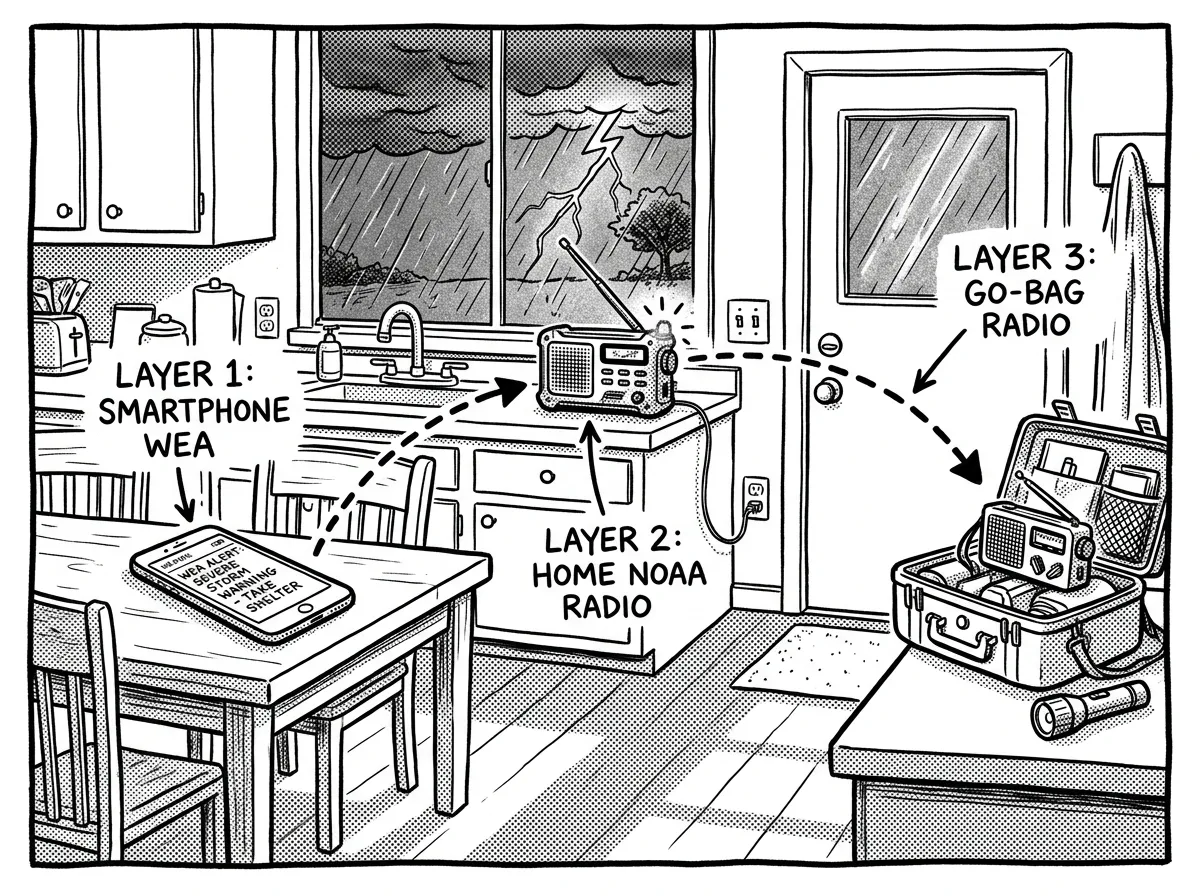 Three layers of emergency alerts — from smartphone to home radio to go-bag
No single alerting method works in every scenario. Cell towers fail. Power goes out. You might have to evacuate with nothing but a bag on your back. The solution is layers.
Here’s a three-layer approach recommended for building redundancy:
A severe ice storm hits your area at midnight. By 2 a.m., your power’s out and your phone shows one bar of signal. By 3 a.m., the cell tower’s backup battery dies and your phone goes dark. A tornado warning is issued for your county at 3:15 a.m. — without a NOAA radio running on battery backup, you’d sleep right through it.
Layer 1: Smartphone WEA Alerts (When Infrastructure Works)
Wireless Emergency Alerts push tornado warnings, AMBER alerts, and presidential alerts directly to your phone with no app needed. They’re fast, automatic, and location-based.
Limitation: When cell towers lose backup power (usually 4–8 hours into a major outage), WEA stops working entirely.
Layer 2: Home NOAA Weather Radio with SAME (Always-On Backup)
A plugged-in NOAA radio with SAME codes programmed for your county acts as a 24/7 sentry. When the NWS issues a warning for your specific area, the radio wakes up and sounds the alarm — even at 3 a.m., even if your phone is dead.
This is your most reliable layer. The NOAA transmitter network has backup power and covers 95% of the U.S. population. A $40 Midland ER310PRO programmed with your county SAME codes fills this role perfectly.
Layer 3: Portable Hand-Crank Radio in the Go-Bag (Evacuation Backup)
If you have to leave your home, you need a radio that works without any infrastructure at all — no grid power, no USB outlet, no cell signal. A compact hand-crank radio like the FosPower or RunningSnail in your bug-out bag covers this scenario.
Why this layered approach works: Each layer covers the failure mode of the one above it. Phone dies? Home radio is still running. Power goes out at home? The radio’s internal battery and crank keep it going. Forced to evacuate? The go-bag radio comes with you. Together, these three layers integrate into your broader essential preppers checklist and ensure you’re never completely cut off from official information.
How to Use and Maintain Your Emergency Radio
A radio that doesn’t work when you need it is worse than no radio at all. A common mistake: people buy an emergency radio, put it in a closet, and don’t touch it for two years. Then a storm hits and the battery’s dead, the antenna’s corroded, and they can’t remember how to tune it. Don’t be that person.
- Power on and verify clear NOAA reception
- Confirm alert function triggers (NWS runs weekly test alerts on Wednesdays)
- Test USB output by connecting a phone — verify it charges, even slowly
- Check flashlight and SOS beacon function
Seasonal and Annual Maintenance
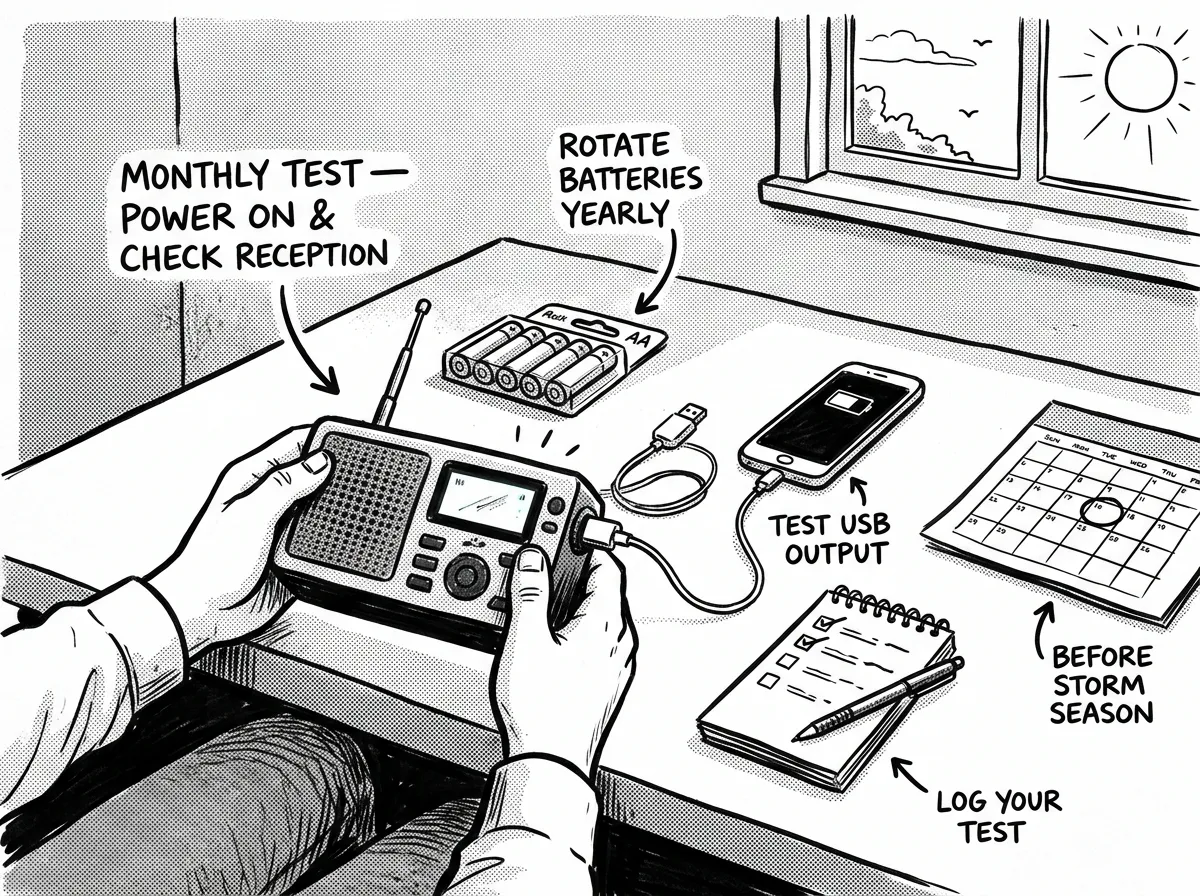 Monthly radio testing and annual battery rotation keep your gear ready
- Rotate replaceable batteries (AA/AAA) yearly. Marking the install date with a Sharpie on the battery itself helps track rotation schedules.
- Top off rechargeable internal batteries before storm season — lithium-ion cells lose charge over months of sitting idle.
- Crank the dynamo for 30 seconds to keep the mechanism lubricated and functional.
- Verify your SAME codes are still correct (county codes occasionally change during redistricting).
Setup Essentials
- Find your SAME county codes at the NWS website (nws.noaa.gov/nwr/coverage/county_coverage.html) — program your county and any adjacent counties you travel through regularly
- Identify your local NOAA frequency — the seven NWR channels are 162.400, 162.425, 162.450, 162.475, 162.500, 162.525, and 162.550 MHz — the NWS website lists which one covers your area
- Improve reception by extending the telescoping antenna fully and moving the radio near a window or to an upper floor
- Store a quick-start card with the radio — during a 3 a.m. alert you won’t remember the SAME programming sequence, so write it down
EMP consideration: If electromagnetic pulse preparedness is part of your plan, store a backup radio in a Faraday bag or sealed metal container with the antenna disconnected. This addresses the concern without requiring military-grade prices.
Programming SAME codes for the first time during an actual weather event can be frustrating without the manual on hand. Keeping a laminated index card with county codes, the local NOAA frequency, and the programming sequence rubber-banded to the radio takes only a few minutes to prepare and can prevent that frustration later.
Frequently Asked Questions
What features are essential in an emergency radio?
Multiple power sources (hand crank plus rechargeable battery at minimum), NOAA Weather Radio alert capability (SAME support if possible), solid AM/FM reception, durable construction, and simple controls. Everything else — flashlights, SOS beacons, reading lamps — is helpful but secondary.
Which emergency radio is best for beginners?
The Midland ER310PRO covers the most needs at the best price point. It’s got SAME alert support, four power sources, and a proven track record. If budget is tight, the RunningSnail MD-090P or FosPower get you NOAA-capable for under $30. Confirm alert support and charging outputs before purchasing.
Do weather radios still work when phones don’t?
Yes. NOAA Weather Radio and local AM/FM are terrestrial broadcasts powered by dedicated transmitter infrastructure with backup generators. They often remain operational for days or weeks after cell towers and internet fail, as long as the transmitter itself is functioning and you’re within range.
What type of radio do first responders use?
First responders use P25 digital trunked radios on dedicated UHF/VHF frequencies — these are specialized, encrypted systems that aren’t available to consumers. For home emergency preparedness, a receive-only NOAA weather radio is the correct starting point. Add FRS or GMRS two-way radios for family communication if you want two-way capability.
Should I have more than one emergency radio?
At least two is recommended: a home base unit plugged in with SAME codes programmed (the Midland ER310PRO or a dedicated desktop model like the Midland WR400) and a compact portable unit in your go-bag or vehicle. This matches the layered alert system approach where each radio covers a different failure scenario.
What’s the best budget emergency weather radio?
The RunningSnail MD-090P at $18–$25 is the best budget emergency radio in this category. It receives all NOAA channels, has hand crank and solar charging, and is compact enough for any bag. Its limitations — no SAME support, small battery, weak build quality — are acceptable trade-offs at this price point. The FosPower at $22–$30 is a step up with better battery life and water resistance.
How do I choose between a solar emergency radio and a hand crank radio?
You don’t have to choose — most modern emergency radios include both. Hand cranking is generally more reliable than solar in regions with frequent overcast skies, since solar charging becomes unpredictable without direct sun. If you’re in the desert Southwest or another sunny climate, solar is a genuine advantage. Regardless of where you live, prioritize a radio with a rechargeable battery you keep topped off via USB, and treat both crank and solar as backup charging methods.
Your Next Step
Finding the best emergency radios isn’t about buying the most expensive unit on the shelf. It’s about matching the right tool to your actual situation and then making sure it works before you need it.
If you’re just starting out, here’s a simple plan: buy a Midland ER310PRO, program your county SAME codes, and plug it in on your nightstand. That one action puts you ahead of 90% of households. Then toss a RunningSnail or FosPower in your go-bag for under $30, and you’ve got a complete layered system for less than a nice dinner out. Test both radios once a month. That’s it. You’re covered.
Set a recurring monthly reminder on your phone — “Test emergency radio” — on the first Wednesday of every month. That’s when most NWS offices broadcast their weekly test alerts, so you can verify both your radio and the alert function in one quick check.
The Complete
Prepper's Reference.
149 articles synthesized into one comprehensive PDF — twelve chapters covering water, food, shelter, first aid, comms, and scenario-specific preparedness. Free with your email.
Unsubscribe anytime · We never share your email
You're in. Check your inbox.
Keep Reading
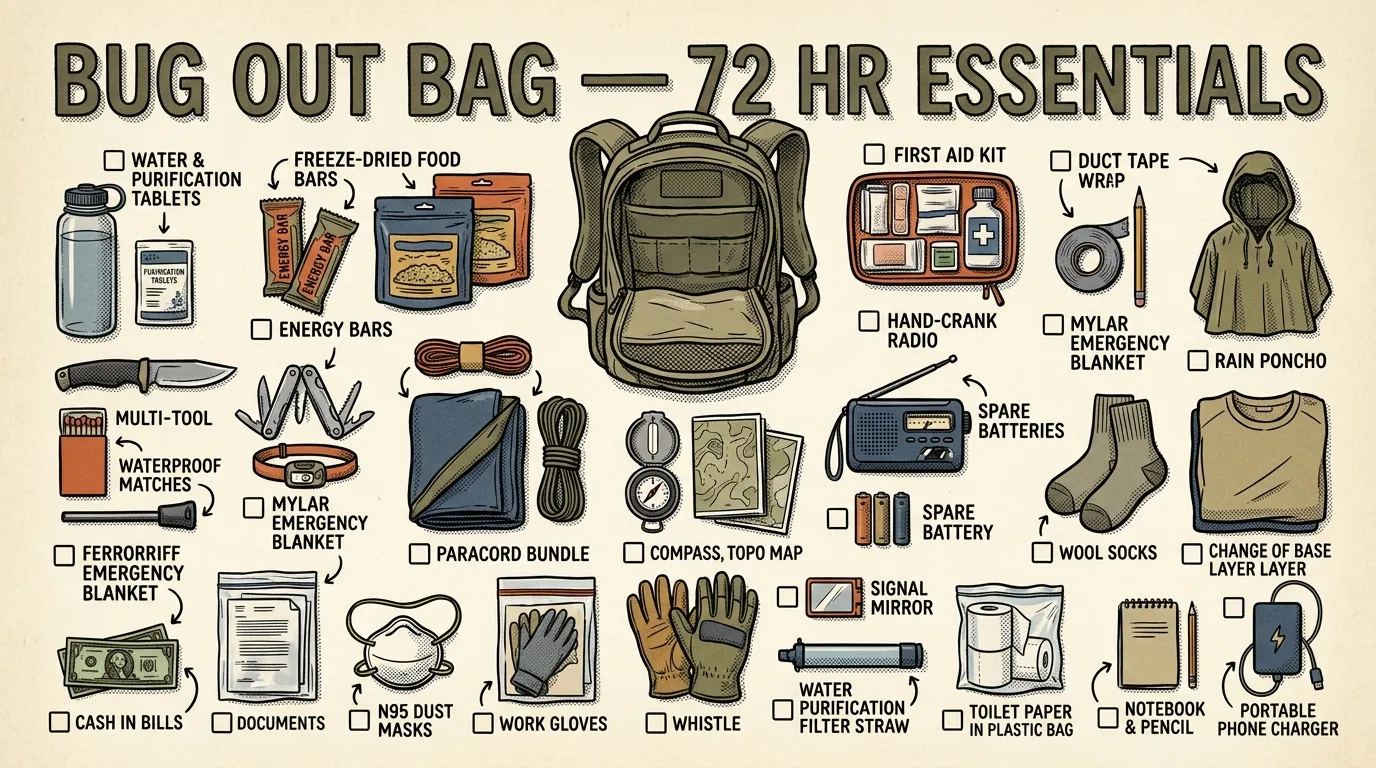
Bug Out Bag Checklist: 72-Hour Essentials Guide
Build a complete bug out bag checklist with 72-hour essentials for water, food, shelter, and first aid. Practical gear picks and free printable list.
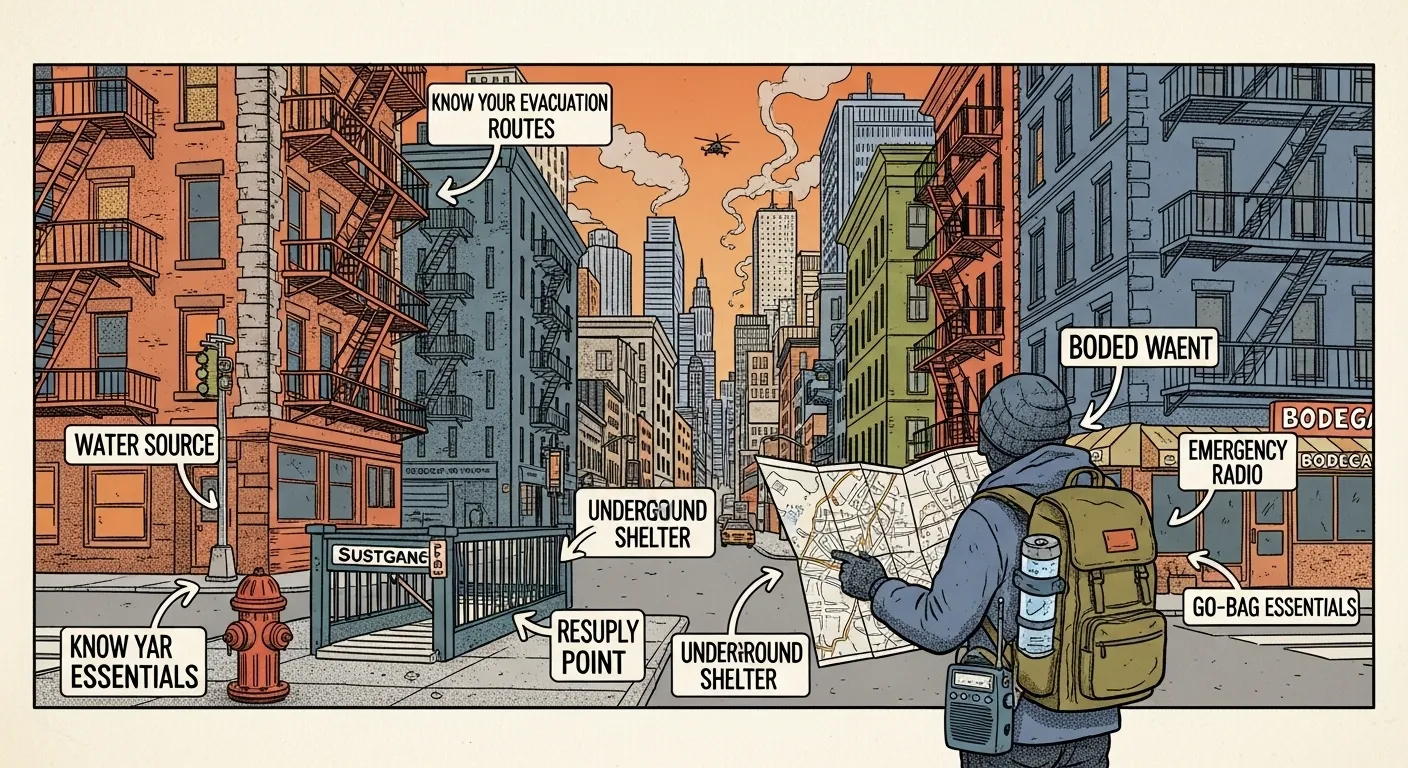
Urban Survival Tips: City Emergency Prep Guide
Practical urban survival tips for city emergencies: compact gear, water storage, exit routes, and community planning. Start preparing today.
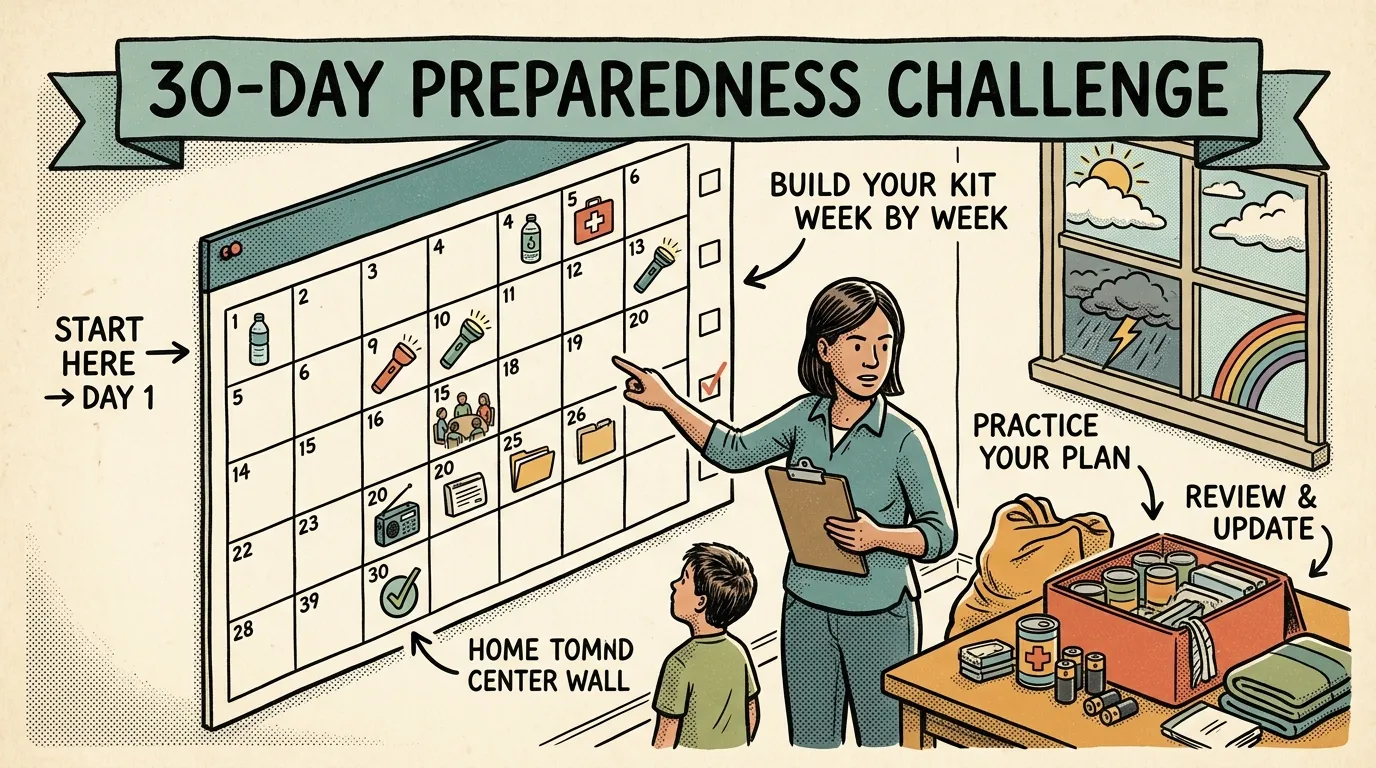
National Emergency Preparedness Month: 30-Day Plan
Use this 30-day National Emergency Preparedness Month challenge to go from unprepared to fully ready. One simple 15-minute task per day. Start now.