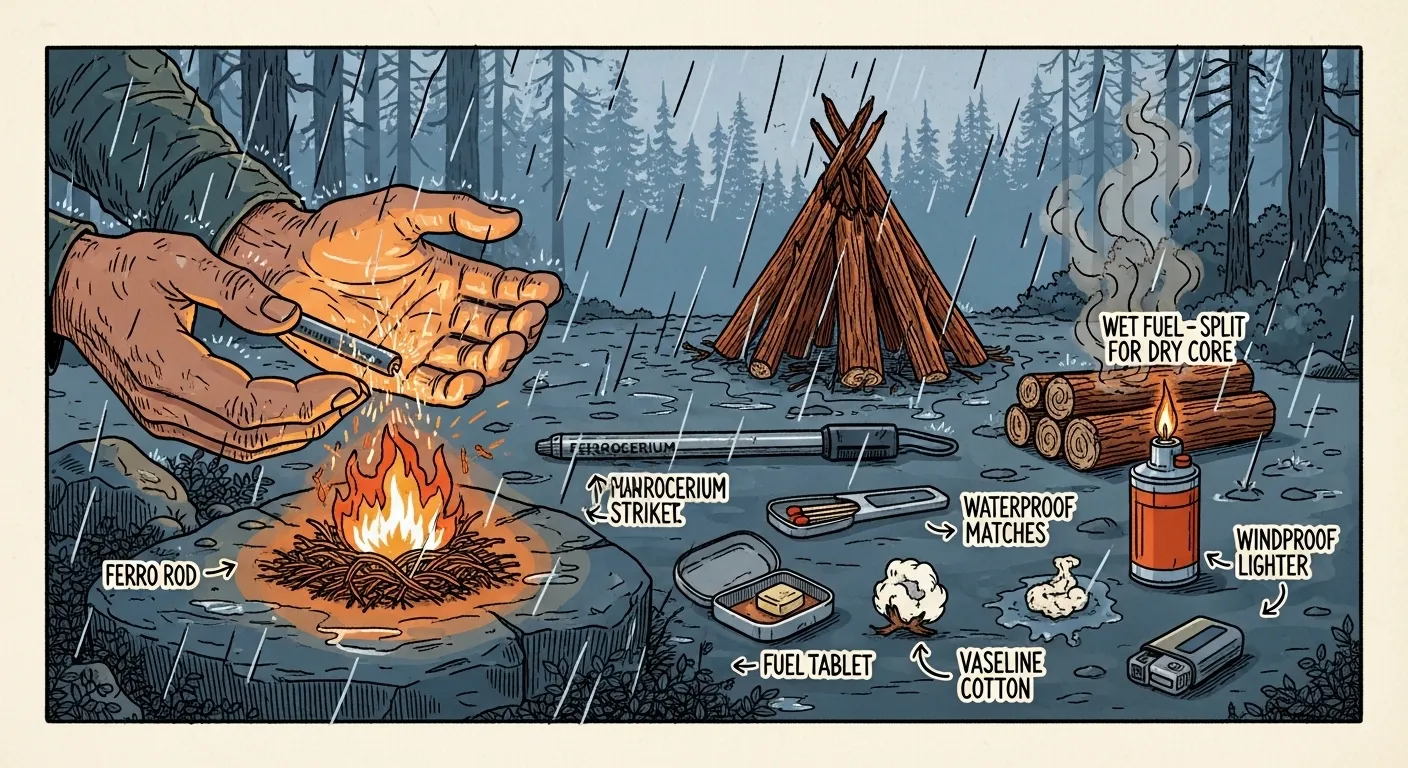
The best fire starters for wet conditions are stormproof matches, ferro rods with waterproof tinder, petroleum jelly cotton balls, wax-based fire starter cubes, and butane torch lighters. For rainy weather, choose fire starters with water resistance, long burn time, strong heat output, and easy ignition, then use them with sheltered fire-building techniques.
Key Takeaways
- Carry at least two fire-starting methods that fail differently — a ferro rod plus stormproof matches covers both spark and flame ignition.
- The ferro rod itself doesn't fail in water; your tinder does. Keep spark-catching tinder sealed in a waterproof container, always.
- Petroleum-jelly cotton balls cost almost nothing to make and outperform most commercial tinder tabs for burn time per gram.
- Build your fire lay under a tarp or dense canopy before you strike anything — shelter comes before ignition, every time.
- Test lighter fuel and cold-weather performance before you leave, not after you're already soaked and shivering.
Best Fire Starters for Rain: Top Picks for Wet Conditions
Building a fire during a multi-day rainstorm, when even moss is dripping, is a different challenge than lighting one on a dry day. Even experienced backpackers can burn through an entire book of paper matches trying to light a fire that never had a chance. The difference isn’t luck. It’s gear choice and technique, in that order.
According to FEMA emergency preparedness guidance, the tool matters less than most people think when starting fire in wet weather, and the prep work matters more than almost anyone thinks. Let’s get into what actually works.
Quick Summary
- Ferro rods paired with waterproof tinder are the single most reliable combo — the rod works wet, the spark just needs the right target.
- Petroleum-jelly cotton balls cost pennies to make and burn far longer than most people expect for how small they are.
- Stormproof matches are the easiest backup for beginners, but they’re single-use — carry more than one tube if you’re relying on them.
- Butane torch lighters ignite fast and cut through wind, but cold weather and low fuel will absolutely leave you stranded.
- Shelter comes before ignition. Build your fire lay under cover first — no fire starter overcomes rain falling directly on your tinder.
- Redundancy isn’t optional in wet climates. Carry two methods that fail for different reasons, not two of the same thing.
Why Rain Changes Everything About Fire Starting
Here’s the thing most gear reviews skip: fire needs heat, fuel, and oxygen, and rain attacks all three at once. It cools your tinder below ignition temperature, it saturates your fuel wood, and it can smother a small flame before it establishes. That’s why the “just bring a lighter” advice you see everywhere falls apart the first time you actually need it in a downpour.
You’re three hours from the trailhead, the temperature’s dropping fast, and your only dry layer is already on your back. Rain’s been steady for six hours. You need a fire not for comfort, but to prevent hypothermia — and every piece of wood within reach is dripping wet.
That scenario isn’t rare. Search-and-rescue reports describe exactly this situation playing out, and the people who came through it fine were the ones carrying redundant, tested fire-starting gear — not the ones who packed one lighter and hoped for the best.
Key Terms You Need to Know
Before you buy anything, get familiar with what you’re actually shopping for. These terms show up on packaging constantly, and half of them get used incorrectly.
Stormproof / waterproof matches — Matches sealed in tubes or chemically treated so they light in wind and rain. They only stay reliable if you keep them in their container until use.
Ferrocerium (ferro) rod — A metal alloy striker that throws extremely hot sparks when scraped with a hard edge. It works fine after being submerged. The catch is you need tinder that can actually catch that spark.
Petroleum-jelly cotton balls — Cotton soaked in petroleum jelly, sometimes called “vaseline tinder.” Burns slowly and steadily when kept dry, and it’s one of the cheapest DIY fire starters you can make at home.
Wax-based fire starter cubes / tinder tabs — Blocks of wax and fiber that burn steadily for several minutes, giving you time to dry and ignite damp kindling around them.
Butane jet torch lighter — A focused, wind-resistant flame, similar to what you’d see in a kitchen torch. Fast and hot. Completely dependent on fuel level and somewhat dependent on temperature.
Fatwood — Resin-rich heartwood, usually from pine stumps, that ignites far easier than regular wood because of its natural pitch content.
The Quick Comparison
If you’re trying to decide what to actually put in your kit, here’s how these stack up against each other in practical terms.
Stormproof matches give you compact, dead-simple ignition, but they’re single-use and you’ll eventually run out. A ferro rod paired with waterproof tinder gives you thousands of strikes and works after full submersion, though it takes some practice to use well. Petroleum-jelly cotton is cheap, lightweight, and burns long enough to catch fine kindling — plus it’s a five-minute DIY project. Wax cubes and tabs provide a sustained flame that’s excellent for drying out damp kindling, though most need a flame source to get started rather than a spark. A butane jet lighter gives you the fastest, most wind-resistant ignition of the bunch, but it’s the most fuel- and temperature-dependent option on this list. Fatwood is a solid natural backup if you can find or carry it dry.
Top Fire Starters for Wet Conditions, Ranked
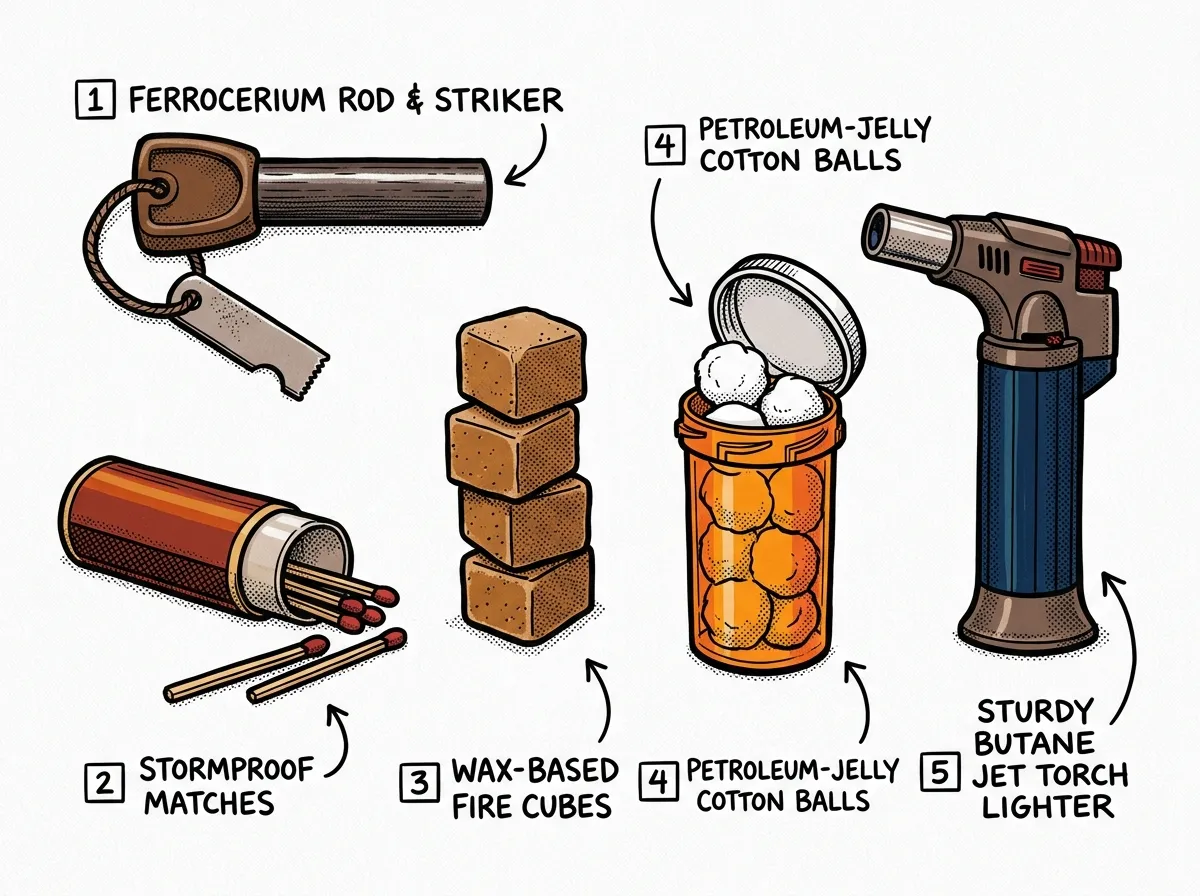 Complete wet-weather fire starter kit laid out
1. Ferrocerium Rod + Waterproof Tinder
This is one of the most reliable options, regardless of season. A ferro rod — usually $8 to $15 depending on size — throws a shower of sparks north of 3,000°F when you scrape it with the back of a knife or the included striker. Water doesn’t hurt it. You can pull it out of a river and it’ll spark just fine thirty seconds later.
The limitation isn’t the rod. It’s what the spark lands on. Strike it into wax tabs, petroleum-jelly cotton, or a commercial tinder like Tinder-Quik, and you’ll get flame in one or two strikes. Strike it into damp bark and you’ll get frustrated fast.
A common mistake is buying a ferro rod, never practicing with it, then trying to use it for the first time during an actual emergency with cold, shaking hands. Practice striking it at home, in the shower, in the rain, whatever it takes. The technique — a firm, fast downward strike, not a slow scrape — takes maybe twenty minutes to get comfortable with, and that twenty minutes matters more than which brand of rod you buy.
2. Stormproof Matches
Stormproof matches run around $8 to $12 for a tube of 20 to 25, and they’re the easiest fire starter for anyone who’s never practiced firecraft. Strike one, and it’ll keep burning even in a stiff wind and light rain — some brands claim they’ll relight after being dunked in water.
The catch is obvious once you think about it: they’re single-use. One tube gets you 20-something fires, and that’s it. Keep them in the sealed tube they came in, and don’t transfer them to a plastic bag — the tube itself is part of the waterproofing.
3. Petroleum-Jelly Cotton Balls
This is a popular DIY tinder option, and it costs almost nothing to make. Soak a regular cotton ball in petroleum jelly — a $3 jar of Vaseline makes dozens of them — until it’s saturated but not dripping, then pack them into a small waterproof container like an old pill bottle.
One of these catches a spark almost instantly, and pulled apart slightly to expose loose fibers, it burns for several minutes — plenty of time to build up fine kindling on top of it. A single ball burns notably longer than dry cotton alone.
Pull the cotton ball apart slightly before you strike your ferro rod into it. A tight, compact ball resists sparks; a fluffed-up one catches almost every time.
4. Wax-Based Fire Starter Cubes and Tinder Tabs
Wax fire starter cubes run about $6 to $10 for a pack of a dozen or so, and they’re built for exactly this problem — sustained heat that dries and ignites damp wood around it. Break one open to expose the wick, light it with a match or lighter, and it’ll burn for five to ten minutes depending on size.
They’re less useful with a ferro rod alone since most need actual flame to get going, but paired with stormproof matches, they’re one of the strongest combos for genuinely soaked kindling. High desert campers dealing with dry lightning storms and sudden downpours find these particularly useful for drying out flash-soaked sagebrush.
5. Butane Jet Torch Lighter
A good butane jet torch lighter — expect to pay $15 to $25 for a quality one — produces a concentrated, wind-resistant flame that lights damp tinder fast when you’re working under shelter. It’s the fastest option on this list, hands down.
It’s also the most fragile in terms of dependency. Fuel runs out. Cold weather drops the vapor pressure inside the canister, which weakens or kills the flame entirely, particularly at elevation when temperatures drop below freezing overnight. Check your fuel level before every trip, and never make it your only method.
A torch lighter shouldn’t be relied on as a primary fire source. In cold conditions, a torch lighter may not fire at all until it’s been warmed — keeping it in an inside jacket pocket for several minutes can restore enough vapor pressure to work. That’s time you may not have in an actual emergency, so treat a ferro rod as the primary method and a torch lighter as a convenience backup.
Honorable Mention: Fatwood and Resin-Rich Tinder
Fatwood — resin-saturated pine heartwood — lights far easier than regular wood because of its natural pitch content, even when the surrounding bark is soaked. It’s a great supplement if you’re in a pine-heavy region like the interior Pacific Northwest. Carry a few pre-split chips in a zip bag, and you’ve got a natural backup that doesn’t rely on batteries, fuel, or chemicals.
What to Look for When You’re Buying
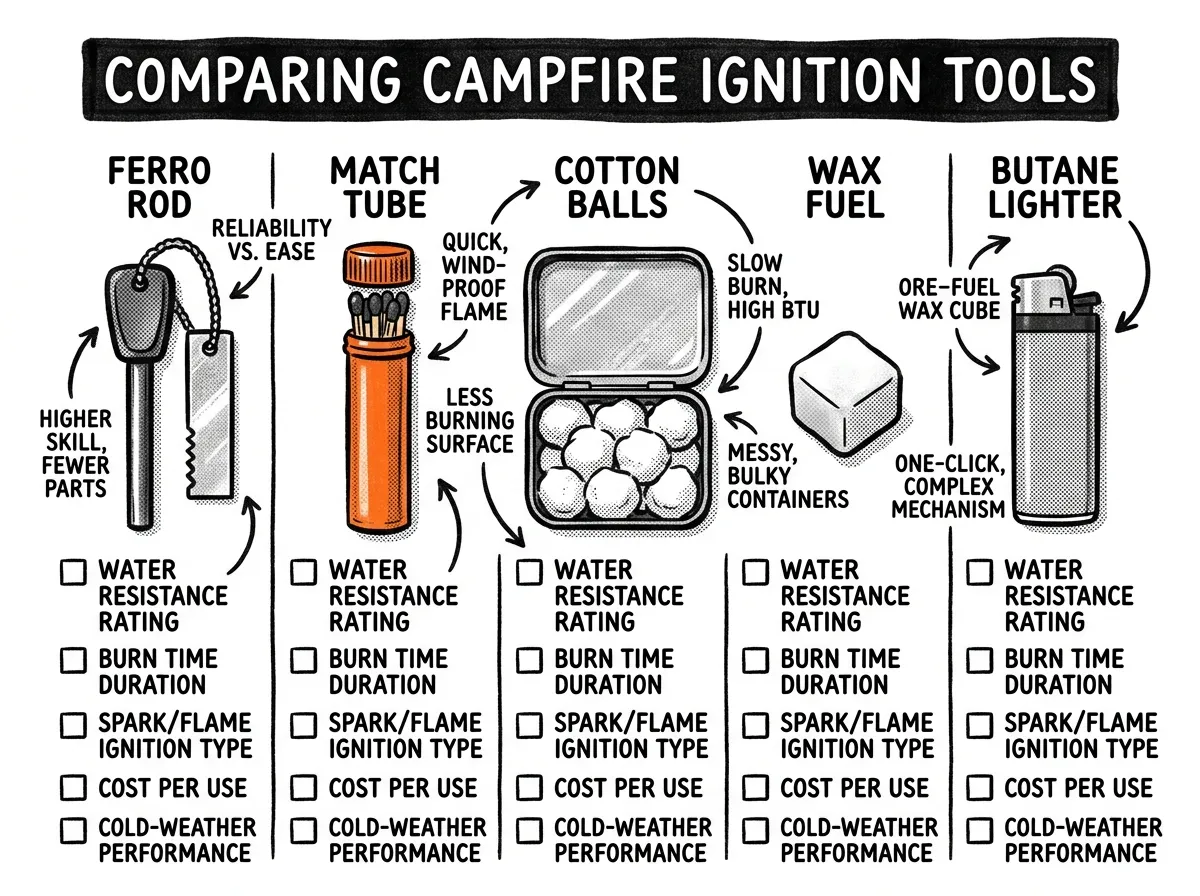 Fire starter buying checklist and comparison
Not every fire starter marketed as “waterproof” holds up the same way. Here’s what actually matters when you’re comparing options.
Water resistance. This means either sealed packaging (matches in tubes, tinder in zip bags) or inherently water-repellent material like wax or petroleum jelly. A ferro rod’s water resistance is built into the metal itself — no packaging required.
Heat delivery. You need enough heat to overcome ambient moisture. Ferro sparks and torch lighter flames both deliver intense, concentrated heat that standard matches sometimes can’t match in genuinely wet conditions.
Burn time. Longer-burning tinder buys you time to build a fine kindling structure before the initial flame dies. Petroleum-jelly cotton and wax cubes both outperform a quick match strike here.
Ease of use. Matches and torch lighters are faster for beginners with no practice time. Ferro rods are more durable and last longer, but they demand technique you should build before you’re relying on it.
Durability and shelf life. Look for corrosion-resistant metal on rods, intact seals on match tubes, and stable wax or petroleum-based tinder that won’t degrade sitting in a bag for two years.
Portability. A ferro rod and a small waterproof tinder container both fit easily in a jacket pocket or the top pocket of a bug-out bag — no reason to skip carrying them.
- Ferro rod with striker (practiced, not just packed)
- Stormproof matches in sealed tube, two tubes minimum
- Petroleum-jelly cotton balls in a waterproof container
- Wax fire starter cubes or tinder tabs
- Butane torch lighter with fuel checked before departure
- Small tarp or poncho for building a dry work area
How to Actually Start a Fire in the Rain
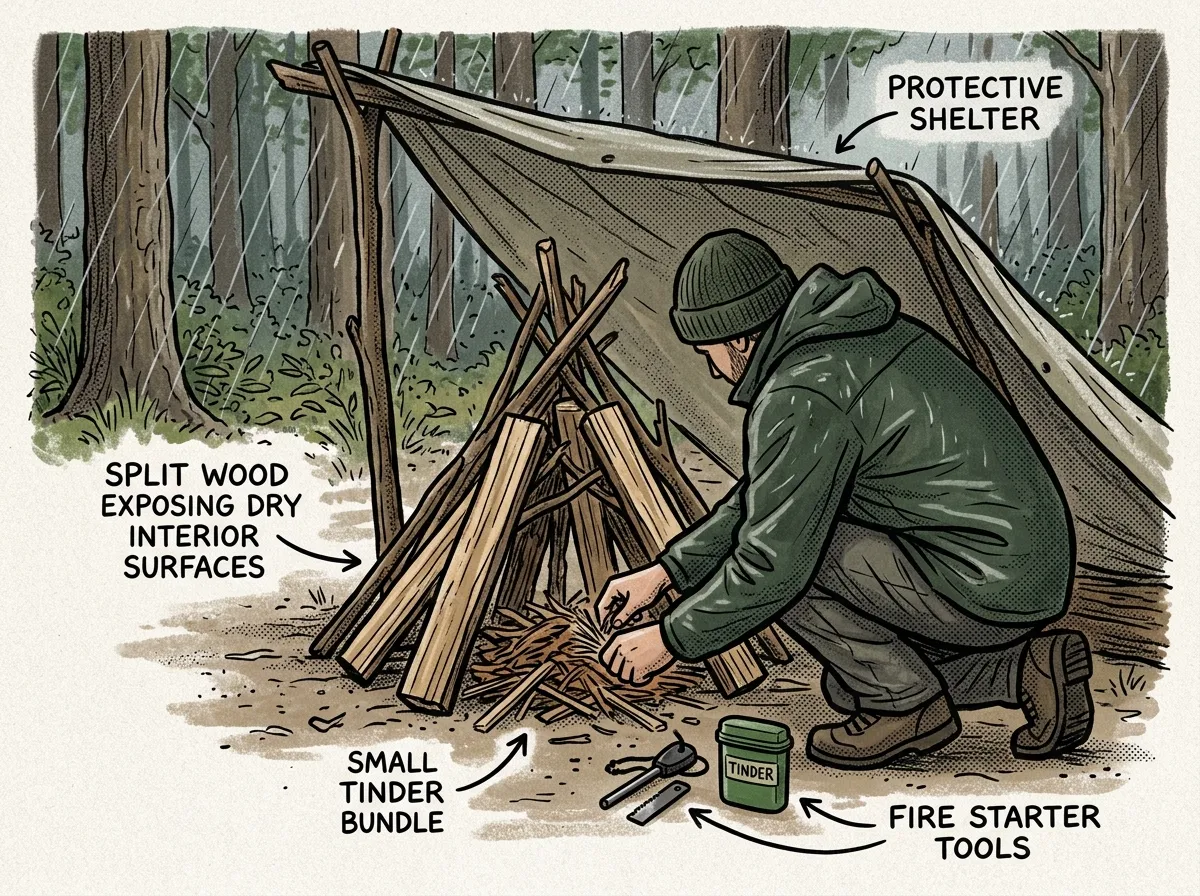 Building a sheltered fire lay in wet conditions
The gear only gets you halfway there. Technique closes the gap, and this is where most preventable failures happen in the field.
- Create shelter first — rig a tarp, poncho, or work under a dense canopy so rain isn’t hitting your hands or tinder directly
- Gather fine tinder and split larger wood to expose the drier inner surfaces, since the outside is almost always saturated
- Build a protected fire lay, like a teepee or lean-to, that shields the initial flame from wind and rain
- Ignite your tinder bundle — aim ferro sparks directly at fluffed tinder, or light a match under cover and cup it with your hand
- Feed the fire gradually, starting with the smallest dry pieces before adding anything larger
- Shield the young flame with your body or pack until it’s established enough to survive brief exposure
Why does splitting wood matter so much? Because the outer inch of any log sitting in the rain is soaked through, but the core stays dry far longer than you’d expect — even after hours of steady rain. A knife or hatchet exposing that dry core is often the single biggest difference between success and failure.
Small, sheltered fires beat large, open ones every time everything around you is wet.
Building a big, impressive fire lay in the rain right out of the gate almost never works. Start small, protected, and patient. Expand once you’ve got confident flame.
Safety and Storage Tips
Getting a fire started is only half the job. Keeping your gear functional and your fire safe matters just as much, especially in wet, high-humidity environments where mold and corrosion creep in fast.
Store tinder and ignition tools in waterproof pouches, zip-top bags, or hard cases — don’t just toss a ferro rod loose in your pack where it’ll pick up moisture and grit. Clear your fire site of flammable debris, and stay alert for smoldering spots hidden under wet leaf litter; they can flare back up hours later even in damp conditions. Never build an open flame inside an enclosed tent, no matter how bad the weather gets outside — carbon monoxide and fire risk don’t care how cold you are. When you’re done, extinguish fully: douse it, stir the coals, douse again, and check for heat with the back of your hand before you walk away. Don’t assume rain will finish the job for you; “extinguished” fires can reignite hours later under drier conditions.
Inspect your kit periodically, not just before big trips. Seals on match tubes fail with age, and butane lighters slowly lose fuel even sitting unused in a drawer.
Frequently Asked Questions
What is the single most reliable fire starter for rain? A ferro rod paired with waterproof tinder gives you the best combination of reliability and longevity — thousands of strikes, and it works fine after being fully submerged. Carry stormproof matches as your backup method.
Do ferro rods work when wet? Yes. They throw hot sparks even right after exposure to water. Wipe off excess moisture and use prepared, dry tinder, and your success rate goes way up.
How long do petroleum-jelly cotton balls burn? Several minutes when they’re properly saturated and stored dry until use. Actual burn time depends on the size of the ball and how much you fluff it before striking.
Final Thoughts
Rain doesn’t care how good your gear is if you’ve never practiced with it. Buy the ferro rod, make the petroleum-jelly cotton balls at home before your trip, and actually strike sparks into them in your backyard first. That twenty minutes of practice does more for your odds than any single product on this list.
Pack redundancy, build shelter before you strike anything, and start small. That combination matters more than any single piece of gear on its own.
The Complete
Prepper's Reference.
149 articles synthesized into one comprehensive PDF — twelve chapters covering water, food, shelter, first aid, comms, and scenario-specific preparedness. Free with your email.
Unsubscribe anytime · We never share your email
You're in. Check your inbox.
Keep Reading
Survival Skills Camp: How to Choose the Right One
Choosing a survival skills camp? Here's what to look for, red flags to avoid, and what real training teaches you.
Survival Skills on a Deserted Island: Field Guide
Master survival skills on a deserted island — water, shelter, fire, food, and rescue signaling. Start learning now.
Survival Skills Training: 8-Week Plan for Beginners
Follow this 8-week survival skills training plan to master shelter, fire, water, navigation & first aid. Start this weekend.