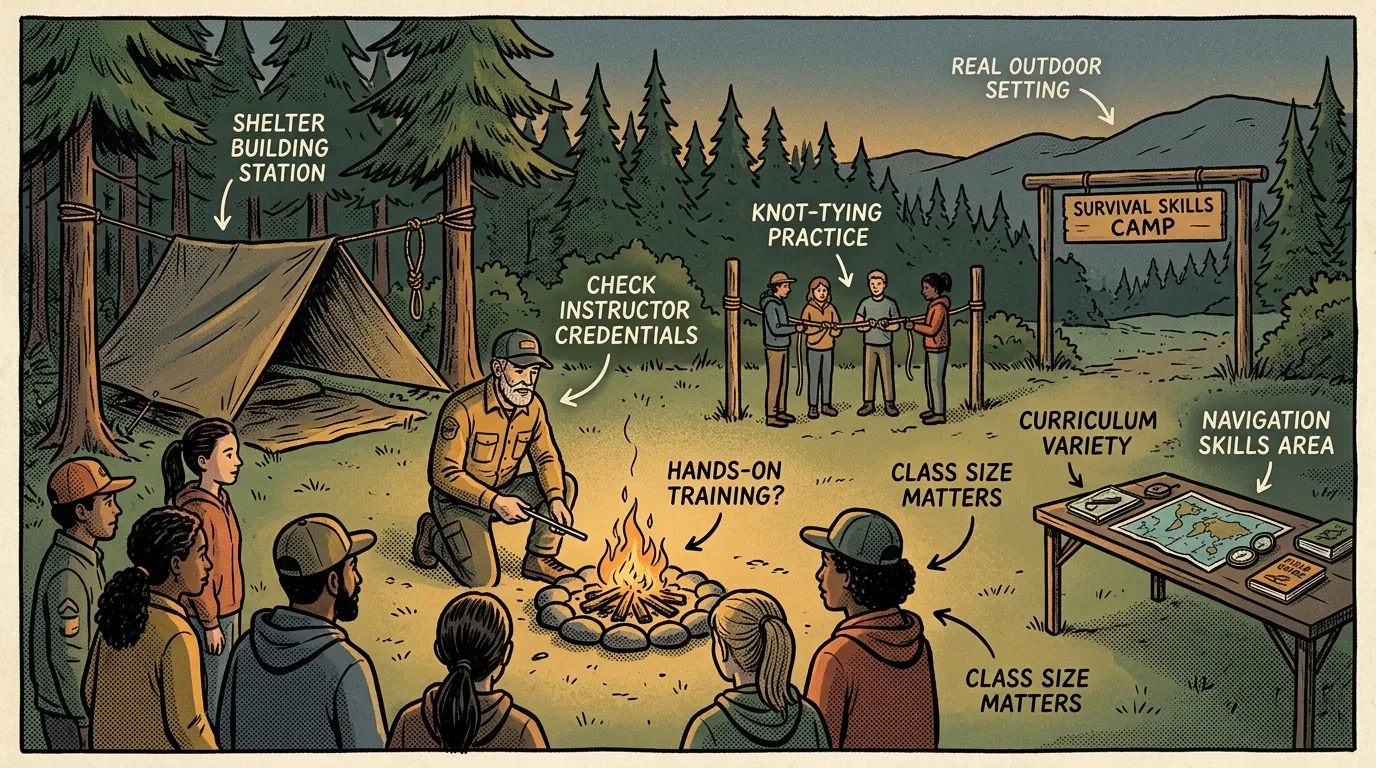
This article is a practical guide for evaluating and choosing a survival skills camp, covering what quality programs teach, red flags to watch for, how immersive training differs from self-study, and what to expect from your first camp experience.
Key Takeaways
- Vet instructor credentials, student-to-instructor ratios, and published curriculum before booking any survival skills camp
- Hands-on camp training builds muscle memory and stress tolerance that YouTube and books cannot replicate
- Match your first camp to your home region's climate and terrain — those are the skills you'll need first
- Start at the beginner level regardless of your experience — correcting bad habits early saves you later
- Budget $200–$500 for a quality weekend course; the return on investment beats most gear purchases
- After your first camp, build a regular practice schedule to prevent skill decay between courses
The first survival skills camp attendees often encounter can nearly ruin the whole concept for them. Some instructors spend hours lecturing from a lawn chair, demonstrate a bow drill for about ninety seconds, and then tell the group to “go practice.” In camps run this way, dropout rates by day two can be steep. The lesson isn’t that camp-based training doesn’t work — it’s that the specific camp was poorly run.
Wilderness survival programs vary enormously in quality, from single-day workshops to month-long immersive courses across the country. The right survival skills camp will teach more in three days than six months of YouTube videos. The wrong one will drain your wallet and leave you frustrated. This guide is going to help you tell the difference.
Quick Summary
- Not all survival skills camps are equal — instructor credentials, student-to-instructor ratios, and curriculum structure matter more than flashy marketing
- Immersive, hands-on camp training builds muscle memory and stress inoculation that self-study simply can’t replicate
- Red flags include vague instructor bios, no published curriculum, and programs that lean heavily on gear sales over skill-building
- Expect to pay $200–$500 for a quality weekend course and $800–$2,500 for a full week-long immersive experience
- The best programs cover the core five: shelter, water, fire, food procurement, and navigation — with real field time for each
- Regional climate and terrain should influence which camp you choose, because desert survival and temperate rainforest survival are vastly different skill sets
What a Quality Survival Skills Camp Actually Teaches You
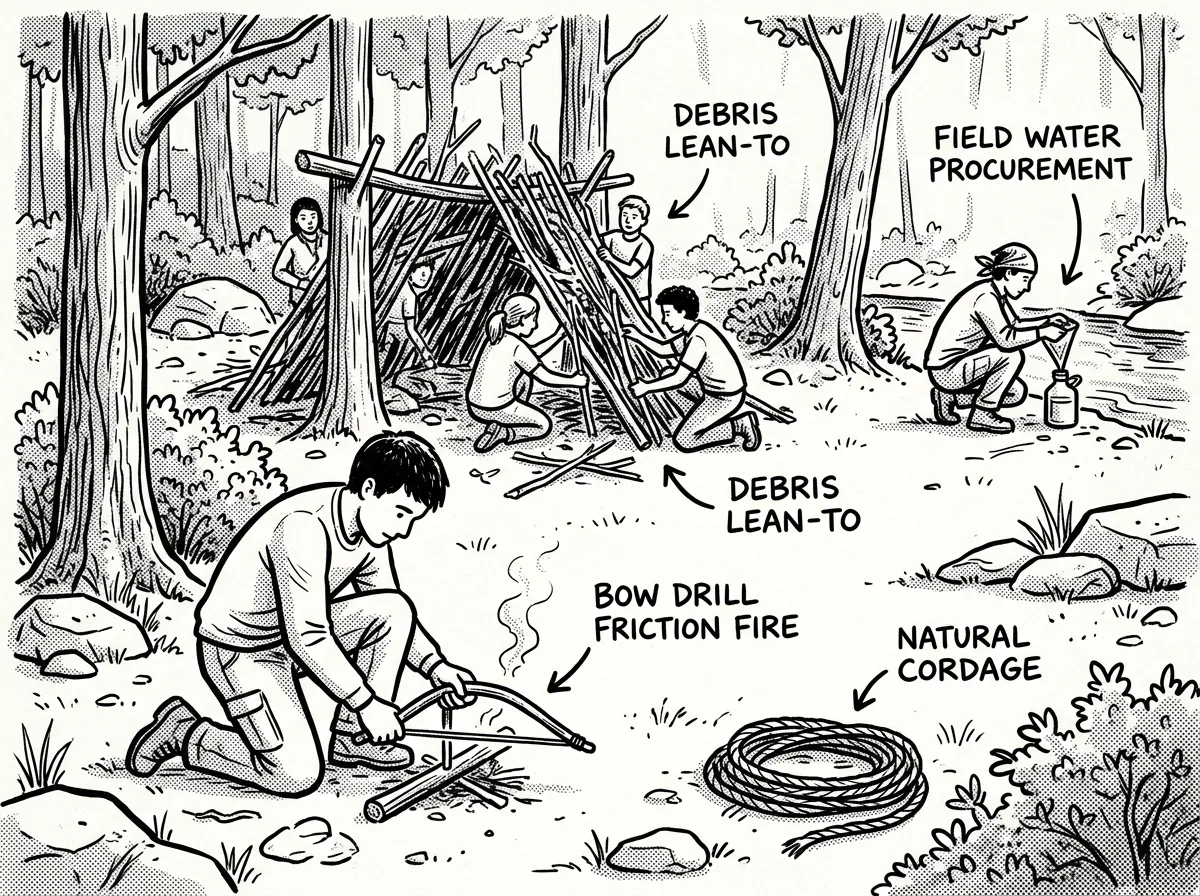 Core survival skills taught at a quality camp: shelter, fire, water, navigation, and foraging
A survival skills camp teaches hands-on wilderness competencies including shelter building, fire craft, water procurement, navigation, and foraging through immersive field training led by experienced instructors. Here’s what a solid curriculum covers:
- Shelter construction using natural and minimal materials
- Fire starting with friction, ferrocerium, and flint methods
- Water sourcing, purification, and container improvisation
- Basic land navigation with map, compass, and terrain features
- Wild edible and medicinal plant identification
- Wilderness first aid and field hygiene
- Knot tying and natural cordage making
- Trap and snare fundamentals where legally permitted
The best programs don’t just demonstrate these skills — they make you do them, fail at them, troubleshoot, and then do them again until the technique sticks. That repetition under real conditions is the entire point. You can watch a hundred bow drill tutorials. Actually feeling the spindle bite into the fireboard, smelling the first wisp of smoke, and knowing exactly how much downward pressure to apply? That only comes from doing it with your own hands, over and over.
One common issue: people show up expecting a checklist experience. Fire? Check. Shelter? Check. But the real value is in the transitions — how you prioritize when you’re cold, tired, and it’s getting dark. That’s where wilderness survival training separates itself from everything else.
What’s the Difference Between Bushcraft and Survival Training?
This distinction matters when you’re choosing a program. Survival training focuses on short-term emergency scenarios — you’re lost, injured, or displaced and need to stay alive until rescue or self-recovery. The emphasis is on improvisation, rapid shelter, signaling, and threat management. Think “72-hour crisis.”
Bushcraft training, on the other hand, is about thriving in a wilderness environment over extended periods. It emphasizes craftsmanship — carving tools, building semi-permanent shelters, processing game, making containers from bark. Think “living in the woods by choice.”
In practice, the two overlap significantly. A quality outdoor survival course will incorporate bushcraft elements, and serious bushcraft training teaches survival fundamentals. But if you’re a prepper choosing your first camp, start with survival-focused training. Those skills address the most likely emergency scenarios. Layer in bushcraft training once you’ve got a solid foundation.
Why Hands-On Camp Training Beats Self-Study
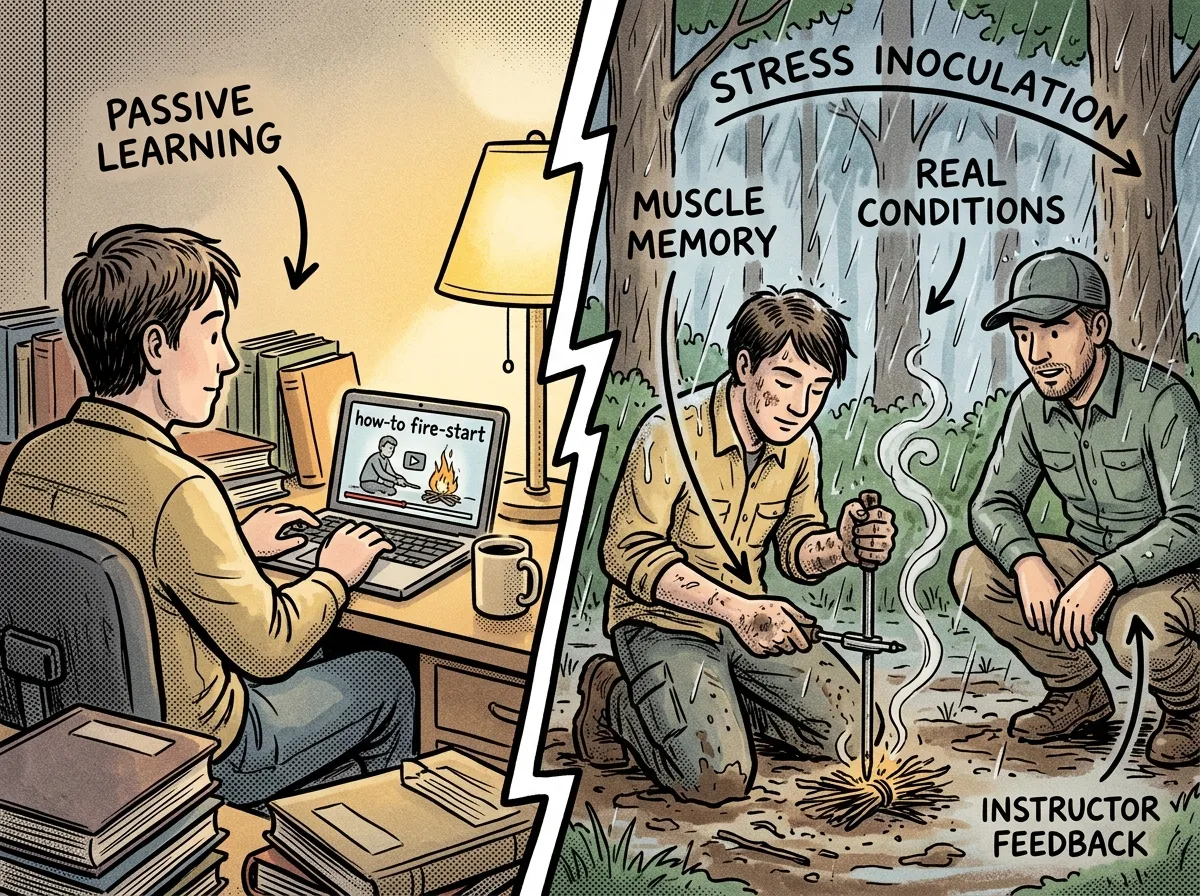 Immersive field training builds muscle memory and stress tolerance that videos and books cannot replicate
So why can’t you just learn this stuff on your own? Honestly, you can learn a lot on your own. Books like “Bushcraft 101” by Dave Canterbury are excellent. YouTube channels from guys like Paul Kirtley deliver genuinely useful instruction. But there’s a ceiling.
Knowledge is knowing how to build a debris hut. Skill is building one that actually keeps you warm at 35°F in the rain.
Self-study gives you knowledge. A survival camp for adults gives you skill. Here’s the difference: knowledge is recalling the steps to build a debris hut. Skill is building one that actually keeps you warm at 35°F in the rain. Skill is knowing when your fire lay needs more tinder because of the humidity that day, not because a manual told you so.
The feedback loop at a quality camp is irreplaceable. An instructor watches your knife work and says, “You’re gripping too tight — you’ll fatigue your hand in ten minutes.” They see your shelter and point out the gap in the ridgepole that’ll funnel rain straight onto your face at 2 a.m. You don’t get that from a book.
There’s also stress inoculation. Even a controlled camp environment introduces discomfort — sleeping on the ground, dealing with weather changes, managing hunger. That low-grade stress teaches your brain to think clearly when things aren’t comfortable. It’s why realistic field exercises are generally considered more effective than classroom instruction alone.
People who consume hundreds of hours of survival content can still freeze when they can’t get a fire going on a damp evening. Not because they lack knowledge — they know the theory cold. They’ve just never failed at it before, and they don’t know how to troubleshoot in real time. That’s the gap camp training fills: you fail in a safe environment so you don’t freeze in a real one.
How to Evaluate a Survival Skills Camp Before You Book
This is where most people go wrong. They Google “survival camp near me,” pick the one with the best website, and hand over their credit card. Don’t do that. Here’s how to actually vet a program.
Instructor Credentials and Background
You want instructors with verifiable field experience — not just certifications, though those matter too. Look for backgrounds in military survival schools (like SERE), professional guiding, search and rescue, or established bushcraft lineages. A Wilderness First Responder or Wilderness EMT certification is a strong signal that the instructor takes safety seriously. That same medical competency baseline matters in anyone teaching outdoor skills — if they can’t manage a field emergency, they shouldn’t be creating the conditions where one might happen.
Ask directly: how long have they been teaching? Where did they train? Do they still actively practice in the field? If the “About” page is vague or reads like a marketing brochure with no specifics, that’s a problem.
Student-to-Instructor Ratio
This one’s huge. You want no more than 8–10 students per instructor for skills-focused courses. Anything above 12:1 and you’re basically attending a demonstration, not a training. Some programs use assistant instructors to keep ratios low — that’s perfectly fine as long as the assistants are competent.
Before booking, email the program and ask their maximum class size and instructor ratio for your specific course date. If they dodge the question, move on.
Published Curriculum and Daily Schedule
A quality program publishes a clear outline of what you’ll cover each day. Vague descriptions like “learn to survive in the wild” aren’t enough. You should see specific skill blocks with time allocations. Does the camp spend four hours on shelter construction or forty minutes? That difference matters enormously.
Land and Environment
Where’s the camp held? Rented public land with minimal biodiversity is different from a private tract with diverse terrain, water features, and varied forest composition. The best programs operate on land they know intimately — land where they can point to specific plants, water sources, and shelter sites they’ve used for years.
Red Flags That Should Make You Walk Away
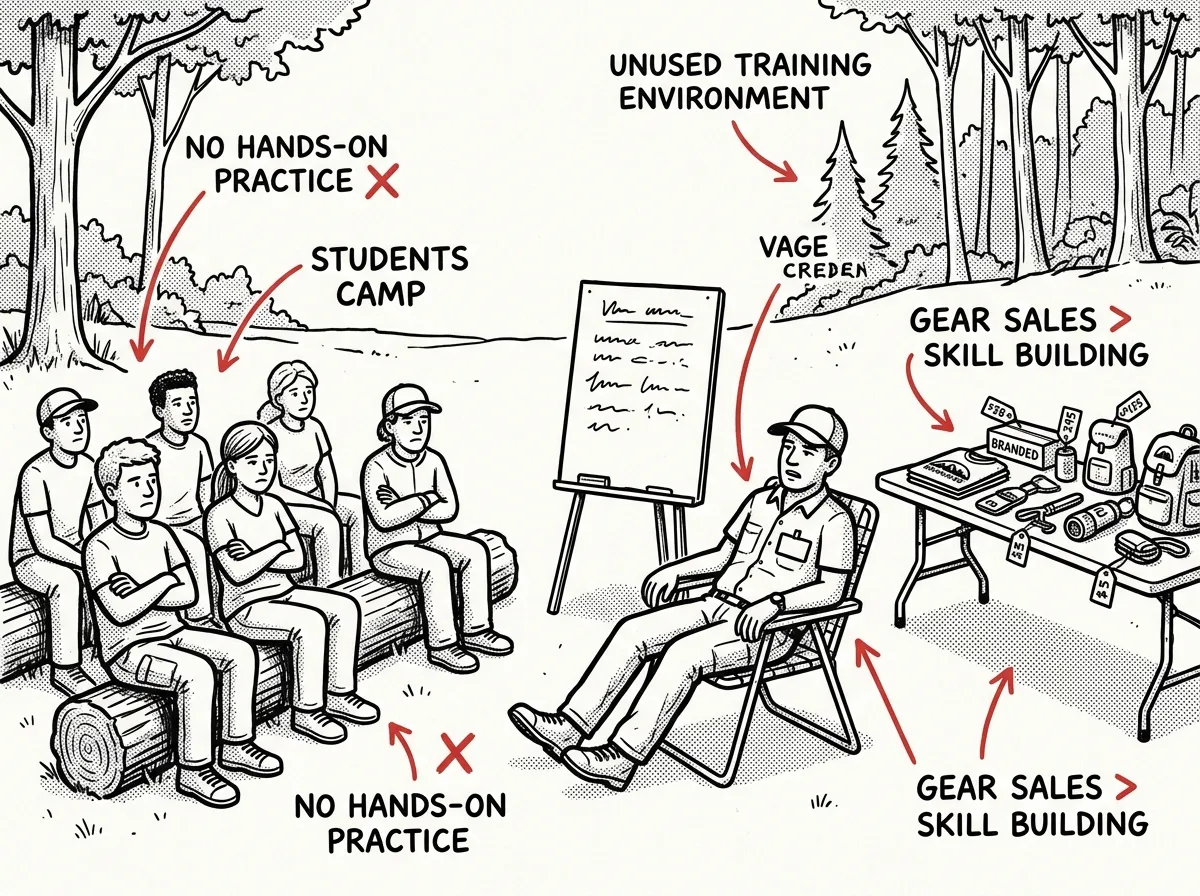 Warning signs of a low-quality survival camp: lecture-heavy instruction, no field time, and gear-sales pressure
Some programs set off every alarm bell. Here’s what to watch for.
- Instructors with no verifiable credentials or field experience
- Heavy emphasis on gear sales over skill instruction
- No published refund or weather cancellation policy
- Class sizes above 15 with a single instructor
- Curriculum that’s 80% lecture and 20% hands-on
- No liability waiver or medical screening form — indicates amateur operations
- Claims of “military-grade” training without any military-affiliated instructors
- Reviews that all sound the same or appear on only the program’s own site
The gear sales thing deserves extra attention. Some programs are essentially extended infomercials for the instructor’s product line or affiliate partnerships. If you notice the curriculum repeatedly circles back to specific branded products you’re encouraged to buy on-site, that’s a commercial operation wearing a training program’s clothing.
Also be cautious of any program that glorifies suffering. Legitimate tactical survival training involves discomfort. It shouldn’t involve instructors berating you, withholding water to “test” you, or creating dangerous conditions for dramatic effect. That’s not training — it’s liability.
Choosing the Right Survival Skills Camp for Your Region and Skill Level
What you need to learn depends heavily on where you live and where you’d likely face an emergency.
In the Pacific Northwest, wet-weather fire craft, rain-resistant shelter building, and Pacific Coast plant identification should be priorities. Hypothermia is the primary killer here — not dehydration. Courses that run through days of relentless drizzle and temperatures hovering around 38°F make clear that fire starting in wet conditions isn’t a nice-to-have skill in this region. It’s the skill. Students who have only practiced fire craft in dry conditions often struggle once they’re faced with genuinely wet terrain.
If you’re in a humid Gulf Coast climate, your biggest concerns shift to heat illness prevention, water-borne pathogen management, and insect-related hazards. High desert is a different problem entirely — water procurement and solar shelter become survival priorities within hours, not days.
You live in Arizona and sign up for a survival skills camp in the Appalachian Mountains because the schedule fits. You spend a week learning to build debris shelters from leaf litter and identify eastern hardwood species. When you get home, you realize almost none of it applies to the Sonoran Desert landscape you’d actually face in an emergency. You’ve gained general experience, but your region-specific skill gap is still wide open.
This doesn’t mean you should only train locally. Cross-training in different environments builds adaptability. But your first wilderness survival camp should absolutely match the terrain and climate you’re most likely to encounter. After that foundation, branching out makes a lot more sense.
When mapping programs to regions, the well-known schools offer distinct advantages: BOSS (Boulder Outdoor Survival School) is ideal for desert and canyon country training in Utah. The Pathfinder School covers eastern woodland skills in Ohio. California Survival School handles West Coast mixed terrain from coastal to mountain environments. True North Wilderness Survival School addresses northern climates. Match your home terrain first.
Skill Level Tiers: What to Expect
Most reputable programs offer tiered courses. Here’s what to expect at each level — and a critical piece of advice for verifying what “intermediate” actually means.
Beginner (1–3 days): Core five skills — shelter, water, fire, food, navigation. Assumes zero prior experience. Plenty of guided practice. This is where everyone should start, even if you think you know the basics.
Intermediate (3–5 days): Longer field immersions, primitive skills like friction fire and hand-drill, more advanced trapping and plant identification, overnight solo experiences. Assumes you can already build a basic shelter and start a fire reliably.
Advanced (5–10 days): Extended solo survival scenarios, minimal gear or no-gear challenges, instructor assessment of field competency. Some programs issue certifications at this level. These aren’t for casual learners — they’re intense.
Before booking an intermediate course, email the program and ask what specific skills they expect you to demonstrate on arrival. Can you reliably start a fire with a ferro rod? Build a shelter in under 90 minutes? If they can’t tell you their prerequisites, their “intermediate” label is marketing, not a real skill gate.
Starting at the beginner level is worth it regardless of background. Even experienced practitioners often learn things in a beginner module that correct bad habits built up over years of informal practice. Ego doesn’t keep you warm at night. A properly built shelter does.
Top Survival Skills Camps and Schools Worth Considering
Here are several established schools worth considering, evaluated using the framework above. This isn’t exhaustive — apply the evaluation framework above to any program you’re considering.
The Pathfinder School (Ohio) — Focus: bushcraft and wilderness survival. Dave Canterbury’s operation runs weekend to week-long courses in eastern woodland terrain. Strong curriculum structure, excellent student-to-instructor ratios, and a clear tier progression from Basic to Advanced. Weekend courses run roughly $250–$400. Best for: beginners through advanced students who want a structured, skill-focused progression with a bushcraft emphasis.
Boulder Outdoor Survival School — BOSS (Utah) — Focus: primitive survival and desert/canyon skills. This is one of the oldest and most respected programs in the country. Their field courses range from 7 to 28 days with minimal gear. Pricing runs $1,200–$4,500+ depending on course length. Best for: intermediate to advanced students seeking genuine immersion. Not ideal as a first camp unless you’re physically prepared and comfortable with serious discomfort.
California Survival School (California) — Focus: mixed-terrain wilderness survival. They offer weekend and multi-day courses covering coastal, mountain, and valley environments across California. Pricing typically falls $200–$600 for weekend courses. Best for: West Coast residents wanting regionally relevant training at the beginner to intermediate level.
True North Wilderness Survival School (Northeast/variable) — Focus: wilderness survival with some urban preparedness elements. Offers courses in northern climates with cold-weather emphasis. Best for: students in northern regions who need to prioritize cold-weather survival skills.
Lifesong Wilderness Adventures (Multiple locations) — Focus: primitive living and awareness-based survival. Their “First Circle” program emphasizes earth-living skills and nature awareness alongside core survival competencies. Best for: students who want a philosophical and awareness-driven approach alongside practical skills.
Urban Survival Training vs. Wilderness Survival Camp
If you’re a prepper researching survival skills camps, you’ve probably also seen “urban survival training” programs. These are fundamentally different animals, and understanding the distinction helps you prioritize your training budget.
Wilderness survival camps teach you to work with natural environments — building shelter from forest materials, purifying water from streams, navigating by terrain and compass. The assumption is that you’re in a backcountry or rural setting with natural resources but limited man-made infrastructure.
Urban survival training focuses on grid-down scenarios in populated areas — navigating infrastructure collapse, improvising tools from man-made materials, managing social dynamics during civil disruption, securing shelter in buildings, and sourcing water and food from urban environments. The skill set overlaps with urban survival strategies but requires a different mindset.
Here’s the general recommendation: start with wilderness survival fundamentals. Those skills transfer more broadly. If you can start a fire, purify water, navigate without GPS, and build shelter from raw materials, you have a foundation that works in almost any scenario. Urban-specific skills — breach-and-clear building assessment, dumpster-to-resource conversion, gray man movement — layer on top of that foundation but don’t replace it.
Some schools blend both approaches. True North incorporates urban preparedness elements, and certain tactical survival training programs bridge the gap between wilderness and urban scenarios. If you live in a major metro area and your most likely emergency is a prolonged power outage or civil unrest rather than getting lost in the backcountry, you might prioritize urban training sooner. But for most people, wilderness fundamentals come first.
What to Expect: Your First Survival Skills Camp Experience
Here’s a realistic picture so you’re not walking in blind.
- Check-in, safety briefing, gear inspection, and group introductions — usually 1-2 hours
- Instructor demonstrations of core skills with Q&A — fire, shelter basics, water purification
- Hands-on practice blocks where you build, fail, get corrected, and rebuild
- Afternoon field exercises applying multiple skills in sequence
- Evening debrief, overnight shelter use (if immersive), and campfire discussion
- Day two ramps up difficulty — less guidance, more independent problem-solving
You’ll be tired. Your hands will be sore. You’ll probably struggle with at least one skill that looked easy during the demo. That’s entirely normal and exactly the point.
Bring broken-in boots — not new ones. Dress in layers you don’t mind getting dirty or torn. And eat a solid breakfast before you arrive, because some programs don’t provide meals as part of the training philosophy.
One product commonly carried to camps: the Mora Companion — around $15–$20. It’s a fixed-blade knife with a Scandinavian grind, and per the manufacturer’s specifications, it handles batoning, feather sticks, and fine carving work well. Students who show up with expensive custom blades are often reluctant to actually put them to hard use. A budget knife like the Mora is easier to work hard, and if it’s lost in the field, the replacement cost is minimal.
Gear Checklist for Your First Survival Skills Camp
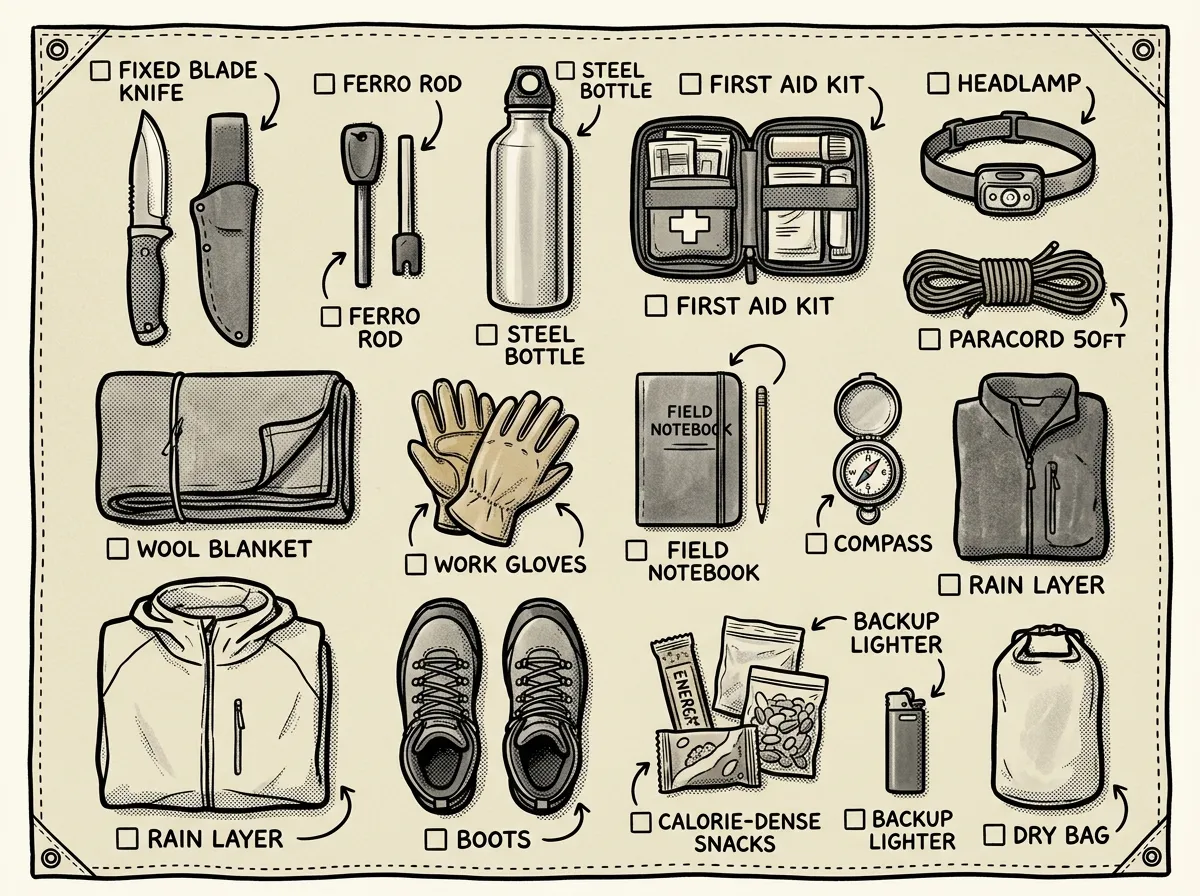 Essential gear laid out for your first survival skills camp weekend
Most camps send a detailed gear list after registration, but here’s a baseline packing list that covers the essentials for a typical weekend outdoor survival course:
- Fixed-blade knife (Mora Companion or similar)
- Ferrocerium rod fire starter
- 32-oz water bottle (stainless steel preferred)
- Weather-appropriate layering system — base, mid, outer
- Sturdy, broken-in hiking boots
- Sleeping bag rated 10°F below expected nighttime lows
- Ground pad or sleeping mat
- Small day pack (25–35L)
- Compass and regional topo map
- Headlamp with fresh batteries and a spare set
- Cordage — 50 feet of paracord minimum
- Personal first aid kit with medications
- Weatherproof notebook and pencil
Always confirm what’s provided and what you need to bring. Some wilderness survival camps supply specialty items like tarps, cooking vessels, or trapping materials. Others expect you to arrive fully self-sufficient.
The Cost Question: What’s a Fair Price for a Survival Skills Camp?
Let’s talk money directly, because survival camp pricing is all over the map.
Weekend courses from established schools typically range from $200 to $500, and are often cited as a strong value given how much they can correct in fire craft and shelter building alone. Week-long immersive programs run $800 to $2,500 depending on the school, location, and curriculum depth. Military-style tactical survival training programs for civilians tend to hit the upper end of that range.
Is it worth the money? If the program is legitimate — yes. Think of it this way: a single course corrects years of bad habits, builds genuine field confidence, and gives you a skill set that doesn’t expire, break, or run out of batteries. That’s a better return on investment than most gear purchases.
But don’t stretch your budget for the most expensive option assuming it’s the best. Some of the most skilled instructors charge moderate rates because they’re focused on teaching, not building a lifestyle brand. Check the curriculum, the credentials, and the reviews. Price alone tells you almost nothing.
Survival Camp for Teens and Families
If you’re looking at a survival skills camp for your kids or as a family experience, the evaluation process is mostly the same — with a few important additions.
Make sure the program has age-appropriate safety protocols. Teen programs should have higher instructor ratios (6:1 or better) and structured risk management. Ask whether instructors have background checks and pediatric first aid training.
Most teen wilderness survival camps accept ages 12–17, though some programs set the floor at 14 for more intensive courses. A few important questions to ask: can teens attend adult courses with a parent or guardian? What’s the screening process? A handful of adult programs allow this, but most recommend purpose-built teen tracks where instruction pacing is calibrated differently.
Programs worth looking at for teens and families: Camp Tonkawa runs primitive survival camps specifically designed for teens that emphasize hands-on earth skills. Camp Rockmont offers a wilderness skills track (their “Backwoods Survival Skills Adventure”) that’s been running for years with solid safety infrastructure. Whitewater Center’s survival camp programs offer shorter family-accessible formats.
Family programs work best when they separate age groups for skill blocks but bring everyone together for group challenges. This lets teens develop real autonomy — making their own fire, building their own shelter — while younger family members get properly scaled instruction.
Teens who attend well-run primitive skills programs, like Camp Tonkawa’s two-week course, often come back with visible confidence — not the “I watched a cool video” kind, but demonstrated ability, such as reliably completing a hand-drill fire start soon after returning home. That’s a skill plenty of adults can’t pull off reliably. It sticks because they failed at it repeatedly in camp, got coached through the mechanics, and eventually succeeded under real conditions.
Before booking a teen or family camp, assess your teen’s readiness honestly. Can they handle 8+ hours outdoors? Follow safety instructions independently without constant reminders? Manage physical discomfort without shutting down? If the answer to all three is yes, they’ll thrive. If not, consider shorter introductory programs first. And if a teen or family camp doesn’t provide a detailed safety plan and emergency evacuation procedure upon request, that’s a hard pass. Legitimate programs are proud of their safety protocols and share them readily.
How to Continue Building Skills After Your First Camp
Here’s where most people drop the ball. They attend a great survival skills camp, ride the high for a few weeks, and then six months later can’t remember whether the shiny side of the tinder bundle faces up or down. Survival skills are perishable. Without practice, they decay — fast.
A post-camp routine helps keep skills sharp between courses. Here’s what to include:
Weekly practice (30–60 minutes): Pick one perishable skill and drill it. Friction fire is the obvious one — if you can start a bow drill fire in your backyard reliably, you can do it in the field. Rotate through fire starting methods, knot tying, and cordage making. These are skills that degrade fastest without repetition.
Monthly overnight solo trips: Take what you learned at camp and apply it in real conditions. Build your shelter. Purify your water. Cook over a fire you started. One overnight trip per month — even at a local campground if that’s what’s accessible — keeps the full skill chain active. You’ll notice gaps quickly when you’re the only one doing everything.
Join a local group: Bushcraft meetup groups, preparedness networks, and prepper communities exist in most regions. Training with others introduces the social problem-solving element that solo practice misses. You’ll also pick up techniques and regional knowledge from experienced locals.
Return for intermediate or advanced courses within 6–12 months: Your first camp builds the foundation. A second course — ideally at the next tier — reinforces it and expands your range. The progression from beginner to intermediate at the Pathfinder School, for example, is dramatic. What took you hours in the first course becomes second nature by the second.
Keep a field journal: After every practice session and every trip, write down what worked, what didn’t, and where you felt rusty. This isn’t busy work — it’s a diagnostic tool. When you can see that your shelter building is solid but your navigation skills have slipped, you know exactly where to focus next.
Skill decay is real and it’s humbling. Going even a few months without practicing friction fire can mean the difference between getting an ember in under five minutes and struggling for forty-five. Regular maintenance practice is what keeps core skills at “reliable under stress” rather than “technically once learned.”
Can You Get Certified at a Survival Skills Camp?
Yes — several programs offer certifications upon completion of advanced courses. The Pathfinder School has a well-known certification track that progresses from Basic to Advanced to Master. Some programs offer instructor certification pathways if you’re interested in eventually teaching survival skills yourself.
That said, certification in wilderness survival isn’t regulated the way medical or engineering certifications are. There’s no single governing body. The value of a certification depends entirely on the reputation of the issuing school. A Pathfinder School or BOSS certification carries weight because the programs are rigorous and well-known. A certificate from an unknown weekend camp doesn’t mean much.
If instructor certification interests you, look for programs that require demonstrated field competency, multiple course completions, and apprenticeship hours — not just a fee and a written test.
Frequently Asked Questions
What skills do you learn at a survival camp?
A quality survival skills camp teaches the core five: shelter construction, fire starting (multiple methods), water procurement and purification, food gathering (foraging, trapping, fishing basics), and land navigation. Most programs also cover wilderness first aid, knot tying, tool making, and situational awareness. The depth depends on course length — a weekend covers fundamentals while a week-long immersive goes significantly deeper into each skill area.
How long is a typical survival skills camp?
Courses range from single-day workshops (6–8 hours) to month-long immersive programs. The most common formats are weekend courses (2–3 days) and week-long courses (5–7 days). Three days is generally considered the minimum for meaningful skill retention. Anything shorter is an introduction — valuable, but not enough time for repetition and overnight application.
Do you need prior experience for a survival camp?
No. Beginner-level courses assume zero prior experience and build from the ground up. In fact, starting at the beginner level is often recommended even if you’ve been practicing skills on your own, because formal instruction corrects habits you don’t know you have. Your existing survival knowledge gives you a head start, but it doesn’t replace structured feedback from a qualified instructor.
What is the difference between bushcraft and survival training?
Survival training focuses on short-term emergency scenarios — staying alive until rescue or self-recovery. It emphasizes improvisation, rapid decision-making, and core life-sustaining skills under pressure. Bushcraft training focuses on longer-term wilderness living — crafting tools, building semi-permanent shelters, processing natural materials into functional items. Both share foundational skills like fire and shelter, but the mindset and time horizon differ. For preppers, it’s generally recommended to start with survival training and add bushcraft skills afterward.
Can you get certified at a survival skills camp?
Yes, some programs offer certification tracks. The Pathfinder School’s progression from Basic to Advanced to Master is one of the most recognized in the field. BOSS and other established programs also issue completion certifications at advanced levels. Keep in mind that wilderness survival certification isn’t regulated by a central authority — the certificate is only as credible as the school behind it. Look for programs requiring demonstrated field competency, not just attendance.
Making Your Decision: A Survival Skills Camp Is the Best Investment You’ll Make
You’ve done the research. You’ve identified programs in your region or in terrain that matches your needs. Now it’s decision time.
Ask yourself three questions. First: does the curriculum cover the skills I actually need for my environment and experience level? Second: do the instructors have verifiable, real-world credentials — not just social media followings? Third: will I get enough hands-on repetition to build actual skill, or is this mainly a demonstration with some audience participation?
If the answer to all three is yes, book it. Stop overthinking it. The single biggest mistake isn’t choosing the wrong survival skills camp — it’s endlessly researching and never actually going. Every week you spend comparing programs is a week you could’ve spent building skills that might genuinely save your life or your family’s.
The wilderness doesn’t care how many articles you’ve read. It cares whether you can build a shelter before dark, get a fire going in the rain, and make smart decisions when you’re cold and exhausted. A good survival skills camp is where that capability gets built — not on your couch, and not on your phone. Pick one that meets the criteria in this guide. Go. Build a practice routine when you get home. Then go back for the next level. That cycle — train, practice, advance — is what separates people who know about survival from people who can actually do it.
Last updated spring 2026.
The Complete
Prepper's Reference.
149 articles synthesized into one comprehensive PDF — twelve chapters covering water, food, shelter, first aid, comms, and scenario-specific preparedness. Free with your email.
Unsubscribe anytime · We never share your email
You're in. Check your inbox.
Keep Reading
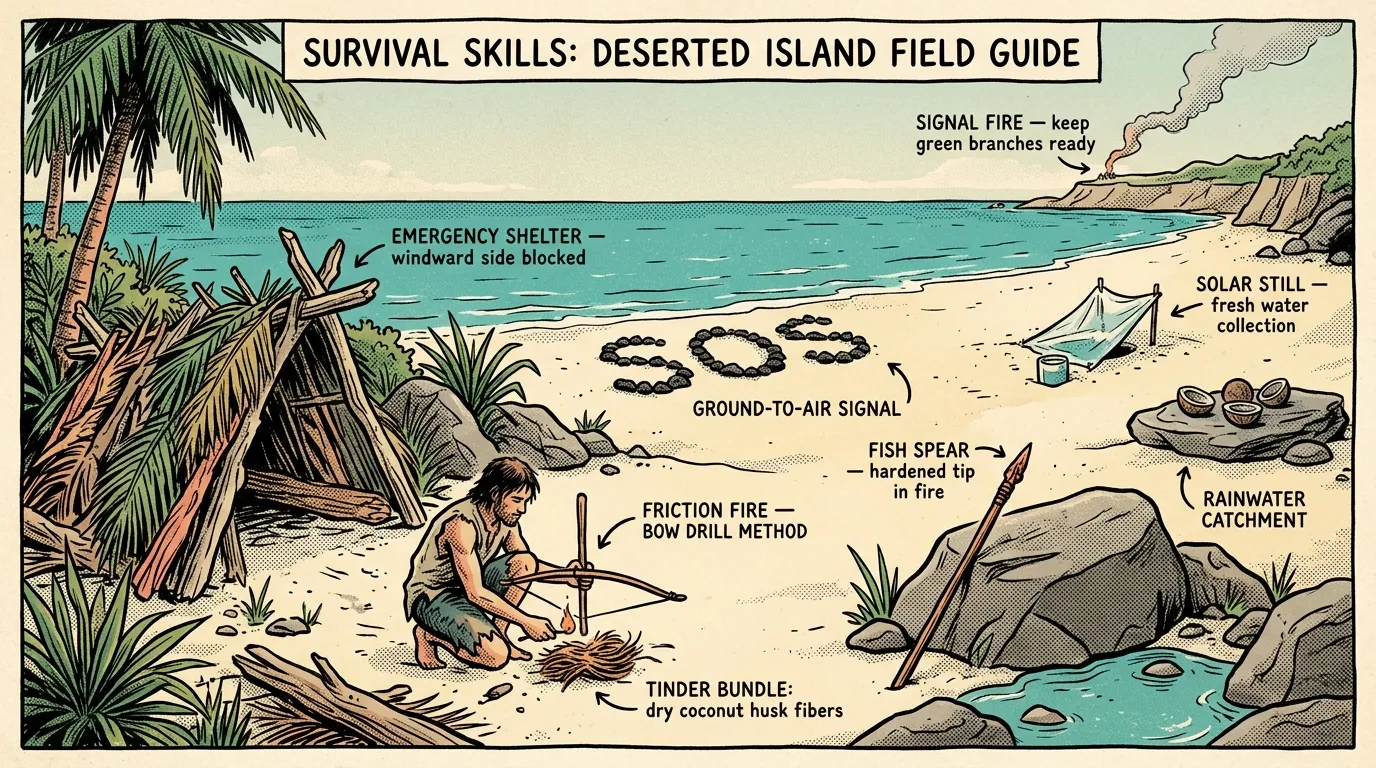
Survival Skills on a Deserted Island: Field Guide
Master survival skills on a deserted island — water, shelter, fire, food, and rescue signaling. Start learning now.
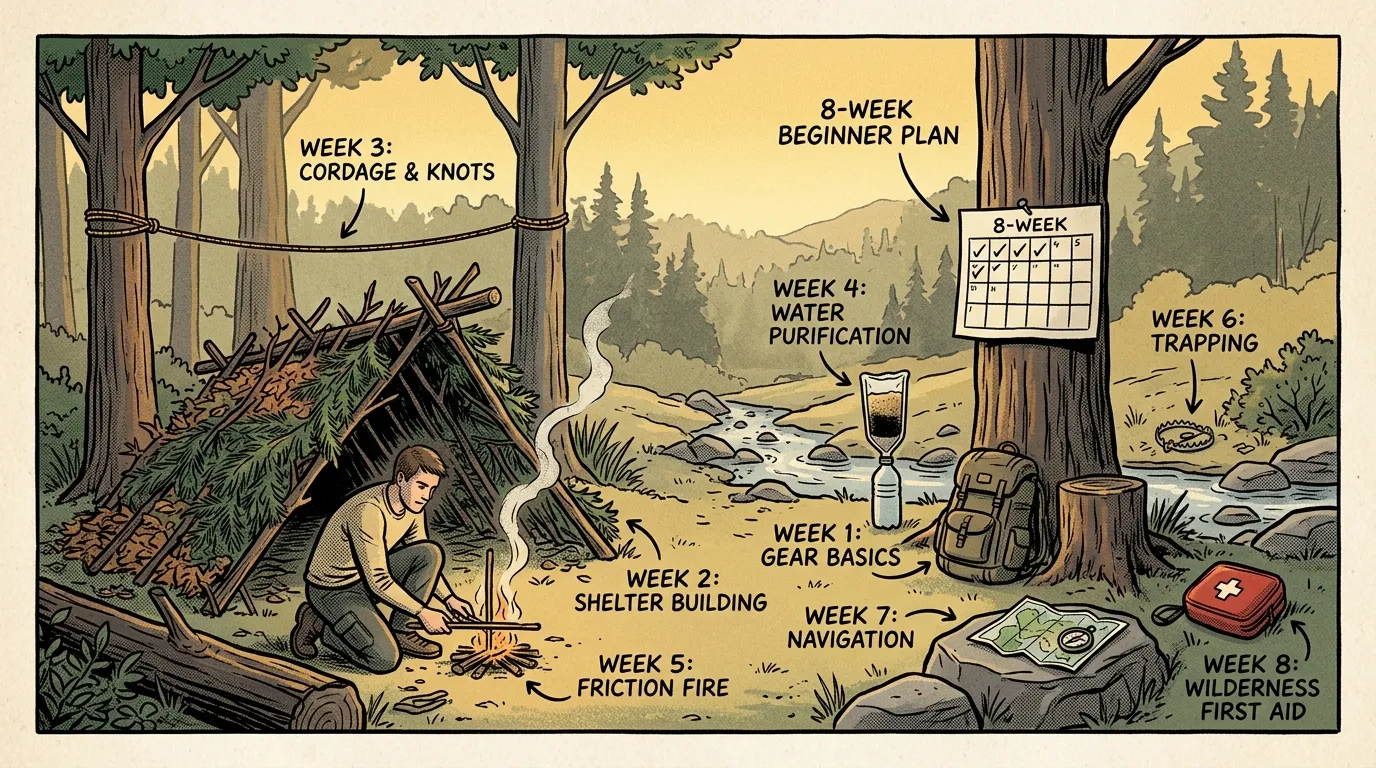
Survival Skills Training: 8-Week Plan for Beginners
Follow this 8-week survival skills training plan to master shelter, fire, water, navigation & first aid. Start this weekend.
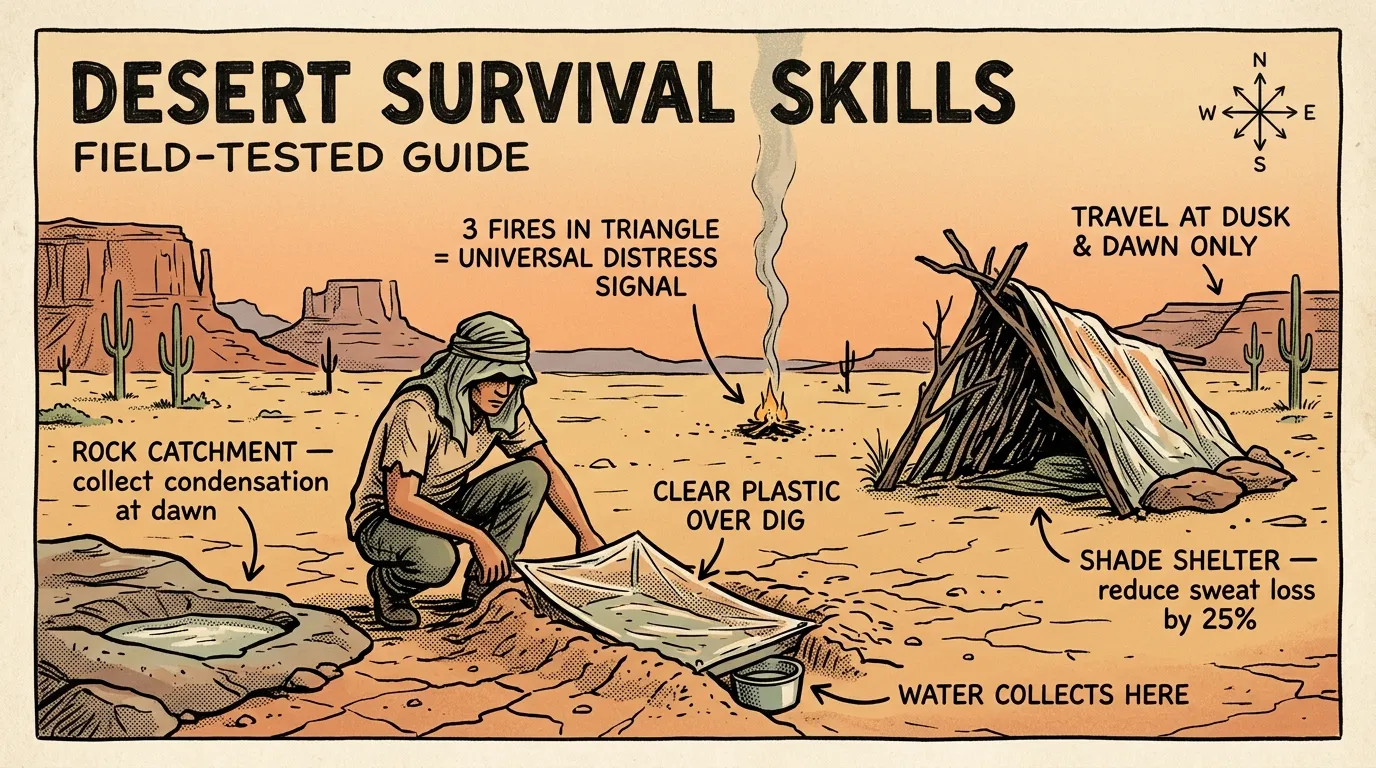
Desert Survival Skills: A Complete Guide
Master 12 essential desert survival skills — water finding, heat management, shelter, and navigation. Start preparing now.