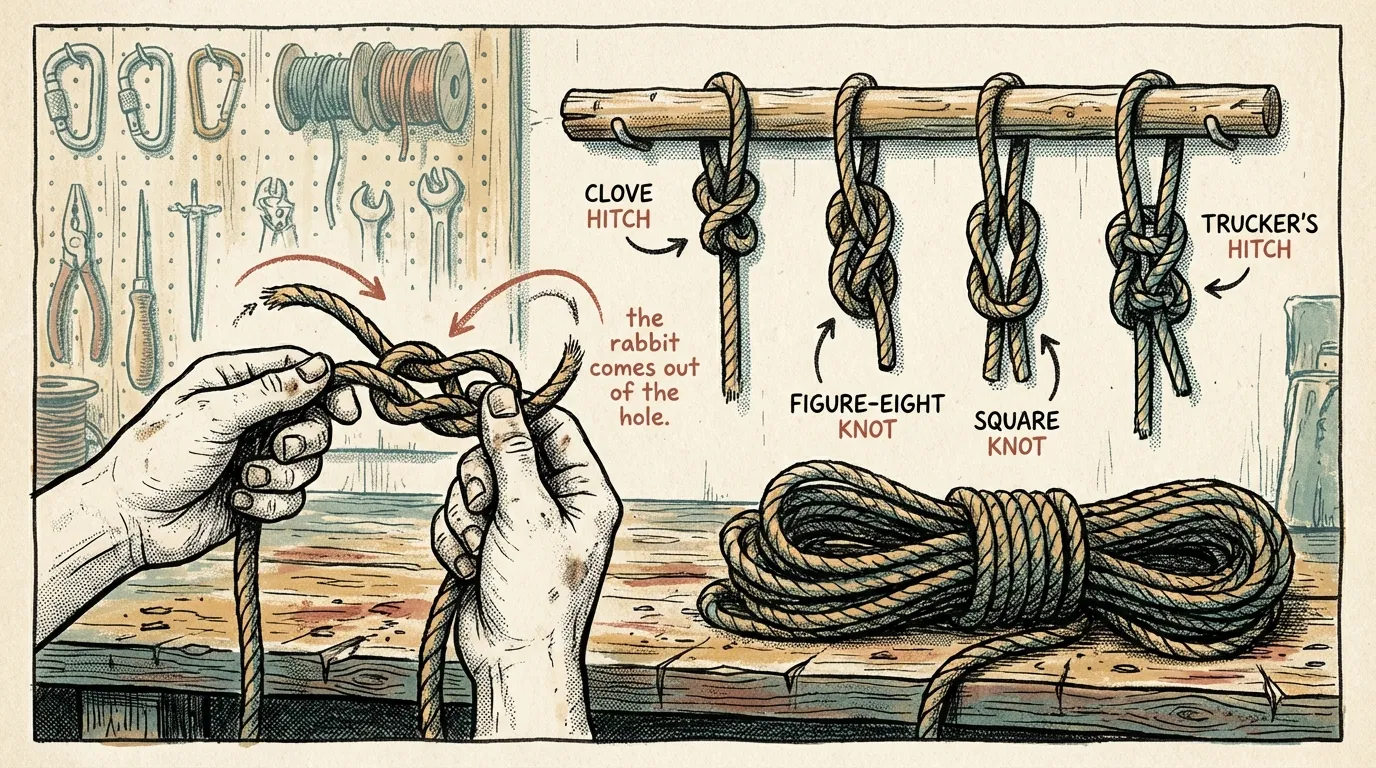
Beginners should start with the square knot, bowline, and clove hitch because they cover bundling, fixed loops, and attaching rope to posts or poles. Knot tying is useful in everyday tasks like securing loads and hanging gear, and in emergencies for shelter building, hauling, and gear management.
Key Takeaways
- Learn square knot, bowline, and clove hitch before attempting any other knots.
- Practice each knot 5 to 10 minutes daily rather than in long infrequent sessions.
- Carry 6 to 10 feet of paracord and a laminated guide card in your kit.
- Assign one specific job per knot: bundles, fixed loops, and post attachments respectively.
- Get certified training before using any knot for rescue, medical, or life-safety tasks.
Knot Tying for Beginners: Essential Knots for Everyday and Emergency Use
Quick answer: Learn three knots: square knot, bowline, and clove hitch. Practice short, frequent sessions with the cordage you plan to use.
Summary: knot tying for beginners delivers practical skills for tasks like securing loads, building shelters, and hanging gear. Learn a few reliable knots, practice them until comfortable, and choose the right knot for each job. For any life-safety, medical, or rescue use, get formal training and certified equipment.
Key definitions
- Knot: an arrangement of rope to join, secure, or stop motion of a line.
- Hitch: a knot that attaches a rope to an object and depends on that object to hold.
- Bend: a knot that joins two ropes.
- Dress a knot: arrange parts neatly so loads distribute correctly.
- Set a knot: tighten it under load so it will hold.
- Tail / tag end: the free end after tying. Leave an adequate tail.
Quick start: three knots every beginner should learn
If you learn only three knots, start with these.
- Square knot, for bundling and light bindings. Do not use for heavy or life-safety loads.
- Bowline, for a fixed, non-jamming loop used in anchors, hauling, and ridgelines.
- Clove hitch, for fast attachment to posts or branches and for starting lashings.
Practice each knot under light tension and with the cordage you will use in the field.
At-a-glance reference
| Knot | Best for | Avoid for | Quick tying summary |
|---|---|---|---|
| Square knot (reef) | Bundling similar-diameter lines | Life-safety, heavy loads | Right over left, then left over right; dress and tighten |
| Bowline | Fixed loop that does not jam | Slippery cordage without a backup | Make a loop, thread end through, around standing part, back through |
| Clove hitch | Quick attachment to post or branch | Long-term or cyclic loads without backup | Wrap, cross, wrap, tuck under last wrap |
| Taut-line hitch | Adjustable tension for guy lines | Critical life-safety use without backup | Sliding hitch for adjustable tension |
| Figure-eight (stopper) | Prevents rope pulling through holes | As a primary bend | Form a figure-8 with the working end |
| Sheet bend | Join two ropes, especially different diameters | High-dynamic loads without dressing | Form a bight in the larger rope, pass the smaller rope through and around |
Detailed knot instructions
Square knot (reef knot)
Best for bundling similar-diameter lines, packages, and rolls when loads are light. Avoid using a square knot for life-safety or where slipping is dangerous.
How to tie:
- Hold one end in each hand.
- Cross the right end over the left and tuck it under.
- Cross the left end over the right and tuck it under.
- Dress and tighten.
If the knot looks twisted or asymmetric, you likely made a granny knot. Untie and try again.
Bowline
Use a bowline to make a fixed loop that holds shape and is easy to untie after loading. Back it up on slippery cord.
How to tie:
- Form a small loop in the standing part.
- Pass the working end up through the loop.
- Wrap it around the standing part and back through the loop.
- Dress neatly before loading.
Memory aid: “The rabbit comes out of the hole, goes around the tree, and back into the hole.”
Clove hitch
Use a clove hitch for quick attachment to a post, rail, or branch and for starting lashings. Add a backup for cyclic or long-term loads.
How to tie around a post:
- Wrap once around the post.
- Cross over the standing part and wrap again.
- Tuck the working end under the last wrap and tighten.
Honorable mentions (learn these next)
- Taut-line hitch, for adjustable tension on tents and tarps.
- Figure-eight stopper, to prevent rope from pulling through openings.
- Sheet bend, to join two ropes of different diameters.
Further reading: Ashley Book of Knots, scouting manuals, International Guild of Knot Tyers.
Why learn knot tying for beginners
Use knot skills to:
- Secure loads in vehicles and trailers.
- Hang lanterns, food bags, or tools.
- Build temporary shelters and ridgelines.
- Lash gear or create simple haul loops.
- Create basic first-aid improvisations, not medical procedures.
Skill usefulness varies by context. Formal training and certified gear are required for rescue and medical tasks.
Knot tying in emergency scenarios
Shelter: use a bowline for anchor loops, clove hitch for attachment points, and a taut-line for adjustable tension.
Evacuation and gear security: lash items to packs, secure loads, and keep critical gear organized.
Safety: do not rely on knots alone for life-safety tasks without training and appropriate hardware. Always back up important knots.
Common beginner mistakes and fixes
- Wrong knot for the job. Learn one primary use per knot.
- Tying too loosely. Dress, set, and test under a light load.
- Too short a tail. Leave adequate tag ends and back up when needed.
- Practicing with unsuitable cordage. Start with paracord or medium rope; slightly thicker rope can make crossings easier to see.
- Memorizing motions without context. Practice knots while doing real tasks.
Practical practice tips
- Use mnemonics such as the bowline rabbit story.
- Assign one job to each knot: square knot for bundles, bowline for loops, clove hitch for posts.
- Short, frequent sessions work best. Five to ten minutes daily beats a long rare session.
- Carry a small kit: 6 to 10 feet of cord, a laminated guide, or flash cards.
- Learn visually with step-by-step diagrams and slow-motion videos.
Practice plan (step-by-step)
- Get a 6 to 10 foot length of paracord or medium rope.
- Practice square knot, bowline, and clove hitch until you can tie each in under a minute.
- Use each knot in a real task: bundle wood, hang a lantern, secure a tarp.
- Add the taut-line hitch, figure-eight stopper, and sheet bend to your toolkit.
- For rescue or medical use, get certified training.
FAQ
Q: What is the most useful knot for beginners?
A: The bowline. It makes a secure, non-jamming loop. Together with the square knot and clove hitch, it forms a solid starter toolkit.
Q: How long to learn basic knots?
A: You can pick up three knots in an afternoon. Retention depends on how often you practice.
Q: Is paracord good for learning knots?
A: Yes. Paracord is portable and durable. Some people prefer slightly thicker rope to make crossings easier to see.
Q: Can knot tying help in emergencies?
A: Yes. Knots help with shelter, securing gear, and hauling. Combine knot skills with formal training and certified equipment for medical or rescue tasks.
Notes and safety
These notes do not replace formal training for life-safety, rescue, or medical applications. Timelines for learning vary by learner.
Knot tying for beginners pays off with a small time investment. Focus on a few versatile knots, practice deliberately, and expand your toolkit as confidence grows.
The Complete
Prepper's Reference.
149 articles synthesized into one comprehensive PDF — twelve chapters covering water, food, shelter, first aid, comms, and scenario-specific preparedness. Free with your email.
Unsubscribe anytime · We never share your email
You're in. Check your inbox.
Keep Reading
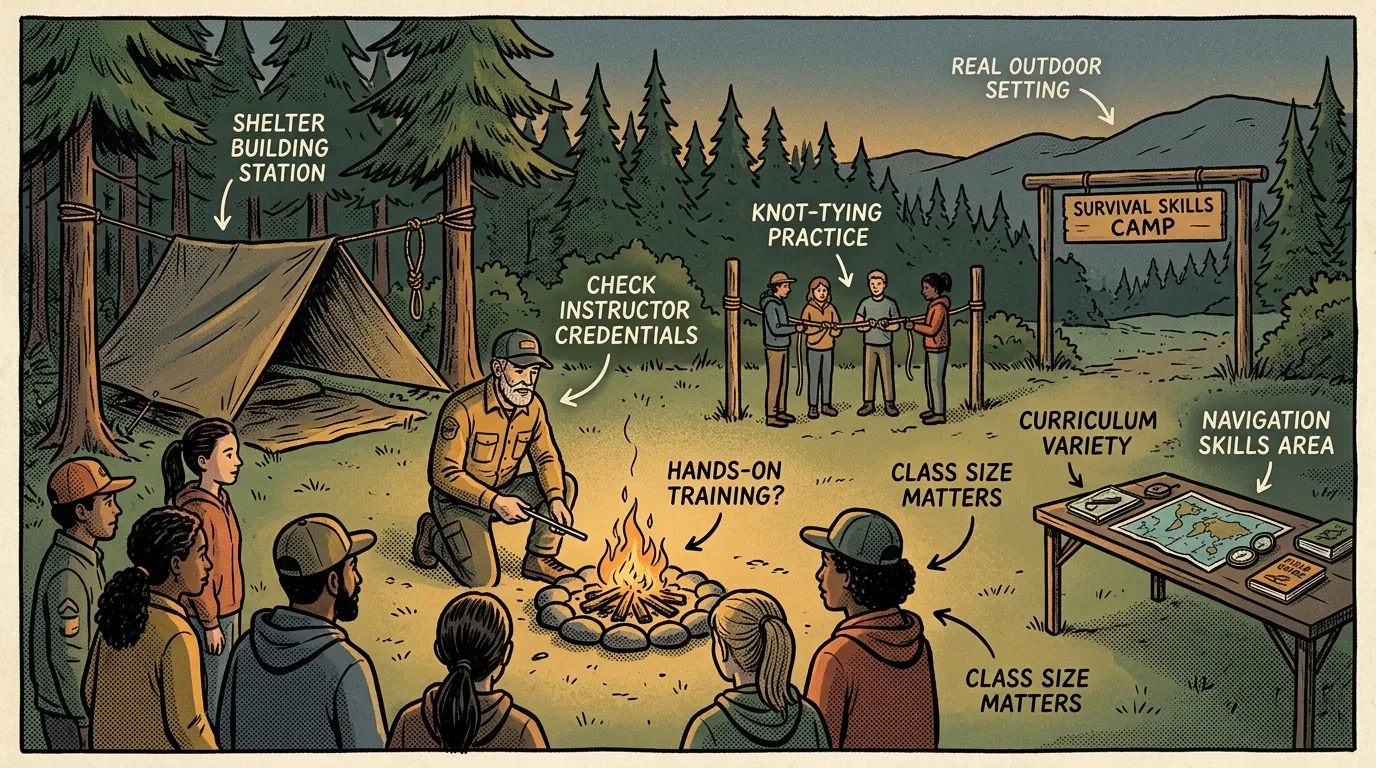
Survival Skills Camp: How to Choose the Right One
Choosing a survival skills camp? Here's what to look for, red flags to avoid, and what real training teaches you.
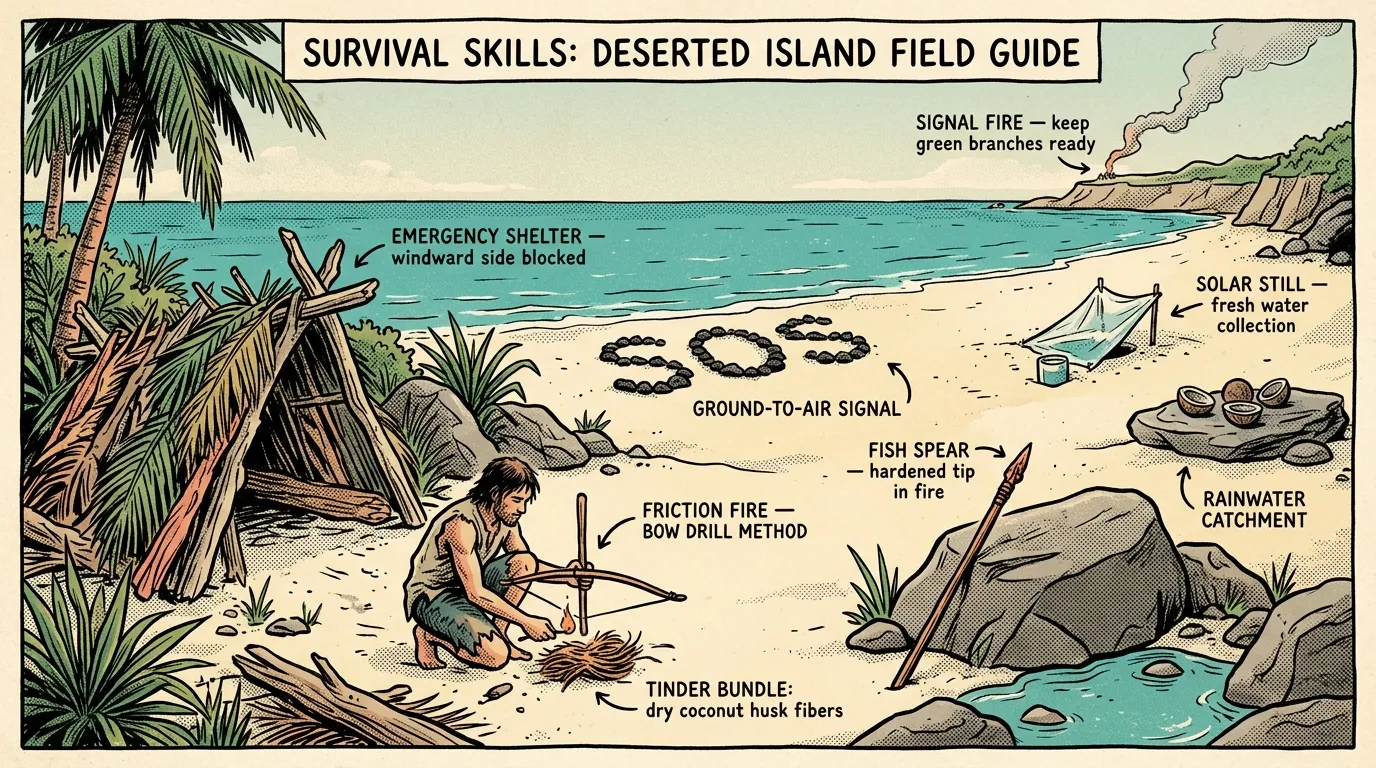
Survival Skills on a Deserted Island: Field Guide
Master survival skills on a deserted island — water, shelter, fire, food, and rescue signaling. Start learning now.
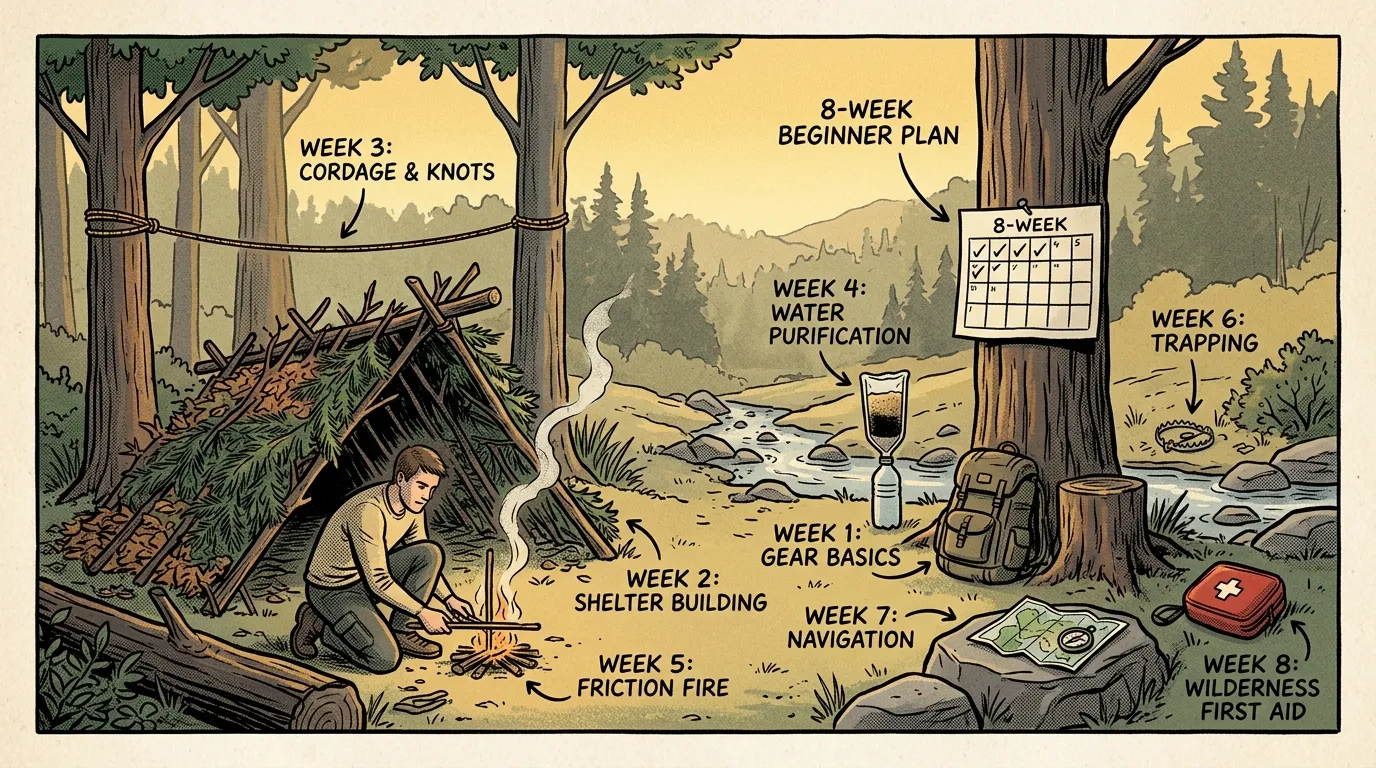
Survival Skills Training: 8-Week Plan for Beginners
Follow this 8-week survival skills training plan to master shelter, fire, water, navigation & first aid. Start this weekend.