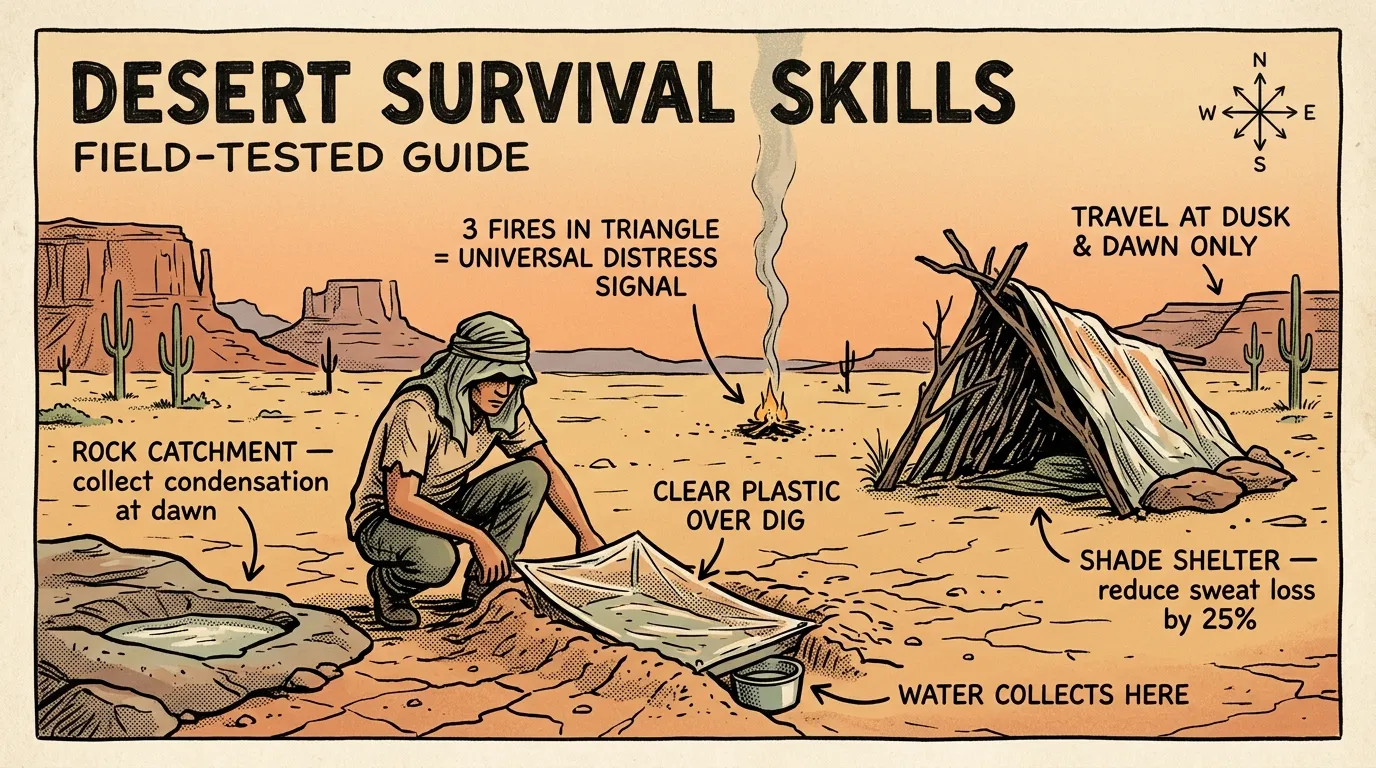
This article teaches essential desert survival skills including water procurement, heat management, shelter building, navigation without landmarks, and heatstroke prevention — all drawn from firsthand field experience in arid environments across the American Southwest.
Key Takeaways
- Carry a minimum of 2 liters of water per person and budget up to 2 gallons per day during summer desert travel
- Stay with your vehicle if stranded — it provides shade, signaling surfaces, and is far easier for SAR teams to spot
- Keep all skin covered with loose, light-colored clothing to reduce both sun exposure and moisture loss
- The 3-3-3 survival rule compresses to under 24 hours for water in desert heat — assume you have less time than you think
- Build or find shade before doing anything else — direct solar radiation can trigger heatstroke within hours
- Pack a sub-3-pound desert survival kit in your vehicle permanently — the checklist in this guide covers everything you need
Desert emergencies rarely announce themselves with drama — often it comes down to simple arithmetic. Underestimating water needs by even a couple of liters on a hot afternoon can leave someone unable to think clearly enough to read a compass. That’s the reality behind desert survival skills.
The desert is a different animal from temperate forests. It doesn’t just test your skills — it tests your physiology. And it does it fast.
Surveys say the average American thinks they could survive 16 days alone in the wilderness. In the desert? Most people without preparation would be in serious medical trouble within the first day. That’s not fear-mongering. That’s thermodynamics.
Here’s what you actually need to know.
Quick Summary
- Dehydration can become life-threatening in under 24 hours during peak desert heat — water is your first priority, always
- Shade is shelter. You don’t need a cabin; you need to get out of direct solar radiation
- Keep your skin covered even when it feels counterintuitive — exposed skin loses moisture faster
- Navigate using terrain association, not landmarks — the desert doesn’t give you many reference points
- The 3-3-3 survival rule compresses hard in arid environments — assume you have less time than you think
- A basic desert survival kit weighing under 3 lbs can triple your odds — here’s exactly what to carry
- Stay with your vehicle if stranded — SAR teams find cars far faster than people on foot
Essential Desert Survival Skills You Need
The essential skills you need to survive in the desert are:
- Water procurement and conservation — Finding, collecting, and rationing water is your single most critical skill since dehydration becomes life-threatening within hours, not days.
- Shade and shelter building — Blocking direct solar radiation prevents heatstroke and dramatically reduces your body’s water consumption.
- Heat illness recognition and treatment — Knowing the difference between heat exhaustion and heatstroke — and how to treat both — can save your life or a companion’s.
- Desert navigation — Using sun tracking, shadow sticks, star navigation, and terrain association to maintain orientation in featureless landscapes.
- Signaling for rescue — Deploying mirror flashes, ground-to-air signals, and vehicle-based signaling to make yourself findable.
- Mental discipline and panic management — Applying structured decision-making frameworks like STOP (Stop, Think, Observe, Plan) to prevent impulsive, fatal choices.
- Clothing and exposure management — Keeping all skin covered with loose, light-colored layers to slow moisture loss and prevent severe sunburn.
- Fire craft for desert nights — Building fire for warmth when temperatures plummet 40°F+ after sunset, and for signaling rescue aircraft.
Each of these desert survival skills gets detailed treatment below. Master them before you need them.
Why the Desert Is a Unique Survival Environment
You might be thinking: “Survival is survival. What makes sand and heat so different?” Everything.
In a temperate forest, you’ve got water sources within a mile or two in most directions. You’ve got shade canopy. You’ve got insulation material on the ground. The desert strips all of that away and replaces it with conditions that actively work against your body’s cooling systems.
Your body cools itself through sweat evaporation. In dry desert air, sweat evaporates so fast you don’t even realize how much fluid you’re losing. It’s common for people to look bone-dry while already a liter into dehydration. There’s no visible warning.
And then there’s the terrain. Open expanses, minimal vegetation, blinding reflected light. Navigation gets harder. Shelter options shrink. Wildlife shifts to nocturnal patterns, which means the things that can hurt you — scorpions, rattlesnakes, Gila monsters — come out when you’re trying to rest.
It’s also worth understanding that not all deserts behave the same. The Sonoran Desert around Phoenix has saguaro cacti and monsoon thunderstorms. The Great Basin high desert of eastern Oregon and Nevada features sagebrush flats with bitter winter cold. The Mojave is the classic hot-and-dry environment most people picture. Your survival strategies need to flex based on the specific arid climate you’re operating in — but the fundamentals of water, shade, and signaling remain universal.
You’re fighting the clock from the moment you’re stranded.
Water: Your Single Most Critical Desert Survival Skill
Let’s not dance around it. Water is the whole ballgame. Every other desert survival skill exists to either help you find water or reduce how much water your body burns through.
How Much Water You Actually Need
The standard guidance says one gallon per person per day. In the desert during summer? That’s a minimum. Moderate activity in peak summer heat can burn through a gallon and a half of water in a single afternoon. If you’re exerting yourself — hiking out, building shelter, signaling — budget two gallons per day.
In the desert, you don’t ration water. You ration sweat.
That’s a critical distinction. Don’t sip water to make it last — that’s a recipe for a slow decline into heat exhaustion. Drink what you need, and focus your energy on reducing how much you need.
Finding Water in Arid Terrain
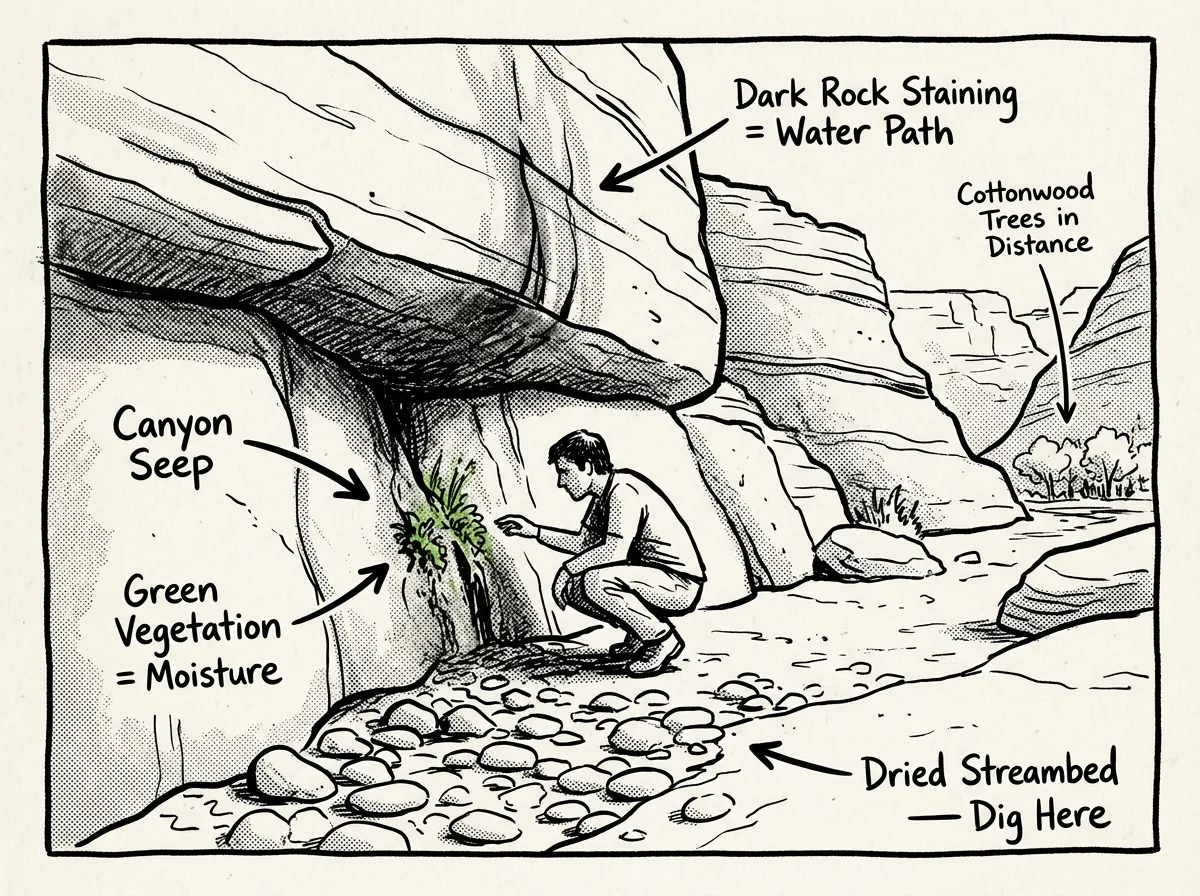 Reading the landscape for hidden water sources in arid terrain
So what happens when your supply runs out? Here’s where desert survival skills get real.
- Look for green vegetation — cottonwoods, willows, and cattails indicate water at or near the surface
- Check the base of canyon walls and cliff faces for seeps, especially on north-facing slopes where evaporation is slower
- Dig in the outside bends of dry streambeds — water collects in the gravel 1-2 feet down
- Watch animal behavior at dawn and dusk — birds and insects converge on water sources
- Look for dark stains on rock faces that indicate seasonal water flow paths
A common mistake is walking right past water indicators while looking for a stream or a pond. In the desert, water hides. You might need to dig for it. You might find it as a thin film on a rock face at sunrise before the sun burns it off.
If you’re in the high desert of the Great Basin — eastern Oregon, Nevada, northern Utah — look for springs mapped on USGS topo maps before you head out. Download those maps offline using apps like Gaia GPS or Avenza Maps. Springs that look like nothing on the map can be literal lifesavers.
Solar Stills: Real Talk
You’ll see solar still diagrams in every desert survival guide ever written. Dig a hole, put a container in the center, cover with plastic, put a rock on top. In theory, condensation drips into the container.
Under near-ideal conditions — moist ground after recent rain — a solar still typically yields only a few hundred milliliters of water over several hours, roughly a cup. The energy spent digging the hole can cost more water in sweat than the still produces. Solar stills work in textbooks, but in a real scenario they’re a supplement at best — never a primary water strategy. That energy is better spent looking for seeps and shade instead.
Shelter and Shade: Your Second Priority
Can’t you just tough it out in the sun? No. Direct solar radiation in the desert can raise your core temperature faster than your body can compensate. Heatstroke — where your body’s thermoregulation fails completely — can set in within hours.
Building Shade When There’s Nothing Around
You don’t need a tent. You need to block the sun and get airflow underneath.
If you’ve got a vehicle, stay with it. This is the number one piece of advice every search and rescue team will give you — and vehicle-specific strategies are covered in detail below. Your car provides shade, reflective surfaces for signaling, and a much larger search target than your body.
No vehicle? Here’s what you do:
- Rock overhangs and shallow caves are your best natural option. Check for wildlife before settling in — and stay out of abandoned mine shafts, which are common across the Southwest. The BLM estimates there are over 500,000 abandoned mines in the western U.S., many with unstable floors and toxic air pockets.
- A trench dug 18 inches deep in sandy soil puts you below the worst of the radiant ground heat. Ground surface temps can exceed 150°F while air temperature three feet up is 110°F.
- Any fabric — a space blanket, tarp, or even a shirt stretched between rocks — creates shade. Double-layer if possible with an air gap between layers for insulation.
If you’re using a reflective space blanket for shade, put the reflective side UP to bounce solar radiation away. Most people instinctively put it shiny-side down, which traps heat underneath.
Clothing Strategy
Here’s where your instincts will betray you. You’ll want to strip down. Don’t.
Loose, light-colored clothing covering your entire body reduces both solar radiation hitting your skin and evaporative water loss. Think long sleeves, long pants, a wide-brim hat or improvised head covering, and something over the back of your neck. Bedouin desert cultures figured this out thousands of years ago. It works.
Change your socks if you can. Moisture buildup in boots creates blisters fast, and in a survival scenario, blisters on your feet can become a genuine mobility crisis.
Desert Survival Skills for Vehicle Breakdowns
Let me be direct: the most common real-world desert emergency isn’t a backcountry hiking accident. It’s a vehicle breakdown on a remote road. And the most common fatal mistake is leaving the vehicle.
Search and rescue statistics consistently show that teams find vehicles far faster than individuals on foot. Your car is a large, reflective, uniquely shaped object visible from aircraft and high ground. You, walking across open desert, are a speck.
The Stay-or-Go Decision Framework
Stay with your vehicle unless:
- You can see a confirmed, occupied structure within walking distance (not “I think that’s a building” — heat shimmer plays tricks)
- Your vehicle is in imminent danger (fire, flash flood zone filling with water)
- You have confirmed communication that rescue is not coming and you have a specific, navigable route to safety with adequate water
In every other scenario, your car is your survival base.
Turning Your Vehicle Into a Survival Station
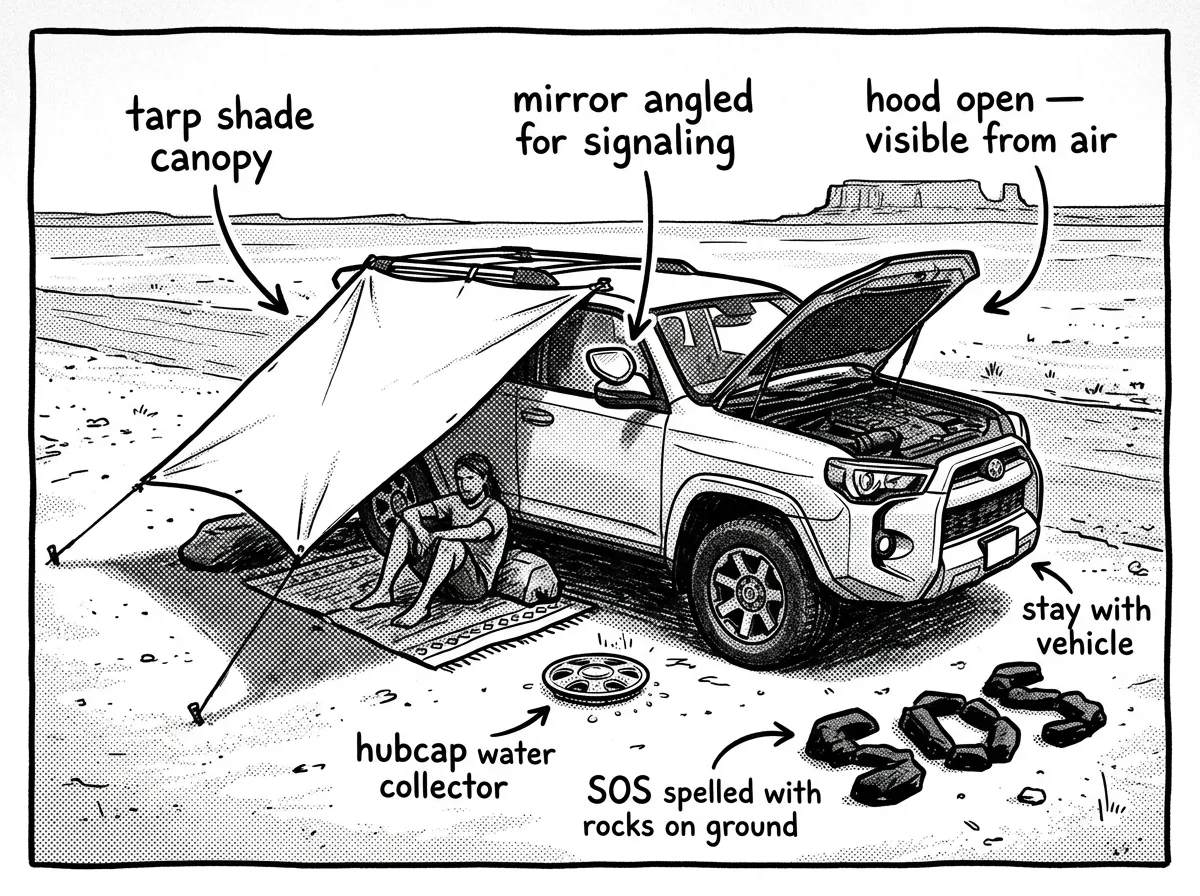 Converting a stranded vehicle into an improvised desert survival station
Shade extension: Pop the hood and trunk to create shade wings on both sides of the vehicle. Pull out floor mats, trunk liners, and seat covers to drape over windows or extend your shade footprint. If you have a tarp or emergency blanket in your kit, rig it off the vehicle’s roof rack or door frames.
Signaling: Your side mirrors can be removed and used as signal mirrors — far more effective than improvised options. At night, your headlights are visible for miles. Turn them on periodically if the battery holds. The hood, propped up, is a universal sign of distress.
Water inventory: Check every compartment. The bottom of a cooler, half-empty bottles rolling under seats, ice melt in a thermos — people often find a surprising amount of liquid they’d forgotten about. Your windshield washer fluid is not drinkable — it’s toxic methanol.
Ventilation: Never sit in a sealed car in desert heat. Open doors or windows for cross-ventilation, and sit in the shade beside the vehicle rather than inside it during peak hours. The interior of a closed car in direct sun can exceed 170°F.
Your car overheats on a remote stretch of highway in southern Nevada. Cell signal is nonexistent. It’s 2 PM in July, 108°F. You’ve got a half-liter water bottle, a cotton hoodie, and whatever’s in the car. The nearest town is 23 miles. Walking there will kill you — at 1.5 liters of sweat loss per hour, you’d be critically dehydrated before covering a quarter of the distance. Staying put, managing your shade and water, and signaling passing vehicles is your survival plan. Wait for cooler temperatures if you must eventually move — travel at dawn, dusk, or night only.
The urge to walk out is overwhelming. Resist it. File a trip plan with someone before every desert drive, including your route, expected return time, and number of people. The best rescue is one that’s already looking for you.
Recognizing and Treating Heat Illness
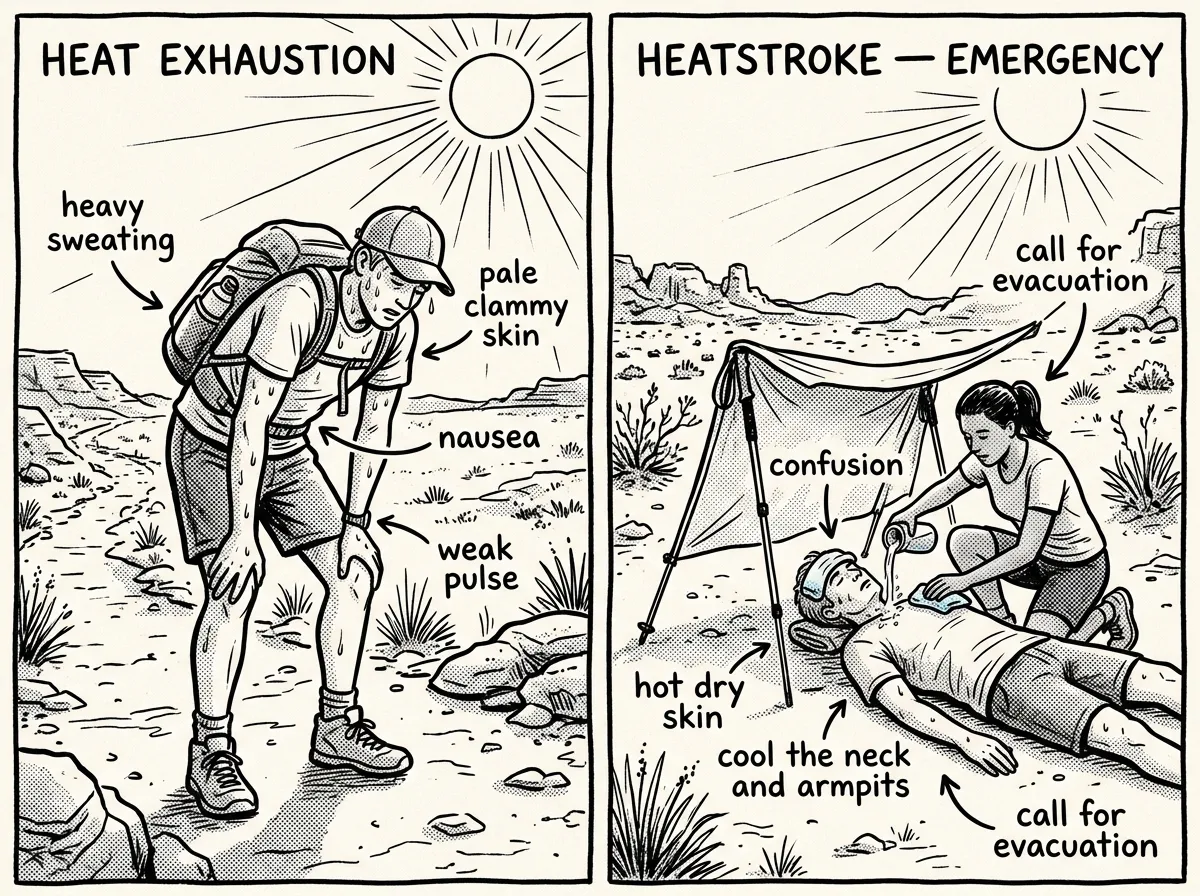 Recognizing the progression from heat exhaustion to heatstroke in the field
Heat illness operates on a spectrum, and you need to catch it early.
Heat exhaustion shows up as heavy sweating, weakness, cold or clammy skin, nausea, and a fast but weak pulse. You’re still sweating, which means your body is still trying. Get into shade, sip water, loosen clothing.
Heatstroke is the emergency. Sweating stops. Skin turns hot and dry. Core temperature rockets past 104°F. Confusion, loss of consciousness, seizures. This kills people. If someone in your group hits this stage, you need to cool them aggressively — wet their clothing, fan them, get them into any shade available — and get evacuation moving immediately.
Early heatstroke signs — confusion, hot dry skin, rapid pulse — can progress from “something seems off” to a medical emergency in as little as 20 minutes. The wet-clothing-and-fan method can help drop core temperature before evacuation. In group settings, check on every member every 30 minutes rather than waiting for someone to complain — by the time symptoms are reported, a person may already be past the point of self-reporting accurately.
Heatstroke prevention comes down to three things: stay hydrated, stay shaded, and stay still during peak heat hours (10 AM to 4 PM). If you must work or move, do it in 15-minute intervals with rest breaks in shade. Wet your clothing if you have water to spare — evaporative cooling on fabric is more efficient than sweating through skin.
Navigation Without Landmarks
Desert navigation is brutally hard. You don’t have tree lines, ridgelines, or water features to orient from. Everything looks the same — and heat shimmer makes it worse by distorting distance perception. Objects appear closer than they actually are; a mesa that looks two miles away can turn out to be seven.
Basic Desert Navigation Techniques
Sun tracking is your simplest tool. The sun rises roughly east, sets roughly west. At midday, shadows point north in the Northern Hemisphere. That’s crude but enough to maintain a general bearing.
Shadow stick method: Push a stick into the ground and mark the tip of its shadow. Wait 15 minutes. Mark the new shadow tip. A line between the two marks runs roughly east-west, with the first mark being west.
Star navigation works beautifully in the desert because you’ve got zero light pollution. Find Polaris (the North Star) by following the two “pointer stars” at the end of the Big Dipper’s cup. Polaris sits almost exactly above true north.
Terrain Association: The Desert-Specific Skill
In the desert, terrain features are your landmarks. Learn to read them:
- Washes and dry streambeds generally flow downhill toward larger valleys and, eventually, roads or settlements. Following a wash downhill is often your best navigation strategy if you must move.
- Alluvial fans — the fan-shaped gravel deposits at canyon mouths — tell you where canyons open onto flats. They’re identifiable on topo maps and from a distance.
- Buttes, mesas, and distant mountain profiles serve as fixed reference points. Pick one and keep it at a consistent angle to your direction of travel to maintain a bearing.
One effective backtracking method: mark your back-trail with small rock cairns every 200 yards. Three stones stacked is enough to spot on the return. It takes seconds and can prevent disorientation when heat shimmer and visual monotony start blurring everything together.
Digital Backup
Before any desert trip, download offline topographic maps to your phone using Gaia GPS or Avenza Maps. Your phone’s GPS chip works without cell service — it reads satellite signals directly. Keep your phone in airplane mode to conserve battery, and carry a small power bank. This digital backup doesn’t replace physical skills, but it’s a powerful layer of redundancy.
But here’s what actually saves most people: don’t navigate blind if you don’t have to. Stay put. Signal. Make yourself visible. A mirror signal flash can be seen 10+ miles away in desert conditions. Three of anything — three fires, three rock piles, three whistle blasts — is the universal distress signal.
The Coghlan’s signal mirror — around $8 — weighs nothing and has a sighting hole that makes aiming the flash dead simple. It’s an underrated signaling device.
Your Desert Survival Kit
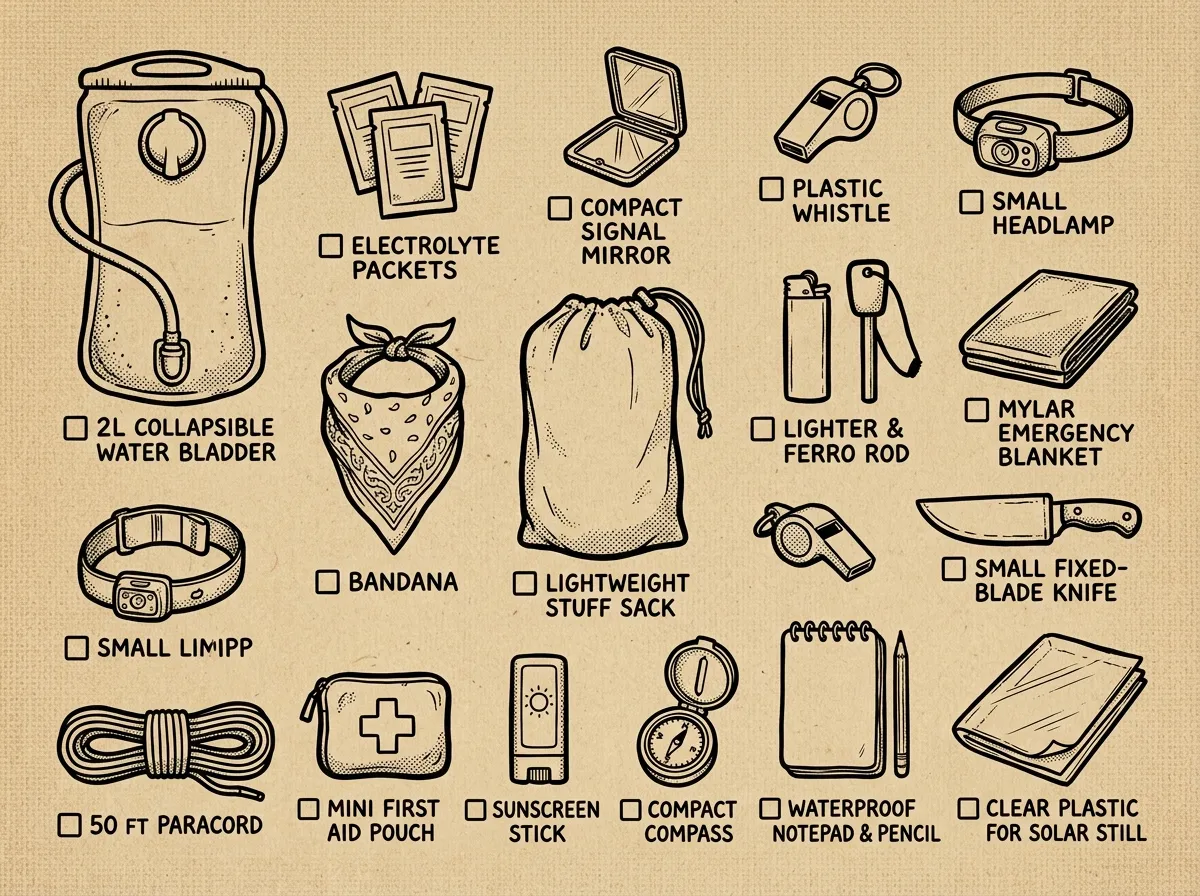 Sub-3-pound desert survival kit — everything you need, laid out
What should you actually carry? Here’s a recommended kit for driving through or hiking in arid terrain.
- 2+ liters water per person (minimum — more in vehicle)
- Reflective space blankets (x2) — shade and signaling
- Signal mirror with sighting hole
- Whistle (Fox 40 — pealess, works when dry)
- Wide-brim hat or shemagh
- Electrolyte packets (not just water — you need salts)
- Compact first aid kit with blister treatment
- Headlamp with fresh batteries (for nighttime movement)
- Lighter and waterproof matches
- USGS topo map of your area (printed, not just digital)
- Small folding knife
- 50 feet of paracord
- Sunscreen SPF 50+
- Protective sunglasses or improvised eye protection
- Bandana or buff (airway protection for dust storms)
The whole kit fits in a small daypack and weighs under three pounds without the water. There’s no excuse not to carry it. Leave it in your vehicle permanently — it’s your insurance policy.
The Sawyer Squeeze — around $30 — is a widely recommended compact filtration option, rated by the manufacturer to remove 99.99999% of bacteria and protozoa. But in the desert, water clean enough to need filtering is often the least of the problem — you’re more likely to find no water at all than contaminated water. A filter still matters when you do find a cattle tank or murky seep, since giardia can turn a bad situation catastrophic. But the bigger investment is carrying more water upfront, not filtration gear.
Mental Discipline: The Skill Nobody Packs
Survival experts consistently point to mental state as the top predictor of who lives and who doesn’t. The desert amplifies this because of sensory deprivation — the monotony of the landscape, the silence, the relentless heat. Your brain starts making bad decisions.
The STOP Protocol
When you first realize you’re in trouble, use the STOP framework:
- S — Stop. Physically stop moving. Sit down if you can.
- T — Think. What are your immediate threats? What resources do you have?
- O — Observe. Look around. What shelter exists? Where is the sun? Do you have water?
- P — Plan. Based on what you know, make a plan. Then work the plan.
This sounds simple. In practice, when your pulse is hammering and the heat is crushing and you’re alone, it’s the hardest thing you’ll ever do. But it’s the difference between a controlled response and a panicked sprint into open desert.
The Psychological Timeline
A consistent psychological pattern emerges among people in extended desert survival scenarios:
- Hour 2: Anxiety peaks. The situation feels real. This is when most impulsive decisions happen — people want to walk out, abandon shelter, “do something.”
- Hour 6: Boredom and restlessness set in. People start rationalizing bad ideas. “It’s not that far.” “I’ll just go look around.”
- Hour 12: Resignation or acceptance. People either settle into a survival rhythm or start to shut down mentally.
- Hour 24: If they’ve managed their resources, most people hit a quiet confidence. They know they can do this.
The gap between hour 2 and hour 12 is where most survival situations are won or lost. Bridge it with structured activity — inventory supplies, improve your shelter, set up signal markers, assign yourself tasks on a schedule.
Breathing Through the Heat
When panic spikes, use box breathing: inhale for 4 seconds, hold for 4, exhale for 4, hold for 4. Repeat for two minutes. This activates your parasympathetic nervous system and physically slows your heart rate. It also forces you to breathe through your nose, which conserves moisture — mouth breathing in dry desert air accelerates dehydration.
The 3-3-3 Rule in the Desert
You’ve probably heard it: 3 minutes without air, 3 days without water, 3 weeks without food. It’s a solid mental framework, but the desert compresses the middle number severely.
In temperatures above 100°F with physical exertion, dehydration can become life-threatening in under 24 hours. Not three days. Not two. One bad afternoon without water and shade can put you in a medical emergency.
That’s why desert survival skills are fundamentally about time compression. Everything happens faster. Dehydration, heat illness, sunburn, decision fatigue — the desert accelerates all of it. Your job is to slow the clock by conserving water, staying in shade, minimizing exertion, and making yourself findable.
Food barely matters in a short-term desert survival situation. Your body can go weeks without calories. It can’t go a day without water in extreme heat. Don’t waste energy hunting or foraging unless you’ve already secured water and shade.
Desert-Specific Hazards Most People Forget
Flash Floods
Sounds absurd in the desert. It’s one of the leading causes of death. A rainstorm 20 miles away can send a wall of water down a dry wash with zero warning. Never camp in a dry streambed or narrow canyon during monsoon season (July through September in the Southwest). If you hear rumbling or see rising water, move to high ground immediately — don’t try to cross.
Hypothermia
Yes, in the desert. Nighttime temperatures in the high desert can plummet 40 degrees or more from daytime highs. If you’re dehydrated and wearing sweat-soaked clothing when the sun drops, hypothermia is a real risk. Those two space blankets in your kit? One is for shade. The other is for warmth after dark. Fire craft becomes critical at night — carry reliable fire-starting tools and gather fuel before sunset.
Venomous Wildlife
Rattlesnakes, scorpions, and spiders are most active at night when ground temperatures drop. Shake out your boots every morning. Don’t reach into rock crevices. Don’t step over logs or rocks without looking at the other side first.
A note on cholla cactus: those “jumping cholla” segments detach at the lightest touch and embed barbed spines deep into skin. Your instinct will be to grab the segment and pull it off. Don’t — you’ll just embed spines in your hand too. Use a comb, two sticks, or a pair of pliers to flick the segment away. Carry a small comb in your kit if you’re in cholla country.
UV Damage and Sand Glare
The desert reflects UV radiation off sand, rock, and light-colored soil — similar to snow glare. Prolonged exposure without eye protection can cause photokeratitis, essentially a sunburn on your corneas. It’s agonizingly painful and temporarily blinding. Always carry sunglasses. In an emergency, you can improvise eye protection by cutting narrow slits in a piece of cardboard, fabric, or duct tape — the same concept as traditional Inuit snow goggles.
Dust Storms and Haboobs
In the Sonoran and Chihuahuan deserts, massive dust storms (haboobs) can appear with startling speed. If you see a brown wall approaching:
- In a vehicle: Pull off the road, turn off headlights (so other drivers don’t follow your taillights into a pileup), set your parking brake, and wait.
- On foot: Get to high ground if possible, turn your back to the wind, cover your nose and mouth with a bandana or shemagh, and protect your eyes. Visibility drops to zero. Don’t try to navigate through it.
Fine particulate inhalation from a dust storm can cause serious respiratory distress, especially if you’re already dehydrated. Keeping a bandana or buff in your desert survival kit costs nothing and could prevent a medical complication.
Desert Survival Skills Checklist: Print-Ready Summary
This is a consolidated reference worth having on hand if stranded. Screenshot it, print it, or save it to your phone.
Pre-Trip Preparation
- File a detailed trip plan with a trusted contact (route, return time, group size)
- Download offline topo maps of your entire route and surrounding area
- Pack your desert survival kit and verify water supply (2 liters minimum per person, far more in vehicles)
- Check weather forecasts for heat advisories, flash flood watches, and dust storm warnings
- Ensure your vehicle is mechanically sound — check coolant, tires, spare, and battery
Immediate Actions If Stranded (STOP Protocol)
- Stop — Don’t move. Sit down.
- Think — Assess immediate threats (heat exposure, water supply, injury)
- Observe — Inventory resources, identify shade, check surroundings
- Plan — Decide whether to stay or move (default: stay with vehicle)
First 6 Hours — Hourly Priorities
- Hour 1: Establish shade. Inventory all water. Deploy signal markers.
- Hour 2: Improve shelter. Ration activity, not water. Begin mental discipline routine.
- Hour 3: Set up secondary signaling (mirror, ground signals, reflective items).
- Hour 4: Rest during peak heat. Minimize all exertion.
- Hour 5: Continue resting. Sip water as needed. Check group members for heat illness.
- Hour 6: Reassess plan. Prepare for evening temperature drop. Gather fire materials if available.
Night Transition Protocol
- Add insulation layer (space blanket, extra clothing) before sunset
- Start fire if fuel is available and you have ignition tools
- Continue signaling — fire is visible for miles at night
- Plan any necessary movement for pre-dawn hours when temperatures are lowest
The single most effective thing you can do before any desert trip is tell someone exactly where you’re going and when you’ll be back. SAR teams save far more lives through timely activation than through advanced wilderness skills. Be findable.
Frequently Asked Questions
What skills do you need to survive in the desert?
You need water-finding skills, the ability to build shade shelter, navigation techniques for featureless terrain, heat illness recognition and treatment, signaling for rescue, and the mental discipline to stay calm and ration energy. Fire-building matters too — desert nights can drop below freezing. The combination of these desert survival skills addresses the two biggest killers in arid environments: dehydration and heat exposure.
What is the 3-3-3 rule in survival?
The 3-3-3 rule states you can survive roughly 3 minutes without air, 3 days without water, and 3 weeks without food. In the desert, that middle number shrinks dramatically. Extreme heat and low humidity can cut your 3-day water window to under 24 hours if you’re exerting yourself in direct sun. This is why every desert survival decision should prioritize water conservation above almost everything else.
What are the 5 most important survival skills?
The five most critical survival skills are water procurement, shelter building, fire craft, navigation, and first aid. In a desert context, water and shelter swap to the top of the list since dehydration and heat exposure are your most immediate lethal threats. Mental discipline could arguably replace any item on that list — without it, the other skills fall apart under stress.
How do you survive in a desert with nothing?
Focus on shade first — find a rock overhang, dig a trench, or use any available material to block direct sun. Minimize movement during peak heat hours (10 AM to 4 PM), breathe through your nose to conserve moisture, and keep all skin covered with whatever clothing or material you have. Look for water in canyon seeps, dried streambeds, and at the base of vegetation. Signal for rescue immediately using any reflective surface, arranged rocks, or three of any signal (fires, piles, sounds). Your priority is being found before your water reserves — both carried and physiological — run out.
The Complete
Prepper's Reference.
149 articles synthesized into one comprehensive PDF — twelve chapters covering water, food, shelter, first aid, comms, and scenario-specific preparedness. Free with your email.
Unsubscribe anytime · We never share your email
You're in. Check your inbox.
Keep Reading
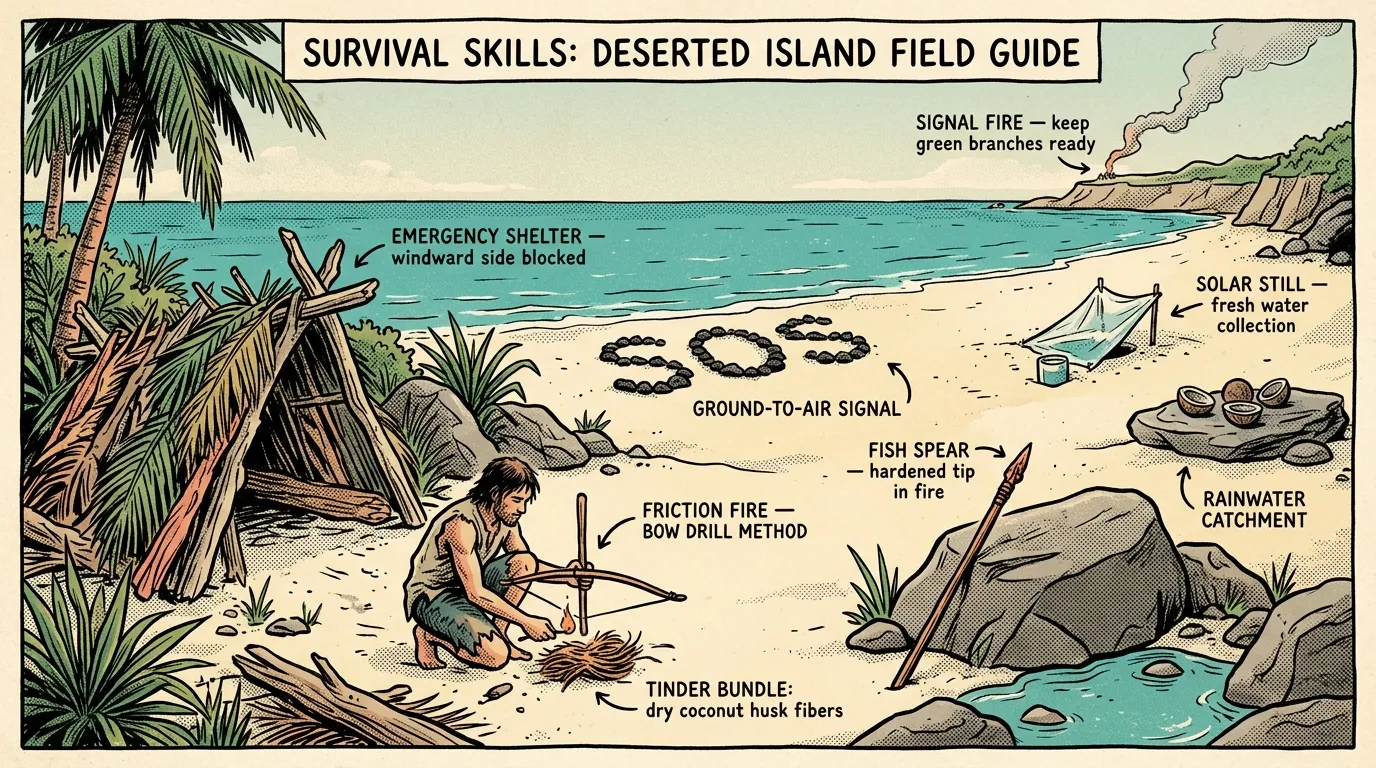
Survival Skills on a Deserted Island: Field Guide
Master survival skills on a deserted island — water, shelter, fire, food, and rescue signaling. Start learning now.
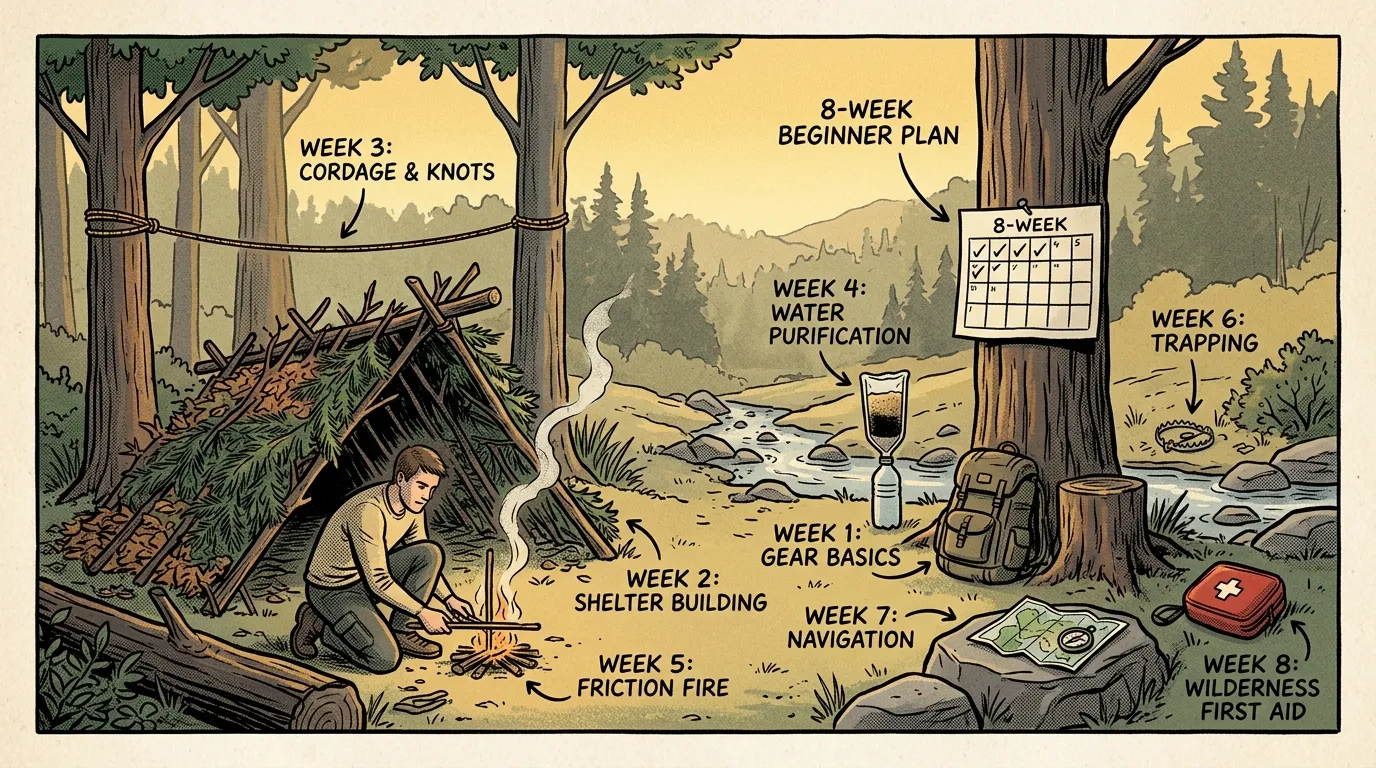
Survival Skills Training: 8-Week Plan for Beginners
Follow this 8-week survival skills training plan to master shelter, fire, water, navigation & first aid. Start this weekend.
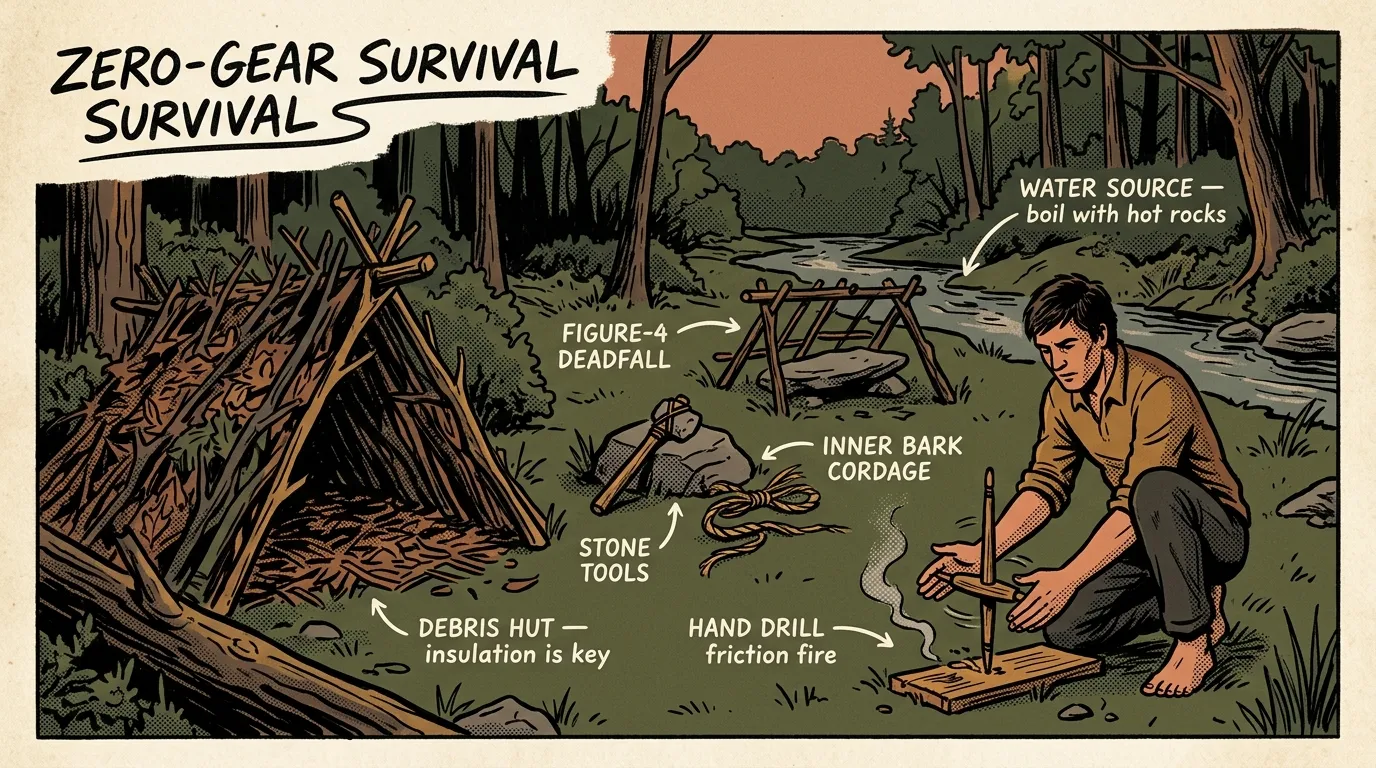
Primitive Survival Skills: Zero-Gear Techniques That Work
Master 10+ primitive survival skills for fire, shelter, water, and tools with zero gear.