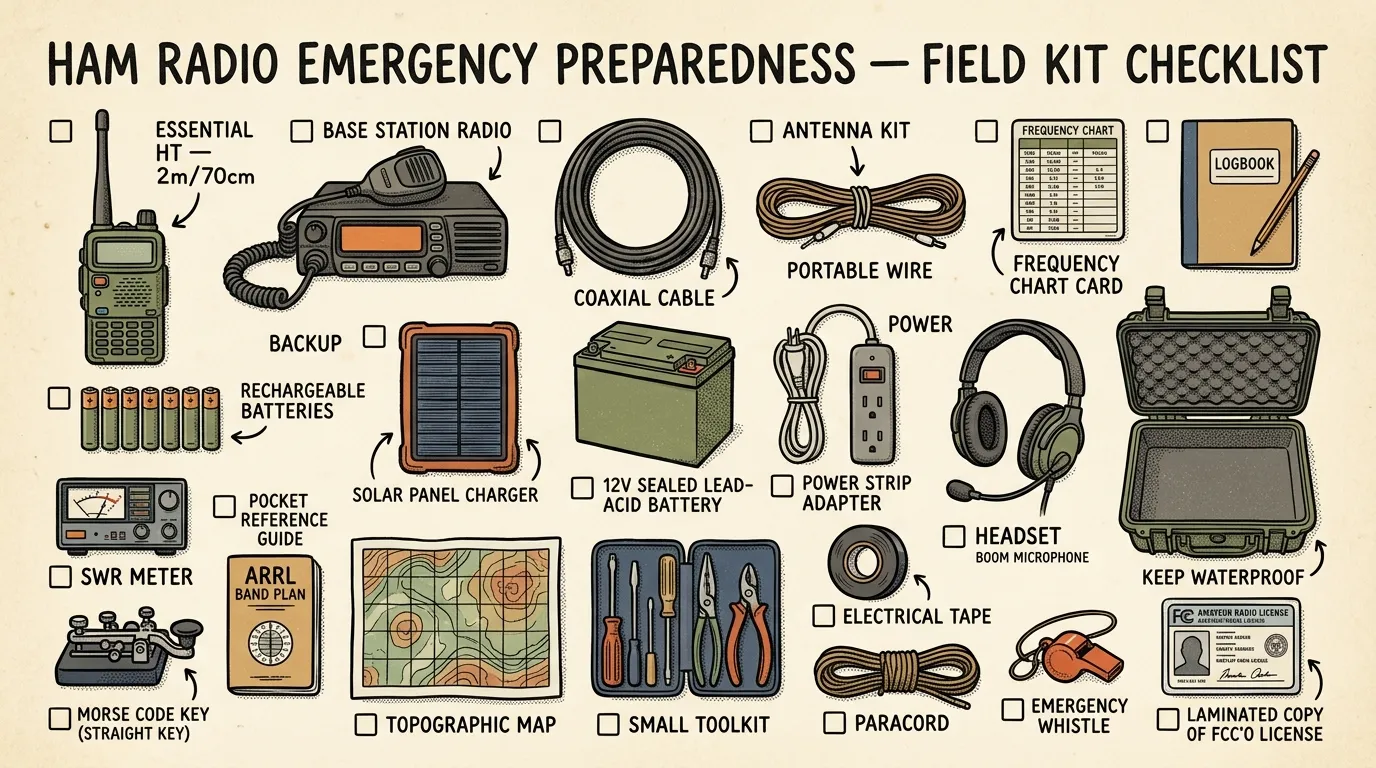
Ham radios are two-way amateur radios that can provide reliable emergency communication when cell networks, internet, and grid power fail. Beginners should start with a basic handheld radio, get an FCC Technician license, learn local repeaters, and practice before an emergency.
Key Takeaways
- Start with a $25–150 VHF/UHF handheld, spare batteries, and a printed repeater list — you can be operationally useful for under $50.
- Get your FCC Technician license in 2–4 weeks of casual study — it's 35 multiple-choice questions and most exams cost $0–15.
- Program 146.520 MHz simplex, your local repeaters, and NOAA weather channels into your radio before any disaster hits.
- Practice weekly on local nets and test your power setup now — gear you haven't used under stress is gear that'll fail you when it counts.
- Join ARES or a local radio club to plug into the organized emergency network that actually gets activated during declared disasters.
Ham Radio Emergency Preparedness: A Field Guide
Cell networks can buckle in ways that surprise most people. During the 2019 Cascadia Rising exercise, which simulated the kind of magnitude-9.0 earthquake that seismologists say is overdue along the Cascadia subduction zone, cell networks were flagged as overwhelmed within the first simulated minutes — completely saturated. An ARES team operating on 2-meter simplex served as the only voice link between three shelters for six straight hours.
That exercise confirmed what disaster preparedness experts have long emphasized: ham radio emergency preparedness isn’t a hobby indulgence. It’s a critical layer in any serious preparedness plan. If you’re working through a beginner’s guide to becoming a prepper, communications should sit near the top of your list, right alongside water, food, and first aid.
This field guide covers real disaster case studies, key frequencies, gear with actual costs, licensing, and a step-by-step plan you can act on this week.
Quick Summary
- Ham radios work when everything else fails — they don’t depend on cell towers, internet, or grid power to function.
- You can get started for under $50 with a Baofeng UV-5R handheld and spare batteries.
- The FCC Technician license takes 2–4 weeks of casual study — it’s 35 multiple-choice questions and most exams cost $0–15.
- Key frequencies to program now: 146.520 MHz national simplex, your local repeaters, and NOAA weather channels.
- Organized networks like ARES and RACES activate during real disasters — joining one plugs you into the system emergency managers actually rely on.
- Practice before the disaster — weekly net check-ins and power-system testing are what separate useful operators from people holding expensive paperweights.
Why Ham Radios Matter When Infrastructure Fails
Here’s the failure chain most people don’t think about until it’s too late:
- Cell towers have battery backup that lasts 8–72 hours. After that, they go dark — and that’s assuming the tower itself isn’t physically damaged by wind, flooding, or seismic activity.
- Landline switches require powered central offices. No grid means no landline.
- Internet needs power at every hop — your modem, the local node, the backbone repeater. One failure in that chain kills the whole connection.
- Network congestion happens within minutes of any major event. After the 2001 Nisqually earthquake in Washington, cell circuits jammed almost instantly.
A handheld transceiver, a charged battery, and knowledge of your local repeater frequencies give you a working voice link when everything else has gone silent.
Amateur radio emergency communication sidesteps all of this. You’re not routing through someone else’s infrastructure. You’re transmitting directly — radio to radio, or radio to repeater to radio. That’s not theoretical. It’s documented history from every major U.S. disaster in the last two decades.
How Ham Operators Have Responded in Real Disasters
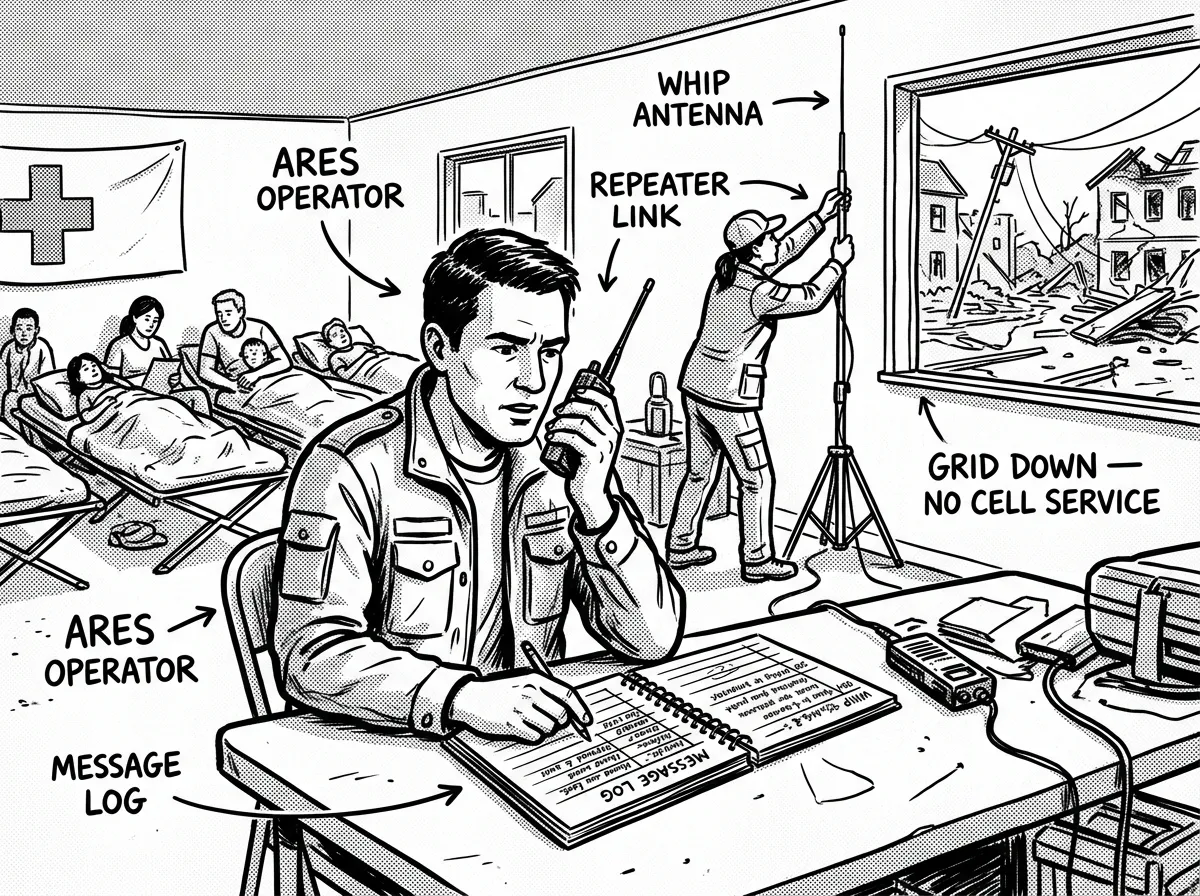 Ham radio operators relaying emergency traffic during a disaster response
The case for ham radio disaster preparedness isn’t speculative. The track record is extensive.
Hurricane Katrina (2005)
When Katrina devastated the Gulf Coast, virtually all commercial communication infrastructure was destroyed across a wide swath of Louisiana and Mississippi. Amateur radio operators provided the only communication link for many communities in the first 72 hours. ARES and RACES volunteers handled thousands of health-and-welfare messages, located stranded survivors, and relayed supply requests to emergency management agencies. The ARRL’s after-action report documented over 1,000 amateur operators who deployed or provided support.
Hurricane Maria (2017)
Puerto Rico lost 95% of its cell sites after Maria. Not for hours — for weeks. Amateur radio was the primary communication link between the island and the mainland United States during that stretch. Operators on HF bands passed critical messages when nothing else worked. The Salvation Army Team Emergency Radio Network (SATERN) and ARRL volunteers coordinated logistics that kept relief flowing.
Joplin Tornado (2011)
The EF5 tornado that struck Joplin, Missouri killed 158 people and flattened entire neighborhoods. ARES operators were on the air within minutes, coordinating shelter locations and medical logistics when the city’s communication infrastructure was destroyed. They provided the backbone that connected volunteer staging areas to incident command.
What This Means for the Pacific Northwest
Modeling of a Cascadia subduction zone earthquake suggests the region could lose communication infrastructure across western Washington and Oregon for days to weeks. Every ham operator who can check into a local net after a quake is one more node in a communication network that emergency managers desperately need.
Ham Radio Emergency Frequencies You Should Know
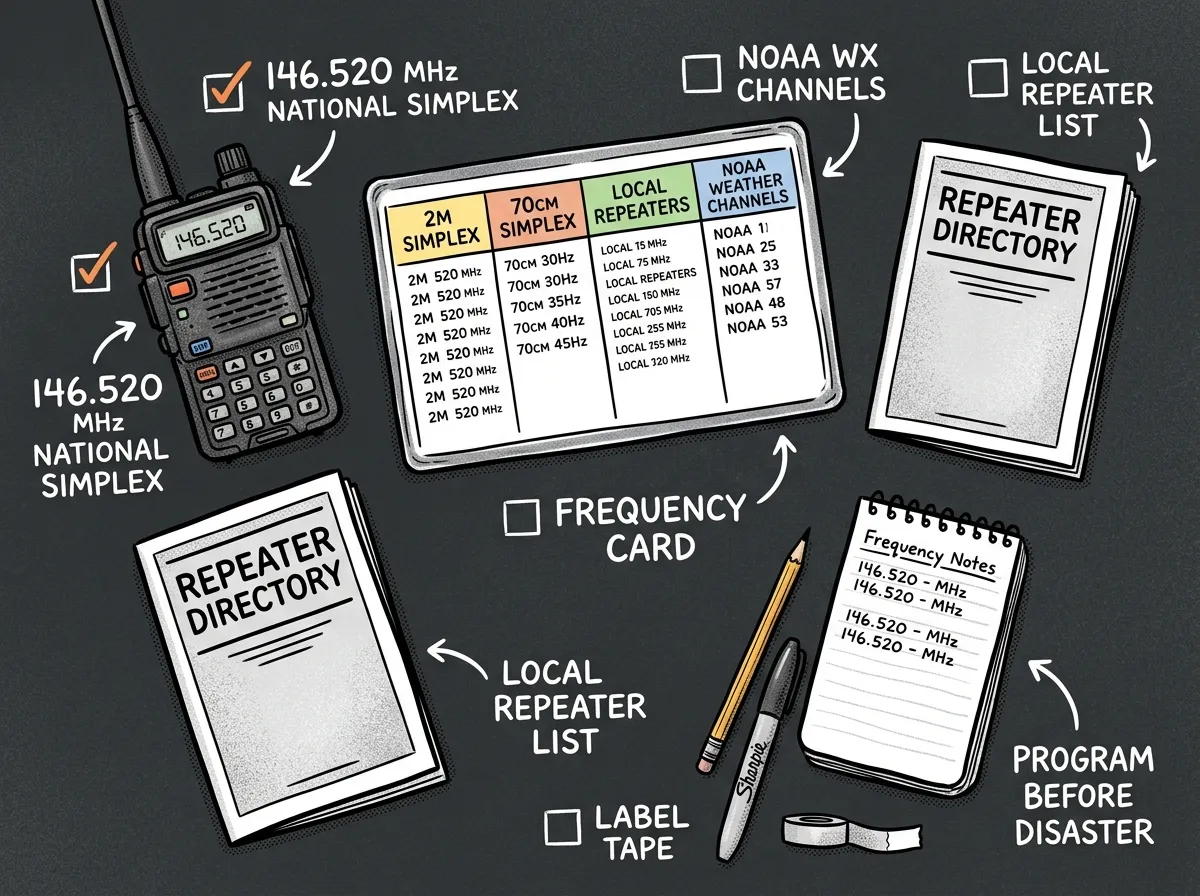 Essential emergency frequencies and channel references for your radio
Which frequencies should you program before a disaster? Here’s your reference table — print this and store it with your radio.
| Frequency | Band/Mode | Purpose |
|---|---|---|
| 146.520 MHz | 2m FM Simplex | National calling frequency — your first stop when repeaters are down |
| 446.000 MHz | 70cm FM Simplex | UHF national simplex calling |
| 7.260 MHz | 40m HF | Health-and-welfare traffic net |
| 14.300 MHz | 20m HF | International emergency net |
| 162.400–162.550 MHz | NOAA Weather | Weather alerts (receive only) |
| Your local repeaters | 2m/70cm | Regional emergency and traffic nets |
Look up your local repeater frequencies on RepeaterBook.com, print the list, and laminate it. Store one copy with your radio and another in your go-bag. Digital infrastructure won’t help you find frequencies after the grid goes down.
It’s also worth learning about Winlink — a system that lets you send and receive email over amateur radio frequencies with no internet connection. During extended outages, the ability to send a short text message to an out-of-area contact is invaluable.
What Is the 3-3-3 Rule for Ham Radio?
The 3-3-3 rule is a prepper community convention for post-disaster communication: monitor channel 3 on CB radio, channel 3 on FRS, at 3-hour intervals starting at the top of the day.
It’s a reasonable starting framework, but it has real limitations. CB and FRS range is short, the convention isn’t universally known, and there’s no guarantee anyone in your area is following it.
Use the 3-3-3 rule as one layer in a broader plan:
- Program your local repeater frequencies as your primary monitoring channels.
- Set 146.520 MHz simplex as your fallback when repeaters are down.
- Monitor NOAA weather frequencies for official alerts.
- Create a family communication plan with specific times, frequencies, and an emergency communication plan for your family that everyone has printed and practiced.
The 3-3-3 rule beats having no plan at all. But a tailored plan built around your local amateur radio emergency networks is far more effective.
Ham Radio vs. FRS vs. GMRS vs. CB: What Do You Actually Need?
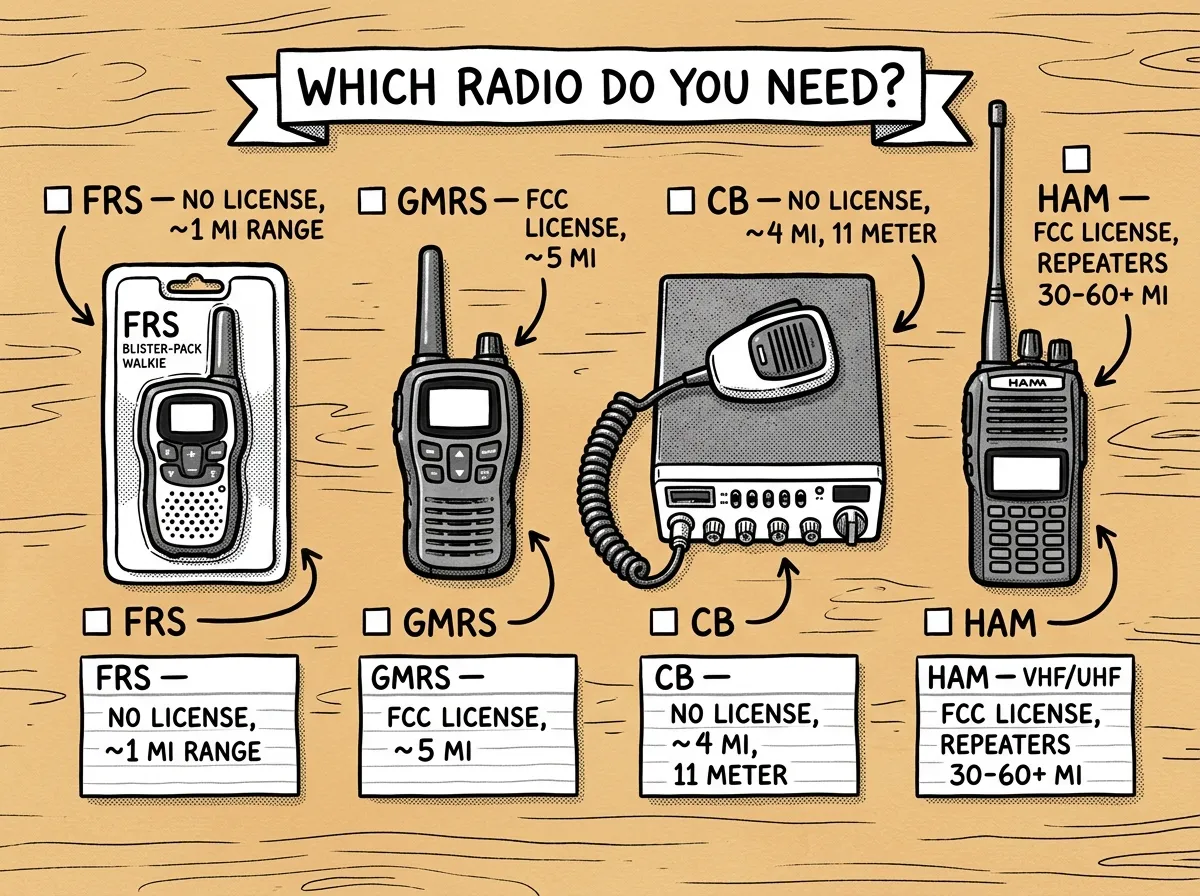 Side-by-side comparison of civilian radio options for emergency use
This is one of the most common questions about emergency radio options. Here’s the honest comparison:
| Feature | Ham Radio (Technician+) | FRS | GMRS | CB |
|---|---|---|---|---|
| License required | Yes (FCC Technician) | No | Yes (FCC, no exam) | No |
| License cost | $0–15 exam fee | Free | $35 for 10 years | Free |
| Typical range | 1–5 mi handheld; 30–60+ mi w/repeater; 100+ mi HF | 0.5–2 miles | 1–5 mi; 15–30+ mi w/repeater | 1–5 miles |
| Repeater access | Yes | No | Yes | No |
| Emergency network integration | Full (ARES, RACES, SKYWARN) | None | Limited | None |
| Power output | Up to 1,500W (HF) | 2W max | Up to 50W | 4W max |
| Entry cost | $25–300 for handheld | $25–50 per pair | $50–150 | $30–80 |
Recommendation: FRS radios work well for close-range family coordination within your household or neighborhood — they’re dead simple and require zero licensing. But for anything beyond a few blocks, ham radio is the clear winner. GMRS sits in the middle and works well for families who want repeater access without studying for a ham exam.
If you’re serious about an emergency ham radio setup as part of your preparedness plan, the Technician license is the entry point that unlocks the most capability for the least investment.
VHF/UHF vs. HF: A Quick Comparison
VHF/UHF is your starting point. Handhelds reach 1–5 miles line-of-sight, and repeaters extend that to 30–60+ miles. It’s what you’ll use for local communication, neighborhood coordination, and shelter-to-shelter links. Equipment runs $25–300 for a handheld.
HF is your next step. It can reach hundreds to thousands of miles depending on solar conditions and antenna setup. That’s where out-of-area liaison, health-and-welfare messages, and long-distance nets happen. Equipment starts around $300 and goes up from there, with larger antennas and higher power requirements.
Start with VHF/UHF. It covers 90% of what you’ll need for local emergency communication. Add HF later when you upgrade to a General license.
Your Practical Starter Plan: Get Useful Fast
- Buy a reliable VHF/UHF handheld with spare batteries and an aftermarket antenna
- Study at hamstudy.org and pass your FCC Technician exam (2–4 weeks)
- Look up local repeaters on RepeaterBook.com, print and laminate the list
- Join a local ARES group or radio club and start checking into weekly nets
- Test your entire power plan — battery runtime, solar charging, vehicle adapter — and document actual numbers
Choosing Your First Radio
Menu systems matter. Build quality matters. Here’s a breakdown by price tier, based on manufacturer specifications and published reviews:
- Budget option ($25–50): Baofeng UV-5R. It’s cheap, widely available, and gets the job done. Battery life is mediocre, so buy extras. Program it with CHIRP software (free) on a computer before you need it.
- Mid-range ($150–200): Yaesu FT-65R. Better receiver, better build quality, easier to program under pressure. This is a solid recommendation for most beginners who want gear that’ll last.
- Premium ($300+): Kenwood TH-D75A. Built-in APRS, excellent receiver, rugged construction. Worth it if you’re serious about ham radio emergency preparedness long-term.
The Yaesu FT-65R (around $150) is frequently recommended as a step up from the Baofeng UV-5R. According to published reviews, its receiver resists overload from strong nearby signals better than typical Baofeng models — a meaningful advantage when operating near a busy repeater site during a real event. If you’re in a dense urban area like Portland or Seattle, the extra cost is generally considered worthwhile.
Building Your Starter Kit
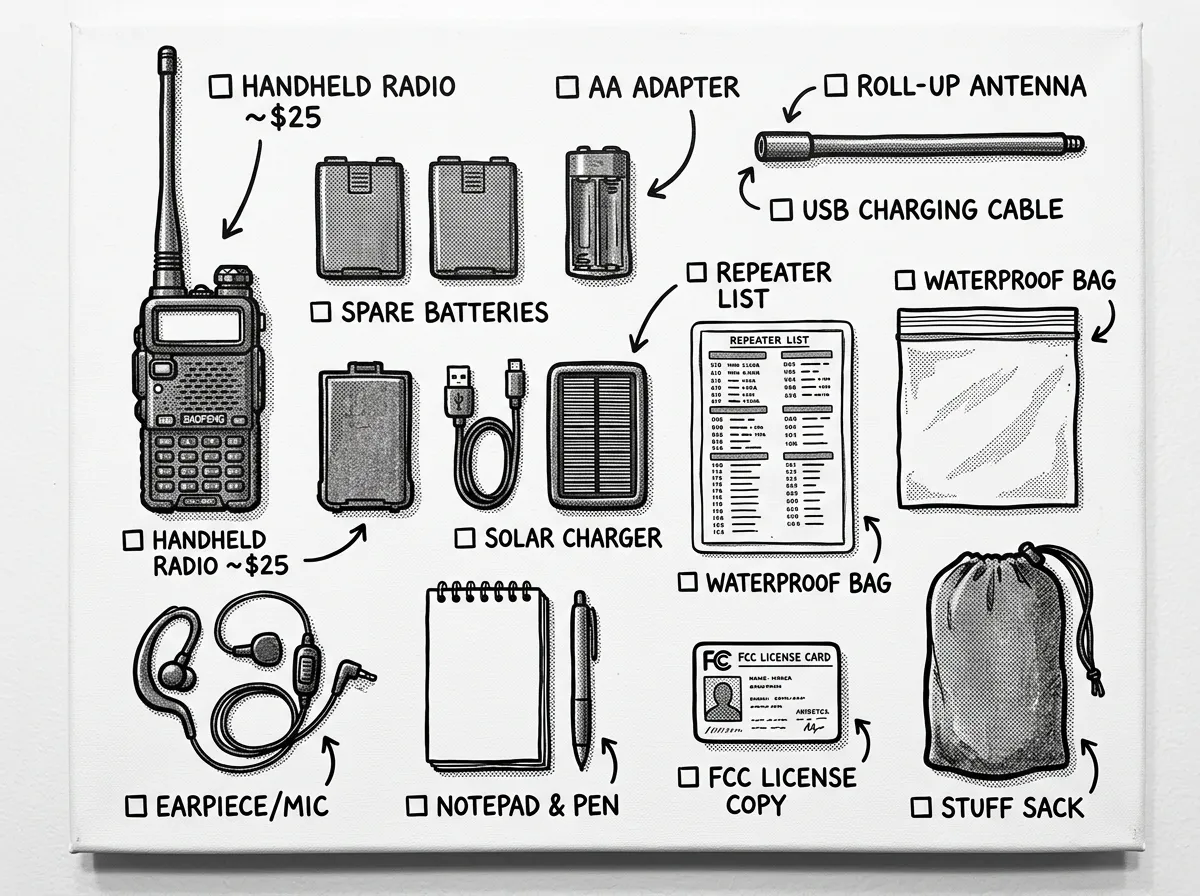 Complete ham radio emergency starter kit laid out and ready to pack
- Handheld transceiver with fully charged battery
- 1–2 spare batteries or USB power bank with correct adapter
- Aftermarket antenna (the stock rubber duck antenna is mediocre)
- Speaker mic for hands-free operation
- Printed and laminated repeater list with emergency frequencies
- USB/DC charger and cable
- Pen and notepad for logging traffic
Add this kit to your go-bag alongside the essentials in your bug-out bag checklist.
Getting Your FCC Technician License
This is easier than most people think. Way easier.
- Study resource: hamstudy.org (free) or the ARRL Technician license manual
- Exam format: 35 multiple-choice questions, you need 26 correct to pass
- Study time: Most people are ready in 2–4 weeks of casual study
- Exam cost: $0–15 at most Volunteer Examiner (VE) sessions. Find one at arrl.org/find-an-amateur-radio-license-exam
- No Morse code required for Technician or General class
Joining the Network
Don’t skip this part. A radio without a network is just a battery-powered noise machine.
- Find local repeaters on RepeaterBook.com and check in on weekly nets
- Join your local ARES group or amateur radio club
- Look into SKYWARN — the National Weather Service’s severe weather spotter program. It’s a natural entry point for emergency-focused operators and your local NWS office offers free training.
- Practice passing formal traffic messages using standard net procedures
Testing Your Power Plan
Your radio’s useless without power. A common mistake is showing up to an exercise with a fully programmed radio and a dead battery. Don’t be that person.
- Run your HT on battery and measure actual transmit time — not what the spec sheet says, what you actually get
- Test charging from a portable solar panel for off-grid power
- Try your vehicle’s 12V outlet with an adapter cable
- Document real-world run times and keep notes with your kit
A common failure mode: a radio gets bought, programmed, and then stuck in a drawer. Months later the battery’s dead, the firmware’s a mystery, and the local repeater channel is forgotten. Checking into a net at least once a week keeps a radio operational and builds the muscle memory to grab it and be on the air in under 30 seconds. In the Pacific Northwest, the Puget Sound Repeater Group and Oregon ARES nets are good places to start building that habit.
Legal and Safety Essentials (U.S.)
- Licensing: Transmitting on amateur bands requires an FCC license. The Technician class is your entry point.
- Emergency exception: FCC Part 97.403 specifically permits any station to provide emergency communication when normal systems are unavailable and there’s an immediate threat to life or property. Part 97.405 covers government requests for amateur assistance. These are real legal provisions — know them.
- Identification: Use your assigned call sign when transmitting. Every time.
- Restrictions: Operate only within the modes, power levels, and bands your license class permits. Encryption is prohibited on amateur bands, and commercial use is restricted.
Regulations vary by country. If you’re outside the United States, confirm rules with your national regulator.
Operational Best Practices
- Listen before transmitting. Never interrupt active emergency traffic. This is the golden rule.
- Use plain language and standard net procedures. Save the jargon for casual contacts.
- Keep transmissions short, clear, and relevant. Say what needs to be said and release the frequency.
- Maintain your gear: Keep batteries charged, connectors clean, and antennas inspected quarterly. If you’re in a humid Gulf Coast climate, corrosion on antenna connectors is a real problem — check them monthly.
- Preplan primary and secondary frequencies and designate an out-of-area contact who can relay messages.
A 7.1 earthquake hits your region at 2 AM. Power’s out across three counties. Cell service is jammed within minutes — you can’t even send a text. Your family members are spread across two cities. You grab your HT from the nightstand, power it up, and check into your local ARES net on the repeater you’ve been practicing on for months. Within 20 minutes, you’ve confirmed your family members are safe through a relay, and you’re passing damage reports to net control for the county emergency manager.
Frequently Asked Questions
Should I get a ham radio for emergencies?
Absolutely. Amateur radio is widely regarded as one of the most reliable communication tools available to civilians when infrastructure fails. A basic handheld, a Technician license, and knowledge of your local repeaters give you a capability that cell phones, landlines, and internet simply can’t match during a disaster. The investment is modest — as little as $25 for a radio and a few weeks of study for the license.
What is the 3-3-3 rule for ham radio?
The 3-3-3 rule is a survival communication convention in the prepper community: monitor channel 3 on CB, channel 3 on FRS, at 3-hour intervals. It’s not an FCC regulation — it’s a community guideline. It’s best supplemented with local repeater frequencies, 146.520 MHz simplex, NOAA weather monitoring, and a written family communication plan with pre-arranged check-in times.
What is the golden rule of ham radio?
Listen before you transmit. This applies double during emergencies. Monitor the frequency long enough to understand what traffic is active, who has net control, and whether priority communications are in progress. Good operating discipline during a disaster saves lives.
Do you need a license to use ham radio in an emergency?
Under FCC Part 97.403, any person may use amateur frequencies when there’s an immediate threat to life or property and no other communication is available. That said, an emergency is the worst possible time to learn how to use a radio. Get your Technician license now, practice regularly, and be ready before you need it.
How far can a ham radio reach in an emergency?
VHF/UHF handhelds reach 1–5 miles on flat terrain. Through repeaters, that extends to 30–60+ miles. HF radios can reach hundreds to thousands of miles depending on atmospheric conditions, antenna, and power. For most local emergencies, a handheld with access to a working repeater covers what you need.
How do ham radio operators help during disasters?
Operators provide damage and road-condition reports, coordinate shelter logistics, pass health-and-welfare messages for displaced families, and serve as communication links between emergency agencies. When ARES and RACES formally activate, trained volunteers integrate directly with incident command structures, serving as force multipliers that emergency managers count on.
What to Do This Week
- Buy a beginner handheld — a Baofeng UV-5R ($25–50) or Yaesu FT-65R (around $150) with a spare battery and aftermarket antenna.
- Start studying at hamstudy.org — aim for your Technician exam within 2–4 weeks.
- Find a local VE exam session at arrl.org/find-an-amateur-radio-license-exam and register.
- Look up your local repeaters on RepeaterBook.com, print the list, and laminate it.
- Create a one-page family communication plan with primary frequencies, backup simplex channels, check-in times, meeting points, and power options. Build this into your broader emergency communication plan for your family.
Ham radio emergency preparedness is one of the highest-return investments you can make in your overall readiness. For under $50 and a few weeks of study, you gain a communication capability that works when cell towers are down, the internet is offline, and the grid is dark. Get the radio. Get the license. Get on the air. That’s how you turn amateur radio from a hobby into a lifeline.
The Complete
Prepper's Reference.
149 articles synthesized into one comprehensive PDF — twelve chapters covering water, food, shelter, first aid, comms, and scenario-specific preparedness. Free with your email.
Unsubscribe anytime · We never share your email
You're in. Check your inbox.
Keep Reading
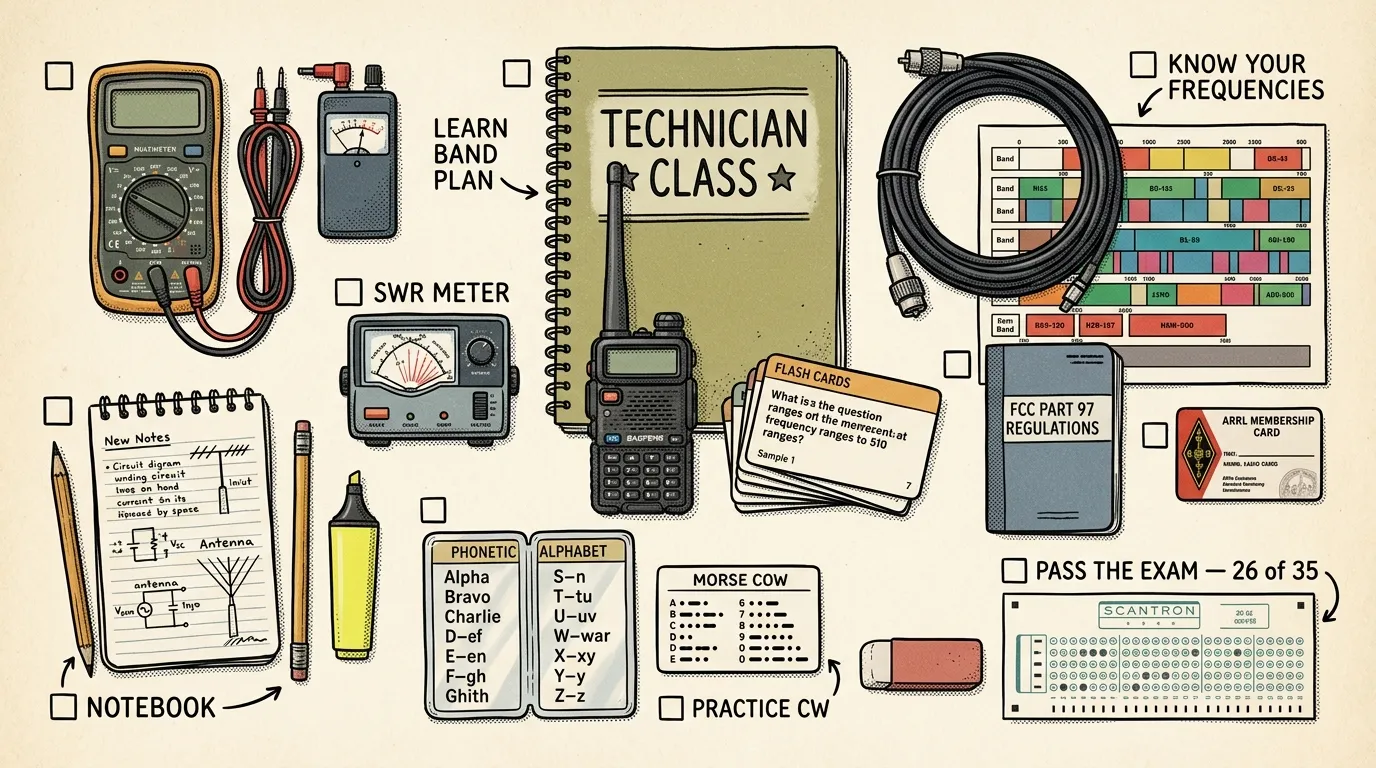
Ham Radio Technician License Study Guide for Preppers
A ham radio technician license study guide for preppers. Exam strategy, best resources, 4-week plan, and key concepts. Start studying today.
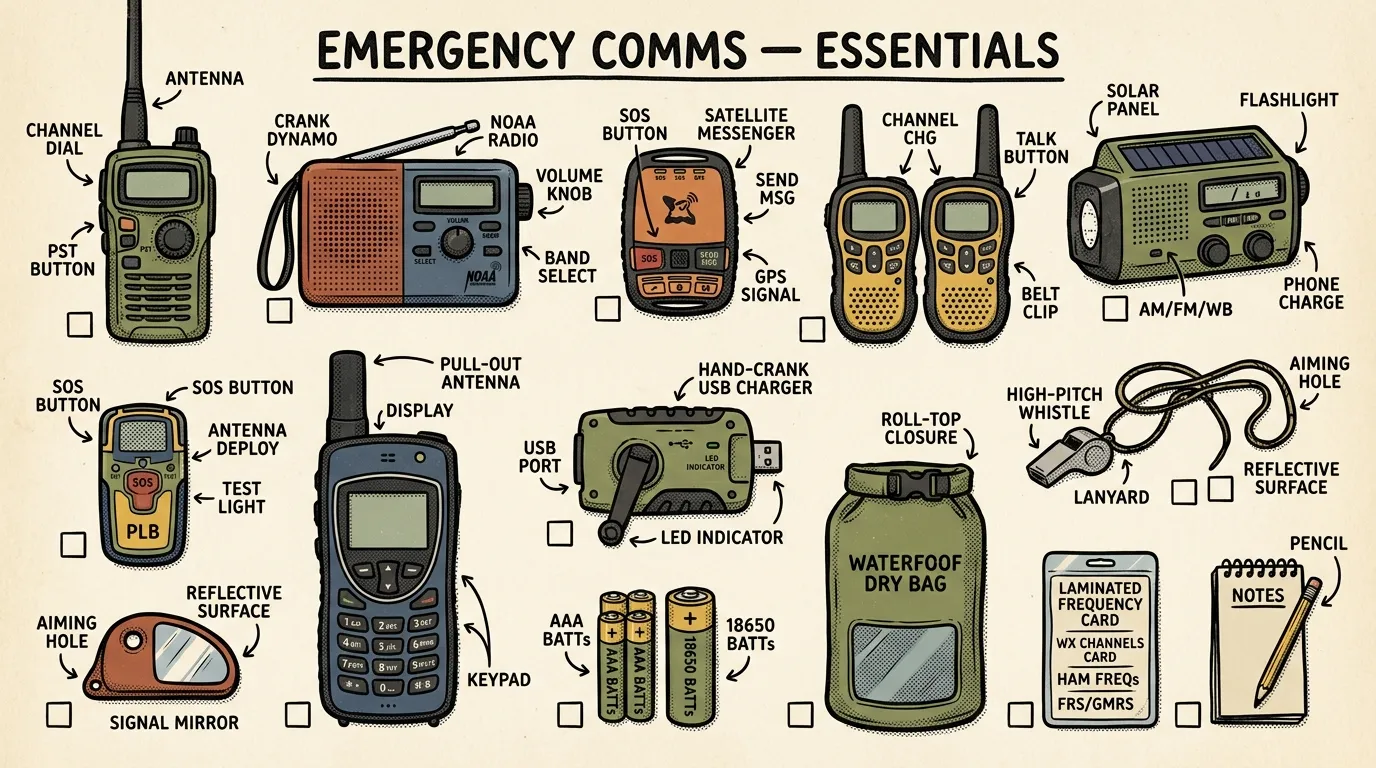
Best Emergency Communication Devices: A Beginner's Guide
Discover the best emergency communication devices for beginners — from NOAA radios to satellite communicators. Build a reliable backup plan today.
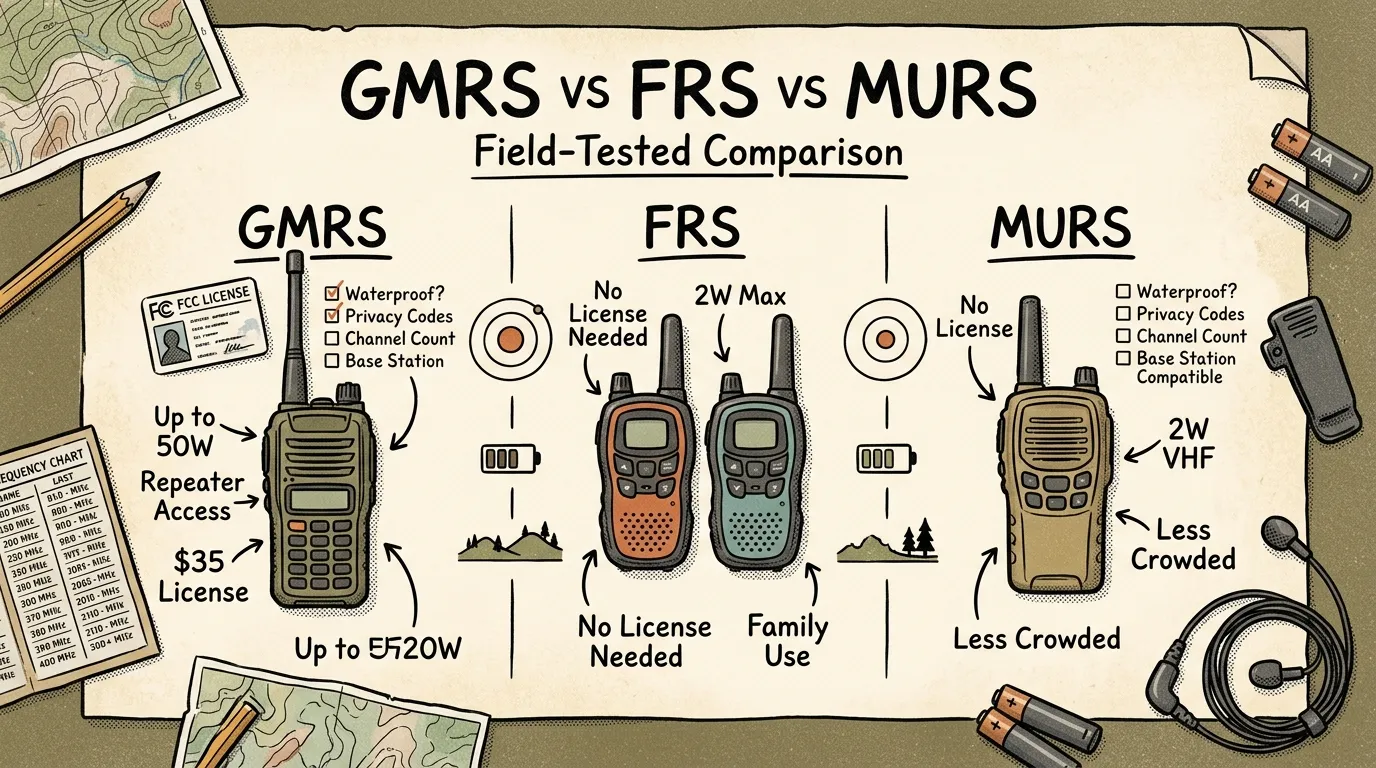
GMRS vs FRS vs MURS for Preppers: Complete Guide
GMRS vs FRS vs MURS for preppers — realistic range expectations, licensing breakdown, and scenario-based picks to choose the right emergency radio. Read more.