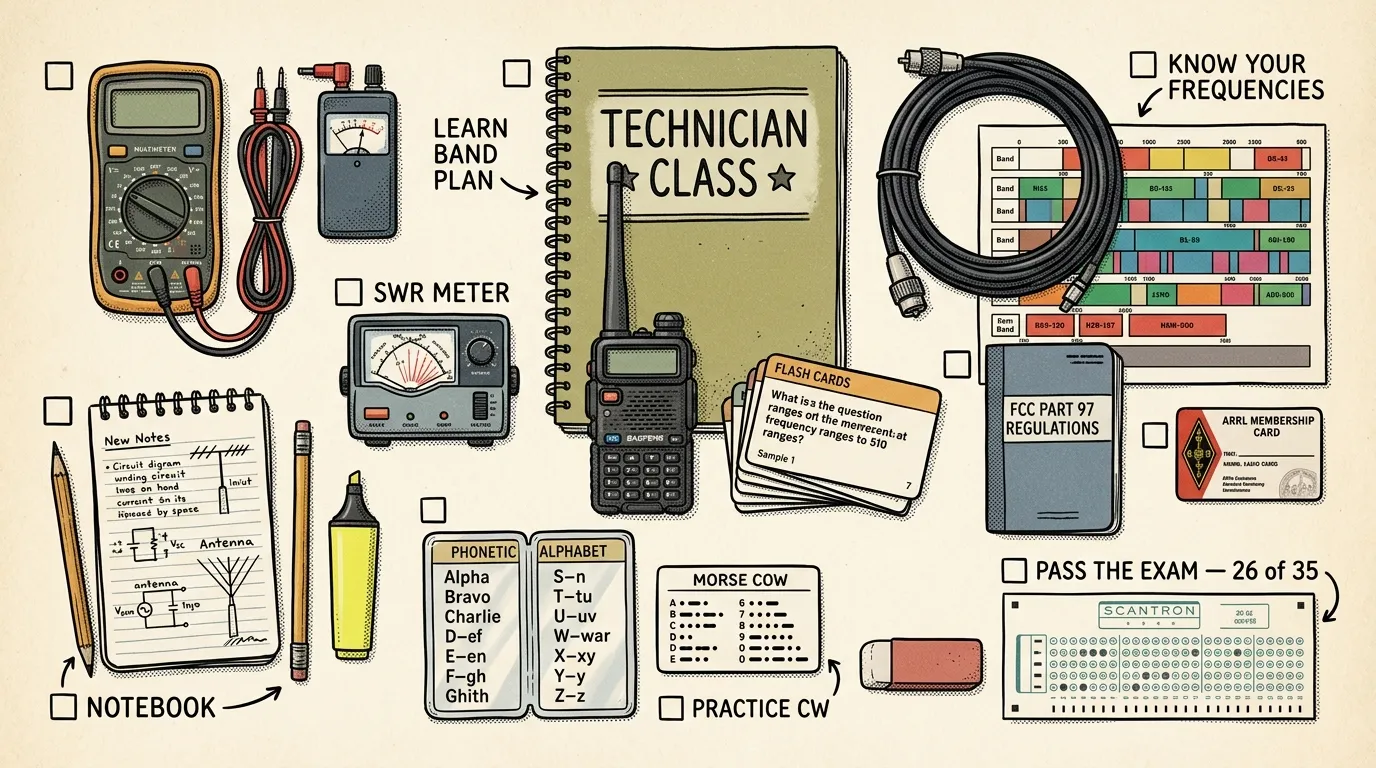
This article is a comprehensive HAM radio technician license study guide tailored for preppers, covering exam structure, the best study resources, key technical concepts framed for emergency use, and a realistic study timeline to pass the FCC Technician Class exam.
Key Takeaways
- The Technician exam is 35 questions from a public pool — score 26 correct (74%) to pass, and most preppers can do it in 2-4 weeks of daily study.
- Use hamstudy.org for free daily practice tests and pair it with the ARRL Ham Radio License Manual for conceptual understanding.
- Focus study time on frequency privileges, repeater operations, and signal propagation — these carry exam weight AND directly apply to grid-down communications.
- Schedule your exam session before you feel ready — aim for Week 4, and use the deadline to stay disciplined.
- After passing, immediately program local repeaters, join an ARES net, and practice operating before an emergency forces you to learn on the fly.
- Total cost is $60-$85 including the $35 FCC fee, and your license is valid for 10 years with free renewal.
I’ll be honest — it’s easy to open a study guide for the Technician license and close it again after twenty minutes. Oscillators, impedance, band plans. It can feel like a physics exam that has nothing to do with the real motivation: reliable comms when cell towers go dark.
That license isn’t just a piece of paper. This ham radio technician license study guide covers exactly what to study, which resources work, and how the technical concepts connect to real scenarios — including situations like the 2020 Oregon wildfire evacuations, when cell service was overwhelmed across three counties.
This guide is built specifically for you if your motivation is emergency preparedness. I’m not going to teach you to love contesting or bounce signals off the moon. I’m going to show you exactly what to study, which resources actually work, and how to frame the technical concepts around the scenarios you’re actually preparing for.
Quick Summary
- The Technician exam is 35 multiple-choice questions — you need 26 correct (74%) to pass, and the entire question pool is publicly available
- Most preppers can pass in 2-4 weeks of daily 30-60 minute study sessions using free or low-cost resources
- HamStudy.org combined with the ARRL Ham Radio License Manual is the most effective one-two punch for understanding concepts and drilling questions
- Focus your energy on signal propagation, frequency privileges, and operating procedures — these are the topics that matter most in a grid-down scenario AND carry heavy weight on the exam
- The FCC application fee is $35, exam sessions run $0-$15, and your license is good for 10 years
- You don’t need to buy a radio before passing the exam — but having one to practice with after you pass accelerates your real-world readiness dramatically
Why Preppers Specifically Need This License
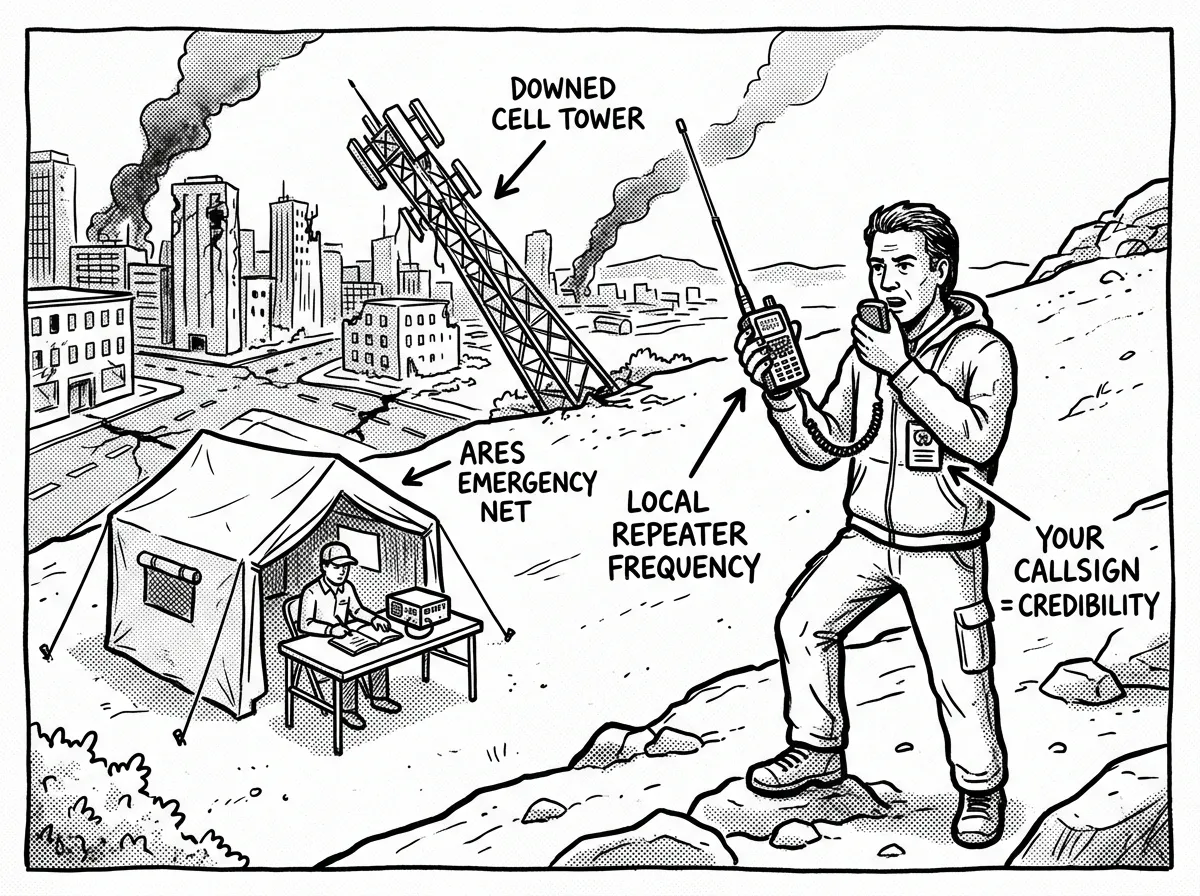 When cell towers fail, licensed ham operators become the communication lifeline
You might be thinking: “Can’t I just buy a Baofeng and figure it out when things go sideways?” Sure, and you can also buy a chainsaw without knowing how to fell a tree. Technically possible. Probably going to end badly.
A major Cascadia Subduction Zone earthquake knocks out cell service across western Oregon and Washington. FEMA estimates restoration will take 7-14 days minimum. You have a handheld radio, but you don’t know which repeaters are still operational, what frequencies emergency nets monitor, or how to properly identify yourself. Your expensive radio becomes a paperweight with an antenna.
The Technician license does three critical things for your preparedness:
- Legal access to practice now — you can’t build real skill by waiting for a disaster. Licensed operators join local nets, participate in ARES/RACES drills, and build relationships with the exact people who’ll be coordinating emergency comms. For more on why community connections matter, check out our guide on prepper networking and building your survival community.
- Actual technical understanding — the exam forces you to learn propagation basics, power limits, and antenna fundamentals that directly translate to getting a signal out when it matters.
- Credibility in the emergency management community — unlicensed operators on emergency frequencies cause real problems for coordinated response efforts. A callsign means you’re part of the solution.
How to Study for the Ham Radio Technician Exam
This is a step-by-step process that works well for most people preparing for the exam.
-
Take a baseline practice test on hamstudy.org. Don’t study first — just take it cold. You’ll probably score 40-50%, and that’s completely normal. This shows you exactly where your knowledge gaps are.
-
Choose a study manual: the ARRL Ham Radio License Manual or Gordon West’s Technician Class book. The ARRL manual builds deeper conceptual understanding; Gordon West gets you to a passing score faster. Pick based on your learning style.
-
Study 30-60 minutes daily for 2-4 weeks. Consistency beats cramming every time. Read one chapter per session and follow up with targeted practice questions on the same topic.
-
Take full 35-question practice exams and drill your weak areas. By Week 2, you should be taking at least two full practice exams daily. Review every wrong answer — read the explanation, not just the correct letter.
-
Schedule your exam session and pass it. Book your exam during Week 2 for a date in Week 4. The deadline keeps you honest, and if you’re scoring 85%+ consistently, you’re more than ready.
The best study strategy combines passive learning (reading the manual) with active recall (practice tests). Research consistently shows that testing yourself is more effective than re-reading. Make hamstudy.org your daily habit.
The Exam Structure: What You’re Actually Facing
Let’s strip away the mystery. The Technician Class exam — called Element 2 — is straightforward once you understand its structure.
Here’s the part that surprises most people: the entire question pool is public. Every single question that can appear on your exam is available right now on sites like hamstudy.org. You’re not studying blind. You’re preparing for a known set of questions, and the exam randomly pulls 35 from that pool.
Questions break down across these topic areas, roughly weighted:
- FCC rules and regulations (~20%) — callsign structure, band privileges, operating restrictions
- Operating procedures (~15%) — repeater use, emergency communications, phonetic alphabet
- Radio wave propagation (~10%) — how signals travel, what affects range
- Amateur radio practices (~10%) — interference, station setup
- Electrical principles (~15%) — basic electronics, Ohm’s law, circuits
- Circuit components and station equipment (~15%) — antennas, transceivers, power supplies
- RF safety (~5%) — exposure limits, safe practices around antennas
2024-2026 Question Pool Changes: What’s Different Now
The NCVEC (National Conference of Volunteer Examiner Coordinators) updates each license class question pool on a 4-year cycle. The current Technician pool went into effect on July 1, 2022, and is valid through June 30, 2026. If you’re reading this near that date, verify whether a new pool has been released before purchasing study materials.
Here’s what changed in this cycle that preppers should pay attention to:
- Increased emphasis on digital modes — the pool added more questions about digital communication protocols, reflecting how heavily ARES and RACES groups now rely on digital nets. This matters because tools like Winlink (email over radio) are increasingly critical in real emergency deployments.
- Updated RF safety standards — questions were revised to align with the FCC’s 2021 updated RF exposure evaluation guidelines. If you’re running an older study guide, the RF safety answers may be wrong.
- More questions on band plan specifics — the pool expanded coverage of where different modes are permitted within each band, which directly affects your ability to operate legally on emergency frequencies.
Before you buy any study resource, confirm it covers the current pool. Look for “2022-2026” or “Element 2, Subelement Group” references. Any book published before mid-2022 is using the old pool and will have incorrect questions. The ARRL Ham Radio License Manual 5th Edition and KB6NU’s No-Nonsense Guide (current version) are both updated for this cycle.
Best Free vs Paid Study Resources Compared
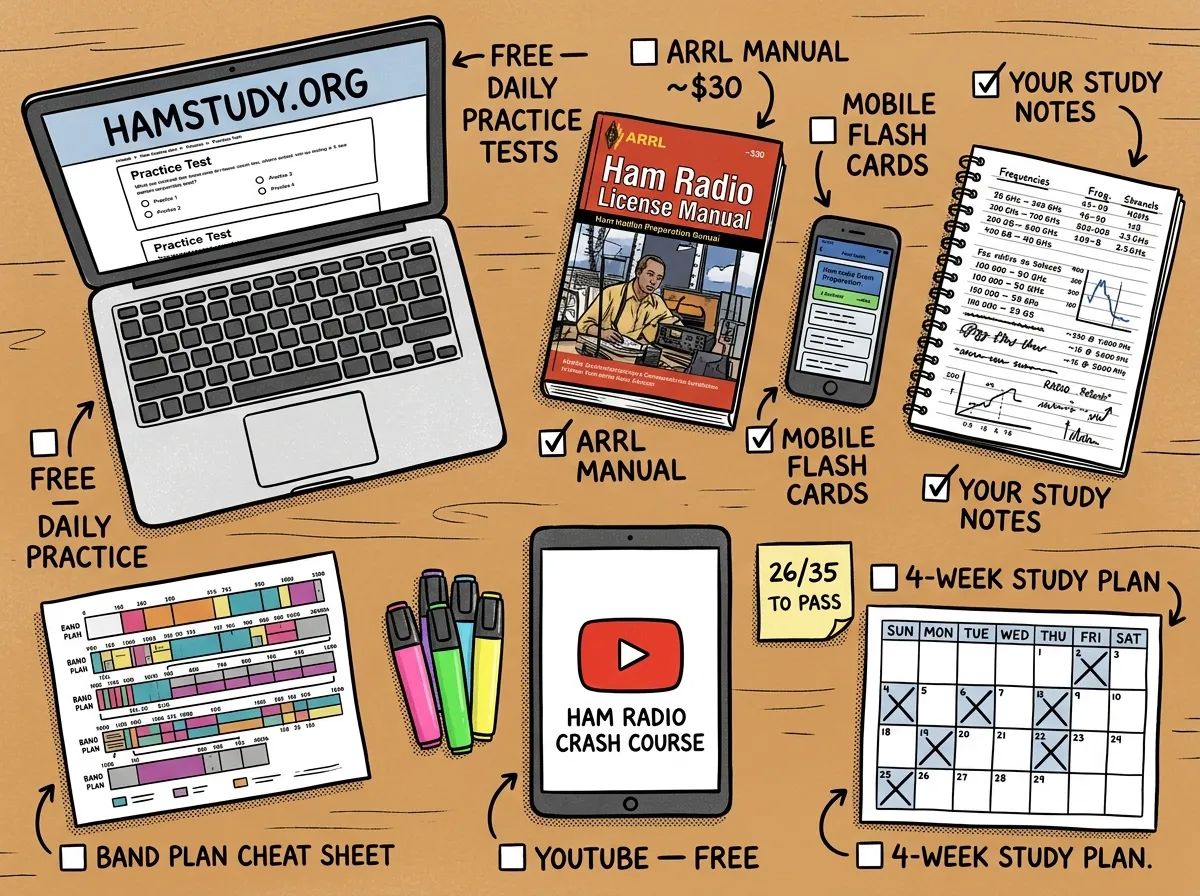 The essential study toolkit for passing your Technician exam
Not all study materials are created equal. Here’s how they stack up:
| Resource | Cost | Format | Best For | Teaches Concepts? |
|---|---|---|---|---|
| HamStudy.org | Free | Web/app, adaptive flashcards & practice exams | Daily drilling, identifying weak areas | Partial — explains answers but no structured lessons |
| KB6NU No-Nonsense Study Guide | Free (PDF) | PDF download, concise text | Budget-conscious learners who want a readable overview | Yes — brief but clear explanations |
| ARRL Ham Radio License Manual (5th Ed.) | $30-35 | Print/ebook, comprehensive textbook | Deep understanding, long-term reference | Yes — the most thorough option |
| Gordon West Technician Class Book | $22-27 | Print, organized by question number | Fast test passage, memory tricks | Minimal — focuses on correct answers |
| Ham Radio Prep | $25-30 | Video course with practice exams | Visual/auditory learners, guided structure | Yes — video explanations of each topic |
For preppers on a budget: Start with the free KB6NU No-Nonsense Study Guide PDF for your reading material and use hamstudy.org daily for practice tests. Total cost: $0.
For preppers who want real operational competence: Pair the ARRL Ham Radio License Manual with hamstudy.org. The ARRL manual doesn’t just teach you to pass — it teaches you to operate. When you’re troubleshooting a faulty antenna connection during a real emergency deployment, you’ll be glad you understood the “why” behind each concept. Total cost: $30-35.
Many people pass using nothing but hamstudy.org and two weeks of daily practice. For a deeper understanding that helps with troubleshooting a broken antenna connection during a field deployment, pairing it with the ARRL manual is a strong combination.
Key Technical Concepts Framed for Emergency Preparedness
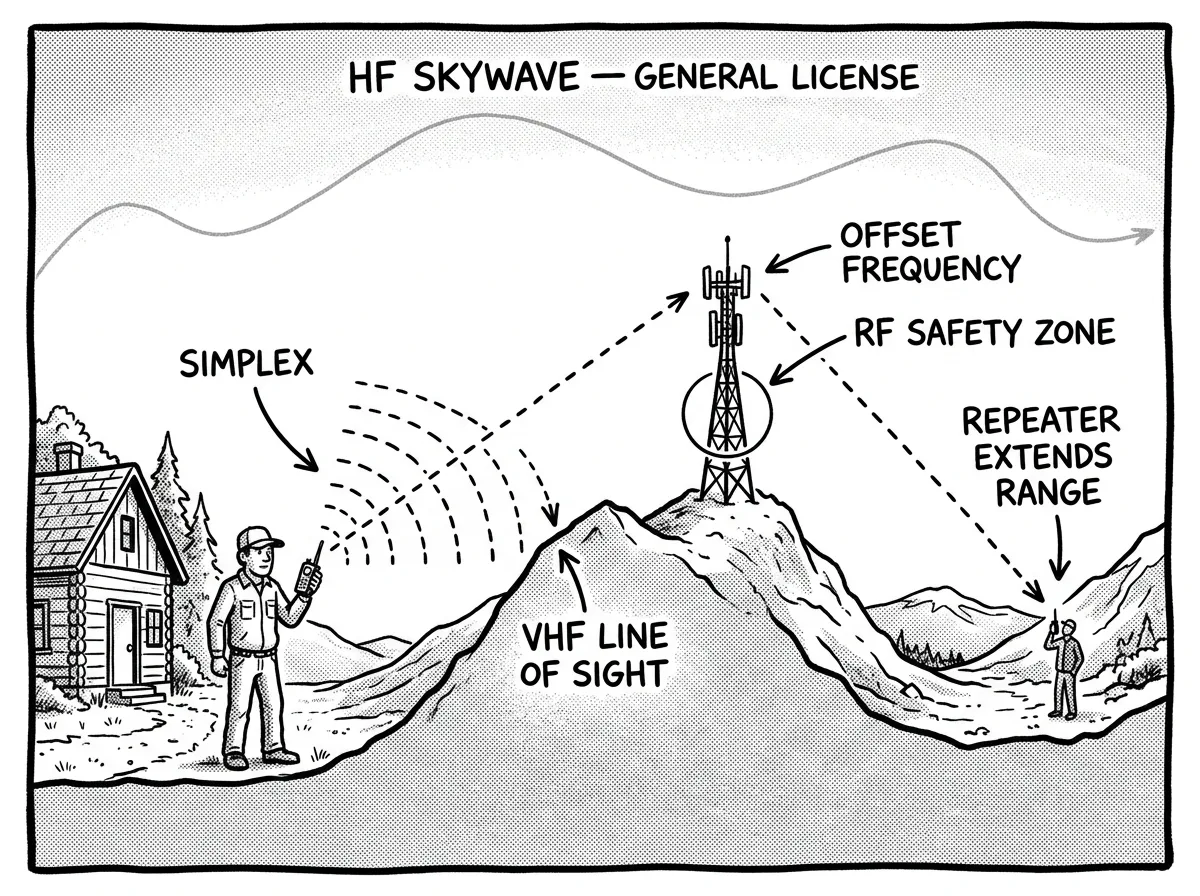 Understanding signal propagation, repeaters, and power keeps your comms alive when it counts
Here’s where most study guides lose preppers — they teach concepts in a vacuum. Let me reframe the topics that matter most for your actual use case.
Frequency Privileges and Band Plans
The Technician license gives you full privileges on VHF (2-meter band, 144-148 MHz) and UHF (70-centimeter band, 420-450 MHz), plus limited HF privileges on 10 meters. Why does this matter for emergencies?
VHF/UHF is your local emergency workhorse. These frequencies are what repeaters use, what ARES/RACES nets operate on, and what you’ll use for neighborhood-level communications out to roughly 5-50 miles depending on terrain and repeater access.
10-meter HF is your reach beyond the horizon. When propagation cooperates, 10 meters lets you communicate hundreds of miles without any infrastructure. During a regional catastrophe, this might be your only way to get information out of the affected area.
On the exam, expect 4-6 questions about which frequencies you’re allowed to use and what modes (FM voice, SSB, digital) are permitted where. Don’t just memorize the chart — understand that VHF/UHF is your go-to for local tactical comms.
Signal Propagation
How does a radio signal actually get from your antenna to someone else’s? The exam tests three main types:
- Line-of-sight — VHF/UHF signals travel in straight lines. Hills, buildings, and the curvature of the earth block them. This is why repeaters on mountaintops extend your range dramatically.
- Ground wave — lower-frequency signals that follow the earth’s surface. Limited range, but reliable.
- Sky wave (ionospheric skip) — HF signals bounce off the ionosphere and return to earth hundreds or thousands of miles away. This is how 10-meter contacts reach across states.
For preppers, the takeaway is this: your handheld radio on VHF is limited by terrain. Knowing how to find and use repeaters, or how to set up a simple antenna at elevation, is the difference between a 2-mile and a 50-mile range.
Repeaters and Offsets
Roughly 5-7 exam questions involve repeaters. A repeater is a station — usually on a hilltop or tall building — that receives your signal on one frequency and retransmits it on another, extending your range enormously.
You need to understand:
- Offset — the difference between the transmit and receive frequencies (typically +/- 600 kHz on 2 meters)
- CTCSS tones (also called PL tones) — sub-audible tones that “unlock” a repeater so it retransmits your signal
- How to program repeater pairs into your radio
A $30 handheld hitting a repeater on a ridge can outperform a $500 radio with no repeater access. Know your local repeaters before you need them.
Ohm’s Law and Basic Electronics
Don’t panic. The math on this exam is simple. You need two formulas:
Ohm’s Law: Voltage = Current × Resistance (V = I × R)
Power equation: Power = Voltage × Current (P = V × I)
That’s it. The exam gives you two values and asks for the third. Here’s a concrete example that connects directly to prepper battery planning:
Your 12V battery powers a radio drawing 2 amps. How much power is that consuming? P = 12 × 2 = 24 watts. Now, if your battery is rated at 20 amp-hours, how long can you operate? 20 Ah ÷ 2A = roughly 10 hours of continuous transmit at that draw. This is exactly the math you’ll use when sizing a solar panel and battery bank for your emergency station.
Here’s an Ohm’s law example from the type of question you’ll see on the actual exam: A 12-volt source supplies current through a 240-ohm resistor. What is the current flow? I = V ÷ R = 12 ÷ 240 = 0.05 amps (50 milliamps). If you can multiply and divide, you can nail every electronics question on this test.
RF Safety
This section is short but carries real-world weight. Radio frequency energy at close range can cause tissue heating. The exam tests whether you know to keep people away from transmitting antennas, especially at higher power levels.
If you’re setting up a base station antenna on your roof, this isn’t theoretical. Mounting an antenna right next to a second-floor bedroom window puts people close to RF exposure at transmit power. Don’t do that. The current pool references the FCC’s updated maximum permissible exposure (MPE) limits — make sure your study materials cover the 2021 revisions.
Common Mistakes That Cause Preppers to Fail the Technician Exam
Here are the five most common mistakes that lead to exam failure, and every one of them is avoidable.
1. Memorizing answers without understanding concepts. You can cram question-and-answer pairs and probably pass. But when you’re sitting in the dark during a power outage trying to figure out why your antenna’s SWR reading is off the charts, rote memorization won’t help you. Learn the “why” behind each answer — it’s what separates an operator from someone who just holds a license.
2. Ignoring the electrical principles section. Many preppers skip straight to the operating procedures and regulations questions because those feel more relevant. The electrical principles section carries roughly 15% of the exam. That’s 5-6 questions. If you blow off this section, you’re starting the exam 5 questions in the hole.
3. Not taking enough full-length practice exams. Doing flashcards on individual questions is great for learning, but it doesn’t simulate test conditions. You need to practice sitting down and answering 35 questions in a row, managing your time, and dealing with questions worded slightly differently than you studied. Take at least 10 full practice exams before test day.
4. Cramming the night before instead of consistent daily study. Your brain consolidates information during sleep cycles over days and weeks, not hours. Thirty minutes daily for three weeks beats six hours the night before. Skills need repetition over time.
5. Waiting until you feel “completely ready” to schedule the exam. This is the biggest killer. People study for weeks, score 90%+ on practice tests, and then never schedule the actual exam because they want to feel 100% certain. Schedule the exam during Week 2 of your study plan for a date in Week 4. The deadline creates productive pressure, and 85% on practice tests means you’re more than ready.
Track your practice exam scores in a simple spreadsheet. Note which sub-topics you miss most often. If you’re consistently getting electrical principles wrong but acing operating procedures, spend 80% of your remaining study time on the weak areas.
A Realistic Study Plan That Works
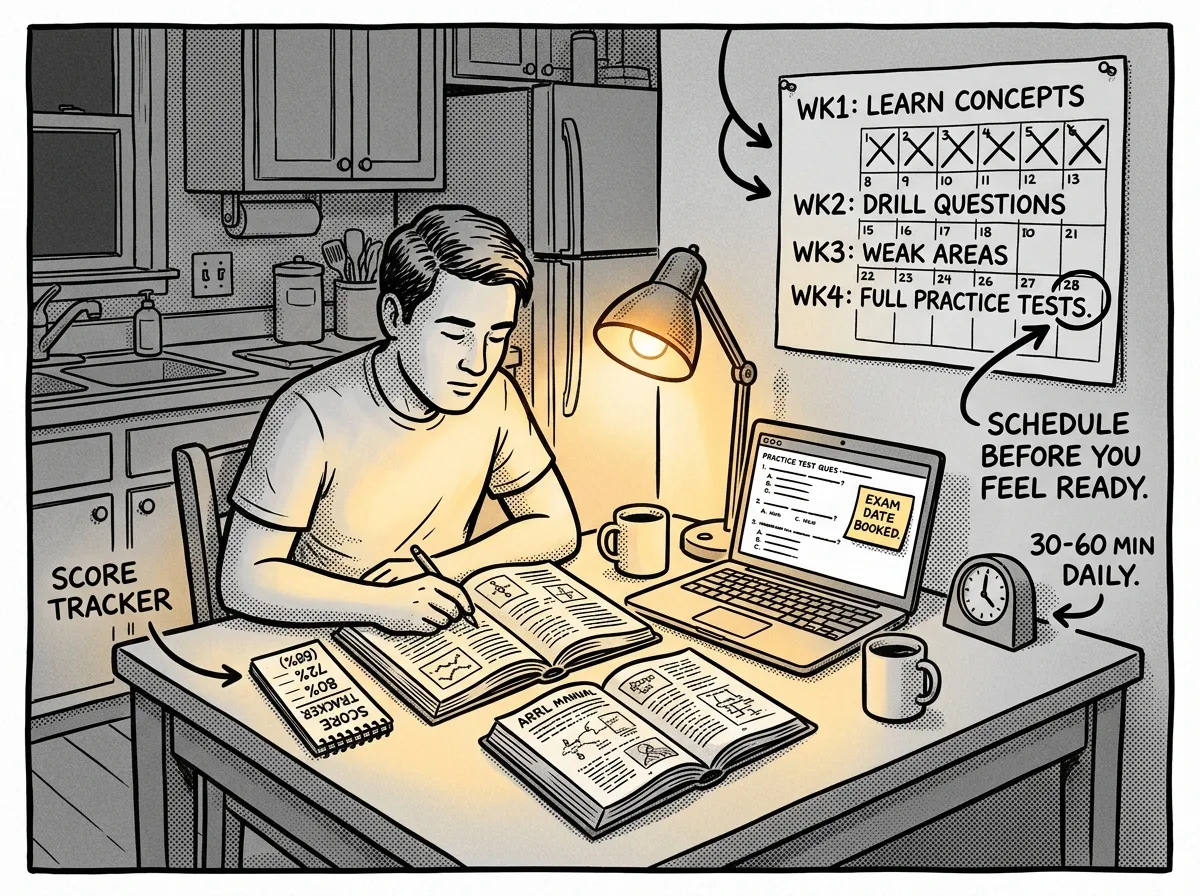 Four weeks of focused daily study gets most preppers across the finish line
Here’s a study plan that works whether you’re using free resources or paid ones.
- Week 1: Read chapters 1-4 of your study manual (rules, operating procedures, propagation). Do 15-20 practice questions daily on hamstudy.org. Schedule your exam for Week 4.
- Week 2: Read chapters 5-8 (electronics, circuits, antennas, RF safety). Continue daily practice. Start taking full 35-question practice exams at least once daily.
- Week 3: Focus entirely on practice exams. Take 2-3 full exams per day. Review every wrong answer — don’t just note it, read the explanation and revisit the manual section if needed.
- Week 4: Identify your weakest two topic areas from practice exam scores. Drill those specific topics. Score 85%+ on three consecutive practice exams. Take the exam with confidence.
If you’re scoring above 85% consistently, you’re ready. The 74% passing threshold gives you a comfortable margin for test-day nerves.
How long does it take to study for the ham Technician exam? For most people, 2-4 weeks of daily 30-60 minute study sessions is the sweet spot. If you already have some electronics background — maybe you’ve tinkered with Arduino projects or done electrical work — you might be ready in 10 days. If math and electronics are completely new to you, lean toward the full four weeks. Either way, consistent daily practice beats weekend marathon sessions.
Finding and Taking the Exam
Exams are administered by Volunteer Examiner (VE) teams across the country. You’ve got two solid options:
In-person sessions — search for sessions near you at the ARRL’s exam finder (arrl.org/find-an-amateur-radio-license-exam-session) or on hamstudy.org. Libraries, fire stations, churches, and ham radio club meetings are common venues. Session fees run $0-$15, and you’ll pay the $35 FCC application fee separately.
Remote online exams — several VE groups now offer fully remote exams via video conference. The main groups offering online sessions include GLAARG (Greater Los Angeles Amateur Radio Group), Anchorage VEC, and W5YI-VEC. You’ll need a webcam, a stable internet connection, government-issued photo ID, and a quiet room where you can share your screen with the proctor.
The remote process typically works like this: you sign up for a session on the VE team’s website, receive a confirmation email with a video conferencing link, join at the scheduled time, show your ID on camera, share your screen so proctors can monitor your testing environment, and take the same 35-question exam you’d face in person. One major advantage of remote sessions — you can often find same-week availability, versus waiting 2-4 weeks for the next in-person session in your area.
- Government-issued photo ID (required for both remote and in-person)
- Your FRN (FCC Registration Number) — register at the FCC CORES system beforehand
- Two No. 2 pencils if taking a paper exam in person
- A basic non-programmable calculator
- Session fee ($0-$15 depending on the VE team)
- A printed copy of your FRN confirmation email
- For remote exams: webcam, stable internet, quiet room, screen sharing capability
Here’s a tip that applies well here: don’t study the morning of the exam. Your brain consolidates knowledge during rest. Get a decent night’s sleep, eat a real breakfast, and trust the preparation you’ve already done.
After You Pass: The Prepper’s Next Steps
You passed. Now there’s a critical step most guides skip: you must pay the $35 FCC application fee through the CORES/ULS system within 10 days of passing, or your exam results expire. Your VE team will submit your paperwork to the FCC, and you’ll receive an email from the FCC with payment instructions. Pay it immediately. Your callsign won’t be issued until the fee is processed, which usually takes 7-10 business days after payment.
Once your callsign appears in the FCC ULS database, you’re legal to transmit. Here’s your action plan:
Program your local repeaters immediately. Your regional frequency coordinator’s website and the RepeaterBook app will show you every repeater within range. Program in the ARES/RACES emergency frequencies for your county. Also program the national calling frequencies — 146.520 MHz simplex for 2 meters and 446.000 MHz for 70 cm. These are the frequencies operators monitor when no repeater infrastructure is available, which is exactly the scenario you’re preparing for.
Check into a local net within your first week. Most areas have weekly 2-meter nets — casual check-ins where you practice proper operating procedure. It feels awkward the first time. Do it anyway. This is exactly the kind of emergency communication practice that pays off when it counts.
Join your local ARES (Amateur Radio Emergency Service) group. These are the operators who deploy during real emergencies. During the September 2020 Oregon wildfires, ARES groups in Jackson County activated emergency nets on 146.840 MHz when cell towers were either burned or overloaded, relaying evacuation route information from incident command to families who had no other way to receive it. This is why a license becomes an actual preparedness tool only when you’ve practiced with it.
Set up Winlink for email over radio. Winlink is a system that lets you send and receive email using your radio — no internet required. It works on the VHF/UHF frequencies available to Technician licensees and is increasingly used by ARES and FEMA-affiliated groups during real disasters. Getting it configured now means you have a backup email system ready when the internet goes down.
The ham radio community itself often becomes one of the most valuable preparedness assets a new licensee gains. Consider upgrading to General class once you’re comfortable operating on Technician frequencies — it opens up the HF bands for long-distance emergency communications that can reach across the country without any infrastructure whatsoever. Many operators begin studying for General a few months after passing Technician; planning a similar timeline can help keep momentum going.
Consider the Baofeng UV-5R (~$25) for your first radio to practice on, but understand its limitations. It works fine for hitting repeaters and joining nets. For your actual emergency kit, look at the Yaesu FT-60R (~$150-$170) — Yaesu builds it to MIL-STD-810 specifications for durability and it has better receiver filtering than budget radios. The Baofeng gets you started; the Yaesu keeps you on the air when it counts.
Frequently Asked Questions
What is the best way to study for a ham radio license?
The most effective approach combines a structured study manual like the ARRL Ham Radio License Manual with daily practice tests on hamstudy.org. Start with a cold practice test to identify your weak areas, then work through the manual one chapter at a time while drilling daily on the adaptive practice platform. Focus on understanding concepts rather than memorizing answers, especially for topics like frequency privileges, propagation, and RF safety that you’ll actually use in emergencies. Most importantly, take full 35-question practice exams starting in Week 2 — active recall beats passive reading every time.
How long does it take to study for the ham Technician exam?
Most people can pass the Technician exam with 2-4 weeks of focused study, spending about 30-60 minutes per day. If you already have some electronics background, you might be ready in as little as 10 days. The key is consistent daily practice tests rather than cramming. The sweet spot for many is three weeks of daily study with a pre-scheduled exam date creating productive deadline pressure.
How much does it cost to get a ham radio Technician license?
The FCC application fee is $35, and most Volunteer Examiner teams charge $0-$15 for the exam session itself. Add the cost of a study guide — anywhere from $0 (using KB6NU’s free PDF and hamstudy.org) to $35 (for the ARRL manual) — and you’re looking at roughly $35-$85 total. The license is valid for 10 years and free to renew through the FCC ULS system.
Can I take the ham radio Technician exam online?
Yes, several Volunteer Examiner groups now offer remote online exams, including GLAARG, Anchorage VEC, and W5YI-VEC. You’ll need a webcam, a stable internet connection, screen sharing capability, and valid government-issued photo ID. The exam content and passing score are identical to in-person sessions. Remote sessions often have more availability than in-person options — you can sometimes schedule within the same week rather than waiting for the next monthly club meeting.
Your Ham Radio Technician License Study Guide Recap
Getting your Technician license isn’t a nice-to-have — it’s the foundation of every serious emergency communications plan. The exam is manageable, the study resources are excellent (and largely free), and the timeline is weeks, not months. Total investment: $60-$85 and about 20-30 hours of study time.
Here’s what I want you to do right now: go to hamstudy.org, take one practice exam cold, and see where you stand. Don’t study first. Just take it. You’ll probably score around 40-50%, and that’s fine — it shows you exactly how much ground you need to cover. Then grab the ARRL Ham Radio License Manual or download KB6NU’s free No-Nonsense Guide, follow the four-week plan above, and schedule your exam.
When the grid goes down — and it will — the operators who practiced, who joined nets, who built relationships with their local emergency management community… those are the ones who’ll make a difference. That starts with 35 multiple-choice questions and a decision to take them seriously. You’ve got this.
The Complete
Prepper's Reference.
149 articles synthesized into one comprehensive PDF — twelve chapters covering water, food, shelter, first aid, comms, and scenario-specific preparedness. Free with your email.
Unsubscribe anytime · We never share your email
You're in. Check your inbox.
Keep Reading
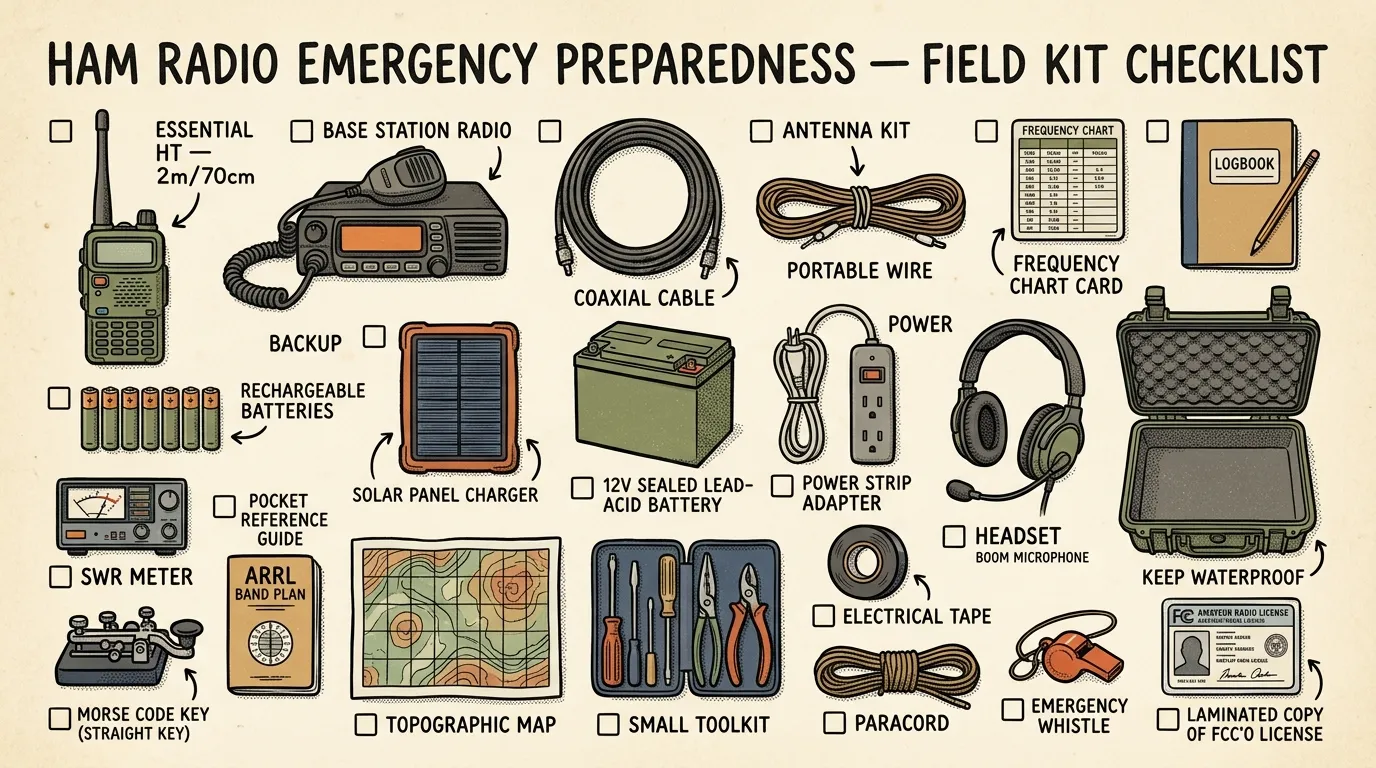
Ham Radio Emergency Preparedness: A Field Guide
Ham radio emergency preparedness explained. Gear, licensing, frequencies, and step-by-step starter plan. Start building your comms kit today.
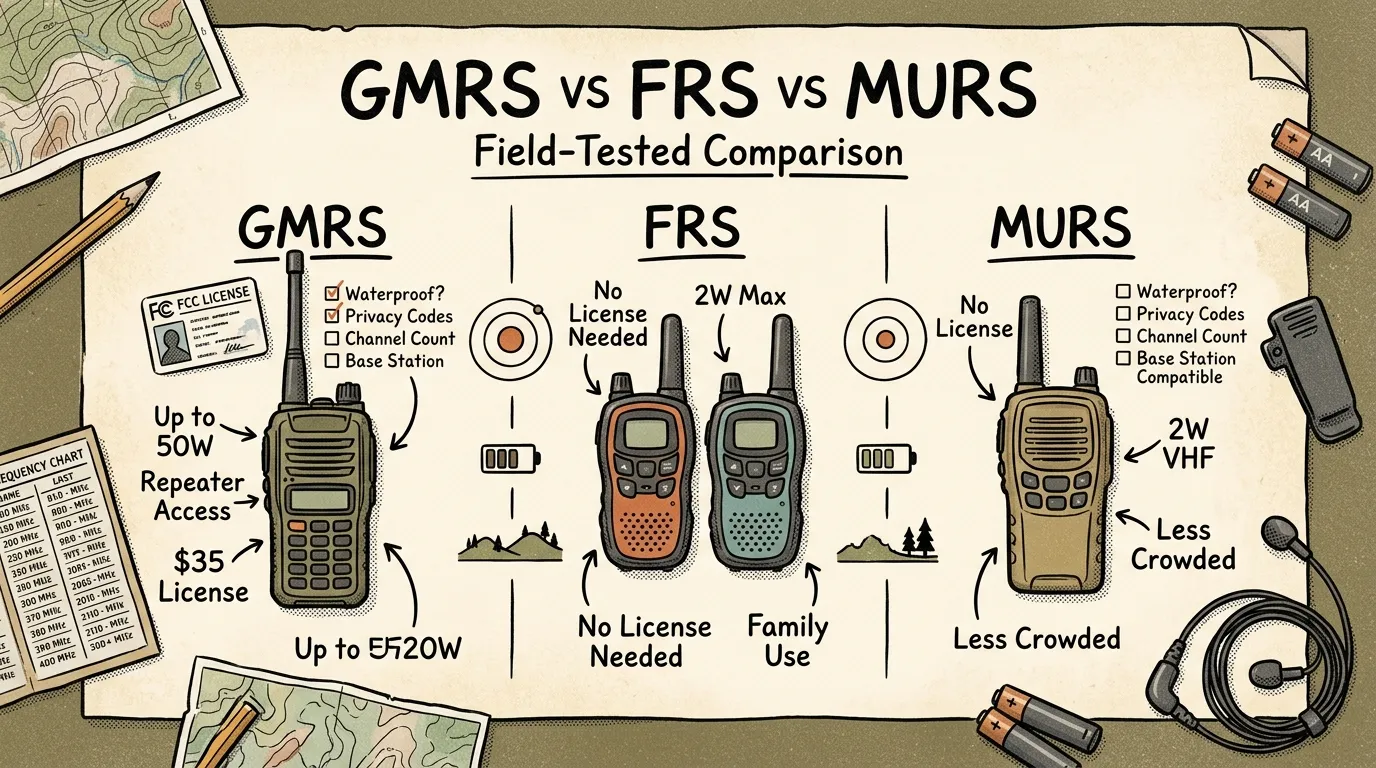
GMRS vs FRS vs MURS for Preppers: Complete Guide
GMRS vs FRS vs MURS for preppers — realistic range expectations, licensing breakdown, and scenario-based picks to choose the right emergency radio. Read more.
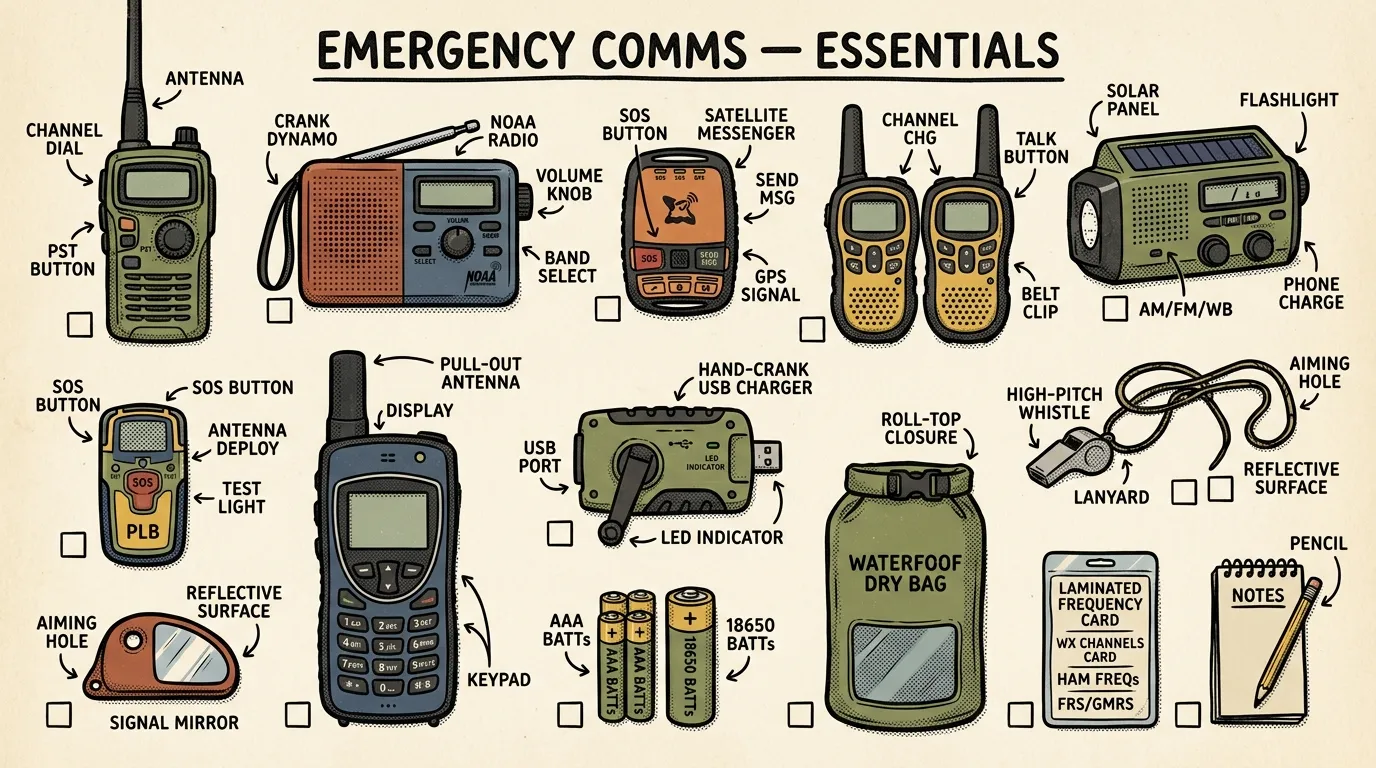
Best Emergency Communication Devices: A Beginner's Guide
Discover the best emergency communication devices for beginners — from NOAA radios to satellite communicators. Build a reliable backup plan today.