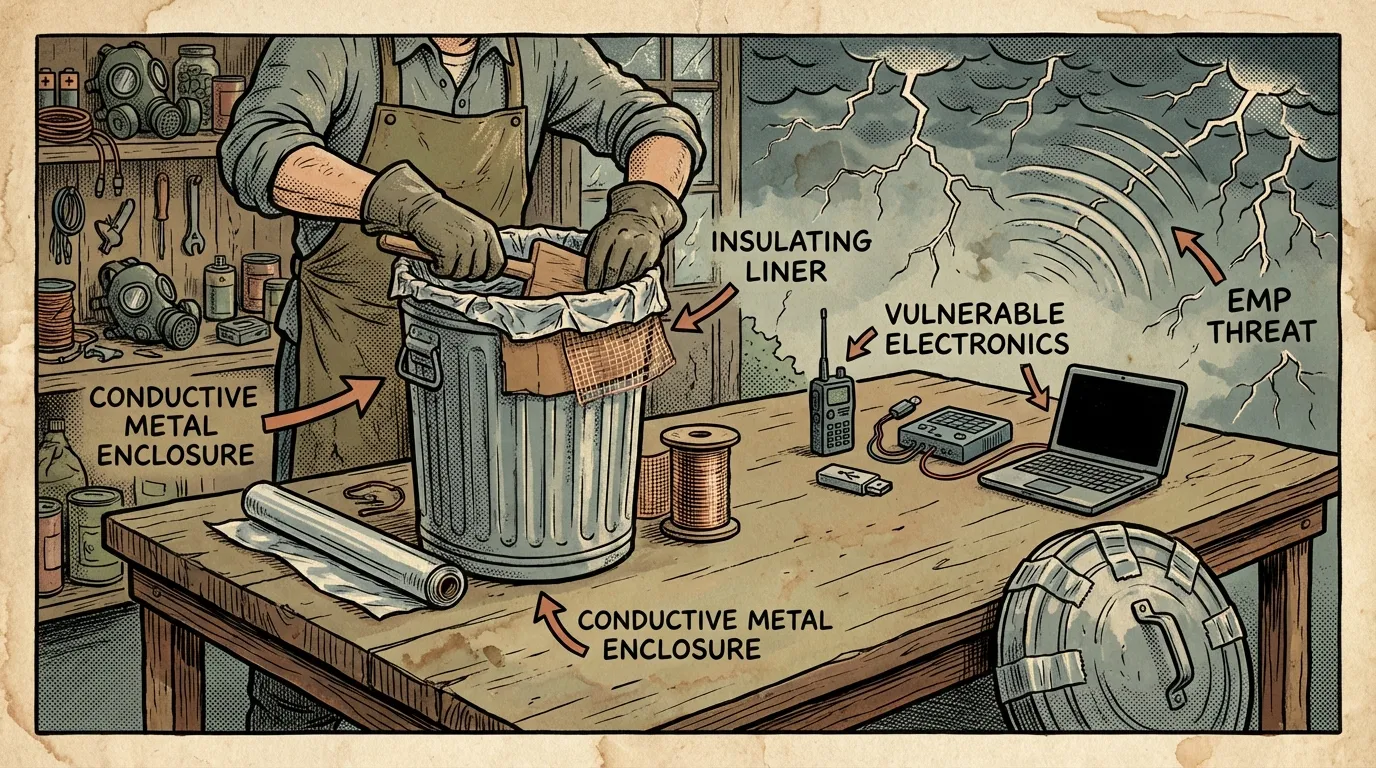
A Faraday cage is a conductive enclosure that helps block electromagnetic fields and can protect electronics from EMPs and interference. Preppers use Faraday cages to shield critical devices like radios, backup phones, and charging gear, and they can be built from materials such as metal containers, mesh, or aluminum foil if properly insulated and tested.
Key Takeaways
- Line metal container interiors with non-conductive material so devices never touch the conductive shell.
- Test enclosures by calling a phone inside and checking for signal loss across Wi-Fi, Bluetooth, and cell bands.
- Scrape paint from contact points on metal lids to ensure continuous electrical conductivity around the perimeter.
- Store multiple backup devices rather than relying on a single protected unit for redundancy.
- Prioritize protecting radios, GPS units, spare vehicle modules, and power banks before attempting larger electronics.
Faraday Cage Uses: How Preppers Protect Electronics from EMPs, Solar Storms, and RFI
Quick answer: Store small, critical electronics such as radios, backup phones, GPS units, drives, and spare vehicle modules inside a continuous conductive shell with good seams and internal insulation. DIY options include ammo cans, lined trash cans, layered foil wraps, and commercial Faraday bags. Performance depends on frequency, build quality, and the type of threat. Test enclosures across the bands you care about and treat home tests as indicative rather than definitive.
Summary
A Faraday cage is a conductive enclosure that redirects external electromagnetic energy around its interior, shielding enclosed electronics from many radio-frequency threats. For preppers, the most practical faraday cage uses are secure storage and transport of critical backup electronics: communications gear, navigation devices, power controllers, and data drives. Proper construction, continuous conductive coverage, internal insulation, and testing greatly affect how well an enclosure performs.
[Becoming a Prepper: The Beginner’s Guide to Survival Readiness]
What is a Faraday cage (brief definition)
- A conductive enclosure that reduces or blocks external electric and electromagnetic fields by redistributing charge on its surface.
- Demonstrated by Michael Faraday in the 1800s. Shielding effectiveness depends on frequency, conductivity, material thickness (skin depth), and how well seams and openings are sealed.
Threats a Faraday cage can mitigate
- Electromagnetic pulses (EMPs), including HEMP components E1, E2, and E3. Effectiveness depends on enclosure design and the EMP spectrum.
- Radio-frequency interference (RFI) and electromagnetic interference (EMI) from transmitters, faulty equipment, or nearby lightning strikes.
- Some high-frequency effects from solar storms. Low-frequency geomagnetically induced currents that damage the power grid are not reliably blocked by small enclosures.
Small enclosures will not survive every EMP or solar storm. Protection depends on the threat and the design.
Why faraday cage uses matter for preppers
Protect the small items you would most regret losing. Priorities include:
- Emergency and hand-crank radios
- Backup cell phones and satellite communicators
- Ham radio transceivers, handhelds, and accessories
- Solar charge controllers, small inverters, and portable power stations
- Battery banks and USB power banks
- GPS units, flash drives, and SSDs with critical documents
- Spare vehicle modules and key fobs
Protecting an entire vehicle is usually impractical. Focus on spare modules and small components instead.
The science, in practical terms
- How it works: Conductor charges redistribute to cancel interior fields, keeping the enclosure interior near zero field across many frequencies.
- Frequency matters: MHz and GHz signals are easier to block with foil or mesh. kHz and lower frequencies behave differently and are harder to stop with small enclosures.
- Materials: Copper, aluminum, and steel work well. Conductive meshes and fabrics can also work. Higher conductivity and continuous coverage improve performance.
- Weaknesses: Seams, gaps, and holes are the main failure points.
Practical DIY and commercial options
Pick a method based on device size and the frequencies you care about.
-
Metal container method (ammo cans, galvanized trash cans, metal toolboxes)
- Use a continuous metal container with a snug lid.
- Line the interior with non-conductive material so devices do not touch the metal.
- Improve lid contact with conductive tape or a conductive gasket. Ensure continuous electrical contact around the perimeter.
- Best for larger items or storing multiple devices.
-
Layered foil wrap for small devices
- Wrap the device first in a non-conductive layer such as a plastic bag or cloth, then a continuous layer of aluminum foil. Avoid aligned seams between layers.
- Add a final insulating layer before storage.
- Works for compact items, but it is fragile and not ideal for frequent access.
-
Commercial Faraday bags and fabrics
- Choose products with manufactured seams and tested zipper designs. Look for independent test data and published attenuation values.
-
Microwave ovens
- Microwaves are RF enclosures near 2.45 GHz and can block certain frequencies. They are not a purpose-built long-term EMP storage solution.
Best practices and common pitfalls
- Insulate contents from the conductive shell to avoid shorts and reduce coupling.
- Ensure continuous conductive coverage. Minimize seams, tears, and imperfect lid contact.
- Scrape paint or test contact points. Painted or coated metal can be non-conductive at the surface.
- Use redundancy. Protect multiple backups rather than relying on a single device.
- For long-term storage, protect against moisture, corrosion, and pests.
- Grounding small enclosures is usually unnecessary and can introduce risks. Consult a professional for large or permanent installations.
How to test your Faraday cage (practical checks)
Home tests do not simulate a full-spectrum EMP but they reveal obvious leaks.
- Cell-phone test: Place an active phone in the enclosure and call it. If the call fails, that band is likely blocked. Test multiple bands where possible.
- Radio test: Put a battery-powered radio tuned to a strong station inside and close the enclosure. Loss of signal shows shielding at that frequency.
- Multi-band checks: Test Wi-Fi, Bluetooth, and different cell bands. Different frequencies can leak differently.
- Advanced testing: Use a network analyzer or visit a professional RF lab to measure shielding in decibels across a frequency sweep. That provides precise data.
FAQ: faraday cage uses
Q: Can a Faraday cage protect against an EMP? A: A properly designed and sealed Faraday cage can reduce or block many EMP effects on enclosed electronics. Protection depends on the enclosure design, materials, and the EMP spectrum and strength.
Q: Is aluminum foil enough? A: Carefully layered and insulated aluminum foil can provide useful shielding for small items. It must be free of tears and gaps. Test it.
Q: Can I use a microwave oven as a Faraday cage? A: A microwave can block certain RF frequencies, but it is not a purpose-built, long-term EMP storage solution.
Q: Can I protect vehicle electronics? A: Protecting an entire vehicle is generally impractical. Store spare modules and key fobs inside validated Faraday enclosures.
Quick practical next steps for preppers
- List the critical electronics you would most regret losing. Focus on communications, navigation, backups, and vehicle modules.
- Choose an enclosure method that fits the size and access needs: ammo can, lined trash can, Faraday bag, or layered foil.
- Insulate contents from metal, ensure continuous conductive coverage, and seal seams.
- Test enclosures across the frequencies you care about and store multiple backups.
- Add Faraday protection to your preparedness plan after securing basics such as water, food, and shelter.
[Becoming a Prepper: The Beginner’s Guide to Survival Readiness]
Suggested preparedness shopping checklist
- Aluminum foil for layered wraps
- Conductive tape or conductive gasket material
- Commercial Faraday bags with published shielding specs
- Metal ammo boxes or galvanized steel containers with tight lids
- Battery-powered emergency radios
- Protective inner lining materials such as cardboard or closed-cell foam
Verify product claims about shielding with independent testing when possible.
The Complete
Prepper's Reference.
149 articles synthesized into one comprehensive PDF — twelve chapters covering water, food, shelter, first aid, comms, and scenario-specific preparedness. Free with your email.
Unsubscribe anytime · We never share your email
You're in. Check your inbox.
Keep Reading
Firearms and Prepping: An Introductory Guide
New to prepping? Learn which firearms fit your plan, how to store them safely, and the key legal and safety basics every beginner should know.
How to Conduct a Home Security Audit
Learn how to do a home security audit step by step, spot vulnerabilities, and upgrade your defenses with practical prepper-friendly tips.

Self-Defense Techniques for the Untrained Prepper
Learn simple self-defense techniques for beginner preppers, including strikes, escapes, mindset, and safe at-home practice to boost readiness.