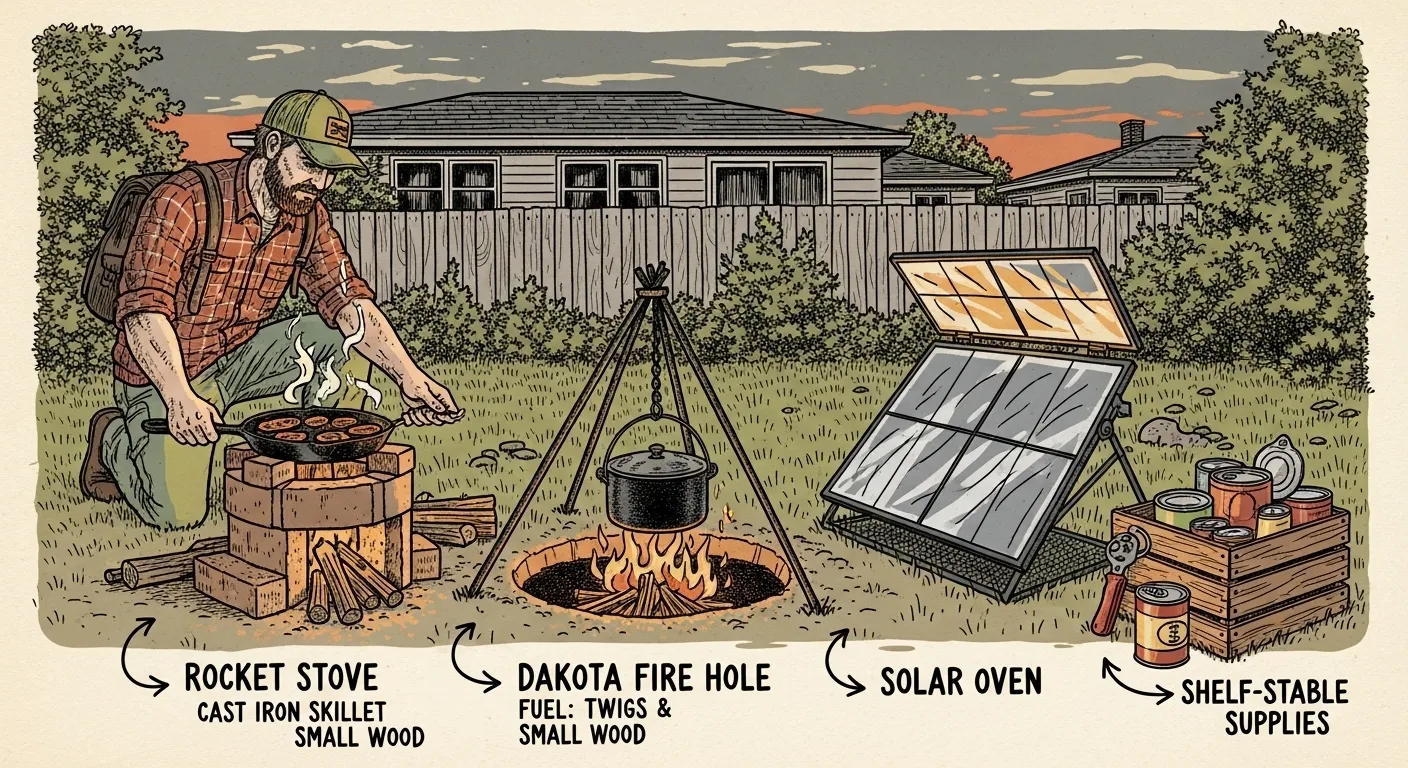
Effective ways to cook without power include solar ovens, campfire cooking, rocket stoves, Dutch ovens with cast iron, and portable butane or propane stoves. To stay safe, use proper ventilation, monitor food temperatures, protect refrigerated foods, and keep essential tools like a thermometer, manual can opener, and fire-starting supplies on hand.
Key Takeaways
- Build a two-method plan: one indoor-approved appliance and one outdoor method, so a single point of failure doesn't leave you without hot food.
- Discard perishables held above 40°F for more than 2 hours — or just 1 hour once it's over 90°F outside.
- Cook poultry to 165°F, ground meats to 160°F, and whole cuts to 145°F with a 3-minute rest, verified with a real thermometer, not a guess.
- Never run an outdoor-rated stove, grill, or generator inside — install a battery-powered CO detector wherever you're cooking with fuel.
- Practice your setup before you need it. Test solar ovens and rocket stoves in your own backyard first, because performance varies wildly by model.
Cooking Without Power: Safe, Practical Methods for Off-Grid Meals
The power goes out and within about six hours, most people have already made their first mistake. They open the fridge every ten minutes “just to check,” they fire up a charcoal grill in the garage to stay dry, or they eat cold beans out of the can for three days straight because that’s all they thought to plan for. Cooking without power isn’t actually the hard part. Planning for it before the lights go out is.
This isn’t complicated stuff. You don’t need a bunker full of gear. You need two or three methods that match your climate and your living situation, a handful of tools you already understand how to use, and a food safety framework so you’re not guessing whether that thawed chicken is still good. Let’s get into it.
Quick Summary
- Layer your methods: one appliance rated for indoor use, one outdoor method, and a compact kit you can grab in under a minute.
- Reliable off-grid cooking options include portable butane/propane stoves, campfire coal cooking, cast iron and Dutch ovens, rocket stoves, and solar ovens.
- Never run outdoor-only stoves, grills, or generators indoors — carbon monoxide doesn’t announce itself.
- Perishable food above 40°F gets a 2-hour clock, or 1 hour if it’s over 90°F outside.
- Cast iron and a Dutch oven are the two tools that work across every heat source on this list, which makes them the backbone of any off-grid kitchen.
Why This Matters More Than People Think
An ice storm knocks out power across your county for 72 hours. The roads are too icy to drive to a restaurant or grocery store. Your fridge food is questionable by hour four, your phone battery is dropping, and you realize the only cooking tool you own that doesn’t need an outlet is a lighter you found in a junk drawer.
That scenario plays out every winter somewhere in the Pacific Northwest. Ice storms take down power lines for days at a time, and the people who handle it well aren’t the ones with the fanciest gear — they’re the ones who practiced their setup before they needed it.
Method 1: Solar Cooking
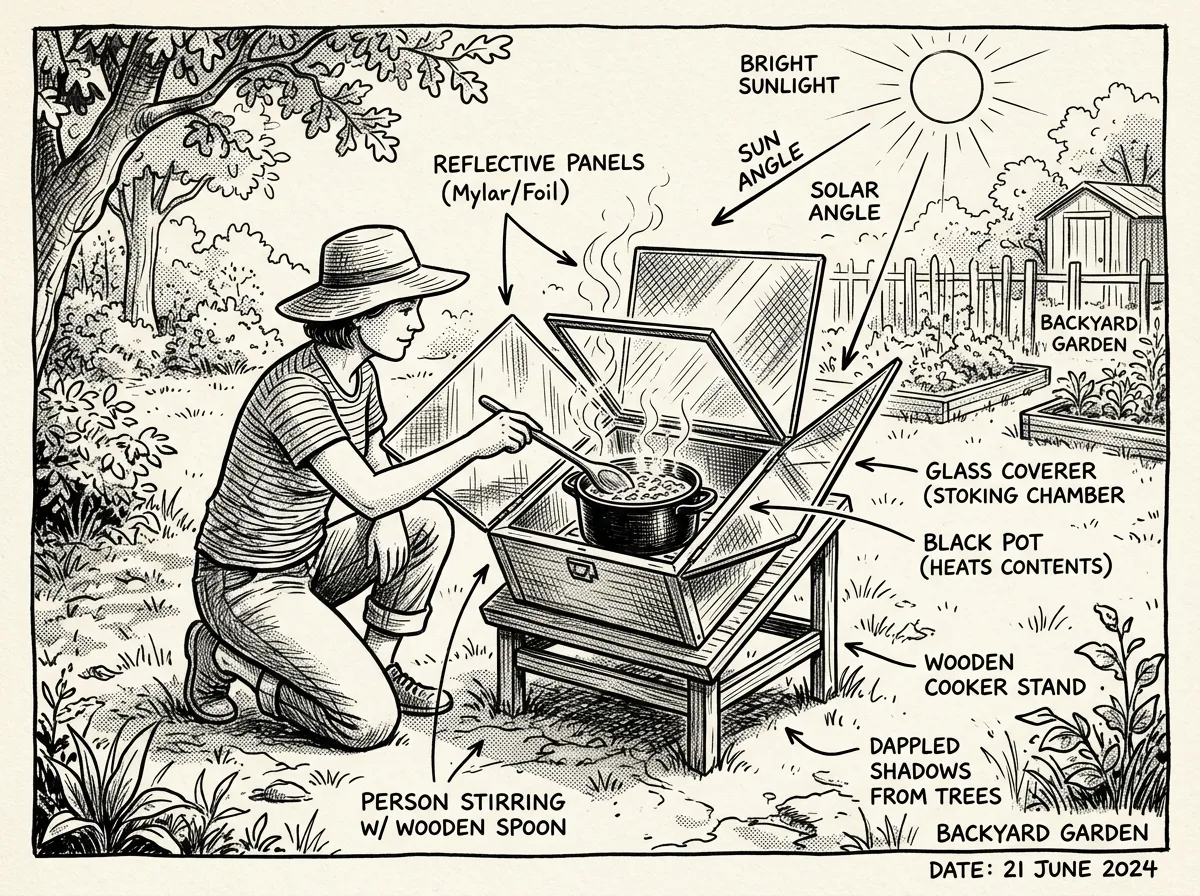 Solar oven in use during daylight hours
A solar oven is a reflective, insulated box that concentrates sunlight onto a dark pot. No fuel, no flame, no smoke. It’s slow — figure two to four hours for rice or beans — but it’s essentially free to run and about as low-risk as cooking gets.
Where it works well: Sunny climates with consistent daytime hours. High desert regions, the Southwest, and much of the interior West are ideal. If you’re in a cloudy, humid Gulf Coast climate, don’t count on a solar oven as your primary method — build it as a backup for the days the sun actually shows up.
Best uses: Heating canned goods, simmering rice and beans, baking simple flatbreads, and pasteurizing water if you know the proper technique and have a way to verify temperature.
Test any solar oven — commercial or DIY — on a clear afternoon before you need it. Cook times and results vary a lot by model, angle, and cloud cover, and the worst time to learn that is during an actual outage.
Method 2: Campfire Cooking
Open flame gets you fast heat, but coals get you controlled heat, which is what you actually want for cooking. Let your fire burn down to glowing coals before you start, then use a grill grate, a Dutch oven buried in coals, foil packets, or a skillet set beside (not directly in) the flame.
Safety Checklist for Fire Cooking
- Build fires only where it’s legal and permitted
- Clear a 10-foot radius of combustible material
- Keep water or sand within arm’s reach
- Never cook over an open flame inside any enclosed space
- Fully extinguish and cool coals before walking away
Starter meals that work every time: foil-packet vegetables with sausage, a one-pot Dutch oven stew, grilled corn still in the husk, and scrambled eggs in a well-seasoned skillet. None of these require precision — that’s the point when you’re managing coal heat for the first time.
Method 3: Rocket Stoves
A rocket stove is a small, insulated combustion chamber that burns sticks and twigs far more efficiently than an open fire. You can boil a liter of water in under ten minutes with a handful of dry kindling, which makes it one of the most fuel-efficient methods on this list.
Use these outdoors or in a very well-ventilated space only — they still produce smoke and carbon monoxide. Match your pot size to the stove’s opening, and test the stability of your cookware before you commit a full pot of soup to it.
A rocket stove built from cinder blocks can be assembled in about twenty minutes and boils water noticeably faster than an open fire using the same amount of wood. In wet climates like the Pacific Northwest, where dry kindling can be hard to find during a storm, keeping a bag of dry tinder stored indoors makes the difference between a stove that works and one that just smokes.
Method 4: Dutch Ovens and Cast Iron
Why they matter: cast iron holds heat longer than almost anything else in your kitchen, it works on coals, charcoal, propane, or a rocket stove, and it lasts for decades with basically zero maintenance beyond keeping it dry and seasoned.
The Lodge 12-inch cast iron skillet — around $25 to $35 depending on where you find it — is a solid starting point for anyone building an off-grid kitchen from scratch. It’s heavy, it’s simple, and it does not care what heat source you throw at it. Pair it with a Lodge camp Dutch oven, 10 to 12 inches, running somewhere around $60 to $90, and you can fry, simmer, braise, and bake bread, all with two pieces of cookware.
Oven-style baking trick: place coals both under the Dutch oven and on top of the lid. That top layer of coals is what turns a stew pot into something closer to a real oven — it’s how you get cornbread or biscuits without an actual oven.
Care basics: dry it completely after washing (moisture is the enemy), re-season with a thin coat of oil after each use, and never let it soak in water overnight.
Method 5: Portable Butane and Propane Stoves
Butane vs. Propane
Butane canisters are compact and convenient for tabletop cooking, but they lose pressure and performance once temperatures drop below roughly 40°F. If you’re cooking outside in a Rocky Mountain winter or anywhere with real cold snaps, butane will let you down right when you need it most.
Propane handles cold weather better and comes in larger canisters that support longer cook times, which makes it the better choice for extended outages or colder climates.
Indoor Use Rules
This is where people often get it wrong. A stove has to be explicitly labeled by the manufacturer as safe for indoor use — not “well, it’s small, it should be fine.” Follow every ventilation instruction that comes with it, and install a carbon monoxide detector — a battery-powered unit runs around $20 to $30 — anywhere you’re running fuel-burning equipment near living space.
A common mistake happens when an outdoor-rated propane stove is brought inside “just for a few minutes” because it’s raining and cooking on the porch feels miserable. That’s exactly how carbon monoxide poisoning happens — it’s odorless, and by the time a headache sets in, there’s already a problem. If a stove doesn’t say indoor-approved on the box, it stays outside. No exceptions, no matter the weather.
Storage and Handling
Store and rotate fuel canisters according to the manufacturer’s guidance and your local fire code. Before every use, inspect canisters for dents, rust, or any sign of a slow leak — a hissing sound or the smell of gas means that canister doesn’t get used, period.
Essential Gear for Off-Grid Cooking
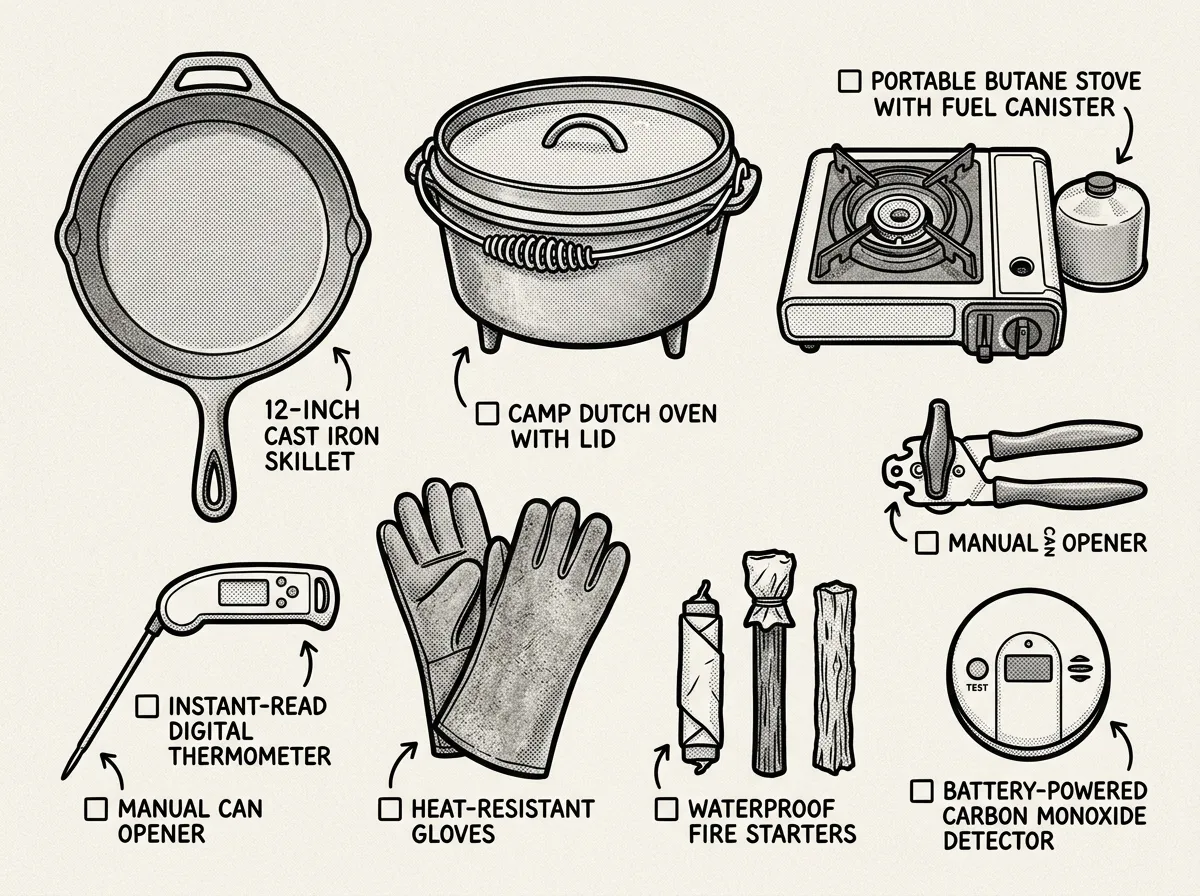 Complete off-grid cooking kit laid out
You don’t need to buy everything at once. Start with the items that cover the most scenarios and build from there.
- Long matches and a reliable backup lighter
- Waterproof fire starters, tucked somewhere dry
- Cast iron skillet, 10 or 12 inch
- Camp Dutch oven, 10-12 inch
- Grill grate and long metal tongs
- Heat-resistant gloves rated for open-flame cooking
- Digital instant-read food thermometer
- Heavy-duty manual can opener
- Water storage plus filters or purification tablets
- Cooler and reusable ice packs
- Backup fuel for your portable stove
- Basic first-aid kit
Nice-to-have extras: a windscreen for portable stoves (wind kills efficiency faster than almost anything else), a collapsible wash basin, a stovetop kettle or percolator for coffee — which matters more for morale than people admit — and a laminated card with your temperature chart and a few practiced recipes.
Food Safety: The Part People Skip
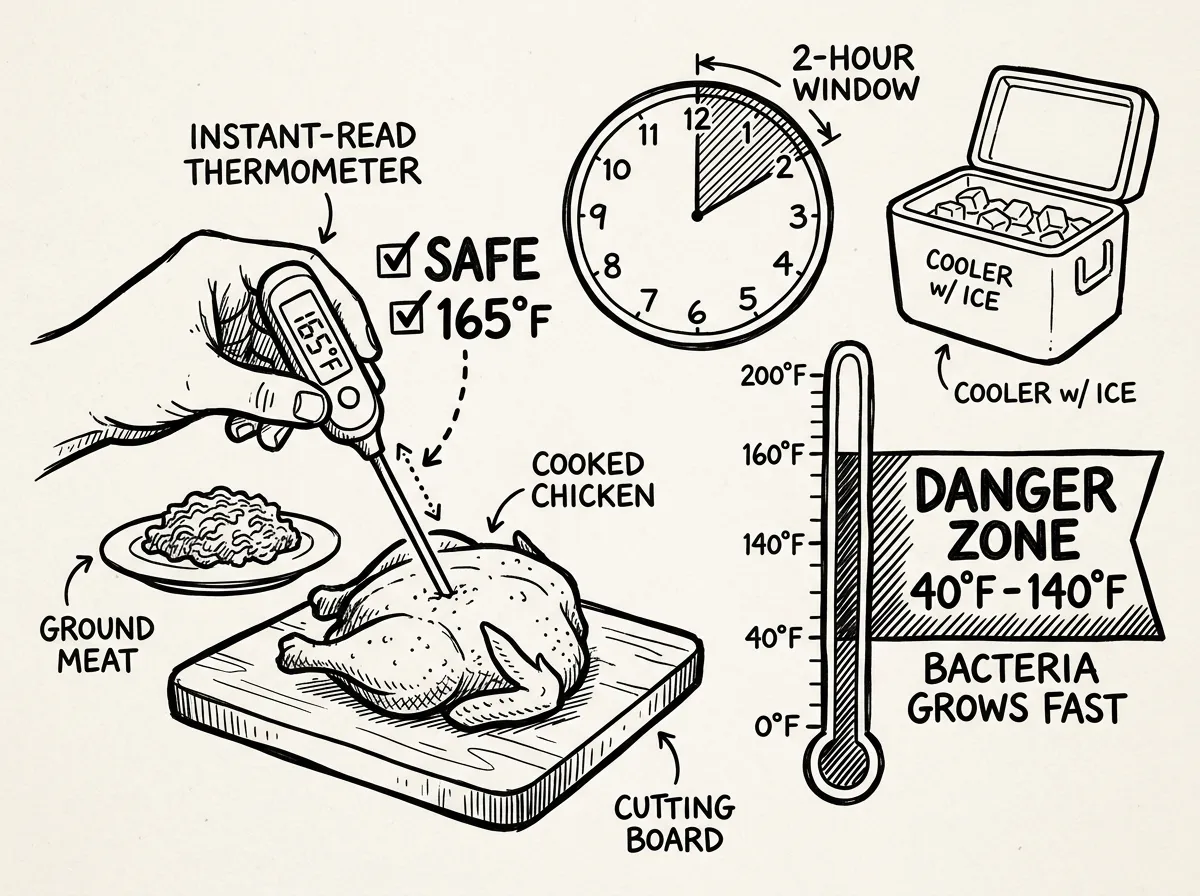 Checking food temperature with instant-read thermometer
This is the section that matters most, because bad information here can actually make someone sick.
Bacteria multiply fastest between 40°F and 140°F — what food safety folks call the danger zone. Perishable food held above 40°F for more than two hours needs to go in the trash, no matter how good it still looks. If the ambient temperature is over 90°F, that window shrinks to just one hour. This is exactly why a real instant-read thermometer — the kind that costs around $12 to $20 — belongs in every kit. Your eyes and your nose are not reliable food safety tools.
USDA Safe Internal Temperatures
- Poultry: 165°F (74°C)
- Ground meats: 160°F (71°C)
- Steaks, chops, roasts: 145°F (63°C), rested for 3 minutes
- Leftovers and casseroles: 165°F (74°C)
Wash hands and utensils with potable water whenever possible, and keep raw meat separated from anything ready-to-eat — cross-contamination doesn’t take a break just because the power’s out.
Shelf-Stable Staples Worth Stocking
Rice, dry pasta, dry beans, canned meats and vegetables, rolled oats, and dehydrated meals should make up the backbone of your outage pantry. None of them need refrigeration, and most of them cook in one pot.
A Simple Three-Day Outage Meal Plan
Day 1: Lean on ready-to-eat canned goods, sandwiches, and anything already prepped in the fridge before it hits the danger zone.
Day 2: One-pot rice or pasta dishes, canned soups heated to a safe temperature. This is where your cast iron or Dutch oven earns its keep.
Day 3 and beyond: Start conserving fuel seriously. Lean on solar cooking if you’ve got sun, and shift toward fully shelf-stable staples that need minimal heat.
Practice Before You Need It
- Pick one indoor-approved appliance and one outdoor method that fit your climate and living situation
- Assemble a compact kit using the checklist above and store it somewhere you can grab in under a minute
- Practice each method at home on a normal weekend, not during an emergency
- Test any solar oven or rocket stove outdoors first — performance varies a lot by model and conditions
- Write a laminated card listing your fuel inventory, kit location, and three recipes you’ve already practiced
The single biggest predictor of whether someone handles a power outage well isn’t how much gear they own — it’s whether they’ve actually used it before. Brand-new camp stoves that sit in their boxes for years often fail the first time someone tries to light them during an actual storm, cold hands fumbling with an unfamiliar igniter. Ten minutes in your backyard now saves you that exact frustration later.
Frequently Asked Questions
What’s easiest for beginners? A portable propane or butane stove is usually the simplest starting point — light it, adjust the flame, cook. If you’re somewhere sunny and want a fuel-free backup, a tested solar oven is worth adding once you’ve got the basics down.
Can I use a camp stove indoors? Only if the manufacturer explicitly says it’s rated for indoor use, and only while meeting their ventilation requirements. Most camp stoves are outdoor-only, and treating that as a suggestion rather than a rule is how people end up with carbon monoxide poisoning.
Which foods work best off-grid? Shelf-stable staples — canned goods, rice, pasta, oats — plus hardy produce and pre-cooked or dehydrated meals that don’t demand precise temperatures or long cook times.
How long will one propane canister last? It depends heavily on the stove and how you’re cooking, but a standard 1-pound canister typically gives you somewhere around an hour of continuous high-heat cooking. Keep at least two or three on hand if you’re planning for a multi-day outage.
The Complete
Prepper's Reference.
149 articles synthesized into one comprehensive PDF — twelve chapters covering water, food, shelter, first aid, comms, and scenario-specific preparedness. Free with your email.
Unsubscribe anytime · We never share your email
You're in. Check your inbox.
Keep Reading
Meal Prepping Ideas That Build Long-Term Food Security
Meal prepping ideas that go past Sunday batch-cooking — build rotating stockpiles, cut costs, and prep for real emergencies. See how.
Mylar Bags for Food Storage: Complete Guide (2026)
Learn how to use mylar bags for food storage to preserve dry goods 25+ years. Expert guide covers thickness, sealing, oxygen absorbers & mistakes to avoid.
Canned vs. Freeze-Dried: The Ultimate Prepper Showdown
Canned vs. freeze-dried food: compare shelf life, cost, nutrition, storage, and convenience so beginner preppers can build smarter emergency supplies.