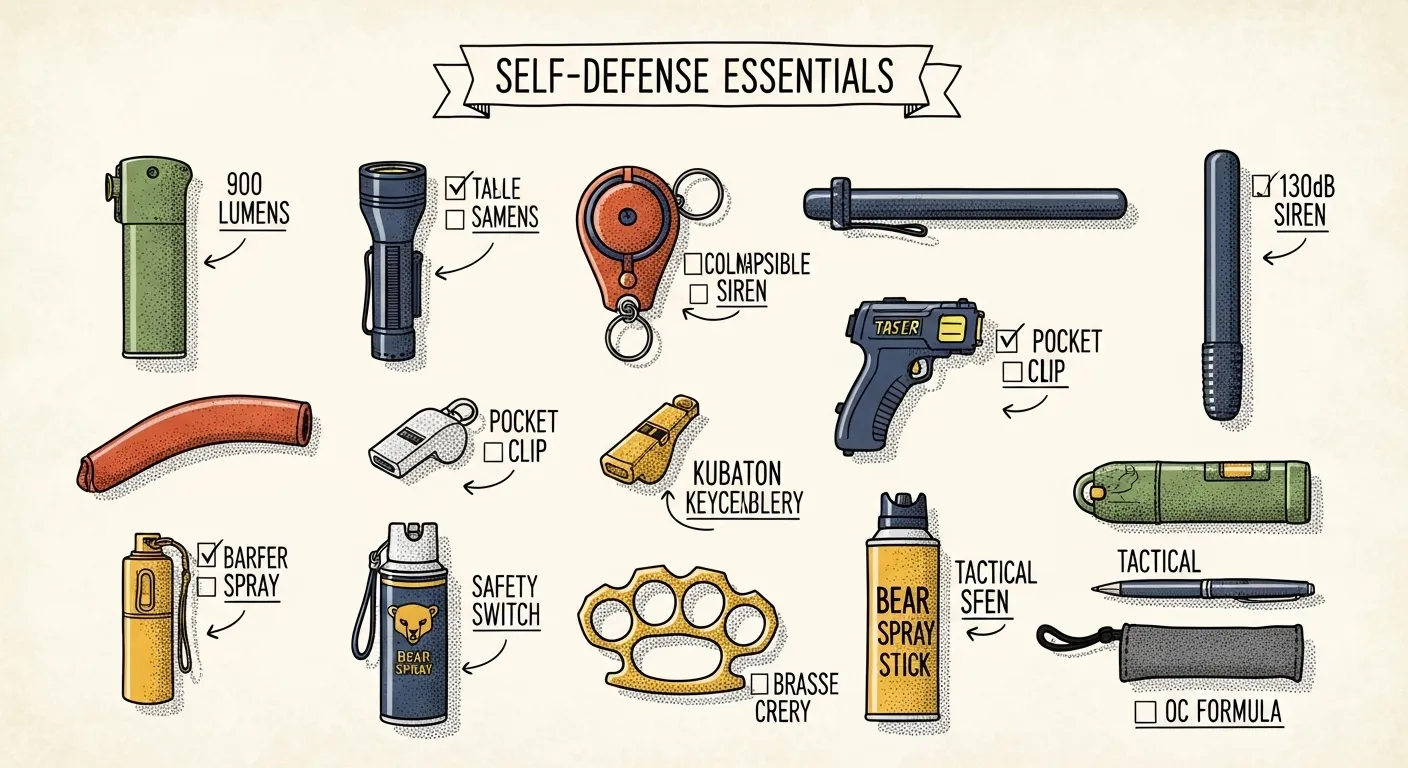
The best non-lethal self-defense weapons for most beginners are pepper spray, personal alarms, stun guns, and tactical flashlights. Pepper spray is usually the top choice because it offers distance, strong stopping power, and ease of carry, while alarms and flashlights add practical layers to a prepper security plan.
Key Takeaways
- Start with pepper spray or pepper gel — it's the highest-value, lowest-training tool for most people, especially for everyday carry.
- Layer your defense: pepper spray, a personal alarm, and a tactical flashlight cover more scenarios than any single device.
- Only add a stun gun or CEW after confirming it's legal where you live and actually training with an inert version.
- Practice draw, activation, retention, and movement — under stress, fine motor skills disappear fast without repetition.
- Check expiration dates and battery charge on a set schedule; expired pepper spray and dead stun guns are worse than carrying nothing.
Best Non-Lethal Self-Defense Weapons: Practical Tools for Preppers
One question comes up more than almost any other when it comes to emergency preparedness and personal safety: what should you carry that won’t get you arrested or land you in a lawsuit, but will actually work if something goes wrong? Non-lethal tools are the honest answer for the vast majority of people. They’re legal in more places, require less training, and — frankly — most personal safety situations resolve a lot better with pepper spray and a loud alarm than they would with a firearm you’re not confident using under stress.
This list draws on manufacturer specifications and published training guidance, not just anecdote — and it accounts for how often people fumble gear they never practiced with when it actually mattered.
Quick Summary
- Start here: pepper spray or pepper gel — it’s portable, effective at a distance, and needs almost no training
- Layer it: add a personal alarm, a tactical flashlight, and a phone with emergency contacts already programmed
- Level up carefully: stun guns and CEWs only make sense once you’ve confirmed they’re legal where you live and you’ve actually trained with one
- Train before you carry: inert trainers let you rehearse the draw and activation without gassing yourself in your kitchen
- Maintain what you carry: expired pepper spray and a dead stun gun battery are both worse than an empty pocket — you think you’re covered and you’re not
Ask yourself four questions before anything goes in your bag or on your keychain: Is it legal where I carry it? Can I access it under stress? Have I actually practiced with it? Is it maintained — charged, unexpired, ready? If you can’t answer yes to all four, it’s not ready to be part of your kit yet.
What “Non-Lethal” Actually Means
Non-lethal — sometimes called less-lethal — refers to tools designed to deter, distract, or temporarily incapacitate someone without the intent to kill. That word “intent” matters, but so does reality: these tools still carry risk of injury, and in rare cases, serious injury. Nothing on this list is risk-free, and none of it replaces situational awareness or a plan to get away from danger.
A few terms worth knowing before you shop:
- OC (oleoresin capsicum) — the active compound in pepper spray that causes intense eye pain, tearing, and often difficulty breathing.
- Pepper gel — a thicker OC formulation. It doesn’t drift in wind the way aerosol spray does, and it’s far less likely to blow back into your own face.
- Stun gun — a handheld device that delivers an electric shock, but only on direct contact with the target.
- CEW (conducted electrical weapon) — the TASER-style category. It fires probes that can incapacitate at a distance, assuming both probes make solid contact.
Top Non-Lethal Tools, Ranked by Recommended Priority
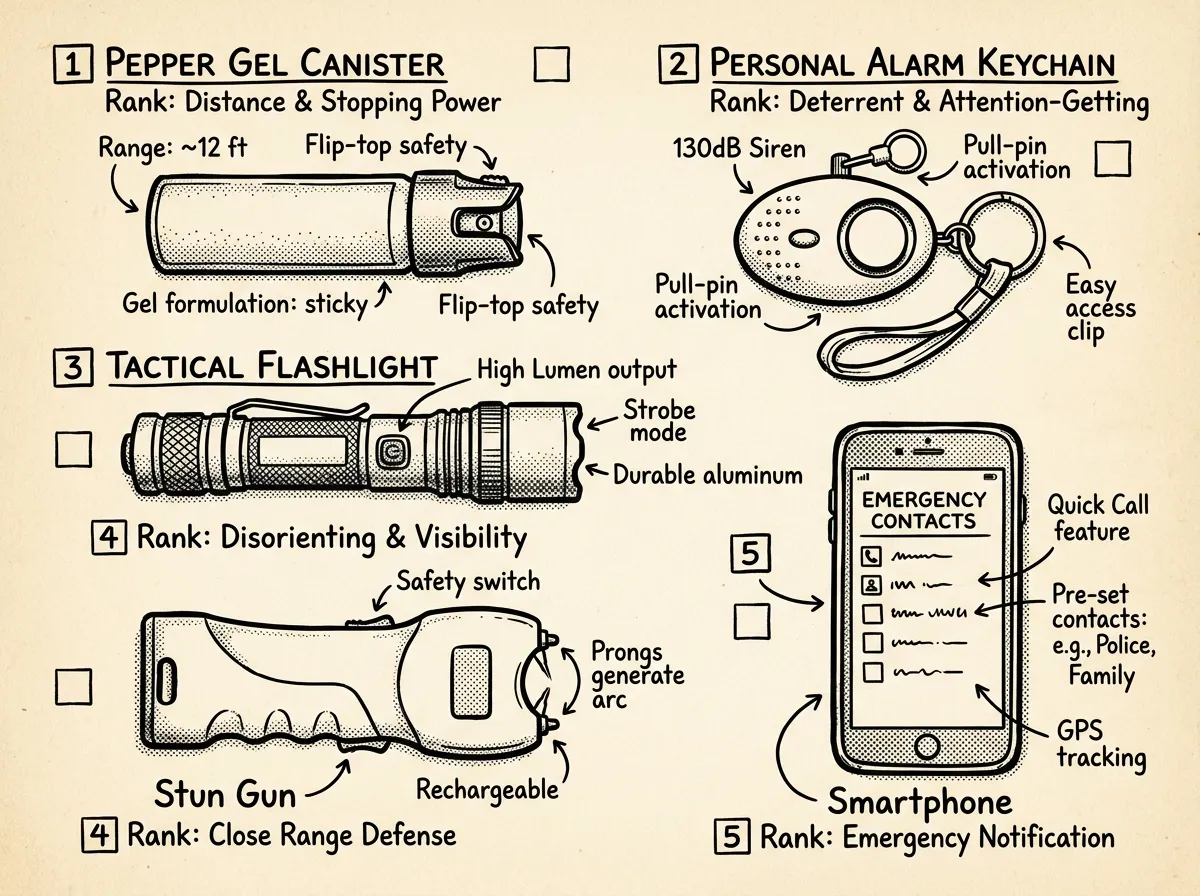 Layered non-lethal self-defense starter kit
Pepper Spray and Pepper Gel
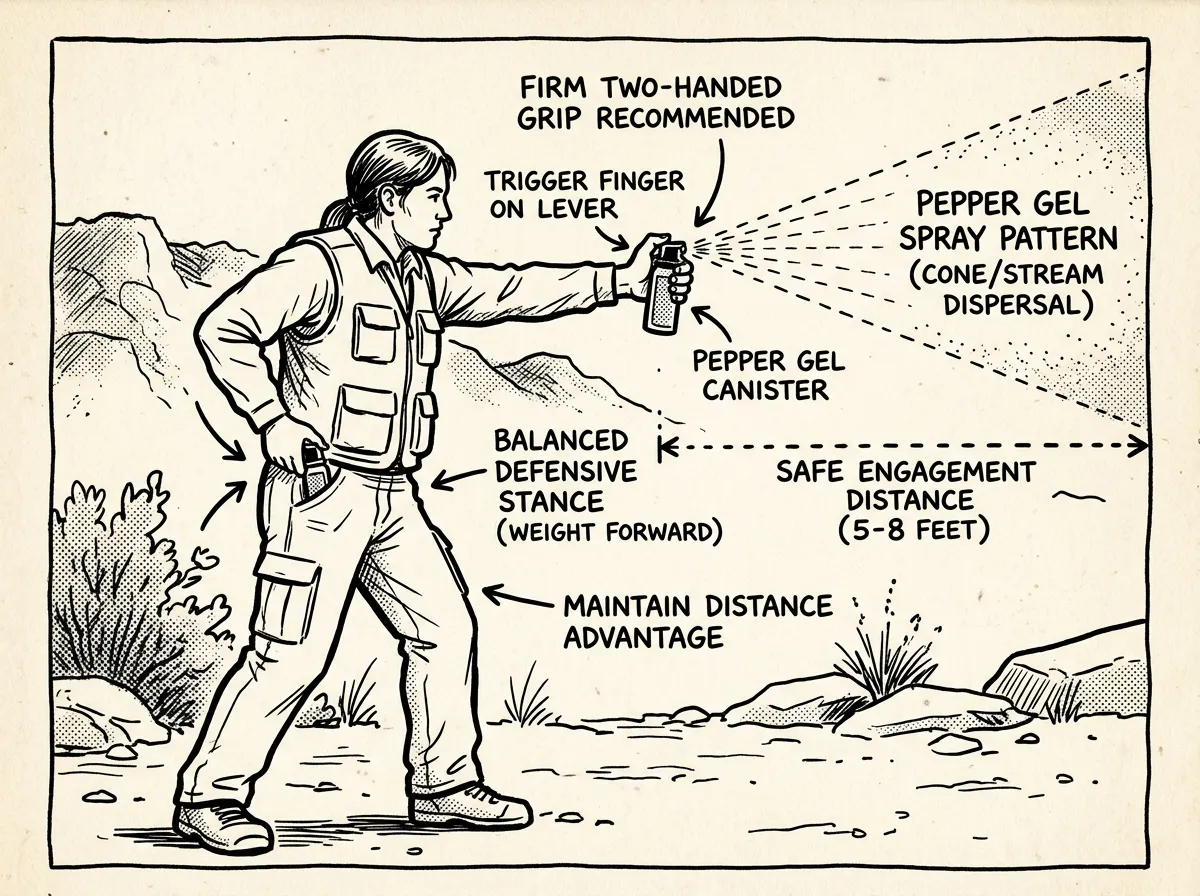 Drawing and deploying pepper spray at distance
This is where most people should start. Pepper spray gives you stand-off distance — you don’t need someone within arm’s reach to use it effectively, which changes the entire equation compared to a stun gun. It causes eye pain, tearing, and breathing difficulty in most people, and that’s usually enough of a window to run.
The tradeoff is wind and aim. Aerosol sprays can drift back at you in a gust, and it’s common for people to spray themselves by accident when they hold the canister wrong or panic and press too hard.
Gel formulas are generally recommended over aerosol sprays: gel doesn’t drift, it’s less likely to blow back in wind, and it tends to be more forgiving for someone using it for the first time under stress. A basic pepper gel canister typically costs around $10 to $15 — inexpensive insurance for something you’ll hopefully never need.
Canisters expire — usually within two to four years — so mark the date and set a phone reminder. An expired canister can have reduced potency, and that’s not something you want to discover mid-incident.
Personal Alarm or Wearable Panic Button
Here’s a tool people underestimate constantly. A personal alarm does one job: it makes an enormous amount of noise, often 120+ decibels, the moment you pull a pin or press a button. No physical contact required. No aiming. No training curve to speak of.
Is it a guaranteed fix? No — it depends on someone being close enough to hear it and react, and it won’t do much good if you’re alone on a remote trail. But as a backup layer, especially for a teenager walking to a car at night or a parent wanting something for their kid, it’s close to foolproof. Some newer models pair with a phone app to send your location to emergency contacts automatically, which adds real value if you’re the type who forgets to text “I’m home safe.”
Tactical Flashlight
A quality tactical flashlight does three jobs: it lets you see what’s actually happening in a dark parking lot, it can temporarily disorient someone with a high-lumen strobe function, and it’s genuinely useful for a hundred mundane tasks — checking a breaker box, finding your keys, signaling for help if your car breaks down.
A common misconception in gear reviews is that people treat the flashlight like it’s a magic wand that’ll stop an attacker on its own. It won’t. Think of it as a tool that buys you information and a half-second of confusion, not a knockout punch. Pair it with pepper spray or an alarm rather than relying on it alone.
Stun Guns
A stun gun delivers a painful shock on contact, and it can absolutely disrupt someone briefly. But “on contact” is the catch — you need to be close enough to touch your attacker, which is exactly the range you’re usually trying to avoid. Effectiveness also drops noticeably through heavy clothing like a winter coat, which is a real problem in cold climates for much of the year.
Stun guns are also more heavily regulated than pepper spray. Some states restrict them outright, some cities add their own rules on top of state law, and campuses or workplaces often have separate policies again. Don’t assume — check before you buy.
CEW (TASER-Style Devices)
These fire probes and can incapacitate at range if both probes make solid contact — which is a real advantage over a contact stun gun. But they’re expensive (often several hundred dollars for a consumer model), heavily regulated in many jurisdictions, and less reliable than people expect if probes miss or clothing interferes with the circuit.
CEWs aren’t generally recommended for beginners. They cost more, require more training to deploy correctly under stress, and the legal landscape shifts by state more than almost any other item on this list. Anyone considering one should take an actual training course first — not just watch a YouTube video — and confirm local law in writing, not from a forum post.
Impact Tools: Expandable Batons and Kubotans
An expandable baton gives you reach and real stopping potential in trained hands. The problem is twofold: they’re restricted or banned in a surprising number of states and cities, and they require ongoing dedicated training to use safely and effectively. This isn’t a “buy it and forget it” item — it’s closer to a martial arts commitment.
One quick note: bear spray is not a substitute for pepper spray meant for personal defense against people. It’s formulated differently, dispersal patterns differ, and using it on a human can carry its own legal complications. Keep them separate in your kit and your mind.
Choosing the Right Tool for You
What actually fits your life? That’s the real question, and it’s different for a college student walking campus at night than it is for someone doing solo trail runs in high desert terrain.
- Check the law at every level that applies to you — city, county, state, campus, and workplace policy can all differ
- Match the tool to your environment: commuting, running, home defense, and vehicle carry each favor different gear
- Think about engagement distance — pepper spray and CEWs work at a stand-off, stun guns and batons require contact
- Be honest about training time you’ll actually put in; alarms and sprays need little, CEWs and batons need a lot
- Build in maintenance — track expiration dates and battery charge on a recurring calendar reminder
- Layer your final kit instead of relying on one single tool
Using These Tools Effectively
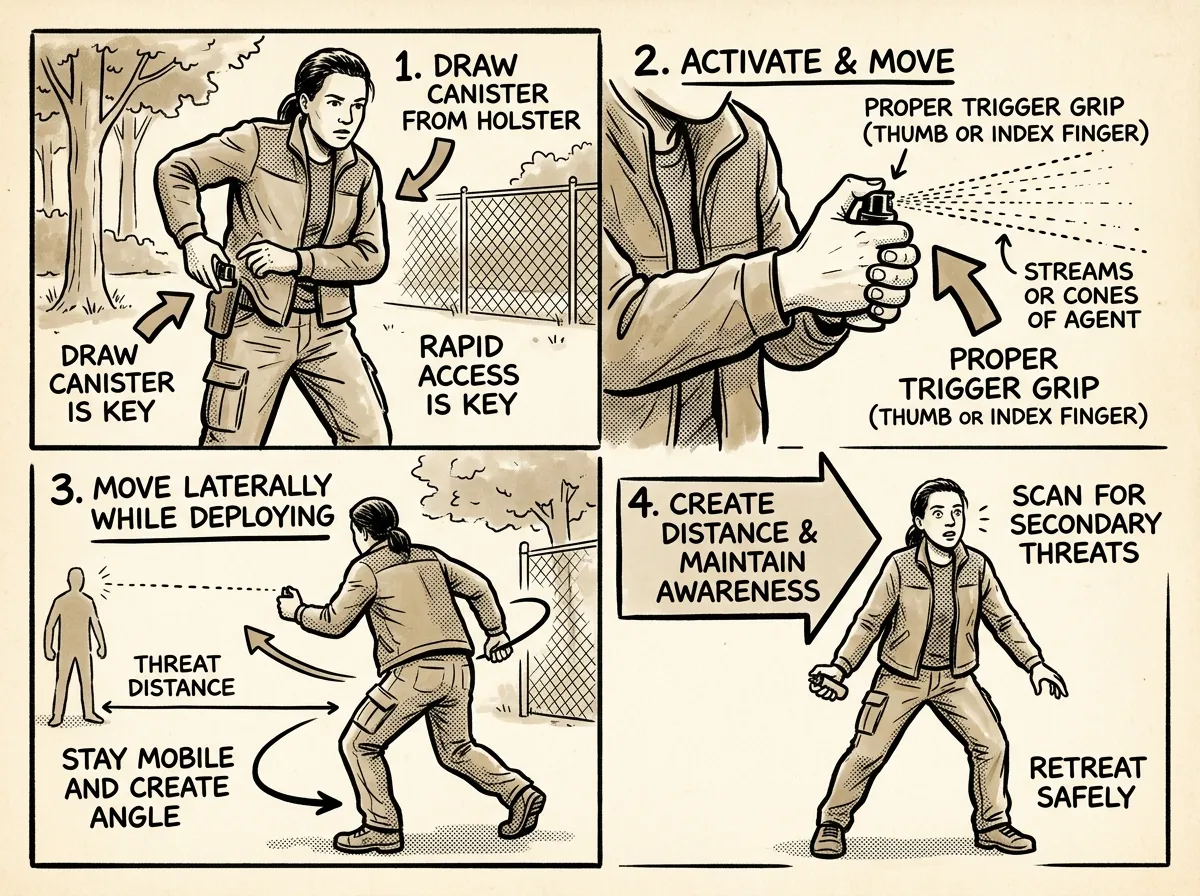 Training sequence: draw, activate, move, and escape
In self-defense training sessions, it’s common to see people try to activate a stun gun with the safety still engaged, under time pressure, in front of an instructor. That’s the gap between owning a tool and being able to use it. Real threats don’t wait for you to read the manual.
- Practice draw, activation, and retention with an inert trainer where legal
- Run malfunction drills — what do you do if the canister jams or the battery’s dead
- Focus every drill on escape, not on “winning” a confrontation
- Rotate expired pepper spray canisters on a set schedule, not “whenever I remember”
- Charge stun gun and flashlight batteries monthly, even if unused
- Practice basic de-escalation and situational awareness alongside your gear drills
If something does happen, your job afterward is simple: get medical attention if you need it, preserve any evidence you safely can, and report the incident to authorities. Don’t try to be a hero after the fact — get yourself safe first.
Technical and Legal Realities Worth Knowing
A few honest caveats that don’t fit neatly into a product description:
- Alarm decibel output varies significantly between models — check the manufacturer’s spec sheet, not just the marketing copy.
- Pepper spray effects depend on the formulation, the dose delivered, and the individual’s own physiology. Reactions vary more than people expect, and in rare cases can be severe.
- CEW effectiveness depends heavily on probe spread, clothing, and the specific device — don’t assume every model performs identically.
- Laws change, sometimes quickly. What was legal in your state two years ago may not be today. Confirm current rules before you buy or carry.
Building a Practical Starter Kit
If you’re starting from zero, here’s a practical kit to consider:
- Quality pepper spray or pepper gel, rotated before the expiration date
- Personal alarm or wearable panic device, tested monthly
- Tactical flashlight with a secure carry method — pocket clip or holster
- Phone with emergency contacts saved and location sharing enabled
- Practiced escape routes for your home, workplace, and regular commute
Add a stun gun, CEW, or impact tool only after you’ve confirmed it’s legal in your area and you’ve actually trained with it — not just read the box. And whenever you have the option, avoid the confrontation entirely. Leave. Get to a public space. Call for help. Every tool on this list exists to buy you time to do exactly that, not to win a fight you never needed to be in.
The best self-defense tool is the one you’ve actually practiced with under pressure — not the one with the scariest specs on the box.
Frequently Asked Questions
What counts as a non-lethal self-defense weapon? Any tool designed to deter or temporarily incapacitate without intent to kill — pepper spray, personal alarms, tactical flashlights, stun guns, and CEWs all fall into this category. All of them still carry some risk of injury, so treat them with respect rather than as toys.
Which option is best for beginners? Pepper spray, hands down. It gives you range, it’s easy to carry, and it works reliably when you actually practice drawing and aiming it. It’s better for a first-time buyer to master pepper spray than half-learn a stun gun.
Are stun guns effective? At close range, yes — they can genuinely disrupt an attacker. But they require contact, which is the range you’re usually trying to avoid in the first place, and they lose effectiveness through heavy clothing. CEWs solve the distance problem but come with more cost and more regulation.
How long does pepper spray incapacitate someone? It varies by person and formulation, but treat it as a short window — seconds to a couple of minutes — not a permanent solution. Use that window to get away and get help, not to stick around and see what happens next.
Follow all local laws and manufacturer instructions for anything you carry. This article is general information — it’s not legal or medical advice, and you should confirm current statutes with your local authorities or an attorney before you buy or carry anything on this list.
The Complete
Prepper's Reference.
149 articles synthesized into one comprehensive PDF — twelve chapters covering water, food, shelter, first aid, comms, and scenario-specific preparedness. Free with your email.
Unsubscribe anytime · We never share your email
You're in. Check your inbox.
Keep Reading
National Emergency Preparedness Month: 30-Day Plan
Use this 30-day National Emergency Preparedness Month challenge to go from unprepared to fully ready. One simple 15-minute task per day. Start now.
Emergency Preparedness Merit Badge: A Parent's Guide
Use the Emergency Preparedness merit badge framework to teach your kids real survival skills at home. Step-by-step activities for each requirement.
Emergency Preparedness Kit: Room-by-Room Home Guide
Build your emergency preparedness kit room by room for 14-day shelter-in-place readiness. Budget-friendly system. Start tonight.