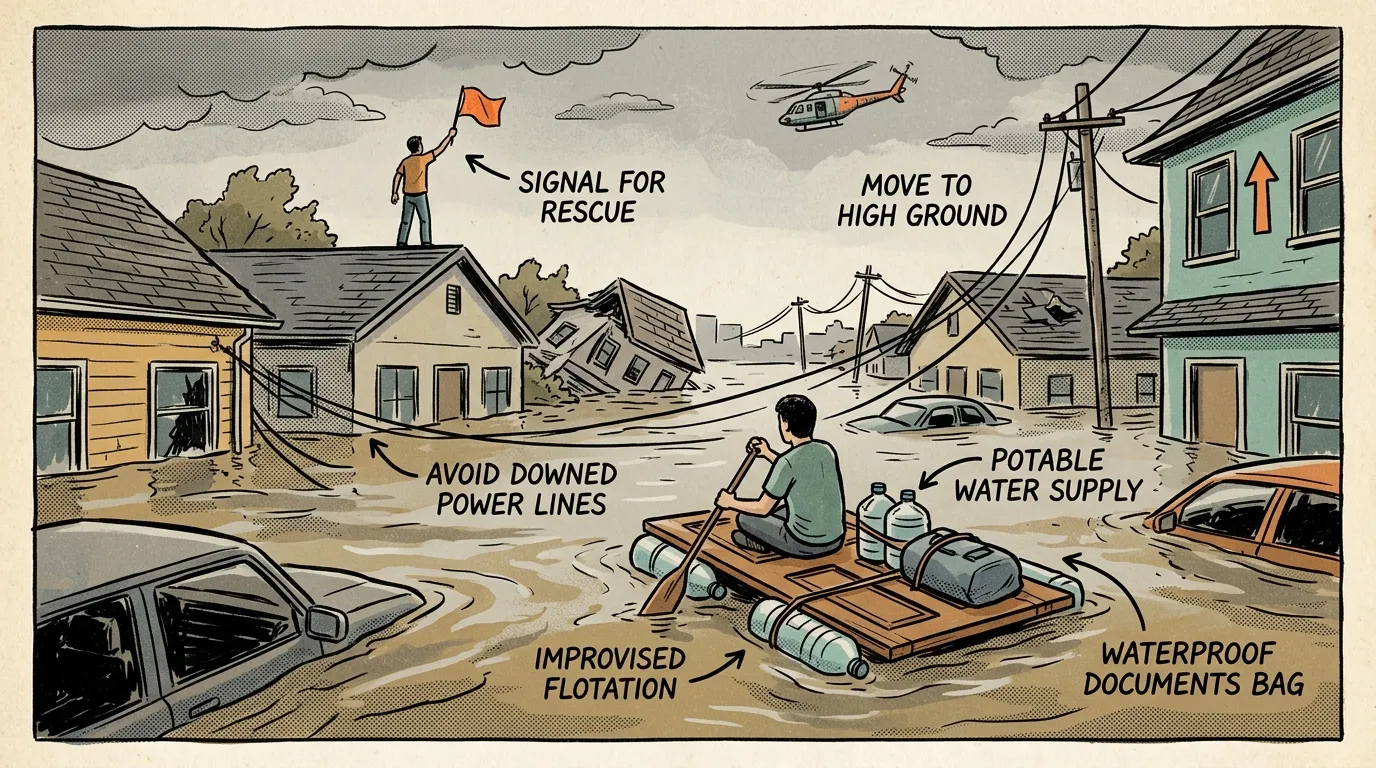
Hurricane Katrina killed over 1,833 people and caused $125 billion in damage, primarily through levee failure and storm surge rather than wind. Organized federal rescue took five days to reach parts of New Orleans. The core lessons are that storm surge causes roughly 90% of hurricane deaths, infrastructure failures cascade for weeks, and individuals must plan for at least two weeks of self-sufficiency.
Key Takeaways
- Plan for a minimum of two weeks of total self-sufficiency — government rescue took five days to reach parts of New Orleans, and Hurricane Maria proved infrastructure can stay down for months.
- Storm surge and flooding cause roughly 90% of hurricane fatalities — if you're in a surge zone, evacuation before landfall is your only real survival strategy.
- Make your evacuation decision when a storm is 5–7 days out, not when it's upgraded to a scary category — rapid intensification can outpace your decision-making window.
- Keep an axe or hatchet staged on your top floor — during Katrina, people drowned in attics because they couldn't breach the roof as floodwater rose.
- Document every room and possession with photos and video stored in the cloud before hurricane season — thousands of Katrina survivors lost all records to floodwater and faced months of bureaucratic nightmare.
Quick Summary
- Hurricane Katrina killed over 1,833 people, displaced more than one million, and caused $125 billion in damage — not primarily from wind, but from levee failure, storm surge, and the collapse of every system people assumed would save them.
- Government rescue took five full days to reach parts of New Orleans. Every major storm since has confirmed that you can’t outsource your survival to institutions.
- Storm surge and flooding account for roughly 90% of hurricane deaths. If you’re in a designated surge zone and you don’t evacuate, nothing else you do matters.
- The infrastructure cascade — power, then communication, then water, then fuel, then medical, then food — can take weeks or months to reverse. Plan for two weeks of self-sufficiency at minimum.
- FEMA reformed significantly after Katrina, but the agency’s own guidance now explicitly tells you to plan for self-reliance. You are your own first responder.
- The storms are getting harder to predict and faster to strengthen. Your preparation window is shrinking even as your warning window improves.
Why the Lessons From Hurricane Katrina Still Matter
On August 29, 2005, Hurricane Katrina made landfall along the Gulf Coast and rewrote the playbook on what a hurricane could do to a modern American city. Twenty years later, the lessons from Hurricane Katrina remain the single most important case study in American emergency preparedness.
The storm itself was devastating. Category 5 at peak intensity over the Gulf. But it was the failure of the levee system that turned New Orleans into a bathtub. Eighty percent of the city flooded, some neighborhoods under 15 feet of water. Over 1,833 people died. More than one million were displaced, many permanently. The economic damage hit $125 billion, and entire communities simply ceased to exist. People waited on rooftops for days. The Superdome became a symbol of institutional failure. Katrina didn’t just expose the power of a hurricane — it exposed the fragility of every system we assume will save us.
Twelve years later, Hurricane Maria slammed into Puerto Rico as a Category 4 and demonstrated that Katrina wasn’t a one-off lesson we’d learned from. Nearly 3,000 people died, most not from the storm itself but from infrastructure collapse in the weeks and months that followed. The entire island lost power — not for days, but for months. Some areas didn’t see electricity restored for almost a year. Hospitals ran on generators until the diesel ran out, then they simply stopped functioning.
Then there’s what happened more recently. Hurricane Ian in 2022 hit Fort Myers Beach as a Category 4 with storm surge reaching 15 feet in some areas. The surge didn’t just flood homes — it removed them from their foundations. 149 people died, many drowning in surge they didn’t believe would reach them. Damage topped $112 billion. And in 2017, Hurricane Harvey parked itself over Houston and dumped an almost incomprehensible 60 inches of rainfall over four days, killing 107 people and causing $125 billion in damage. Harvey barely had notable winds by the time it stalled. It didn’t need them.
These disasters taught specific, actionable lessons that should reshape how every household prepares for hurricane season. The people who die are overwhelmingly the ones who didn’t leave when they could or didn’t prepare when they had time.
7 Critical Lessons Learned From Hurricane Katrina
Katrina was the defining disaster of modern American emergency management. Every one of these hurricane Katrina lessons learned has been validated by every major storm since — they aren’t historical curiosities, they’re operating principles.
-
Government rescue may not come for days — self-sufficiency is mandatory. Organized federal response took five days to reach parts of New Orleans. Plan for at least two weeks without any outside assistance.
-
Levees and infrastructure fail — don’t trust engineered systems blindly. New Orleans’ levee system was designed to protect the city, and it catastrophically failed. Your survival plan can’t depend on systems you don’t control.
-
Storm surge and flooding kill far more people than wind. According to NOAA data, roughly 90% of hurricane fatalities are water-related. If you’re in a surge zone, evacuation is your only survival strategy.
-
Communication systems collapse within 24–72 hours. Cell towers lost backup power across the Gulf Coast, leaving hundreds of thousands unable to call for help. Have backup communication plans.
-
Medical systems fail when power fails — stockpile medications. Hospitals and pharmacies became inaccessible. Patients dependent on dialysis, insulin, and oxygen died waiting for systems that never came back online.
-
Cash is king when digital systems go down. ATMs, credit card terminals, and banking systems were nonfunctional for weeks. Small-denomination cash was the only currency that worked.
-
Community networks save more lives than individual stockpiles. The Cajun Navy and neighborhood rescue groups pulled more people from flooded homes than official first responders in the first 72 hours. Your neighbors are your most valuable asset.
Katrina didn’t just expose the power of a hurricane — it exposed the fragility of every system we assume will save us.
How FEMA Changed After Katrina
Katrina was the case study that changed everything about how self-sufficiency is taught in disaster response curriculum. Before Katrina, the prevailing assumption — even within emergency management — was that federal resources could scale to meet almost any domestic disaster. Katrina shattered that completely.
The failures were systemic. FEMA hadn’t pre-positioned adequate supplies or personnel. Coordination between federal, state, and local agencies was disastrously poor. FEMA Director Michael Brown had no emergency management experience, and his now-infamous “Brownie, you’re doing a heck of a job” moment became shorthand for government incompetence during crisis. The agency’s own after-action report, documented in the White House’s Federal Response to Hurricane Katrina: Lessons Learned report, acknowledged failures at virtually every level.
Congress responded with the Post-Katrina Emergency Management Reform Act of 2006, which restructured FEMA significantly. The law required the FEMA Administrator to have demonstrated emergency management experience. It established better pre-staging protocols, requiring supplies and personnel to be positioned before landfall rather than deployed reactively. The National Response Framework was overhauled, and the Integrated Public Alert and Warning System (IPAWS) was upgraded for faster, more targeted notifications.
Here’s what matters most for you: even with all of these FEMA changes after Katrina, the agency’s own guidance now explicitly states that individuals and families should plan for self-sufficiency. FEMA’s current recommendations, outlined in publications like FEMA P-2055, acknowledge that federal response can’t reach everyone quickly. The lesson FEMA itself learned is the same one you need to internalize — you are your own first responder. If you haven’t started building a 72-hour emergency kit, understand that even FEMA considers that the bare minimum, and their post-Katrina framework assumes you’ll need far more than 72 hours of self-reliance.
Why People Didn’t Evacuate — And What That Means for Your Plan
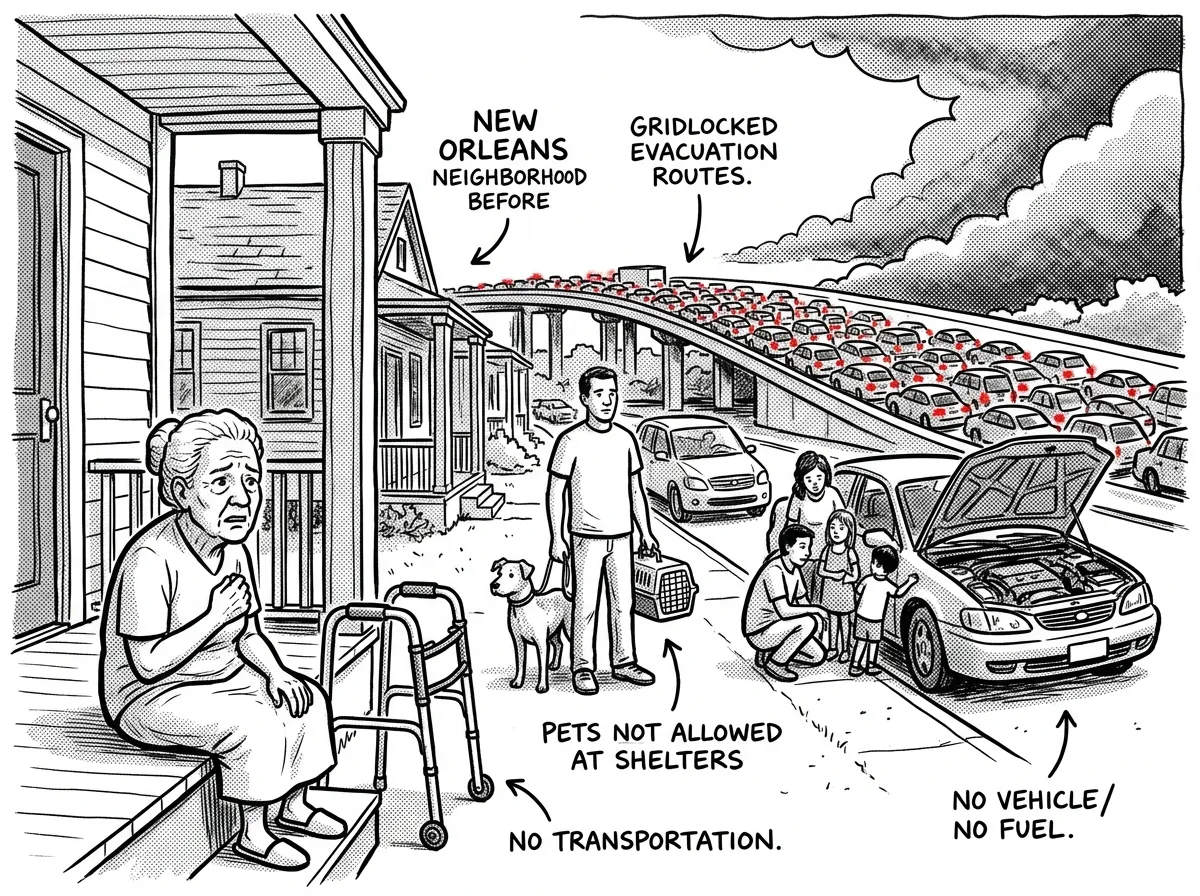 Common evacuation barriers that trapped thousands during Katrina
One of the most haunting questions from Katrina is: why did over 100,000 people stay in New Orleans when a Category 5 hurricane was bearing down on them? The answer isn’t stupidity or stubbornness. It’s far more complicated — and understanding it is essential for building a plan that actually works for real people.
No vehicle access. Over 100,000 New Orleans residents — roughly 27% of the city’s households — didn’t own a car. When the mandatory evacuation order came, they had no way to leave. Public transit was shut down. No government-organized evacuation transport was provided until it was too late.
Poverty preventing travel. Even residents with vehicles often lacked the money for gas, tolls, food, and hotel rooms. Evacuating three or four hours away for an unknown number of days costs hundreds of dollars — money many families simply didn’t have at the end of the month.
Normalcy bias. New Orleans had survived Hurricane Ivan’s near-miss in 2004 and numerous other storm scares. Many residents had evacuated before for storms that turned or weakened, spending money they couldn’t afford on trips that felt unnecessary in hindsight. “It won’t really be that bad” isn’t irrational when your lived experience has consistently confirmed it.
Distrust of government warnings. In communities with long histories of being underserved or actively harmed by government institutions, official evacuation orders don’t carry the same weight. That isn’t paranoia — it’s pattern recognition from lived experience.
Caring for immobile family members. Elderly and disabled residents who couldn’t be easily transported often meant entire families stayed. Leaving grandma alone wasn’t an option, and no plan existed to help her leave.
Every one of these reasons points to something you can act on now. Establish evacuation partnerships with neighbors — if someone on your block doesn’t have a car, they ride with you, period. Pre-identify free shelter routes and know where Red Cross shelters will open along your evacuation path. Maintain a dedicated evacuation fund — even $200 in cash set aside specifically for this purpose changes your calculus entirely. Build a plan that accounts for mobility-limited household members, including medical equipment, medications, and comfort items. And invest in creating a family emergency communication plan so every member of your household knows exactly where to go and how to reconnect if separated.
The prepper lessons from Katrina aren’t just about having enough freeze-dried food. They’re about building a plan flexible and inclusive enough that your entire household — and your neighbors — can actually execute it under pressure.
How Much Warning You’ll Actually Get
So how much time do you really have? Here’s the genuinely good news about hurricanes compared to almost every other natural disaster: you get warning. Tropical systems are tracked days in advance. The National Hurricane Center typically issues a reasonably accurate track forecast 3 to 5 days before landfall, sometimes up to 7 days out. You’ll know a storm is coming. You’ll have time.
But there’s a critical caveat. Intensity forecasting is far less reliable. A storm that looks like a manageable Category 1 three days out can rapidly intensify into a Category 4 monster in the final 24 to 48 hours. Ian did exactly this. So did Michael in 2018, which went from Category 2 to Category 5 in roughly 24 hours. If you wait for the intensity forecast to scare you into action, you’ve already lost your window.
Waiting for an “official” severity upgrade before acting is a common and costly mistake — by the time forecasts confirm the worst-case scenario, stores are stripped and gas stations are dry. The moment a named storm is tracking toward a coastline, it’s time to activate a preparedness plan rather than wait and watch. The 5-to-7-day window when a storm’s future path is still uncertain is the only window that matters for beating the rush.
The practical reality is this: once a hurricane watch is issued for your area — typically 48 hours before expected tropical-storm-force winds — the clock is already running down. Gas stations will have lines. Plywood will be gone from Home Depot. Evacuation routes will be congested. Your real window to prepare is when the storm is 5 to 7 days out and everyone else is still watching and waiting.
The First 72 Hours: Before, During, and After Landfall
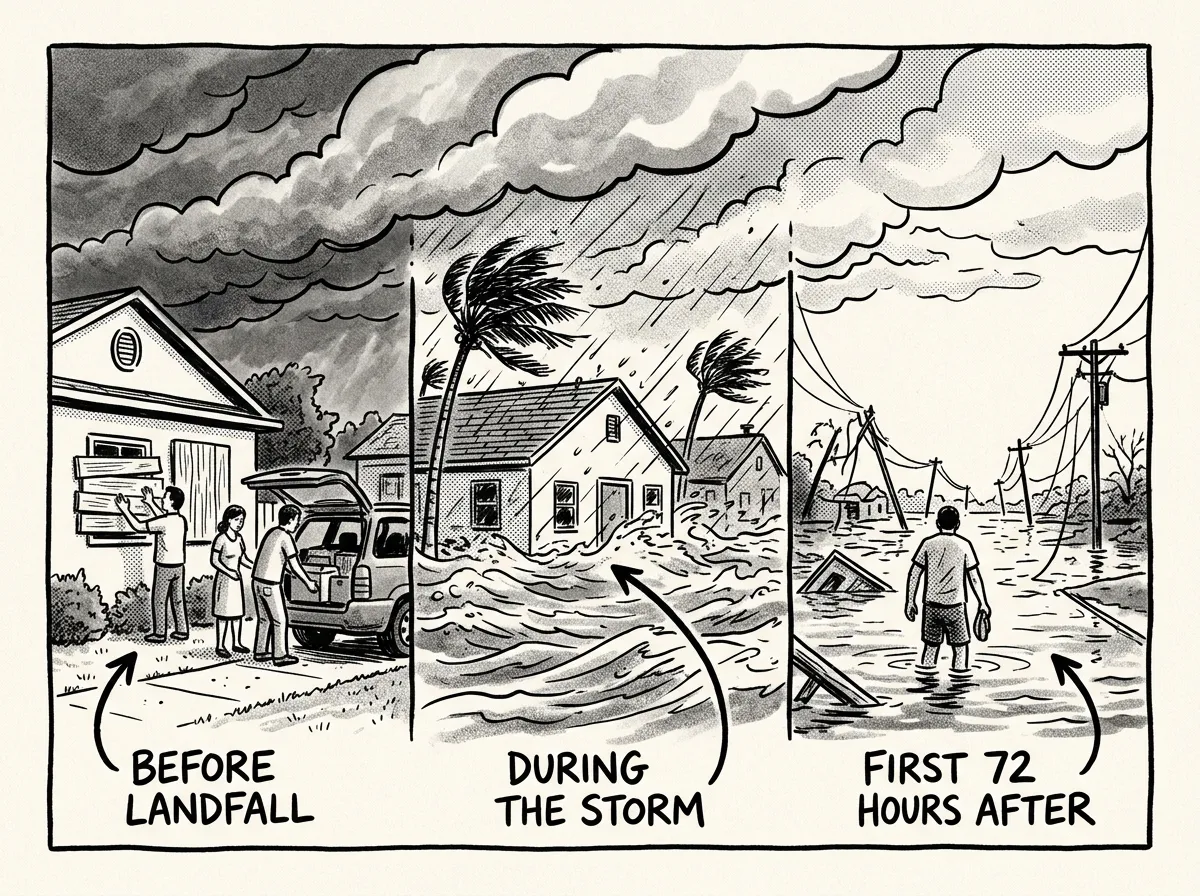 The critical 72-hour hurricane timeline from final preparations to aftermath
Before Landfall (Final 24–48 Hours)
This is your last chance to make decisions that’ll determine how the next few weeks of your life go. If you’re in an evacuation zone — and you need to know your zone designation before hurricane season, not during — you leave. Period. Storm surge kills more people in hurricanes than any other factor, and no amount of preparation inside your home will protect you from 10 to 15 feet of ocean pushing through your living room.
If you’re sheltering in place in a non-evacuation zone, your final hours should be spent filling your bathtub with water. A WaterBOB bladder insert holds 100 gallons of clean drinking water and costs around $35 — it’s one of the best investments in hurricane preparedness you’ll ever make. Move critical documents and electronics to the highest floor. Secure or board windows with plywood (minimum ½ inch) or hurricane shutters. Verify your generator is positioned outside with a carbon monoxide detector active inside. Fill your vehicle’s gas tank — you should’ve done this 72 hours ago, but if you haven’t, do it now and expect a long wait. For generator safety and backup power planning, make sure you’ve got a placement strategy figured out well before storm season.
During the Storm
Stay inside and stay away from windows. Hurricanes can spawn tornadoes with little warning, and flying debris is the primary killer during the wind event. An interior room on the lowest floor — away from windows and exterior walls — is your shelter position.
Do not go outside during the eye. The calm is temporary, and the back half of the storm hits with winds from the opposite direction, meaning debris that was blown one way is now coming back. Don’t run your generator indoors or in a garage, even with the door open. Carbon monoxide from generators killed more people after Hurricane Laura in 2020 than the storm itself did. That’s not an exaggeration. It’s a leading cause of post-hurricane death, and it’s entirely preventable.
The First 24–72 Hours After
The immediate threats shift from wind and surge to flooding, contaminated water, structural collapse, and downed power lines. Standing water isn’t just an inconvenience — it’s often electrified by downed lines, contaminated with sewage and chemicals, and hiding road washouts and open manholes. Don’t wade through floodwater if you can avoid it. Don’t drive through it.
If your home flooded, the water supply is compromised and shouldn’t be consumed without purification, even if it looks clear. Understanding water purification methods for emergencies isn’t optional — it’s essential knowledge. In this window, you are your own first responder. Emergency services will be overwhelmed, roads may be impassable, and 911 may not be functional.
Keep shoes on at all times during and immediately after a hurricane — broken glass and debris are everywhere, and a foot laceration when medical services are unavailable can become a serious emergency fast.
When Days Become Weeks
After the initial 72 hours, the reality of extended infrastructure failure starts to set in. Power is the first domino, and everything else falls with it. Without electricity, refrigerated food spoils within 24 to 48 hours. Municipal water treatment may fail, meaning even tap water becomes unreliable. ATMs and credit card terminals are dead — if you don’t have cash on hand, you can’t buy anything even if a store manages to open. Cell towers lose backup battery power after about 24 to 72 hours. Gas stations can’t pump fuel. Pharmacies can’t fill prescriptions.
The public health lessons learned from Hurricane Katrina make this phase especially critical. Over 25,000 people were stranded at the New Orleans Superdome with inadequate food, water, and sanitation for five days. Conditions deteriorated to the point of medical emergencies, violence, and death inside the building. Some NOPD officers abandoned their posts entirely. The floodwater itself became a toxic soup — oil, raw sewage, industrial chemicals, and decomposing organic matter that created long-term health hazards for anyone exposed. CDC reports documented spikes in respiratory illness, skin infections, and gastrointestinal disease.
The breakdown order typically follows a predictable pattern: power first, then communication, then water reliability, then fuel, then medical access, then food supply chains. By day 5 to 7 without power restoration, you’re dealing with spoiled food creating sanitation and pest problems, standing water breeding disease-carrying mosquitoes, mold colonizing every flooded surface, and growing security concerns as desperation sets in among those who didn’t prepare.
Your hurricane preparedness plan needs to account for a minimum of two weeks of self-sufficiency. Not three days. Not the FEMA-recommended 72-hour kit. Two weeks minimum, and in high-risk coastal areas, a month isn’t paranoid — it’s prudent. Having the right emergency food storage and shelf-stable supplies staged and ready makes an enormous difference between uncomfortable and unlivable.
Katrina vs. Maria vs. Ian: How Each Storm Changed Preparedness
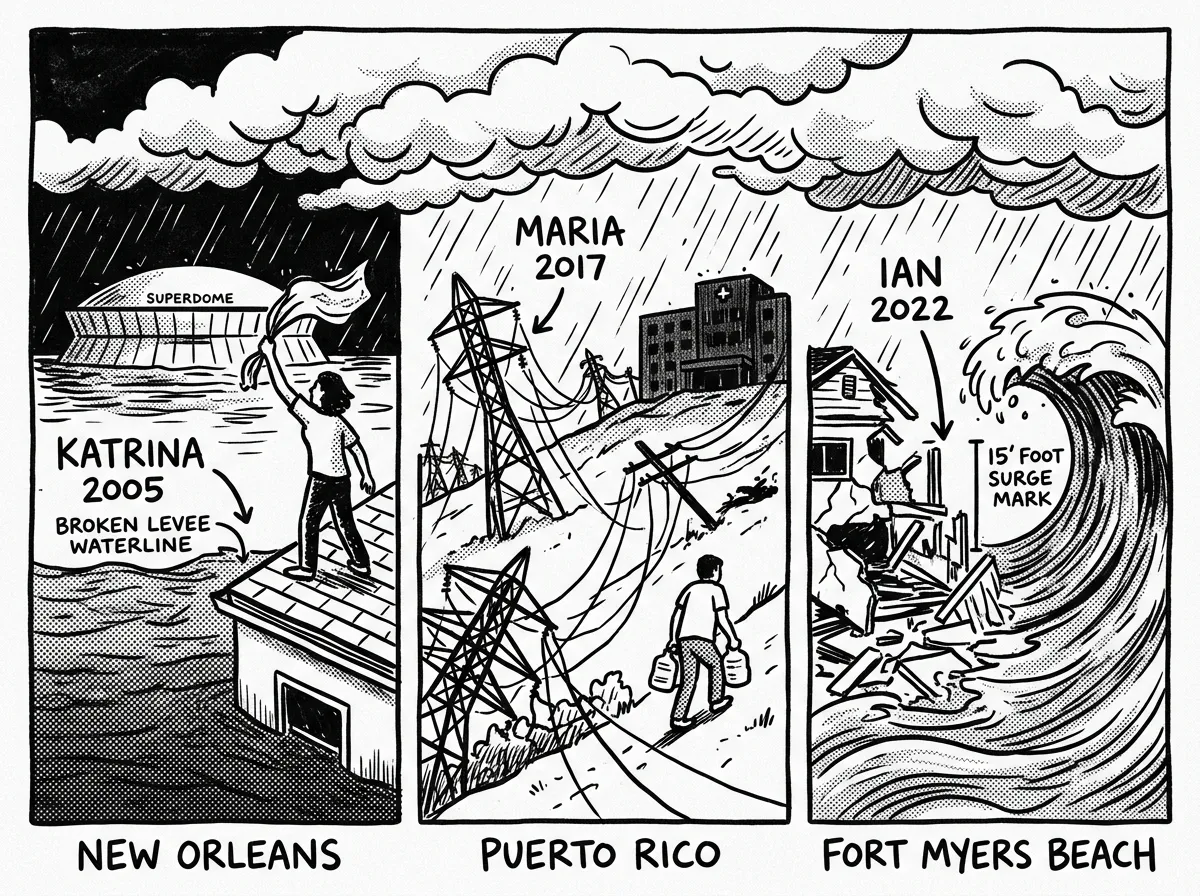 Three defining storms that reshaped American hurricane preparedness
The principles from hurricane preparedness transfer directly to other disaster types, including flooding and extended winter storm power outages. It’s worth examining how each major hurricane taught distinct lessons that compounded into our current understanding.
Hurricane Katrina (2005) taught us about infrastructure failure and government response gaps. The levees failed. FEMA failed. Communication failed. The core lesson: engineered systems break, institutions are slow, and you can’t outsource your survival to anyone. Katrina fundamentally shifted the conversation from “the government will help” to “you need to help yourself first.”
Hurricane Maria (2017) taught us about prolonged grid collapse and isolated community vulnerability. Puerto Rico’s power grid didn’t just go down — it stayed down for nearly a year. Maria showed that isolated communities — whether islands or rural areas cut off by flooding — can be functionally abandoned for months. The CDC-estimated death toll of nearly 3,000, most from indirect causes, proved that the aftermath kills far more than the storm.
Hurricane Ian (2022) taught us about rapid intensification and the fatal danger of staying in surge zones despite improved warnings. By 2022, forecasting and alert systems were dramatically better than 2005. People received warnings. Many received mandatory evacuation orders. And still, 149 people died — many drowning in surge they chose not to evacuate from, partly because the storm intensified so rapidly that the threat level changed faster than people’s decision-making could keep up.
The current state of preparedness, given all three data points, demands this: plan for infrastructure to fail completely, plan for that failure to last weeks or months, and make your evacuation decision early. Climate science from NOAA indicates that the conditions driving rapid intensification — warmer sea surface temperatures and higher atmospheric moisture — are becoming more common, not less.
What Most People Get Wrong
The single most dangerous misconception in hurricane preparedness is that the wind is the primary killer. It isn’t. Storm surge and inland flooding account for the overwhelming majority of hurricane deaths. During Ian, people in Fort Myers Beach who were in well-built homes that could withstand 150 mph winds drowned in their living rooms because 12 feet of storm surge turned the first floor into the ocean. During Harvey, people who had zero wind damage lost everything because 60 inches of rain turned Houston into a lake. If you’re in a storm surge zone and you don’t evacuate, no amount of plywood, supplies, or bravery will save you from the water.
The second biggest mistake? Taping windows. Let me be unequivocal: putting tape on your windows does nothing. It doesn’t prevent them from breaking. It doesn’t hold glass together in any meaningful way. It just wastes tape and gives you false confidence. Plywood or rated hurricane shutters are the only options that matter.
Three Katrina-specific mistakes deserve special attention:
People fleeing to attics without roof escape tools. As floodwater rose through homes in the Lower Ninth Ward and Lakeview, residents climbed to attics as a last resort — and many drowned there because they had no way to break through to the roof. Always have a hatchet, axe, or pry bar staged on your top floor.
Pets left behind because shelters wouldn’t accept them. This killed people. Residents refused to board evacuation buses because their animals couldn’t come. After Katrina, Congress passed the Pets Evacuation and Transportation Standards Act (PETS Act) of 2006, but you still need your own plan — carriers, supplies, vaccination records, and knowledge of pet-friendly shelters along your route.
Loss of all identity and financial documents. Thousands of Katrina survivors lost birth certificates, property deeds, insurance policies, Social Security cards, and medical records to floodwater. Rebuilding your life is exponentially harder when you can’t prove who you are or what you owned. Scan everything. Store it in the cloud. Keep a waterproof USB backup in your go-bag. This takes an afternoon and could save you months of bureaucratic nightmare.
Post-disaster exercises consistently reveal that most participants — even trained emergency management personnel — lack digital backups of critical documents. Scanning everything and setting up cloud storage takes about an afternoon and is one of the highest-return preparedness tasks available. If nothing else gets done after reading this article, scanning documents and uploading them is worth prioritizing tonight.
If you haven’t started building your baseline preparedness skills yet, the beginner’s guide to survivalism is a practical starting point that applies directly to hurricane scenarios.
Your Hurricane Preparedness Checklist
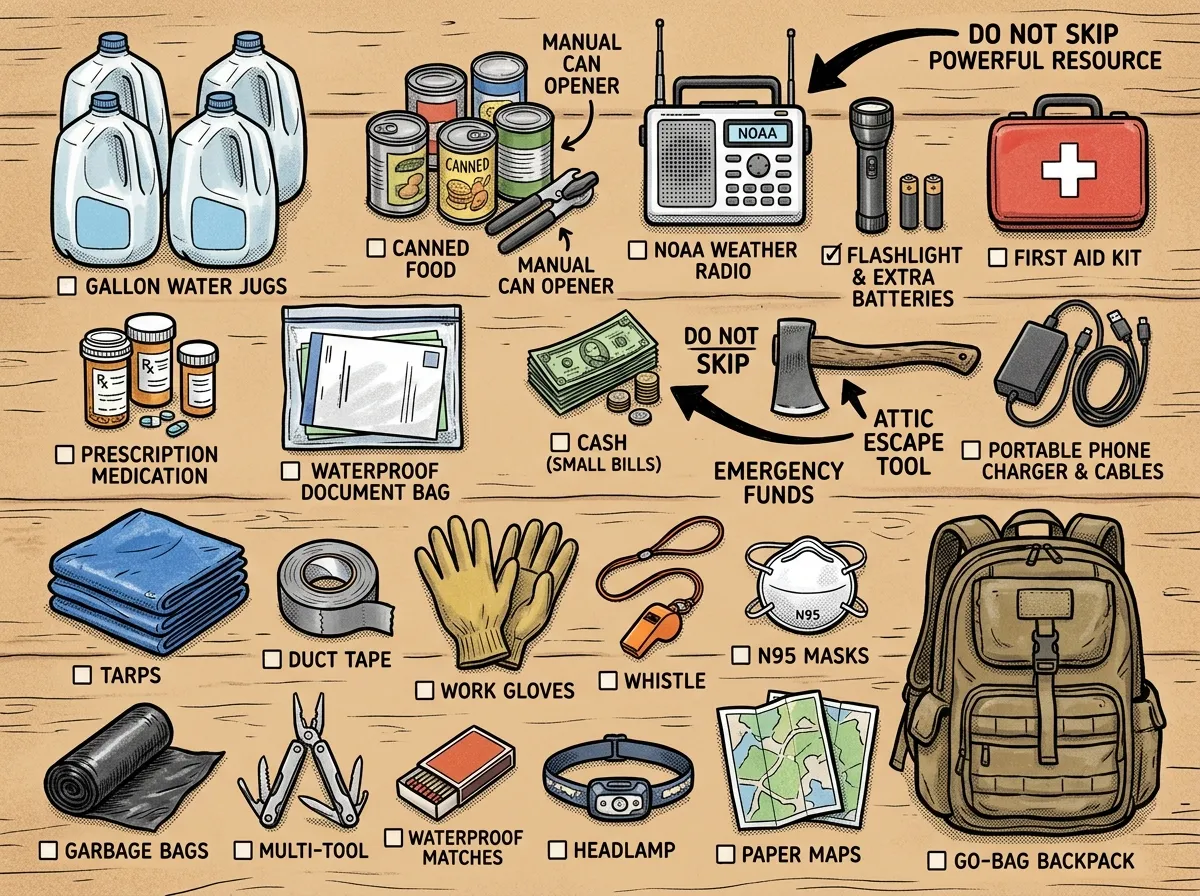 Complete hurricane survival kit laid out and ready to go
- Know your evacuation zone (A, B, or C) and identify at least two evacuation routes that avoid bridges
- Fill your vehicle’s gas tank at least 72 hours before projected landfall
- Stockpile cash in small denominations ($1s, $5s, $10s, $20s)
- Stage ice and coolers — freeze water bottles and gallon jugs to serve as both ice packs and drinking water
- Board or shutter windows with rated plywood (minimum ½ inch) or hurricane shutters — tape does nothing
- Fill your bathtub using a WaterBOB bladder insert or food-grade liner (around $35 for 100 gallons)
- Stock a minimum two-week supply of non-perishable food and a manual can opener
- Fill prescriptions for a 30-day supply and store in a waterproof container
- Move documents, electronics, and irreplaceable items to the highest floor in waterproof bags
- Photograph and video-document every room and all major possessions — store copies in the cloud
- Confirm your generator works with sufficient fuel and a clear outdoor-only placement plan at least 20 feet from any window
- Install or verify carbon monoxide detectors on every floor with fresh batteries
- Charge all devices, battery banks, and portable radios — a hand-crank NOAA weather radio is essential
- Trim dead branches and secure all loose outdoor items
- Keep an axe or hatchet on your top floor as a roof escape tool
- Prepare a pet evacuation plan with carriers, food, and vaccination records
During the storm: Shelter in an interior room on the lowest floor, away from windows. Don’t go outside during the eye. Never run a generator indoors. Monitor NOAA weather radio for tornado warnings. If flooding enters your home, move to the highest floor immediately.
After the storm: Don’t wade or drive through standing floodwater. Document all damage with photos and video before any cleanup. Boil or purify all water until authorities confirm safety. Begin mold prevention immediately — remove wet materials, open windows, run fans if you have generator power. Check on neighbors, especially elderly or disabled individuals. Report downed power lines but never approach them.
Long-Term Recovery: When Weeks Become Months
History has shown repeatedly that hurricane recovery is measured in months and years, not days. After Katrina, the population of New Orleans dropped by more than half and took over a decade to partially recover. Many residents never returned. Studies published in the American Journal of Public Health documented persistent PTSD, depression, and substance abuse among survivors years later.
After Maria, Puerto Rico’s power grid wasn’t fully restored for approximately 11 months. Entire communities in the Florida Panhandle still had visible damage from Hurricane Michael three years after landfall. The long-term reality includes extended displacement, insurance battles that drag on for years, destroyed small businesses that never reopen, and fundamental reshaping of community demographics. The environmental justice dimension can’t be ignored: in Katrina, Maria, and Ian alike, lower-income communities and communities of color bore disproportionate losses and received slower recovery assistance — a pattern documented by FEMA’s own equity reviews.
For you, long-term impacts mean potential relocation, navigating FEMA and insurance bureaucracy (document everything before and after), managing mold remediation, and living in a community where normal services may be degraded for months. If your area is in a known hurricane corridor, your preparedness should include not just survival supplies but a relocation plan, digital backups of all important documents stored in the cloud, and a financial buffer that lets you absorb weeks or months of disruption.
The Lessons From Hurricane Katrina Haven’t Expired
We’re twenty years past Katrina now. The question isn’t whether we’ve learned the lessons — it’s whether we’ve acted on them. Katrina fundamentally rewired how emergency management professionals think about disaster response. But institutional change doesn’t protect your family. Policy improvements don’t fill your bathtub with clean water. Reformed FEMA protocols don’t stockpile your medications.
The lessons from Hurricane Katrina are simple, even if executing them requires discipline. Be self-sufficient for two weeks minimum. Evacuate surge zones early and without hesitation. Keep cash, documents, and medications accessible and protected. Know your neighbors and build mutual aid relationships before you need them. Understand that the infrastructure you depend on daily — power, water, communication, medical systems — can all fail simultaneously and stay failed for months.
The storms are getting stronger. Rapid intensification is becoming more common. Coastal populations continue to grow. The next Katrina-scale event isn’t a question of if — it’s a question of when and where. The only variable you control is whether you’re ready.
The Complete
Prepper's Reference.
149 articles synthesized into one comprehensive PDF — twelve chapters covering water, food, shelter, first aid, comms, and scenario-specific preparedness. Free with your email.
Unsubscribe anytime · We never share your email
You're in. Check your inbox.
Keep Reading
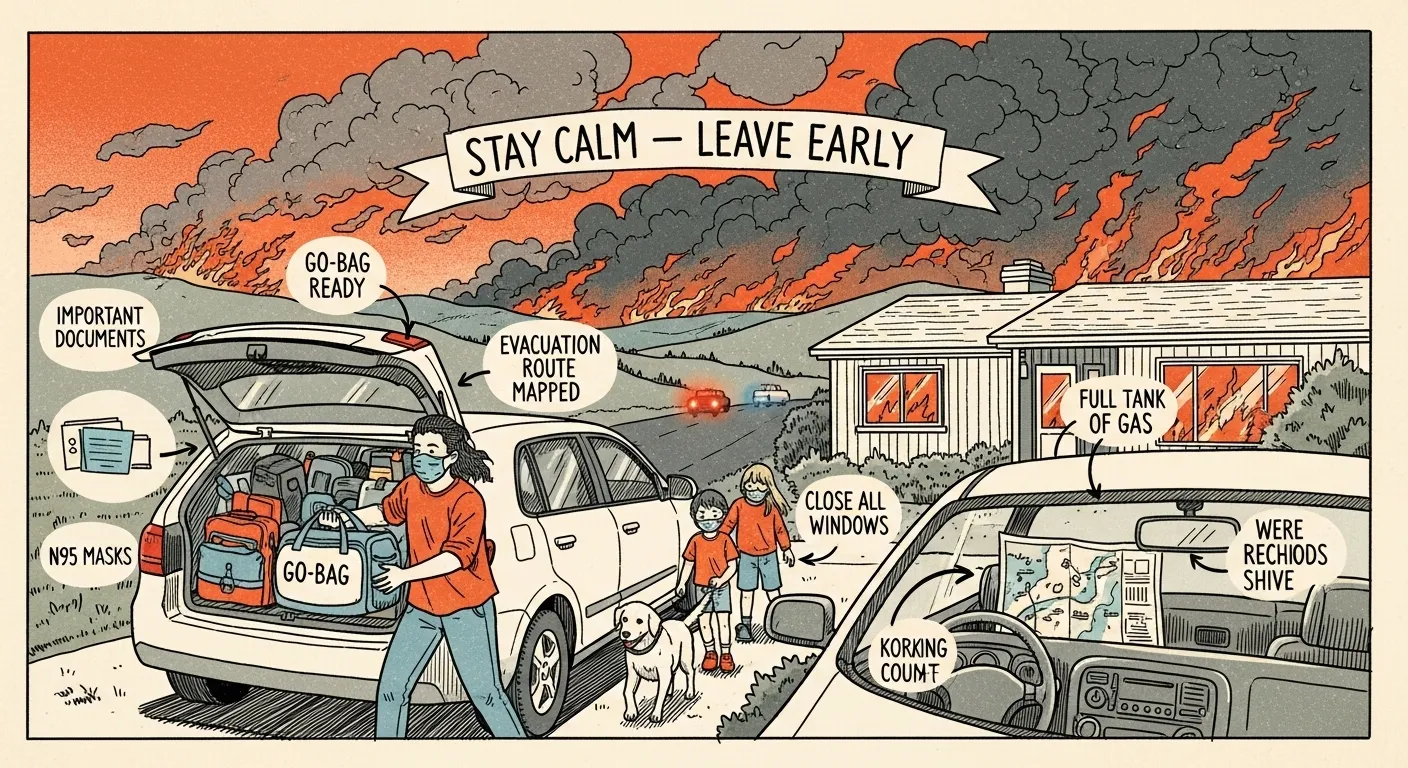
Wildfire Preparedness: Evacuation Guide & Survival Plan
Learn wildfire preparedness from real disasters like the 2018 Camp Fire. Evacuation plans, go-bags, defensible space & checklists to protect your family.
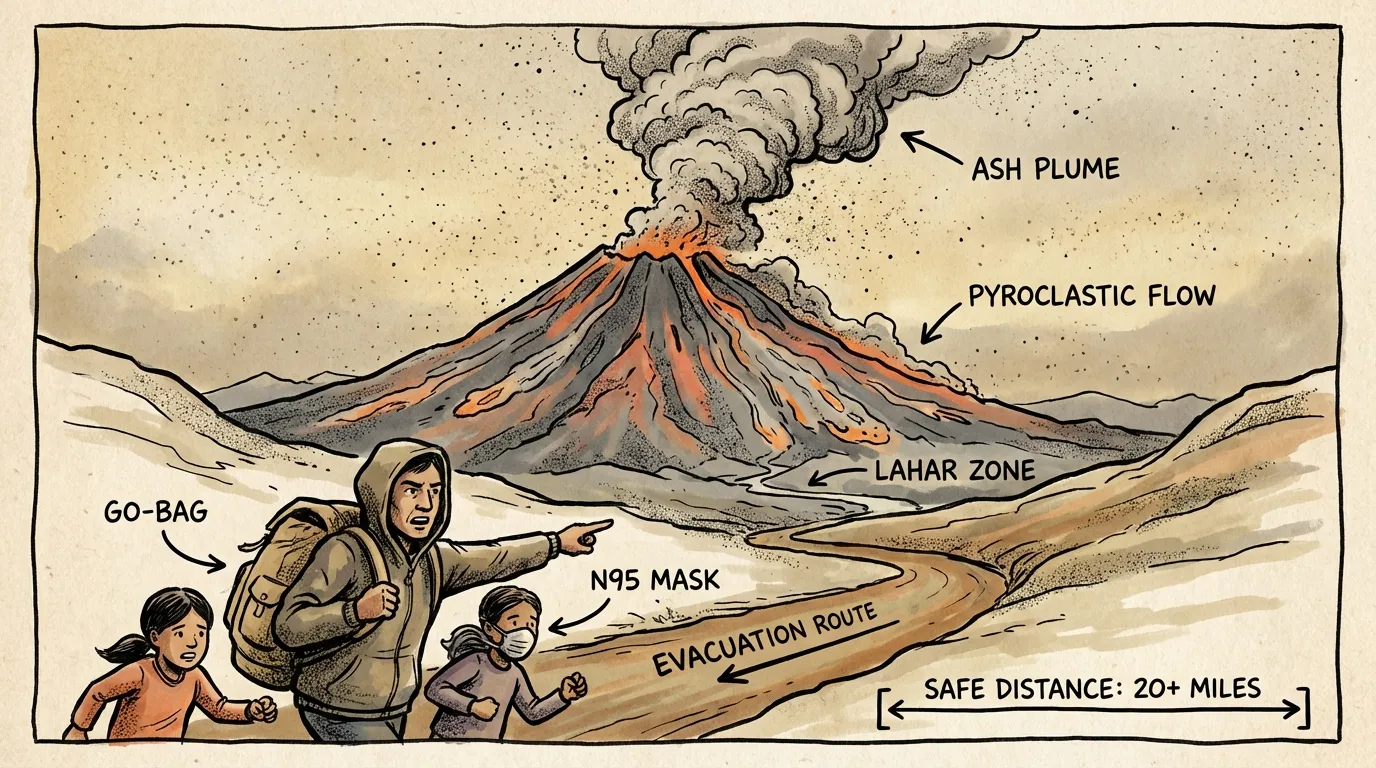
Volcanic Eruption Preparedness: When the Mountain Wakes Up
Mount St. Helens gave scientists 2 months of warning — yet 57 people still died. The 2022 Tonga eruption sent a shockwave around the planet twice. Here's what volcanic eruptions actually threaten, how far danger extends, and how to prepare whether you live near a volcano or not.
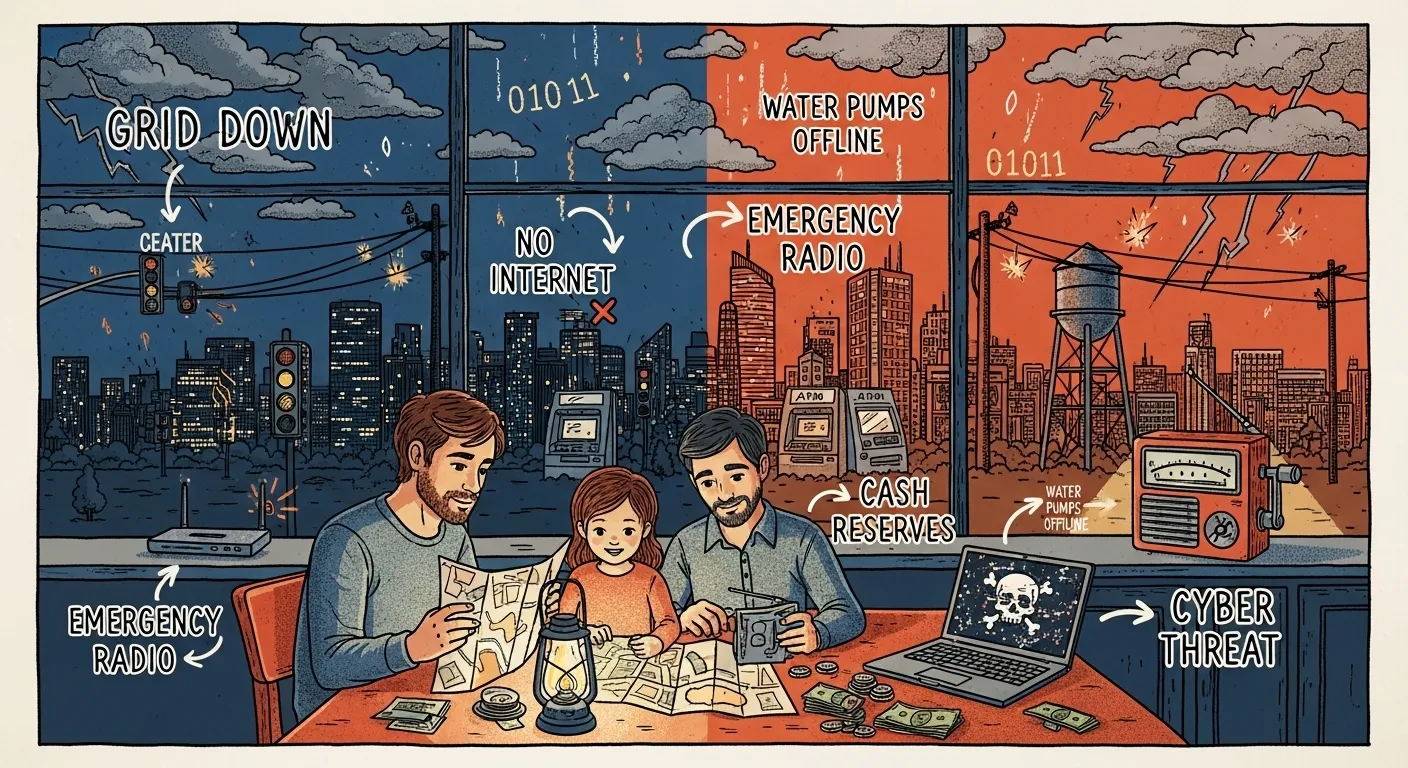
Cyberattack and Infrastructure Failure: The Invisible Emergency
In 2021, a ransomware attack shut down the Colonial Pipeline and caused gas shortages across the Southeast in 6 days. In 2015, hackers turned off power for 230,000 Ukrainians. Digital attacks on physical infrastructure are here — here's how to prepare for when they hit yours.