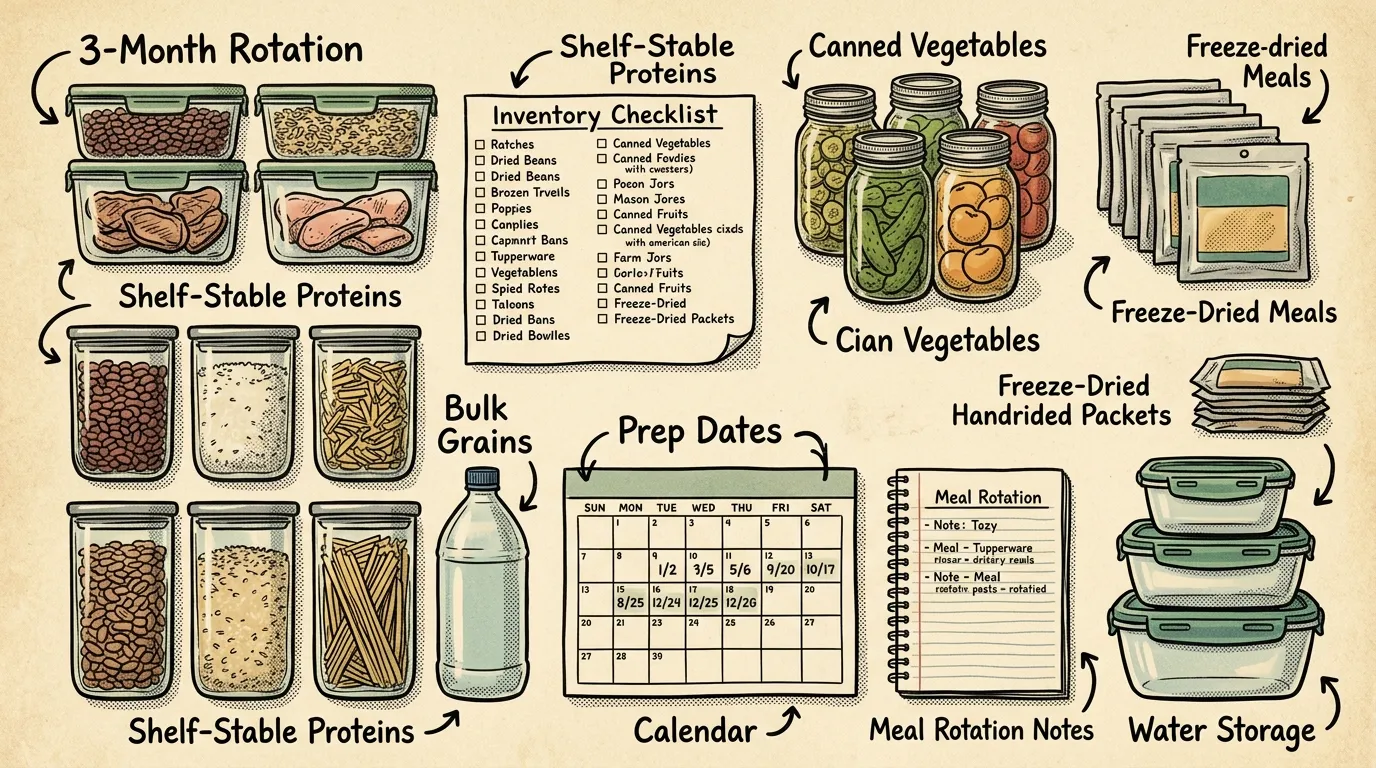
This article teaches how to combine mainstream meal prepping techniques — batch cooking, portioned containers, weekly menus — with prepper food security principles like FIFO rotation and shelf-stable reserves, so readers build both weekly convenience and long-term resilience.
Key Takeaways
- Batch-cook one extra portion of rice, beans, or soup every week and freeze it — six weeks builds a genuine two-week reserve
- Use FIFO: new cans go behind old cans, every time, so nothing expires unnoticed
- The 3-3-3 rule (3 proteins, 3 carbs, 3 vegetables) beats cooking five different recipes and prevents meal prep burnout
- Cooked meals stay safe in the fridge for 4-5 days below 40°F — freeze the rest instead of pushing day six
- A family of four can eat on $100/week by buying whole chickens and bulk grains, not by couponing individual items
- Every ingredient in your weekly fridge prep should have a shelf-stable cousin waiting in the pantry behind it
Here’s something that doesn’t get said often enough: meal prepping and prepping are the same skill wearing different clothes. One just doesn’t know it yet.
Most meal prepping ideas floating around the internet are about Sunday batch-cooking — chicken and rice in containers, overnight oats in mason jars, that kind of thing. Good stuff, genuinely useful. But it stops at Friday. It never asks what happens if you can’t get to the grocery store for two weeks, or if your budget gets cut in half overnight. That’s where prepper food-security thinking comes in, and honestly, blending the two is one of the most practical things you can do for your household this year.
Quick Summary
- Weekly meal prepping ideas (batch cooking, portioned containers, ingredient prep) reduce food waste and save real money — but they’re only step one
- FIFO rotation (first in, first out) turns your pantry into a living stockpile instead of a mystery cabinet of expired cans
- The 3-3-3 rule (3 proteins, 3 carbs, 3 vegetables) gives you weekly variety without daily recipe hunting
- Layering shelf-stable staples underneath your fresh weekly prep builds a buffer that survives job loss, weather events, or supply disruptions
- A family of four can eat well on a tight budget by prepping in bulk and rotating stock, not by clipping coupons
Why Weekly Meal Prep and Long-Term Food Security Are the Same Skill
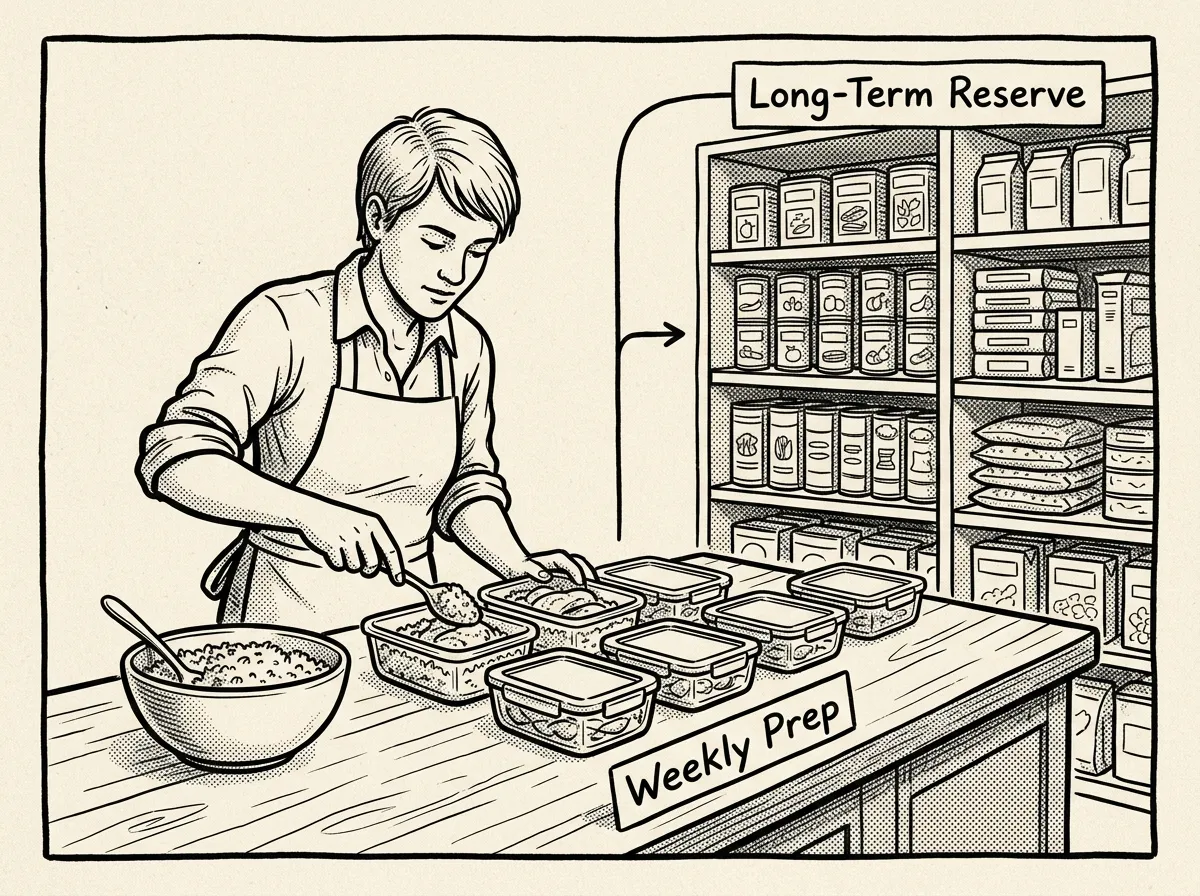 Weekly meal prep flowing into long-term food security
Think about what meal prepping actually asks of you. You plan ahead. You buy in intentional quantities instead of impulse quantities. You portion things out so you’re not overeating or under-eating. You store food properly so it doesn’t spoil before you use it.
Now look at prepper food security principles — FIFO rotation, portion-controlled stockpiling, building a reserve that lasts weeks instead of days. Same muscles, different rep range. The person who’s already comfortable batch-cooking on Sunday is maybe three habit changes away from having a genuinely resilient food system at home.
Meal prepping teaches you to plan for the week. Food security teaches you to plan for the year. Do both and you stop worrying about either one.
A common mistake is building a beautiful weekly meal prep routine — grilled chicken, roasted broccoli, quinoa, four perfect containers — and then having zero backup plan for the week the schedule falls apart or the grocery budget takes a hit. That whole food system is one bad week away from collapse. The fix isn’t complicated, it just requires thinking one layer deeper than the weekly meal plan.
Household food systems tend to collapse fast when there’s no reserve layer. After Pacific Northwest ice storms that left households without grocery access for a full week, the ones with any kind of rotating pantry made it through without panic, while the ones without one were calling neighbors by day three.
Meal Prepping Ideas for Beginners: Getting Started Without Overwhelm
If you’ve never meal prepped before, the biggest mistake is trying to build the whole system in one weekend — five recipes, a full set of matching containers, a color-coded label system. It collapses under its own weight by week two.
Start smaller than feels productive. Here’s the version recommended for first-timers:
- Pick one meal to prep for the first week — lunch is usually the easiest win
- Choose a recipe with five ingredients or fewer so shopping and cooking stay simple
- Buy only what fits in one grocery bag — this keeps cost and waste low while you’re still testing the habit
- Use 2-3 container sizes, not a full labeled set — you can upgrade once the habit sticks
- Cook once, portion into 4-5 servings, and see how it actually holds up in your fridge over the week
Households that start this small and build up gradually tend to stick with it. The ones who try to do everything at once — full week of meals, five recipes, brand-new gear — usually quit within a month. Prove the habit before you scale the system. That one sentence has saved more meal prep routines than any container set ever will.
What Foods Are Best for Meal Prepping (and Also Stockpiling)
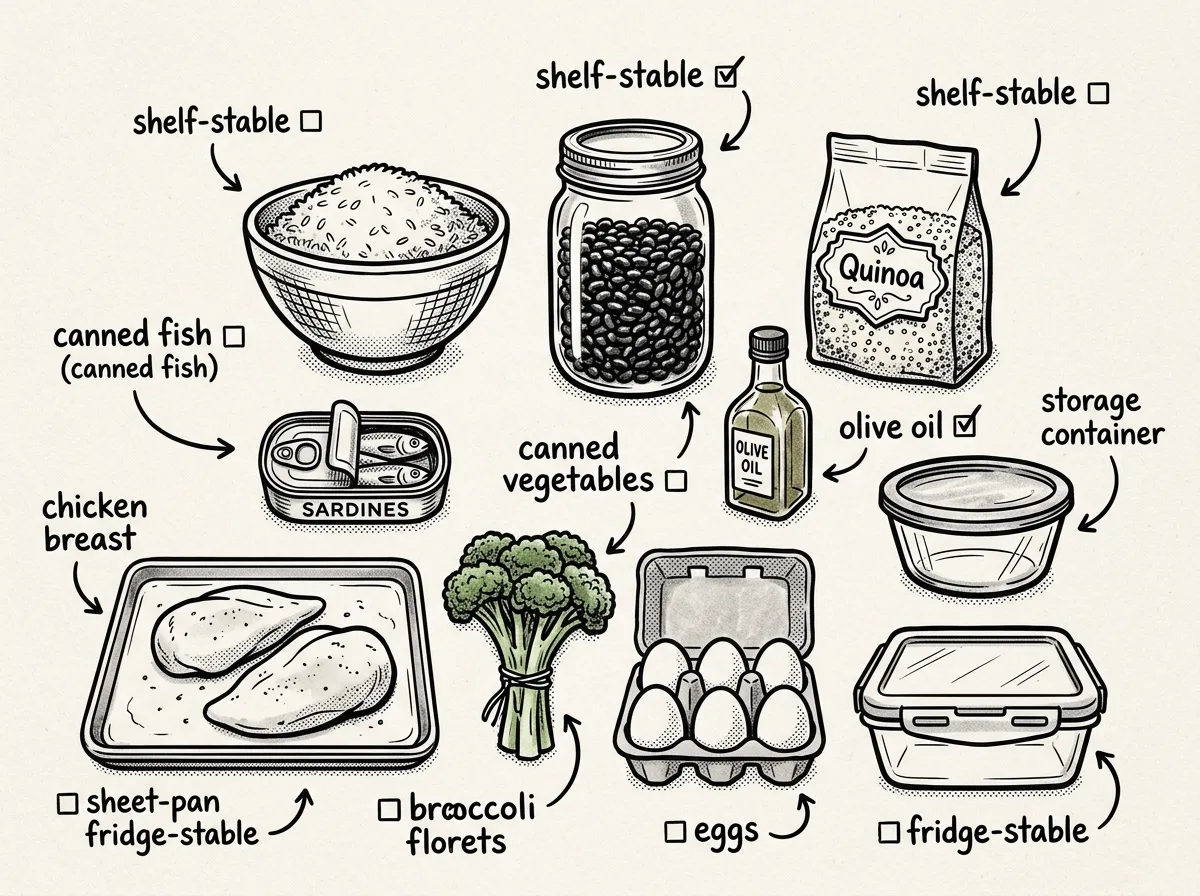 Essential meal-prep and stockpiling ingredients
This is where the crossover really pays off. The best foods for weekly meal prep are, almost without exception, the same foods that rotate well into a longer-term reserve.
Grains like rice, quinoa, and oats store for months in the pantry and reheat beautifully from the fridge. Dried or canned beans do double duty — cook a big batch for this week’s bowls, and keep unopened cans in rotation behind them for the month you don’t feel like cooking from scratch. Eggs, a meal-prep staple for breakfast burritos and egg bites, also happen to be one of the most budget-efficient proteins you can buy in bulk.
Frozen vegetables deserve more credit than they get. Harvard’s T.H. Chan Nutrition Source has noted that frozen produce is typically flash-frozen at peak ripeness, which means it’s nutritionally comparable to fresh — often better than the “fresh” produce that’s been sitting in a truck for a week. Frozen vegetables also solve the single biggest meal prep problem: fresh greens and delicate veggies wilting by Wednesday.
Canned fish — tuna and salmon especially — is the other pillar I don’t see mentioned enough. It’s shelf-stable for years, needs no cooking, and works in a grain bowl exactly the same way a fresh-cooked fillet would.
Here’s a way to think about it: every ingredient in your fridge right now should have a shelf-stable cousin sitting in your pantry, one step behind it in the rotation.
- Rice, quinoa, or oats (fresh-cooked batch + 20lb bag in reserve)
- Canned or dried beans (cooked for this week + sealed cans rotating behind)
- Eggs (fresh dozen + shelf-stable egg powder as backup)
- Frozen or canned vegetables (fresh roasted for prep + canned or frozen for pantry depth)
- Cooking oil and basic spices (small daily-use bottle + bulk reserve container)
- Protein (fresh-cooked chicken or ground beef + canned chicken, tuna, or freeze-dried backup)
A 25-lb bag of long-grain rice stored in a food-grade bucket with a Mylar liner runs about $25-30 depending on where you buy it, and keeps for years when sealed properly. Scoop out what’s needed for the week’s meal prep and let the rest sit in rotation. There’s no need for a separate “prepper pantry” and “meal prep pantry” — it can be one system if it’s set up right.
Meal Prepping Ideas by Meal Type: Breakfast, Lunch, Dinner, and Snacks
Since “ideas” is the word people actually search, let’s get concrete. Below are options for each meal type, with notes on how long each actually holds up.
Breakfast
- Egg bites (silicone mold, baked) — fridge 5 days, freezes well up to 2 months
- Overnight oats in jars — fridge 4-5 days, doesn’t freeze well once assembled with dairy
- Breakfast burritos (eggs, beans, cheese, tortilla) — fridge 4 days, freezes exceptionally well up to 3 months
- Cottage cheese egg bake — fridge 5 days, freezes in individual portions
- Baked oatmeal cups — fridge 5 days, freezes well
Lunch
- Grain bowls (3-3-3 method, dressing separate) — fridge 4-5 days, does not freeze well once assembled
- Chicken salad in jars (dressing on the side) — fridge 3-4 days, mayo-based versions don’t freeze
- Turkey or hummus wraps — fridge 3 days, doesn’t freeze (tortillas turn soggy)
- Lentil and rice bowls — fridge 5 days, freezes very well
- Tuna or salmon salad over greens — fridge 3 days, does not freeze
Dinner
- Sheet-pan chicken thighs with roasted vegetables — fridge 4-5 days, freezes well
- Turkey or beef chili — fridge 5 days, freezes excellently up to 4 months
- Chicken or beef stir-fry (sauce separate) — fridge 4 days, freezes moderately well
- Ground beef taco filling — fridge 4 days, freezes very well
- Casseroles (baked ziti, chicken and rice bake) — fridge 4-5 days, freezes well before or after baking
Snacks
- Energy balls (oats, peanut butter, honey) — fridge 2 weeks, freezes well
- Hummus with portioned raw veggies — fridge 5 days, hummus freezes, veggies don’t
- Portioned trail mix or nut mix — pantry-stable for months, no freezing needed
- Hard-boiled eggs by the dozen — fridge 7 days
- Protein muffins — fridge 5 days, freezes well
For higher-protein goals specifically, lean into Greek yogurt with portioned fruit and nuts, hard-boiled eggs by the dozen, and shredded rotisserie chicken split across multiple bowl combinations. For weight-loss-focused prep, the same 3-3-3 structure works — you’re just weighting portions toward vegetables and lean protein and going lighter on the starch side.
Freezer-Friendly Meal Prep Ideas for Longer Storage
This is the section that actually bridges weekly meal prep into real food security, so pay attention here even if you skim the rest.
Some foods freeze beautifully and lose almost nothing in texture or flavor: soups, chilis, and stews; casseroles (baked or unbaked); cooked grains like rice and quinoa; browned ground meat, plain or seasoned; and cooked beans, whether from scratch or canned.
Others don’t survive the freezer at all: raw greens and lettuce turn to slush on thawing; mayo-based salads separate and go watery; fried foods lose their crisp texture entirely; and anything with a high water content, like cucumbers or raw tomatoes, turns mushy.
The workflow matters as much as the food choice. Portion into single or family-sized servings before freezing, not after — trying to hack a frozen block apart later is a bad time. Label every container with the date and contents using a Sharpie directly on the lid, not a sticky note that’ll fall off in the cold. Thaw in the fridge overnight rather than on the counter — this keeps food out of the 40-140°F “danger zone” where bacteria multiply fastest, per USDA food safety guidance, which also sets the two-hour limit for perishable food sitting at room temperature.
This freeze-thaw workflow is the actual mechanism behind the 30-day reserve I’ll walk through below. Without it, “meal prepping ideas” stay a weekly convenience. With it, they become genuine depth in your food system.
The 3-3-3 Rule: Weekly Variety Without the Burnout
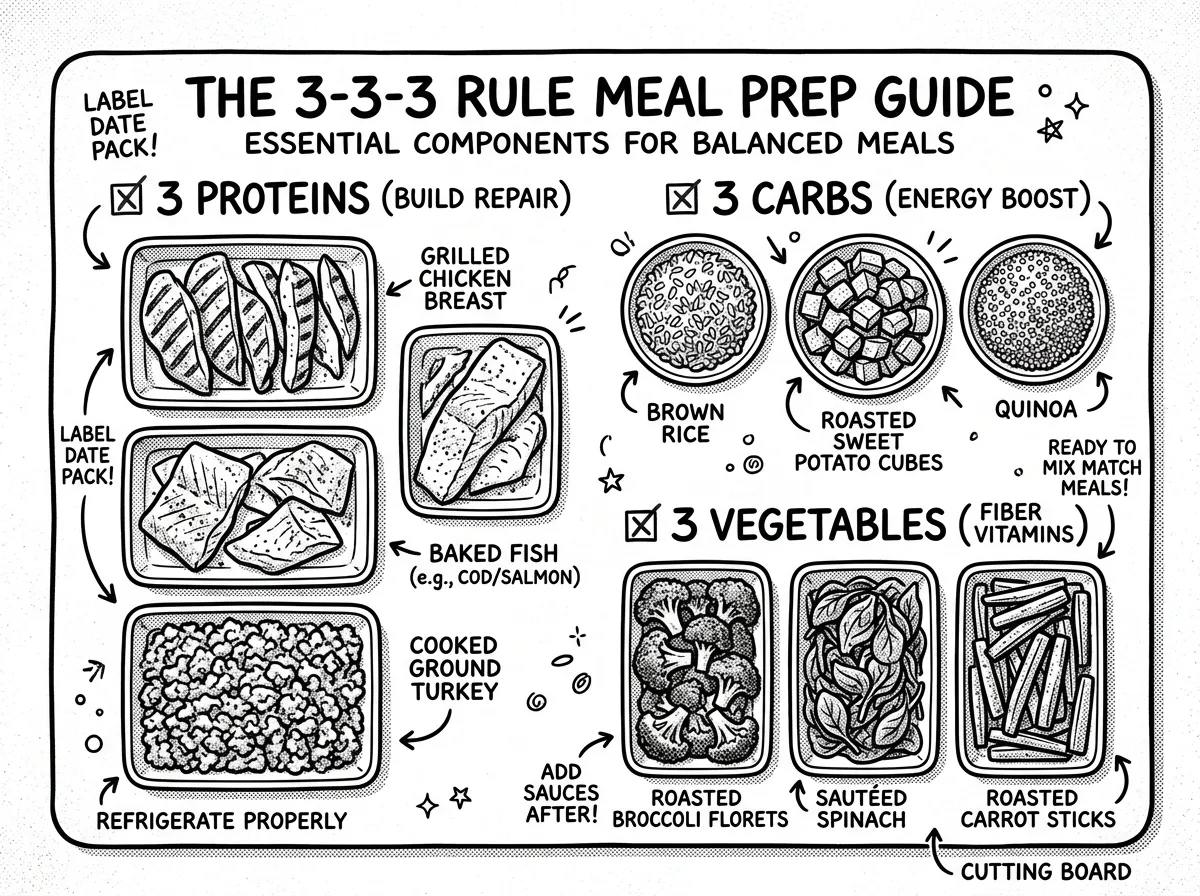 3-3-3 meal prep components laid out for mixing
If you’ve hit meal prep burnout before — and almost everyone has — it’s usually because you tried to cook five completely different recipes on a Sunday afternoon. That’s a recipe for quitting by week three.
The 3-3-3 rule fixes this. Prep three proteins, three carbs or starches, and three vegetables, then mix them into different combinations across the week. Monday might be chicken, rice, and roasted broccoli. Wednesday’s the same chicken with quinoa and roasted peppers instead. You’re not cooking nine separate dishes — you’re cooking nine components and building meals out of the combinations.
- Pick 3 proteins that cook well in bulk — chicken thighs, ground turkey, hard-boiled eggs
- Pick 3 carbs that hold texture for 4-5 days — rice, roasted potatoes, quinoa
- Pick 3 vegetables that reheat without turning to mush — broccoli, peppers, green beans
- Batch-cook everything in one 2-3 hour cooking session
- Portion into containers by combination, not by identical daily meals
- Store sauces or dressings separately so nothing gets soggy in the fridge
This is also, not coincidentally, exactly how a two-week food reserve should be thought about. Instead of nine fresh components, you’re rotating in shelf-stable versions — canned chicken instead of fresh, instant rice instead of leftover rice, freeze-dried green beans instead of fresh-roasted. Same framework, longer shelf life.
Is It Safe to Meal Prep for 5 Days? Here’s the Real Answer
Short answer: yes, with conditions. Cooked food stored properly in the fridge — below 40°F, in airtight containers — is generally safe for 4 to 5 days. Past that, bacterial growth risk climbs even if the food still looks and smells fine.
Food safety principles apply the same way whether it’s a backcountry cook site or a Tuesday-night fridge. The danger zone is 40-140°F, and the two-hour rule applies everywhere: don’t let cooked food sit out longer than that before refrigerating it. Cool food fast, store it cold, reheat it hot. If you’re prepping for a full week, split your batch: eat fresh from the fridge for days one through four, and freeze the rest instead of pushing your luck on day six.
Label every container with the date it was cooked, not the date you plan to eat it. This is the single easiest FIFO habit to build, and it’s the one that stops food waste before it starts.
Humid Gulf Coast kitchens and hot Southwest apartments without great AC face a faster spoilage curve than a cool Pacific Northwest kitchen in October — if your kitchen runs warm, be more conservative and lean toward the 4-day mark, not the 5-day mark.
FIFO: The Habit That Turns Meal Prep Into Food Security
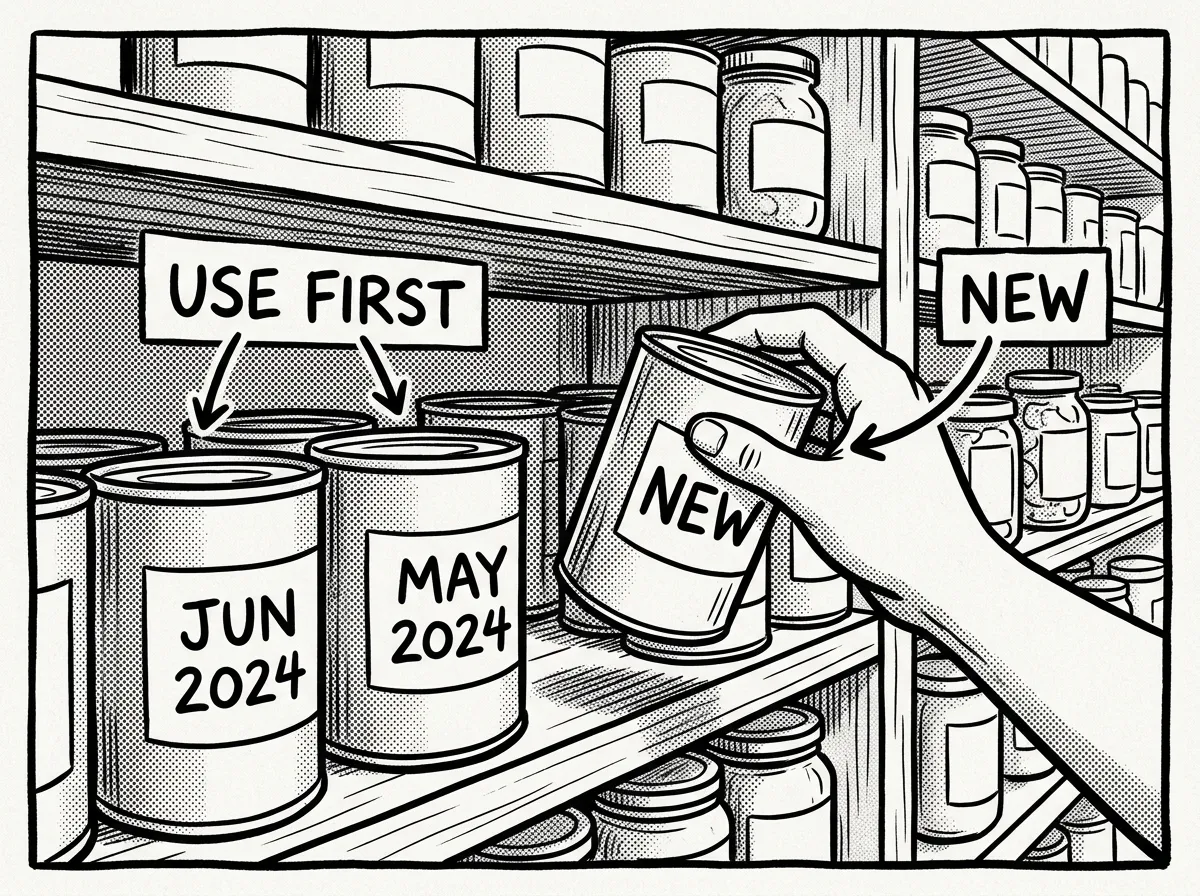 FIFO rotation in action at the pantry shelf
FIFO — first in, first out — is the single most important habit prepper communities have that mainstream meal prep culture mostly ignores. It’s simple: new stock goes to the back, older stock moves to the front, and you always use the oldest thing first.
Applied to your weekly meal prep, this means your Tupperware of leftover rice from Sunday gets used before the rice you cook fresh next Sunday. Applied to your pantry reserve, it means that 20-pound bag of rice you bought six months ago gets rotated into meals before you crack open the new bag.
You open your pantry looking for canned tomatoes and find three cans expired eight months ago behind a stack of newer ones you bought without checking. This happens in almost every kitchen at some point — it’s not a discipline failure, it’s a system failure. Fix the system, not the person.
The fix is almost embarrassingly simple: when you put groceries away, new cans go behind old cans, always. Same shelf, same spot, every time. It takes ten extra seconds and it’s the difference between a stockpile that actually works and one that’s just an expensive science experiment.
Write the purchase date on canned goods with a Sharpie the second you get home from the store. Manufacturer expiration dates are hard to find and easy to ignore — your own handwriting on the lid is not.
Vegan, Vegetarian, and Keto Meal Prepping Ideas
Diet-specific meal prep is where a lot of people get stuck, thinking it means abandoning the pantry-depth approach. It doesn’t — every one of these ideas has a shelf-stable version waiting behind it.
Vegan and vegetarian: Lentil and rice bowls are the workhorse here — lentils store dry for up to a year, cook in 20 minutes, and freeze well once prepared. Chickpea and roasted vegetable grain bowls work the same way, with canned chickpeas as the pantry-stable backup for dried. Tofu scramble with frozen hash browns holds up for 3-4 days in the fridge and gives you a breakfast option that isn’t eggs.
Keto and low-carb: Egg and cottage cheese bakes are close to perfect for this — high protein, low carb, and they both freeze and store well in the fridge for 5 days. Chicken thigh and roasted broccoli bowls skip the starch entirely and reheat cleanly. Zucchini noodle and ground beef skillets work for a few days in the fridge but don’t freeze well, so plan those for early-week eating.
Stretching any protein budget: Canned or dried beans substitute for meat in almost any of the above at a fraction of the cost per serving, and they’re exactly the kind of ingredient that should be sitting two-deep in your pantry behind whatever you’re cooking fresh this week.
How to Feed a Family of 4 for $100 a Week
This question comes up constantly, and the honest answer is: it’s absolutely doable, but not by grabbing small packages at regular price every single week. It’s doable by combining meal prep batching with stockpile-style bulk buying.
Here’s the math that actually works. A whole chicken costs less per pound than boneless breasts and yields both a main protein and stock for soup. A 25-pound bag of rice costs less per serving than a 2-pound bag bought weekly. Dried beans cost a fraction of canned, and canned beans cost a fraction of pre-made bean dishes. Buy the bulk version once, portion it into your weekly meal preps, and let the FIFO system carry the rest into future weeks.
A rough weekly breakdown that works for many families: $25-30 on bulk proteins (whole chicken, ground turkey, eggs), $15-20 on grains and starches bought in bulk, $20-25 on fresh and frozen vegetables, $10-15 on pantry staples like beans, oats, and canned tomatoes, with the remainder as buffer for spices, oil, and the occasional fresh herb or fruit. The trick isn’t extreme couponing — it’s buying in quantities that let you batch-cook multiple meals from single purchases, then rotating older stock forward so nothing goes to waste.
The container question comes up often, so it’s worth answering directly. Rubbermaid Brilliance glass containers — roughly $30-40 for a 10-piece set — work well for weekly fridge prep because they resist staining, seal tightly, and are rated for microwave and freezer use. For longer-term dry goods, Mylar bags with oxygen absorbers generally outperform vacuum-sealed bags, since Mylar blocks light completely, which matters for shelf life. Flimsy plastic container sets tend to warp within a year, making sturdier containers worth the upfront cost.
Building the Bridge: From Weekly Prep to 30-Day Reserve
Once your weekly meal prep routine is solid, expanding it into a real reserve isn’t a huge leap. It’s really just adding depth behind what you already do.
Start by doubling one component of your weekly prep — cook double the rice, freeze half. Double the beans, can or freeze half. Within about six weeks of doing this consistently, you’ll have a genuine two-week buffer sitting in your freezer and pantry without ever feeling like you did anything dramatic. That’s the whole trick. Food security doesn’t require a bunker mentality — it requires consistency applied over time.
The next step is layering in true shelf-stable staples that don’t depend on your freezer at all — rice, dried beans, canned proteins, cooking oil, salt. These become your foundation layer, the stuff that sits quietly for months while your weekly fresh prep happens on top of it. If a storm knocks out power for a week — like the ice storms that hit the Willamette Valley a few winters back and left households without grocery access for days — that foundation layer is what keeps meals on the table without a panic run to the store.
- Pick one staple you already batch-cook weekly (rice, beans, or a soup base)
- Double the batch and freeze or can the extra portion
- Repeat for a second staple the following week
- After 4-6 weeks, rotate the oldest frozen batch into your weekly meal, replacing it with a fresh double-batch
- Add one shelf-stable, non-refrigerated staple per month (rice, oats, canned goods, cooking oil) until you hit a 2-4 week pantry buffer
If you haven’t built a broader pantry system yet, it’s worth reading through The Prepper Pantry: Stocking Up Like a Pro once your weekly reserve habit is solid — it picks up right where this leaves off. And if you want a deeper dive on the shelf-stable staples themselves, Non-Perishable Food Items: Best Emergency Pantry Guide is a good next stop.
Frequently Asked Questions
What foods are best for meal prepping?
Foods that hold up well over 3-5 days in the fridge and reheat cleanly work best — grains like rice and quinoa, roasted vegetables, sheet-pan proteins, frozen vegetables, and canned fish. For freezer prep, soups, chilis, and casseroles hold texture far better than anything with raw lettuce or delicate fish.
What is the 3-3-3 rule for meal prep?
The 3-3-3 rule is a simple framework for building weekly variety without extra cooking time or burnout, and it maps directly onto how food reserves are commonly rotated.
- 3 proteins — such as chicken thighs, ground turkey, or hard-boiled eggs
- 3 carbs or starches — such as rice, roasted potatoes, or quinoa
- 3 vegetables — such as broccoli, peppers, or green beans
Is it safe to meal prep for 5 days?
Yes, as long as food is cooled quickly, stored in airtight containers below 40°F, and reheated to 165°F internal temperature. Most cooked proteins shouldn’t be pushed past 4-5 days — if longer coverage is needed, freeze half the batch instead of stretching the fridge timeline.
How can I feed a family of 4 for $100 a week?
Build meals around bulk grains, dried beans, eggs, and whatever protein is on sale, then batch-cook in large multi-serving quantities instead of individual recipes. Buying a 20-pound bag of rice or a case of canned beans at bulk pricing cuts your per-meal cost dramatically compared to grabbing small packages each week.
Final Thoughts on Meal Prepping Ideas That Actually Last
The households that feel the most confident about food — not just this week, but in general — aren’t the ones with the fanciest containers or the most elaborate Sunday cooking sessions. They’re the ones that have quietly built a system where weekly meal prepping ideas and long-term food security work together instead of as two separate projects.
Start small. Pick one staple to double this week. Label your containers with dates. Put new cans behind old ones. None of this requires a bunker or a five-figure investment — it requires the same planning instinct you already use to decide what’s for dinner on Tuesday, just aimed a few weeks further down the road. Do that consistently, and you’ll find yourself with both a well-fed week and a genuine buffer against the weeks you can’t predict. That’s the real payoff of good meal prepping ideas — not a prettier fridge, but a household that doesn’t panic when the schedule, the budget, or the weather goes sideways.
The Complete
Prepper's Reference.
149 articles synthesized into one comprehensive PDF — twelve chapters covering water, food, shelter, first aid, comms, and scenario-specific preparedness. Free with your email.
Unsubscribe anytime · We never share your email
You're in. Check your inbox.
Keep Reading
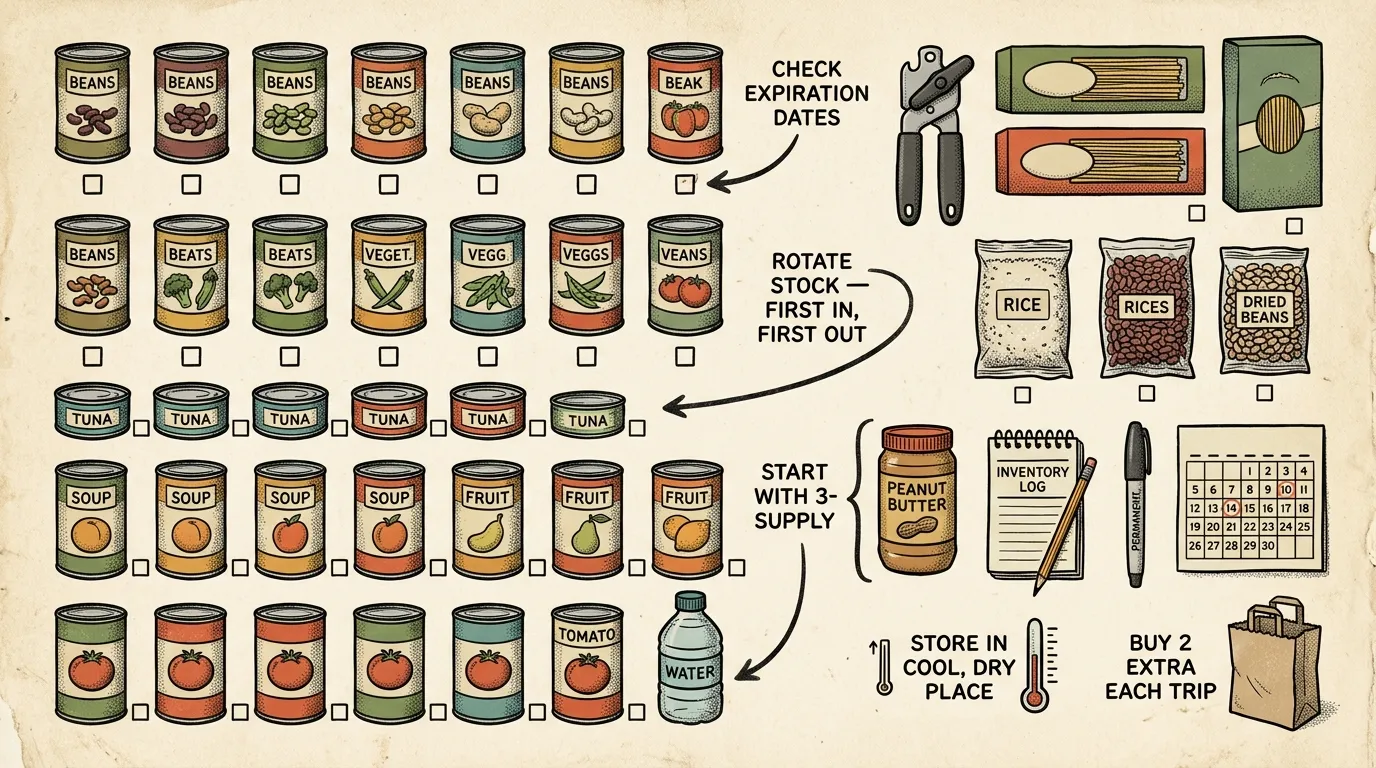
How to Start Stockpiling Food: Canned Goods & Beginner Guide
Learn how to start stockpiling food with canned goods, budget-friendly staples, and smart rotation. Step-by-step beginner guide.
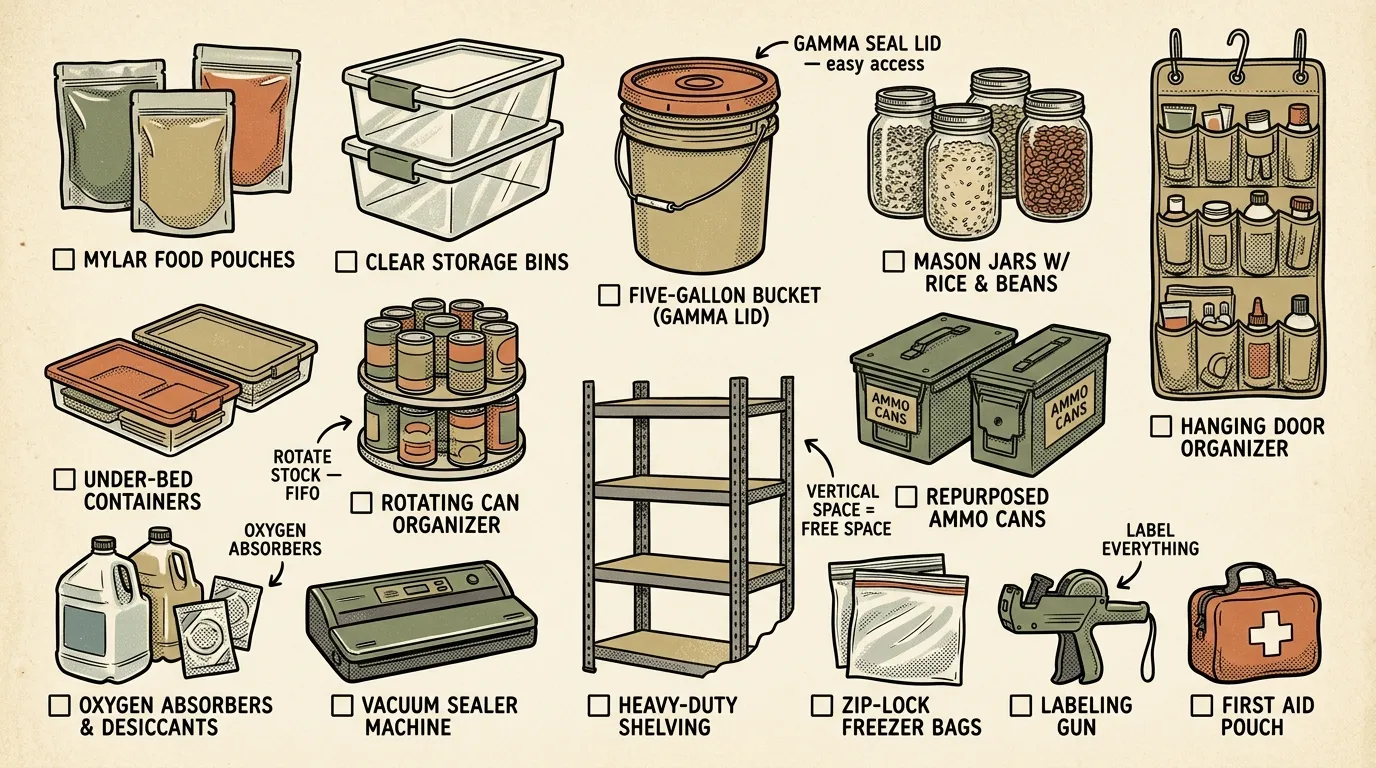
Prepper Storage Solutions: Save Space & Stay Ready
Proven prepper storage solutions to maximize space, protect supplies, and stay organized. Budget tiers, room-by-room plans, and rotation tips. Start today.
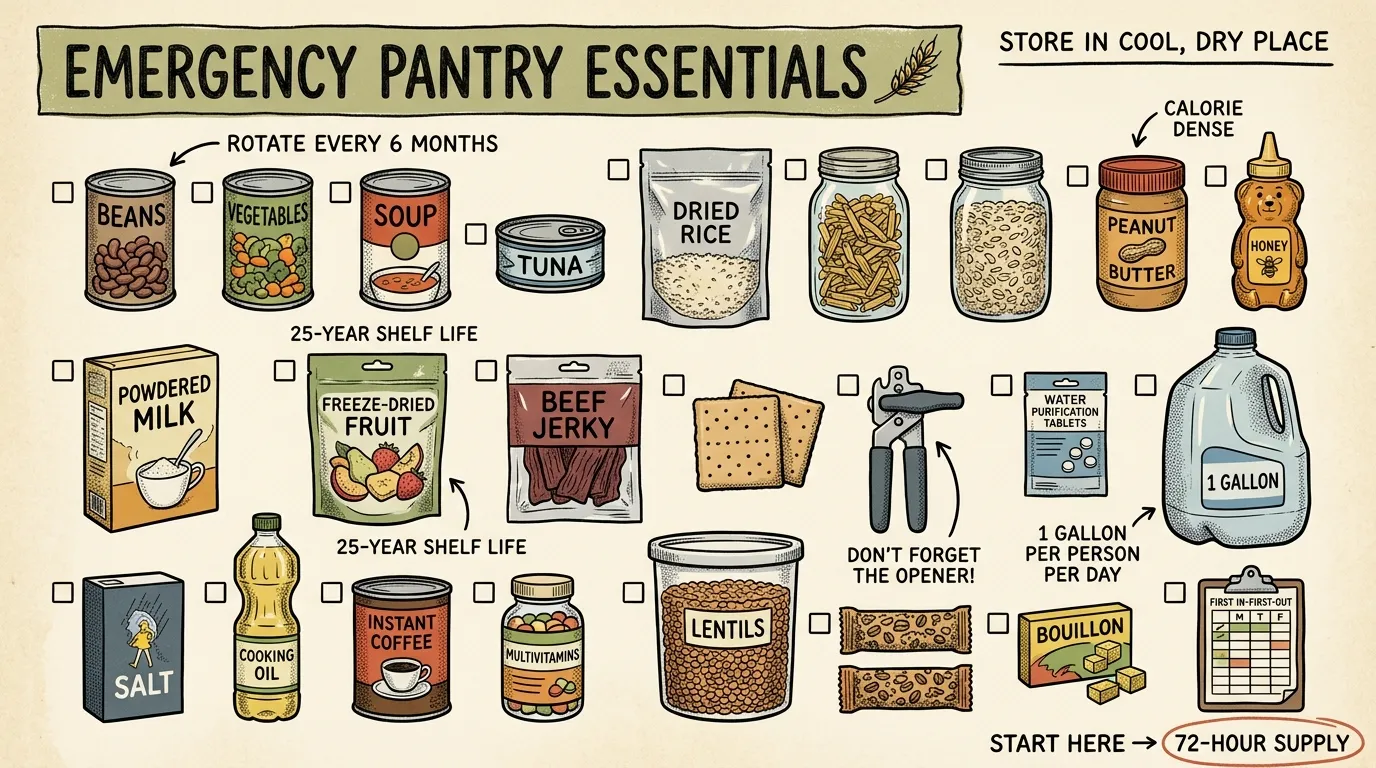
Beginner Food Prepping Essentials: Emergency Pantry Guide
Master beginner food prepping essentials — from shelf-stable staples and storage methods to simple emergency meals. Start your prep today.