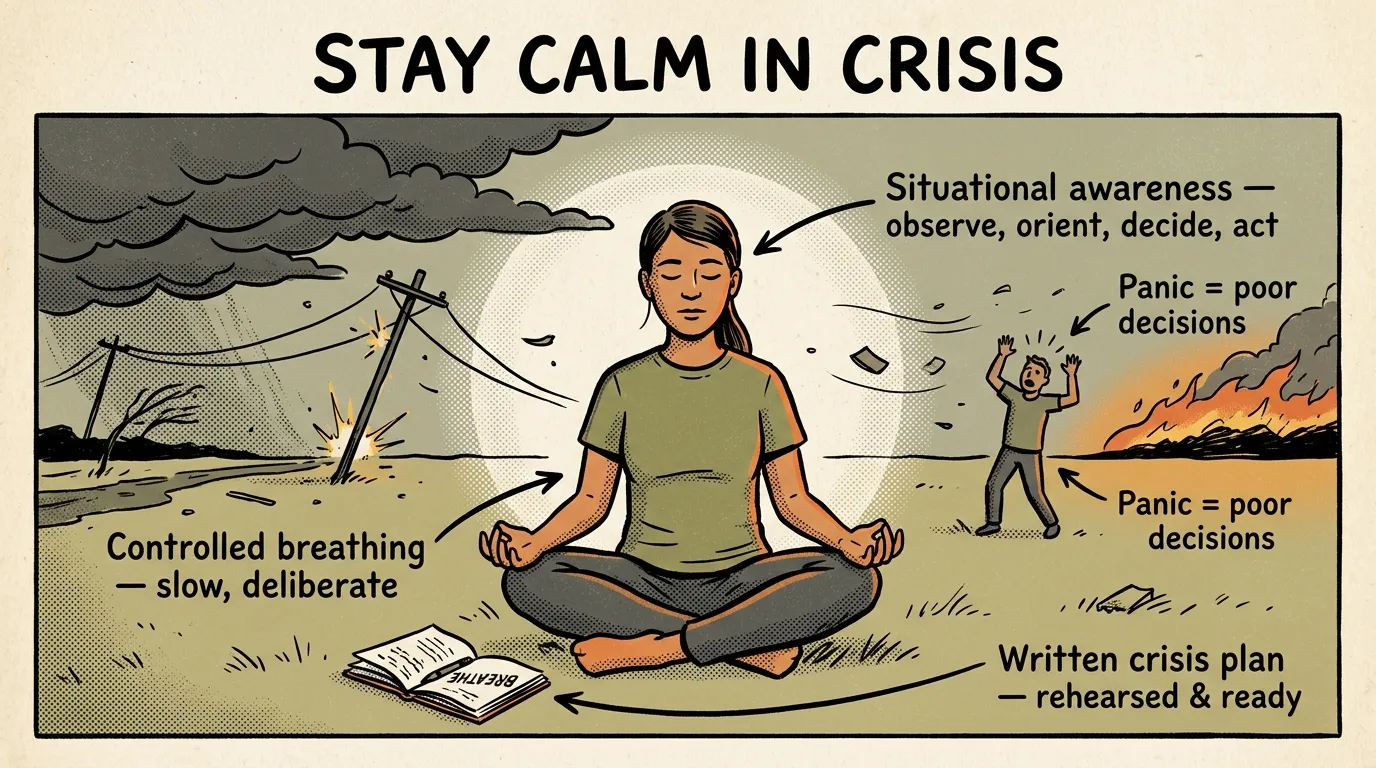
Mental preparedness is the ability to stay calm, think clearly, and make effective decisions during emergencies. New preppers can build mental resilience through mindfulness, visualization, scenario planning, journaling, drills, and repeated skills practice. It complements physical preparedness by helping people use their gear, plans, and resources more effectively under stress.
Key Takeaways
- Train your mind like you train your skills — mental preparedness determines whether your gear and plans actually work under real pressure.
- Start this week: practice box breathing daily, write a one-page scenario plan for your most likely local emergency, and run a one-hour power-outage drill with a five-minute after-action review.
- Use the OODA loop (Observe, Orient, Decide, Act) during drills to build rapid decision-making habits before a crisis forces you to improvise.
- Stress inoculation through controlled discomfort — cold showers, off-grid nights, timed drills — rewires your nervous system so real emergencies feel less paralyzing.
- Curate your gear ruthlessly: every untested item is a source of doubt that competes for mental bandwidth when you need clarity most.
Mental Preparedness for Preppers: Stay Calm in Crisis
Mental preparedness for preppers is one of the most underfunded line items in survival planning. People with $5,000 kits can freeze at the sound of a smoke alarm, while people with a headlamp and a gallon jug can move their families to safety without a wasted step. The difference isn’t gear. It’s what happens between their ears before the crisis started.
Mental preparedness means training the cognitive and emotional skills that let you manage stress, maintain situational awareness, and make effective decisions when everything around you is falling apart. Your supplies matter. Your plans matter. But neither one works if panic’s running the show.
Quick Summary
- Your mind is the operating system — the best kit in the world won’t help if you can’t think clearly under stress.
- Box breathing is the fastest on-ramp — four seconds in, four hold, four out, four hold. Practice it daily so it’s automatic when you need it.
- One-page scenario plans beat hundred-page binders every time, because you’ll actually read and rehearse them.
- Stress inoculation (cold showers, off-grid nights, timed drills) builds real tolerance, not just theoretical readiness.
- Family buy-in is force-multiplying — your crisis performance depends on the emotional state of the people around you.
- After day three, the mental game changes completely — adrenaline fades, boredom gets dangerous, and structure becomes survival.
Why Mental Preparedness Matters More Than Gear
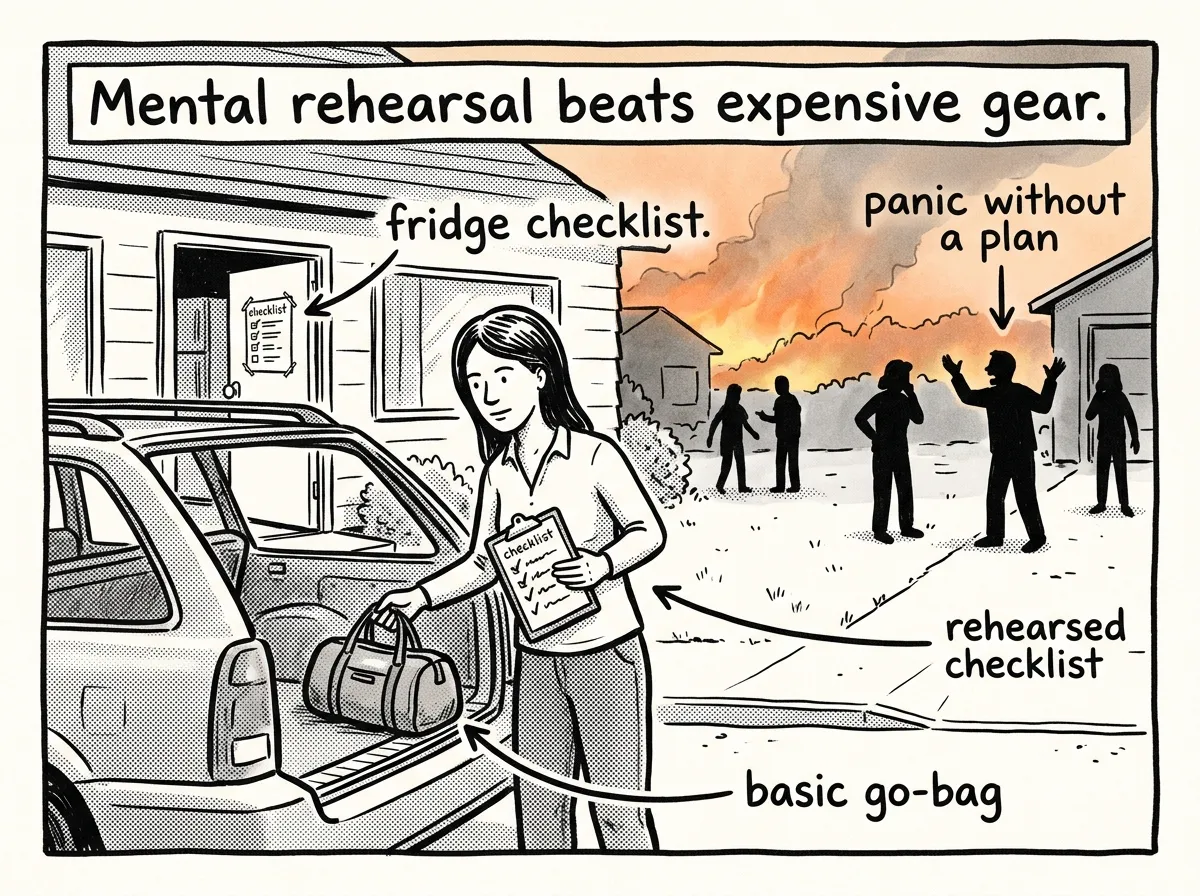 A calm, prepared evacuee loads her car using a fridge checklist while chaos unfolds behind her
During the 2020 Labor Day fires in Oregon, entire communities in the Santiam Canyon had minutes — not hours — to evacuate. Some families with go-bags packed and vehicles fueled still couldn’t get out efficiently because the adults were arguing about what to grab, which route to take, or whether they should leave at all. Panic overrode every piece of preparation they’d done.
One account from that same evacuation describes a retired teacher with a basic kit, a handwritten checklist taped to her fridge, and a clear mental picture of her two evacuation routes loading her car in under eight minutes and driving to the designated rally point. She later said she’d “practiced in her head” dozens of times. That’s mental rehearsal. It works.
FEMA’s own research on disaster decision-making confirms this: under acute stress, the brain defaults to trained responses. If you haven’t trained any, you get whatever your amygdala decides — and that’s usually freeze, flee without a plan, or argue. A 2003 study in the Journal of Traumatic Stress found that individuals who practiced stress inoculation techniques showed significantly better cognitive performance and lower anxiety during high-pressure scenarios compared to untrained controls.
A $5,000 kit and zero mental rehearsal loses to a $50 kit and a brain that’s been through the scenario twenty times.
Here’s why this changes outcomes:
- It prevents simple mistakes. Stress commonly causes you to skip steps, leave a stove on, or forget to treat water. A rehearsed checklist catches errors your panicked brain won’t.
- It shortens decision time. Clear frameworks and pre-built decision trees get you moving when seconds count.
- It keeps teams coordinated. One steady voice can turn a chaotic scene into an organized response within minutes.
- It sustains stamina over days. Mental preparedness isn’t just about the first hour — it’s about day four, day seven, and beyond.
The Four Types of Mental Preparation
You might be wondering whether “mental preparedness” is just a fancy way of saying “stay calm.” It’s not. There are four distinct dimensions, and they reinforce each other during real emergencies.
Cognitive Preparation
This is what most people think of first: learning skills, building checklists, acquiring knowledge. It’s the scenario planning that lets you walk through a wildfire evacuation in your mind before smoke ever appears on the horizon. A practical example: writing a one-page plan for a 72-hour power outage that lists your top three priorities, five critical supplies, primary contacts, and three likely failure points with backup options.
Emotional Preparation
Knowledge alone won’t hold up under fear. Emotional preparation means building your capacity to tolerate discomfort, manage fear without being controlled by it, and use grounding techniques to pull yourself back to the present. Think of it this way — practicing box breathing daily for two weeks means that when your smoke alarm goes off at 2 AM, your hands reach for your checklist instead of shaking at your sides.
Motivational Preparation
This is the “why” behind your actions. When fatigue sets in on day five of a grid-down event, motivation’s what gets you out of bed to check your water supply instead of pulling the blanket over your head. Clarify who you’re doing this for — your kids, your partner, your community. Write it down. Purpose outlasts willpower every time.
Social Preparation
Your mental state in a crisis is directly influenced by the people around you. Social preparation means practicing clear communication under stress, learning to delegate tasks, and knowing how to de-escalate conflict when everyone’s tired and scared. Try running a family drill where each person has an assigned role and you practice a two-minute briefing at the start: “Here’s the situation, here’s the plan, here are your tasks, any questions?”
All four work together. Cognitive gives you the plan. Emotional keeps you calm enough to follow it. Motivational sustains your effort when things get hard. Social ensures the people around you amplify your effectiveness instead of undermining it.
Healthy Preparedness vs. Harmful Obsession
A common question is whether prepping itself is a sign of anxiety disorder. The short answer: preparedness is a psychologically healthy behavior rooted in risk awareness and personal agency. The American Psychological Association consistently recommends that individuals take practical steps to prepare for likely hazards as a healthy coping mechanism.
The COVID-19 pandemic made this mainstream. Millions of people who never considered themselves prepared suddenly found themselves stocking food and thinking about supply chains for the first time. Preparedness isn’t paranoia — it’s pattern recognition paired with action.
That said, there’s a real line between productive preparedness and compulsive prepping.
Healthy preparedness looks like: reduced anxiety because you have a plan, increased confidence, practical skills that improve your daily life, and a sense of community with others who prepare.
Compulsive prepping looks like: persistent catastrophic thinking that doesn’t ease even after you’ve prepared, financial strain from buying gear you can’t afford, relationship damage because preparedness dominates every conversation, and inability to enjoy normal life because the next disaster always feels imminent.
If you recognize yourself in that second list, that’s not weakness — it’s information. The fix isn’t to stop prepping. It’s to address the underlying anxiety driving the behavior. A licensed mental health professional can help you separate productive action from fear-driven compulsion. For a deeper exploration, read understanding the prepper mindset.
Ask yourself honestly: Does preparing make me feel more capable or more afraid? Am I spending money I don’t have on scenarios that are extremely unlikely? Can I go a full week without thinking about disaster scenarios? Your answers will tell you which side of the line you’re on.
Practical Techniques to Build Your Mental Edge
Box Breathing and Grounding
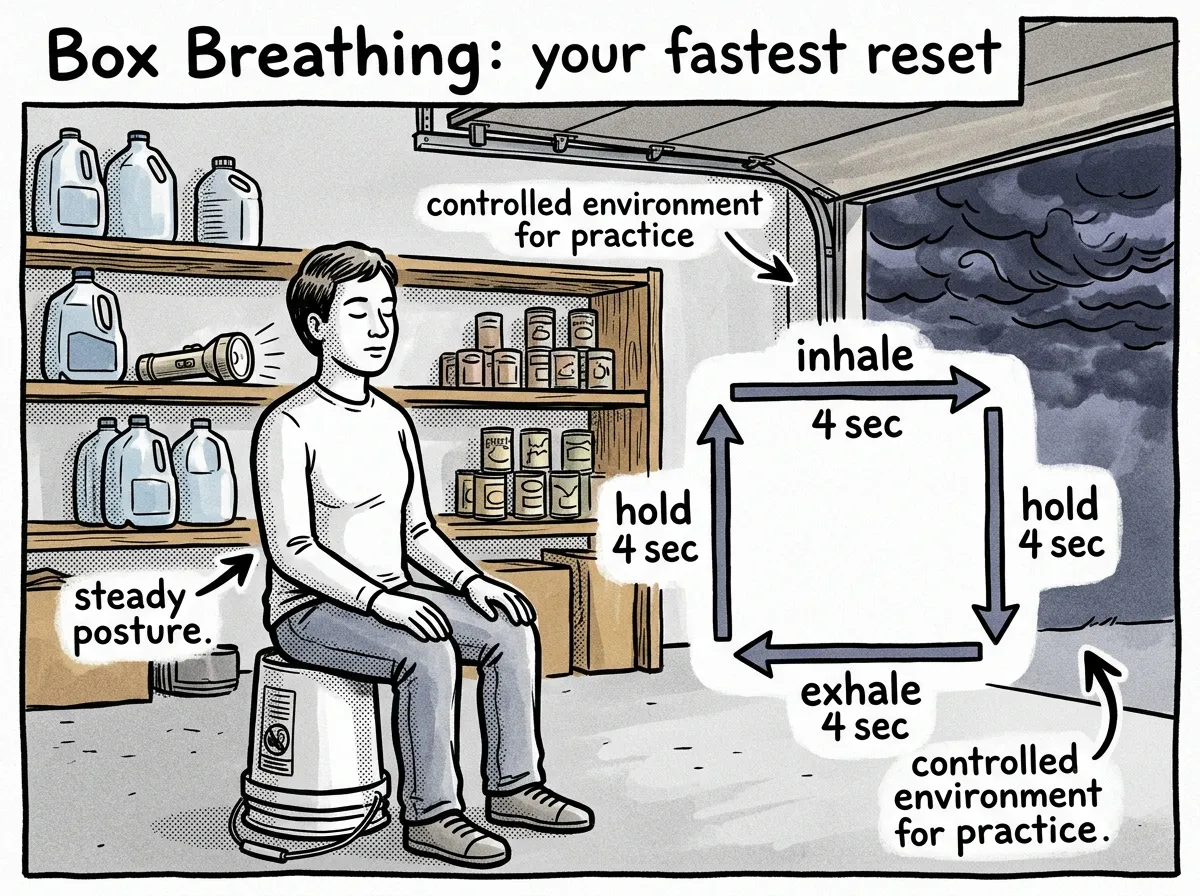 A prepper practices box breathing during a stressful drill, with the four-count cycle visualized
Box breathing is one of the most accessible techniques for managing acute stress. Inhale for 4 seconds, hold for 4, exhale for 4, hold for 4. Do 3 to 6 cycles. It’s not woo-woo relaxation advice — slow, controlled breathing activates the vagus nerve, which triggers your parasympathetic nervous system. You’re sending a measurable physiological signal that overrides panic.
When you feel scattered, use the five-senses grounding exercise: name five things you can see, four you can touch, three you can hear, two you can smell, and one you can taste. This yanks your attention from catastrophic future-thinking back to the present, where your decisions actually matter.
Practice box breathing for just one to two minutes daily. It only becomes reliable under real stress if it’s already automatic — you can’t learn it mid-crisis.
Visualization and Mental Rehearsal
Pick a scenario — a 48-hour power outage, a wildfire evacuation, a winter storm that traps you at home for a week. Mentally walk through the first 30 to 60 minutes. What’s your first action? Where are your supplies? Who do you call? What’s your biggest vulnerability? Write the sequence down, then run a brief physical drill to test it.
Mental rehearsal often reveals practical issues — like a first-aid kit stored under a pile of gear where it can’t be reached quickly — before they matter in a real emergency. A five-minute visualization can save critical minutes when it counts. Small insights like that stack up fast.
Scenario Planning and Checklists
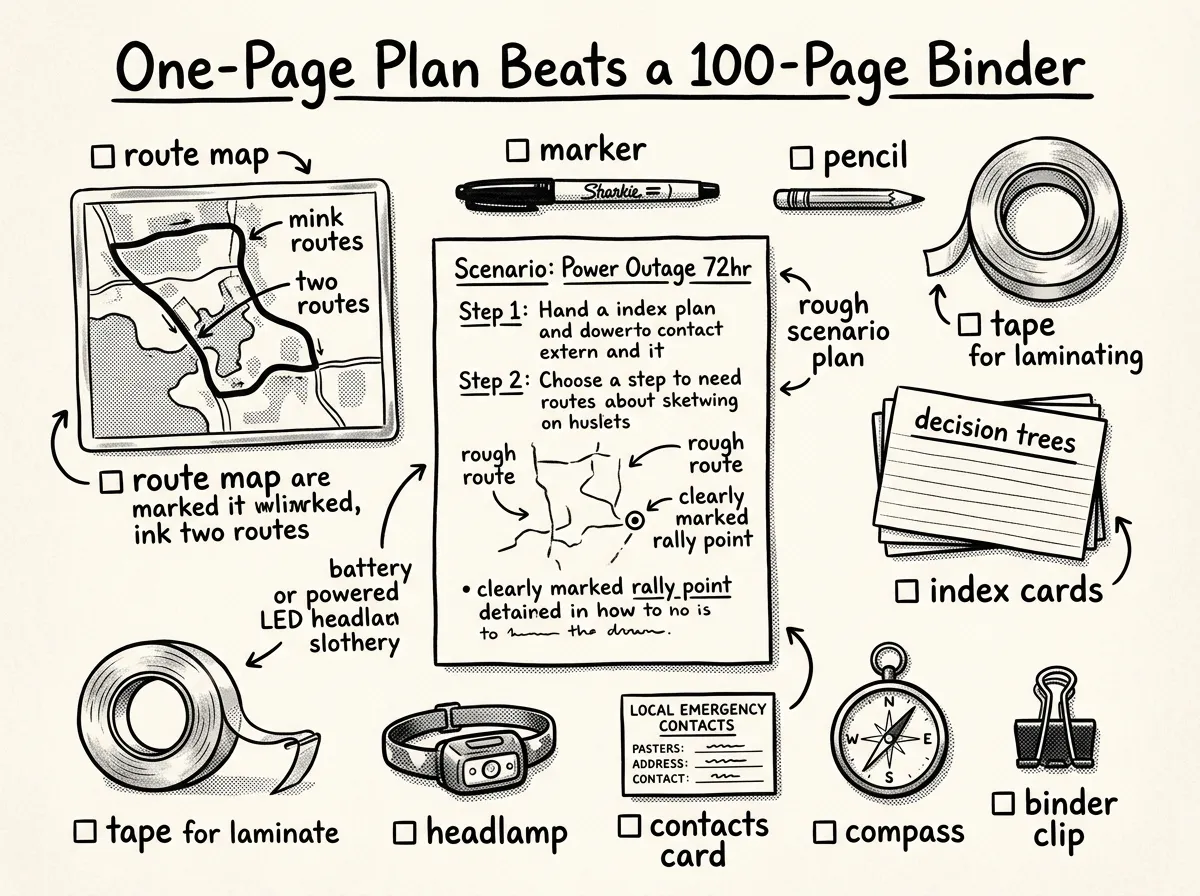 A one-page scenario plan and essential planning tools laid out for quick reference
Create a one-page plan using this structure: title of scenario, top three priorities, top five supplies, primary contacts, three most likely failures with a Plan B for each. Print it. Post it somewhere everyone in the household can find it. Checklists aren’t a sign of incompetence — they’re what pilots, surgeons, and emergency responders use because human memory is unreliable under pressure.
The OODA Loop in Practice
The OODA loop — Observe, Orient, Decide, Act — is a decision-making framework originally developed for military operations and now widely used in incident command training. It’s not abstract theory. It’s how you make fast, good-enough decisions when perfect information doesn’t exist.
Smoke is visible from the east and air quality’s declining. Neighbors are loading vehicles but there’s no official evacuation order yet. You know two routes — Route A heads east (faster but closer to the fire line) and Route B heads north (longer but well clear). Your go-bag’s packed and your tank is three-quarters full. You orient on wind direction, decide Route B is safer, notify your neighbor who lives alone, text your rally-point contact, and act — load, grab the document binder, knock on the neighbor’s door, depart.
Practice this loop during drills. Time yourself packing your bug out bag essentials under a five-minute countdown. The goal isn’t perfection — it’s building the habit of cycling through observe-orient-decide-act instead of standing in the driveway staring at the sky.
Stress Inoculation Training
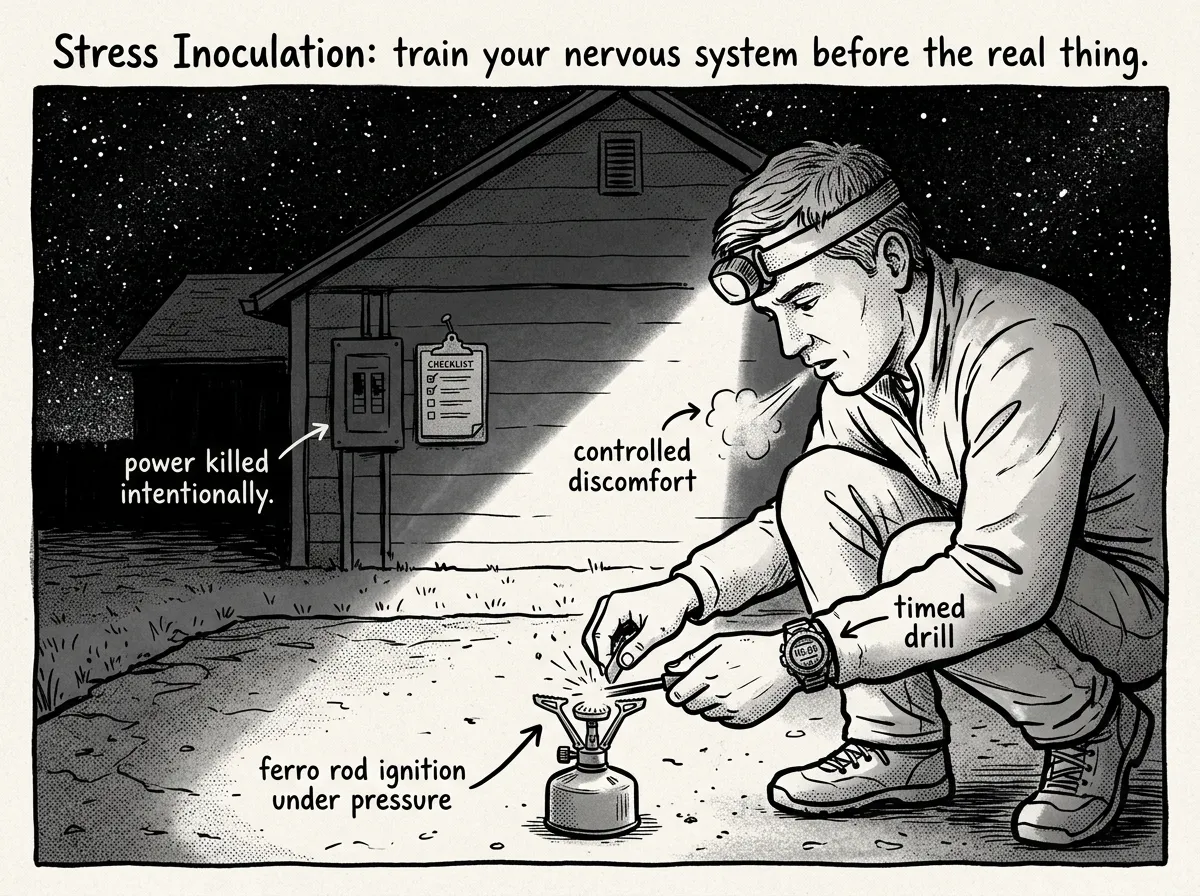 A prepper builds stress tolerance through a timed off-grid drill at night
Stress inoculation is a clinical technique developed by psychologist Donald Meichenbaum. The core principle’s simple: expose yourself to progressively harder stressors while practicing your coping techniques, so real emergencies feel less paralyzing because your nervous system has been there before.
- Week 1: Take a cold shower for 60–90 seconds each morning while focusing on controlled breathing — pure discomfort tolerance training.
- Week 2: Spend one overnight with no electricity, no phone, and no running water, using only your emergency supplies. Notice where anxiety and boredom show up.
- Week 3: Run a timed bug-out drill — 10 minutes to pack your bag, secure the house, and reach your vehicle. Use the OODA loop and run an AAR afterward.
- Week 4: Combine elements in a 24-hour off-grid drill that includes a timed evacuation component, a meal cooked without your stove, and a family communication check-in using your emergency communication plan.
If you have medical conditions or significant trauma history, consult a clinician before starting intensive stress exposure exercises.
Week 2 is often where people get the biggest wake-up call. It’s rarely the cold or the dark that gets to you — it’s the boredom and low-grade anxiety at hour six, when you realize how much of your evening routine depends on a screen. That’s valuable data. Don’t skip the overnight.
Journaling and After-Action Reviews
After every drill, take five minutes for an AAR. Three questions: What worked? What didn’t? What’s one change for next time? Keep entries to one to three bullets each. Over months, your preparedness journal becomes a personalized training manual built from real experience.
The Rite in the Rain All-Weather Notebook — around $8 to $12 — is designed for exactly this purpose: its waterproof paper holds up in wet conditions where regular paper turns to mush.
Limit Information Overload
The 24-hour news cycle is engineered to keep you alarmed. Research from the American Psychological Association shows that constant disaster news consumption increases anxiety and reduces perceived self-efficacy — the exact opposite of what mental preparedness requires.
Set boundaries: choose two to three reliable sources. Check them at set times — morning and evening, not continuously. Turn off push notifications from sensational news apps. Replace doomscrolling time with a 10-minute drill or a journal entry. Your attention is a finite resource. Spend it on actions that build capability, not feeds that build fear.
Build Sustainable Routines
Routines reduce decision fatigue and keep preparation from feeling like a crisis in itself.
- Daily: Sleep, hydration, movement, one minute of box breathing.
- Weekly: 10 to 15 minute quick check of supplies — batteries, water, medications.
- Monthly: 15 to 30 minute family review of your scenario plan and contact list.
- Quarterly: A full one- to three-hour drill with an AAR.
Skill Repetition
Core skills to drill regularly: filter and boil water, basic wound care, start a fire, use a handheld radio, cook without the grid. Use short, frequent sessions — 10 to 30 minutes is plenty. A skill you’ve practiced 50 times is worth more than 10 skills you’ve practiced once.
Gear That Undermines Your Mental Edge
Bad gear doesn’t just waste money — it actively damages your psychological preparedness. When a tool fails during a drill, it introduces doubt. Doubt breeds hesitation. Hesitation kills effectiveness. Part of mental preparedness for preppers is being ruthlessly honest about what deserves space in your kit.
Gear that consistently creates false confidence:
- Ultra-cheap “survival kits” from marketplace sellers. Those $15 tin boxes with 47 items sound impressive until the wire saw snaps on first use. You’re better off with five reliable items than a grab bag of junk.
- Tactical gear you haven’t trained with. A plate carrier in the closet doesn’t make you prepared. If you haven’t worn it for a full day, it’s a costume.
- Oversized “everything” duffels. If you can’t carry your bag at a brisk walk for 30 minutes, your brain will register it as an anchor during a real event.
- Gimmick fire starters. Carry a BIC lighter and a ferro rod you’ve struck 200 times. Your hands should know the motion cold.
- Information products you’ve never opened. Binders of laminated cards and USB drives of PDFs don’t count as knowledge. Read it, practice it, or remove it.
Unfamiliar gear costs you time during a real emergency — time spent working out how a tool operates is time you are not spending using it. A filter you have already unpacked, assembled and used goes to work immediately; one still sealed in its packaging is a problem you have deferred to the worst possible moment. Every untested item in your kit is a small open loop competing for mental bandwidth when you need clarity most. If your honest reaction to a piece of gear is “I think this works,” replace it or remove it.
Extended Scenarios: Mental Resilience from Day 4 to Day 14
Most preparedness content focuses on the first 72 hours. But the mental game changes dramatically after day three. Your adrenaline’s spent. Routines haven’t fully formed. And the uncertainty about when this ends starts eating at you.
During the 2020 Oregon fires, some evacuees spent 10 days in shelters or with extended family before they could return home — if there was a home to return to. Accounts from that period suggest the people who held together past day three had one thing in common: they imposed structure immediately and maintained it.
What happens to your brain after 72 hours:
- Adrenaline crash. The acute stress response fades into heavy fatigue. Decision quality drops sharply if you don’t recognize this transition.
- Boredom becomes dangerous. It leads to risky behavior, arguments, and depression.
- Interpersonal friction escalates. By day five, sleep deprivation and dietary monotony turn minor annoyances into flashpoints.
- Grief and loss processing begins. Around days four through seven, the psychological weight of what’s happened starts to land. That’s normal, not weakness.
Practical strategies for the extended timeline:
- Impose structure immediately. Wake times, meal times, task assignments, downtime. Write a daily schedule and post it visibly.
- Rotate responsibilities. Giving people ownership of specific tasks reduces helplessness and distributes mental load.
- Schedule morale activities. A deck of cards, a paperback, a preparedness journal. Budget 30 to 60 minutes daily for something that isn’t survival-related. This isn’t optional — it’s maintenance.
- Hold daily five-minute check-ins. Two questions: “What do you need?” and “What’s bothering you?” Keep them brief and non-judgmental.
- Track supplies visually. A chart showing water, food, fuel, and medicine levels gives everyone shared reality. Uncertainty about resources is one of the biggest anxiety drivers in extended events.
If your mental preparedness training stops at 72 hours, you’ve prepared for the sprint but not the marathon. Run at least one extended drill — a long weekend off-grid — and pay attention to where friction and fatigue show up.
How to Involve Reluctant Family Members
Your stress response is directly influenced by the emotional state of the people around you. A household where everyone understands the basics is one where panic has less room to spread. Getting family on board is high-leverage — and commonly botched.
Why do people resist? Fear avoidance, mostly. Thinking about emergencies is uncomfortable, and pushing harder activates more resistance. Sometimes it’s identity resistance — they don’t want to be “a prepper.” If the label’s the barrier, drop the label. And sometimes it’s pure overwhelm. You’ve been studying this for months. They’re at zero. Dumping your full knowledge base in one conversation guarantees glazed eyes.
A common mistake: someone gets excited about preparedness, corners their partner with a 45-minute monologue about grid failure scenarios, and wonders why the response is cold. Avoid that approach.
A step-by-step approach that actually works:
- Start with shared experiences, not lectures. A camping trip, a power outage handled calmly together, a conversation about a local weather event.
- Ask, don’t tell. “What would we do if the power went out for three days?” invites collaboration. “We need to prepare for grid failure” invites eye-rolling.
- Match roles to strengths. The cook owns the food plan. The teenager researches emergency communication options.
- Keep first steps absurdly small. Pick where the flashlights live. Fill three water jugs.
- Never use fear as a motivator. Frame preparedness as a life skill — practical, adult, unremarkable.
- Respect their pace. A partner who calmly maintains a three-day water supply is more valuable than one who memorizes your checklist under duress and resents you for it.
Urban vs. Rural: How Location Shapes Your Mental Training
Mental preparedness isn’t one-size-fits-all. Where you live fundamentally changes the threats you face, the resources available, and the psychological pressures that hit first.
If you’re in an urban environment, prioritize mental training around social dynamics, sensory overload management, and constrained-space scenarios. Rehearse shelter-in-place as your primary plan — not your backup. Practice grounding techniques that work in noisy, chaotic environments. Visualize carrying supplies up stairwells, negotiating with neighbors, and moving through crowds without drawing attention.
If you’re in a rural area, focus on autonomous decision-making, isolation resilience, and medical self-reliance. When the nearest hospital is 45 minutes away, the psychological weight of every medical decision gets heavier. Build a communication plan with at least two nearby allies and schedule regular radio check-ins. Don’t let resource abundance breed complacency — a well and a woodlot won’t help if the well pump dies in January and you never rehearsed that scenario.
Both need the fundamentals. The emphasis shifts based on your zip code.
Actionable Steps to Start This Week
- Practice box breathing daily for three days — 3 to 6 cycles each session
- Create a one-page scenario plan for your most likely local emergency
- Run a one-hour home power-outage drill using only your emergency supplies, then do a five-minute AAR
- Start a preparedness journal and note one lesson after each practice session
- Ask one family member: “What would we do if the power went out for three days?” — and listen to their answer
Your Mind Is Your Most Important Piece of Gear
Mental preparedness for preppers isn’t a nice-to-have supplement to your physical kit. It’s the operating system that makes everything else function. The best water filter in the world is useless if you’re too panicked to remember where you packed it. The most detailed evacuation plan fails if you can’t make a decision under pressure.
Train your mind the same way you train your skills — with repetition, progressive difficulty, honest self-assessment, and regular practice. Start with one technique this week. Build from there. Involve the people around you at a pace they can sustain.
You don’t have to be fearless. You have to be practiced. Start now.
Frequently Asked Questions
What is the psychology of preppers?
The psychology of preppers is rooted in risk awareness, pattern recognition, and a desire for personal agency — all psychologically healthy traits. Research shows that practical preparedness reduces anxiety and increases confidence. COVID-19 normalized this behavior for millions of people who suddenly found themselves stocking supplies and thinking about resilience. The key distinction is between preparedness that makes you feel more capable and compulsive prepping driven by unresolved anxiety. If preparation consistently increases your fear rather than reducing it, that’s a signal to seek professional support.
What are the 4 types of mental preparation?
The four types are cognitive (knowledge and planning), emotional (stress tolerance and grounding), motivational (purpose and willpower), and social (communication and team coordination). They work together: cognitive preparation gives you the plan, emotional preparation keeps you calm enough to follow it, motivational preparation sustains effort over days, and social preparation ensures the people around you help rather than hinder your response.
How can new preppers build mental preparedness?
Begin with one breathing technique — box breathing’s the most accessible. Then write a one-page scenario plan covering your most likely local emergency. Run a short timed drill like a one-hour power outage. After the drill, do a five-minute after-action review asking three questions: what worked, what didn’t, what’s one change for next time? This sequence builds cognitive, emotional, and practical readiness simultaneously without requiring any gear purchases.
How do you stay calm during an emergency as a prepper?
Calm under pressure comes from two things: practiced physiological tools like box breathing that activate your parasympathetic nervous system, and mental rehearsal where you’ve already walked through the scenario in your head so your brain has a template to follow. You can’t think your way to calm in the moment — you have to train the response beforehand through regular, low-stakes practice.
What is stress inoculation training for preppers?
Stress inoculation is gradual exposure to controlled, manageable stressors while practicing coping techniques. Examples include cold showers, off-grid overnights, and timed evacuation drills. Over weeks, your nervous system learns to tolerate discomfort without triggering full panic, which means real emergencies feel less overwhelming. It’s a clinically validated approach originally developed by psychologist Donald Meichenbaum.
Sources and Further Reading
- FEMA Individual and Community Preparedness Division: ready.gov
- American Red Cross Emergency Preparedness: redcross.org/get-help/how-to-prepare-for-emergencies
- Meichenbaum, D. (1985). Stress Inoculation Training. Pergamon Press.
- American Psychological Association: apa.org/topics/disasters
- FEMA National Incident Management System (NIMS) training resources: training.fema.gov
The Complete
Prepper's Reference.
149 articles synthesized into one comprehensive PDF — twelve chapters covering water, food, shelter, first aid, comms, and scenario-specific preparedness. Free with your email.
Unsubscribe anytime · We never share your email
You're in. Check your inbox.
Keep Reading
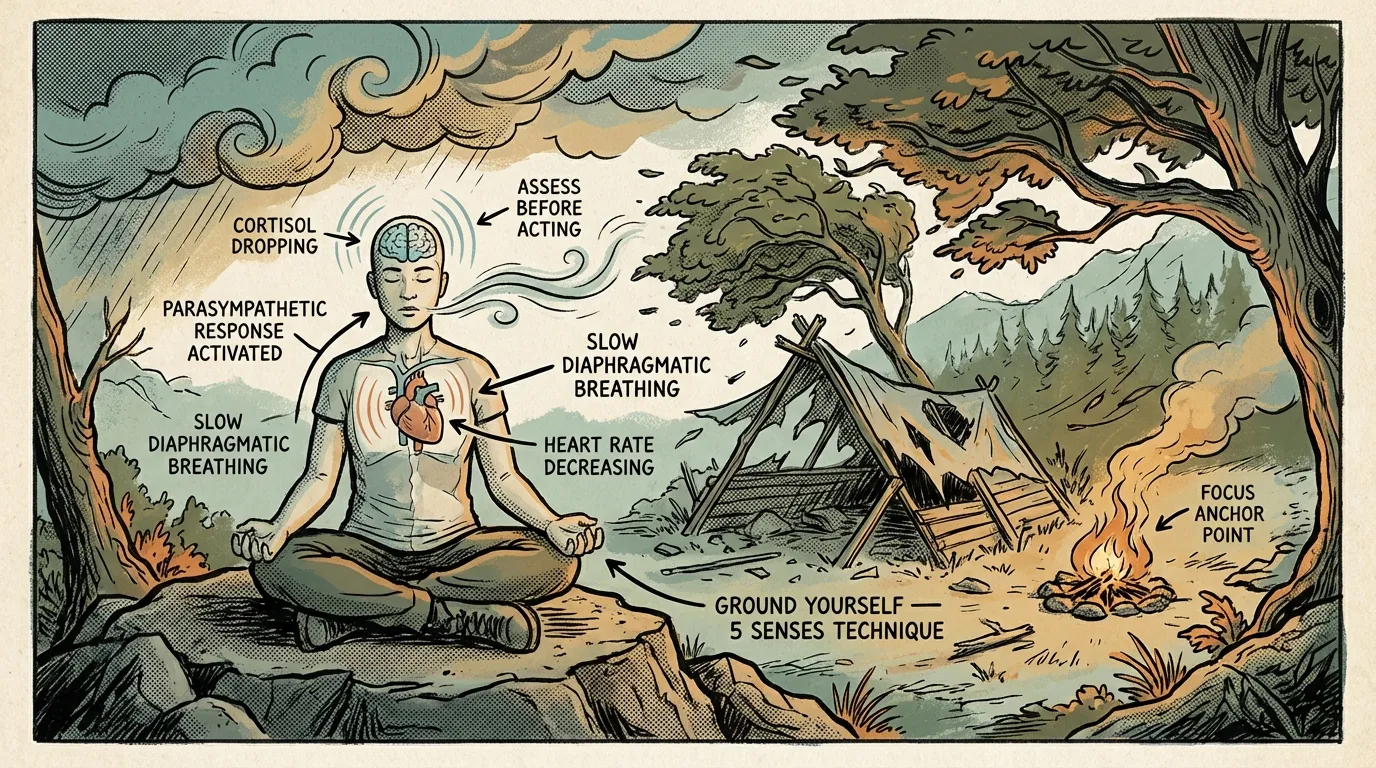
The Science of Staying Calm: Stress Management in Survival Situations
Learn practical stress management techniques for survival situations so you can stay calm, think clearly, and make smarter decisions in an emergency.
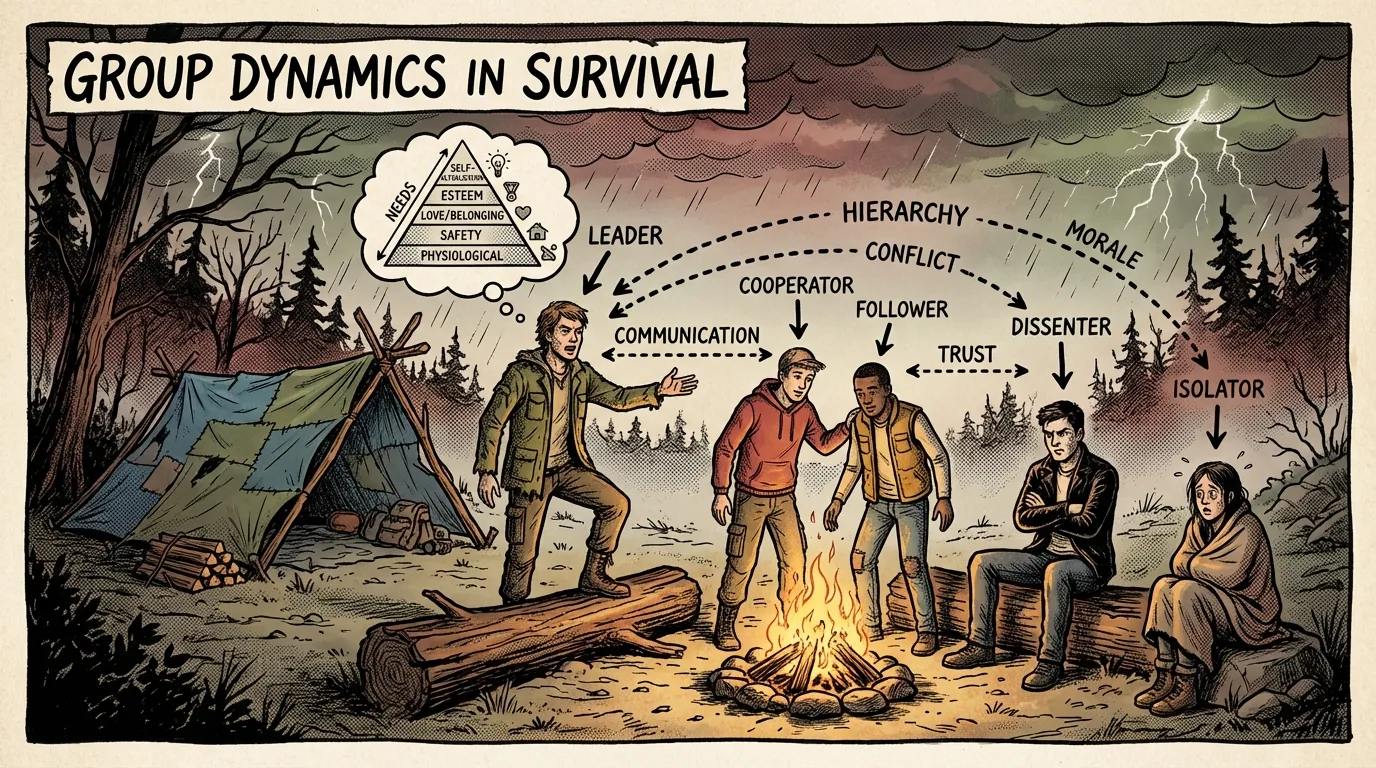
The Role of Psychology in Survival: Understanding Group Dynamics
Learn how survival psychology, communication, leadership, and trust shape group success in emergencies—and how new preppers can prepare now.
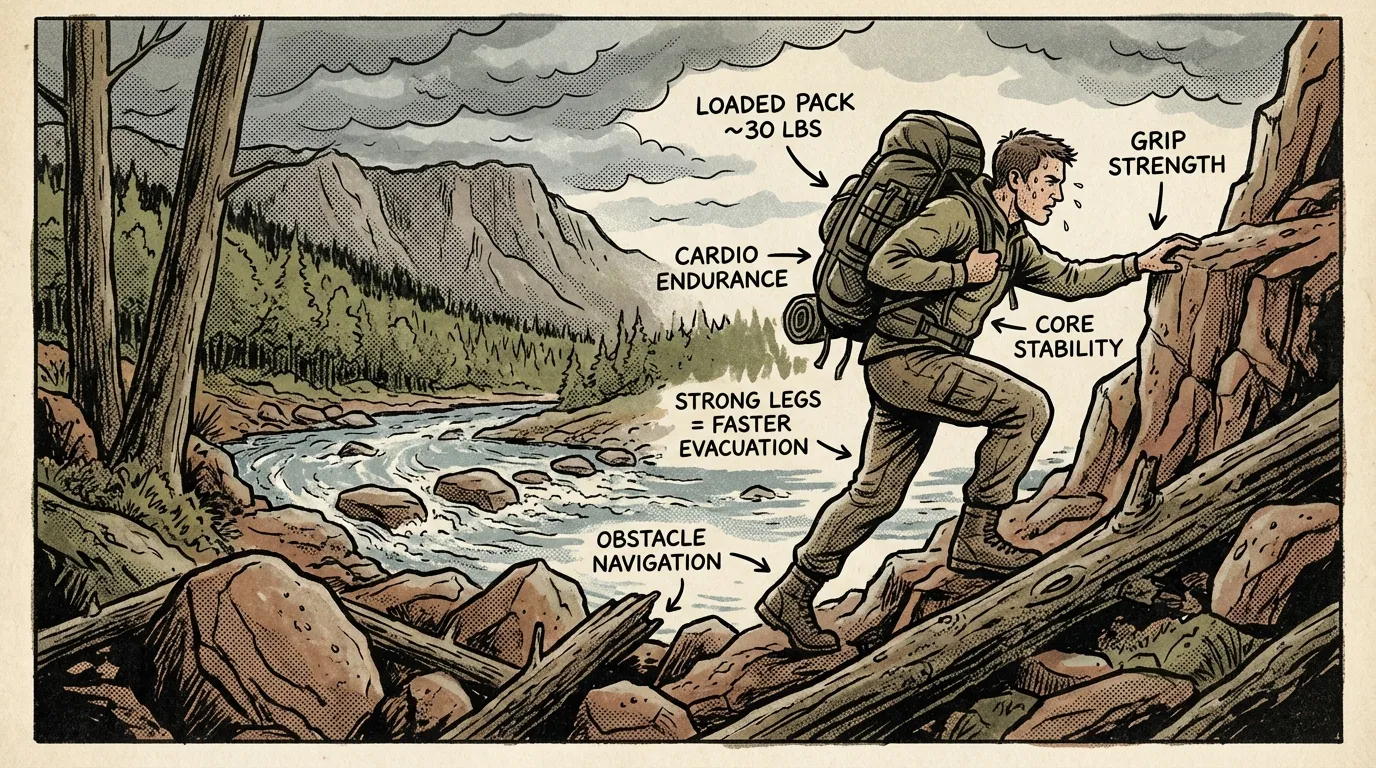
The Importance of Fitness in Survival Situations
Physical fitness boosts strength, endurance, and mobility—giving new preppers a better shot at handling emergencies with confidence.