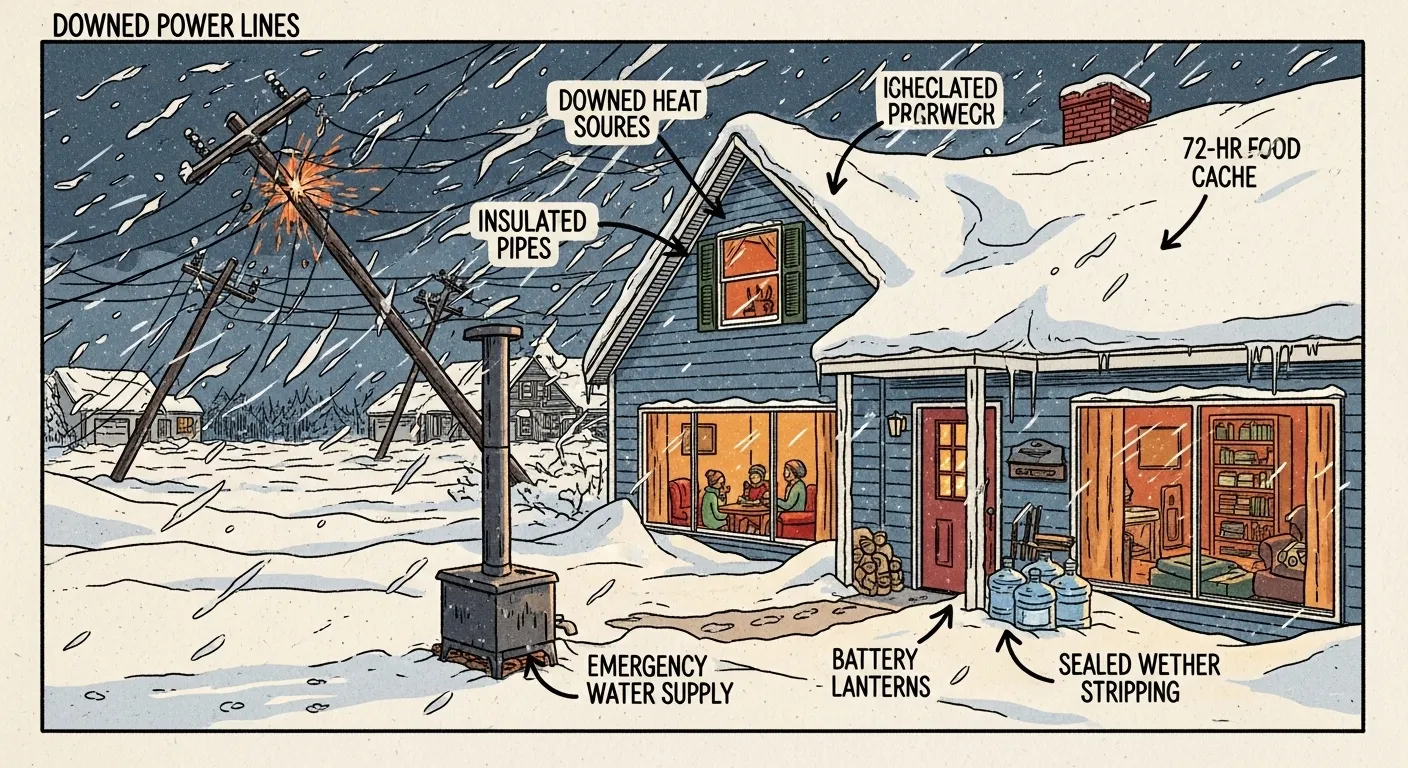
Winter Storm Uri hit Texas in February 2021, dropping temperatures to single digits statewide. The ERCOT power grid collapsed under demand surges while natural gas infrastructure froze, cutting power to 4.5 million homes for up to a week. At least 246 people died, primarily from hypothermia and carbon monoxide poisoning, with economic damages exceeding $195 billion.
Key Takeaways
- Seal off one interior room as your survival core the moment power drops — heat retention matters far more than heat generation in the first critical hours.
- Stock at least 14 gallons of water per person and two 20-lb propane tanks with an indoor-rated heater before winter — municipal water and resupply routes fail simultaneously during major storms.
- Install battery-operated carbon monoxide detectors now, not during the event — CO poisoning from improvised indoor heating is the second-leading killer in winter grid failures.
- Know your main water shutoff valve and practice turning it before any freeze — burst pipes during the thaw caused billions in damage during the 2021 Texas freeze.
- Execute your evacuation plan before roads ice over — if indoor temps drop below 40°F with no backup heat, the safe departure window is already closing.
Quick Summary
- Winter Storm Uri (2021) killed at least 246 people and caused over $195 billion in damage — mostly because individuals and infrastructure weren’t prepared for sustained cold plus grid failure.
- Your first move when power drops isn’t generating heat — it’s retaining it. Seal one interior room, move everyone in, and you’ll buy yourself hours before you even touch a heater.
- Indoor-rated propane heaters and battery-operated CO detectors are non-negotiable gear. Carbon monoxide poisoning is the second-leading killer in these events, and it’s almost entirely preventable.
- Store at least 14 gallons of water per person and two 20-lb propane tanks — municipal water and fuel resupply routes fail at the same time the grid does.
- Know your evacuation trigger before the storm, not during it. If indoor temps hit 40°F with no backup heat, your safe window to drive out is already shrinking.
- Restock everything within a week of the event. The next winter storm won’t check whether your tanks are full.
When It’s Happened Before
In February 2021, Winter Storm Uri slammed into Texas and showed the entire country what happens when winter storm preparedness gets treated as someone else’s problem. Temperatures plunged to single digits across a state where many homes lack insulation rated for anything below 30°F. The ERCOT grid buckled under demand it was never designed to handle, and within hours, 4.5 million homes lost power — some for nearly a week straight. Pipes froze and burst in millions of homes simultaneously. Water treatment plants lost pressure and power, leaving over 12 million Texans under boil-water notices with no way to boil water. At least 246 people died, many from hypothermia in their own homes, others from carbon monoxide poisoning after running generators, grills, and car engines indoors out of desperation. The economic damage topped $195 billion.
Hypothermia can set in at indoor temperatures most people would consider merely uncomfortable — 50°F is genuinely dangerous for the elderly and infants. What happened in Texas wasn’t a freak anomaly. It was a preview.
Uri wasn’t the first time a winter storm exposed critical infrastructure, either. In January 1998, a catastrophic ice storm struck Quebec and the northeastern United States, coating power lines in inches of ice and collapsing over 1,000 transmission towers. 4 million people lost power, some for up to five weeks. The Canadian military deployed 16,000 troops. Thirty-five people died, many elderly residents who refused to leave their homes.
And it doesn’t take a winter storm to kill the grid. The Northeast Blackout of 2003 knocked out power to 55 million people across the eastern U.S. and Canada — triggered not by weather but by a software bug and overgrown trees touching power lines in Ohio. The cascade took nine seconds to black out an area stretching from New York City to Toronto. The pattern is consistent: extreme cold plus grid failure equals a body count, every single time.
What Actually Caused the Texas Grid to Fail
If you’ve ever wondered “what happened in February 2021 cold weather?” — the answer is a cascading systems failure that nearly destroyed an entire state’s electrical infrastructure. Understanding the mechanics matters because it explains why you can’t rely on the grid to protect you.
Texas operates its own isolated power grid through ERCOT, deliberately separated from the two major national grids to avoid federal regulation. That independence came at a cost: no ability to import power from neighboring states when demand spiked. When temperatures plunged to record lows, electricity demand surged roughly 70% above ERCOT’s forecasts. Simultaneously, supply collapsed. Natural gas wellheads and pipelines froze because Texas had no winterization requirements. Gas-fired power plants couldn’t get fuel. Wind turbines iced over (though they accounted for a relatively small share of lost generation). Coal piles froze solid. Even a nuclear plant tripped offline.
The result was a supply-demand gap so severe that ERCOT came within four minutes and thirty-seven seconds of a total, uncontrolled grid collapse. Had that happened, engineers estimated recovery could’ve taken weeks to months, not days. Officials implemented controlled rolling blackouts — except those blackouts weren’t rolling for millions of people. They were permanent outages lasting days.
The grid failure wasn’t caused by unprecedented cold alone — it was caused by decades of choosing not to prepare.
The lesson for you is blunt: if an entire state grid can make the choice not to prepare, so can your utility company. Grid failure preparedness starts with accepting that the grid will fail and building your plan around that certainty.
How Much Warning You’ll Actually Get
For major winter storms, you typically get 3 to 7 days of advance warning. Modern meteorology is remarkably good at predicting large-scale winter weather events — the National Weather Service issued warnings about Uri almost a week before it hit. The problem wasn’t prediction. It was action. Most people heard the warnings, assumed it’d be a dusting or a day of inconvenience, and went about their business. By the time they realized this was different, the roads were impassable and the stores were empty.
What you won’t get much warning about is the grid failure cascade. Even if forecasters nail the storm timing, nobody can tell you exactly when or if the power grid will buckle. In Texas, the gap between “rolling blackouts” and “complete system collapse” was measured in minutes. Plan around the storm window — you’ll see it coming — but understand that the power outage is the secondary event that turns a bad week into a survival situation, and that part comes with almost no warning at all.
Rural residents face the added reality that they’re last in line for utility restoration and road clearing. Urban dwellers deal with density — more people competing for fewer emergency resources, more apartment buildings with no alternative heating, and water pressure drops that hit high-rises first.
The First 72 Hours: A Survival Timeline
Hour One: Retain Heat Before You Generate It
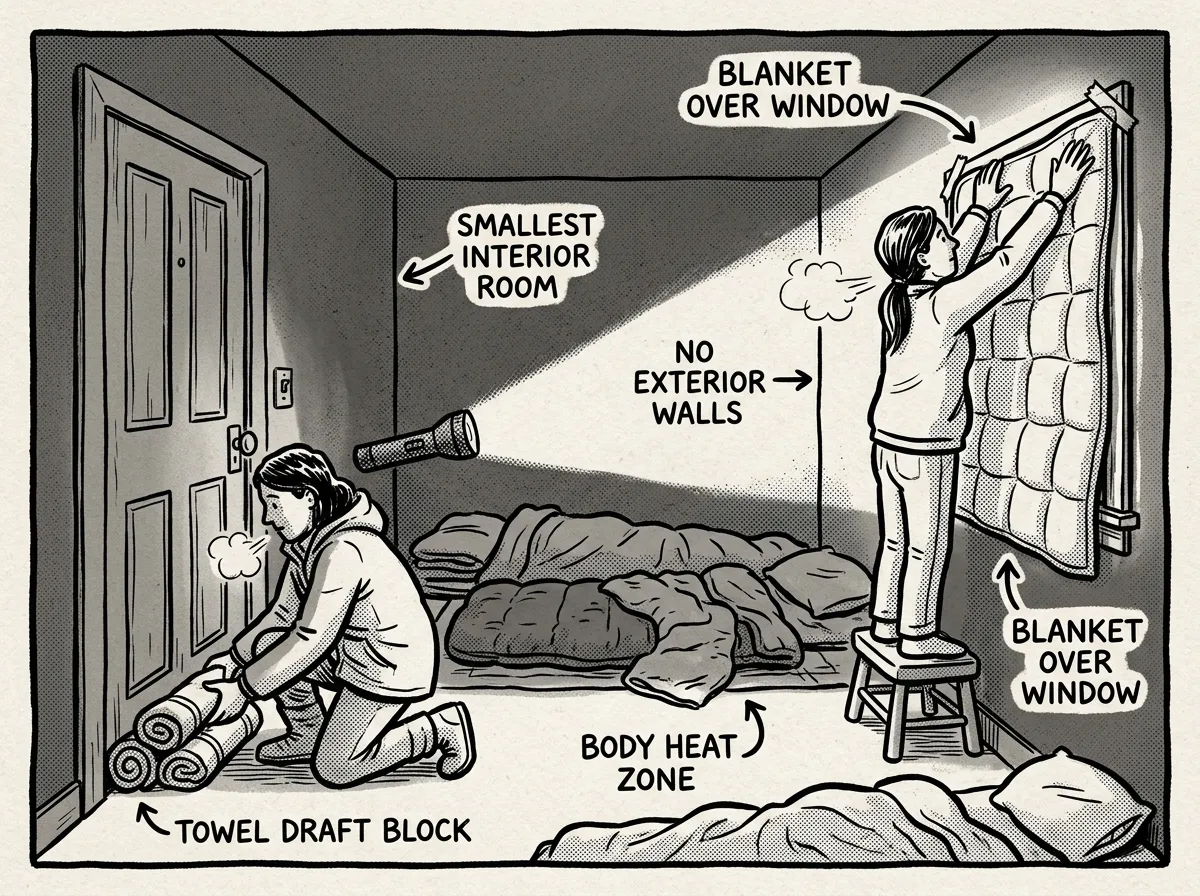 Sealing off an interior room to trap existing heat before temperatures plummet
The moment you lose power in a winter storm, your home starts bleeding warmth. A well-insulated house might hold livable temperatures for 8 to 12 hours. A poorly insulated one can drop below 50°F inside within 3 to 4 hours when it’s single digits outside. Your first move is to pick one room to heat and seal it off. Choose an interior room, ideally south-facing for passive solar gain during the day. Hang blankets or heavy fabric in the doorways. Move everyone into that room. This is your survival core.
If you’ve got an indoor-rated propane heater, now’s when you fire it up. And that carbon monoxide detector better already be installed with fresh batteries. According to CDC guidance, carbon monoxide poisoning presents with symptoms similar to fatigue and flu, which is exactly why victims often don’t recognize it until it’s too late. CO is colorless and odorless. You’re drowsy, then unconscious, then dead. During Uri, it was the second-leading cause of death.
Communication matters in these first hours. Charge all phones before the storm arrives and switch to low-power mode immediately upon outage. Designate one device as your emergency information source and keep the rest off. A NOAA weather radio is the most reliable source when cell towers lose backup battery power — which typically happens within 4 to 8 hours of a grid outage.
Within the first 12 hours, check on your neighbors — especially elderly or single-person households. During Uri, people died alone in houses directly adjacent to neighbors who had working heat and would’ve helped if they’d known.
Hours 6–24: Water and Pipes
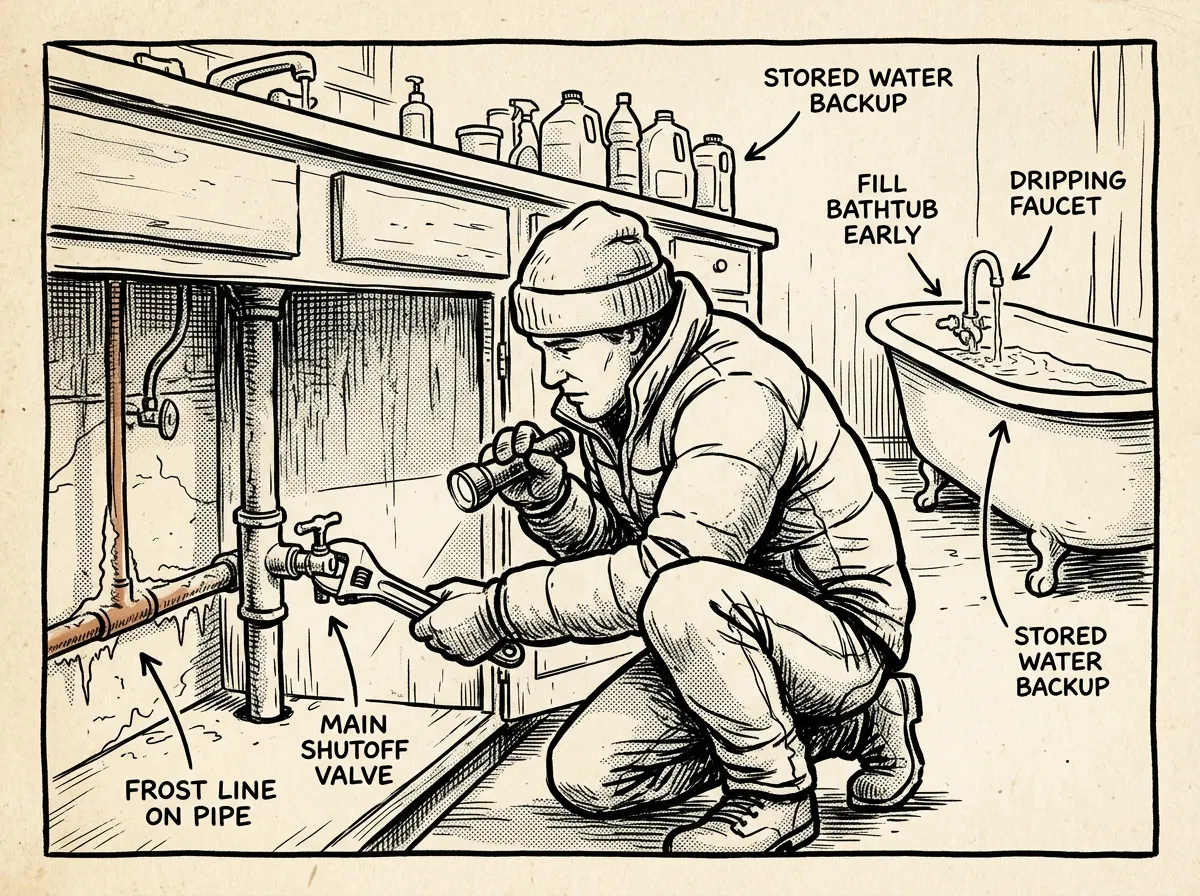 Racing to protect pipes and secure water before the freeze sets in
Within the first 24 hours, your focus shifts to water and pipes. If temperatures are dropping below freezing and your heat is out, your pipes are on a countdown. Know where your main water shutoff valve is before the storm hits. If pipes freeze, you need to shut off water to prevent catastrophic flooding when they eventually thaw and burst. If you still have water pressure, fill every bathtub, pot, and container you own immediately. This is when you rely on your stored water supply — and if you need a framework for how much and how to store it, emergency water storage and purification covers the specifics.
Days Two and Three: The Psychological Grind
This is where physical danger escalates and morale drops. If you’ve got elderly family members or infants in the home, they’re at acute risk of hypothermia even at indoor temperatures that feel merely uncomfortable to a healthy adult. Sleeping bags rated to 0°F or below for every member of the household are critical. Layer them with thermal underlayers and wool socks. Cotton kills in cold weather — it holds moisture against the skin. Wool and synthetics insulate even when damp.
You need a non-electric cooking method — a camp stove with propane canisters or a wood-burning option — to prepare hot food and drinks. Calories are heat. A hot meal does more for morale and survival than most people realize. If you’re building out this kind of gear setup, best camping gear for emergency preparedness covers the essentials. For a complete supply framework for this critical initial window, see our guide on building a 72-hour emergency kit.
Best Backup Heating Options When the Power Goes Out
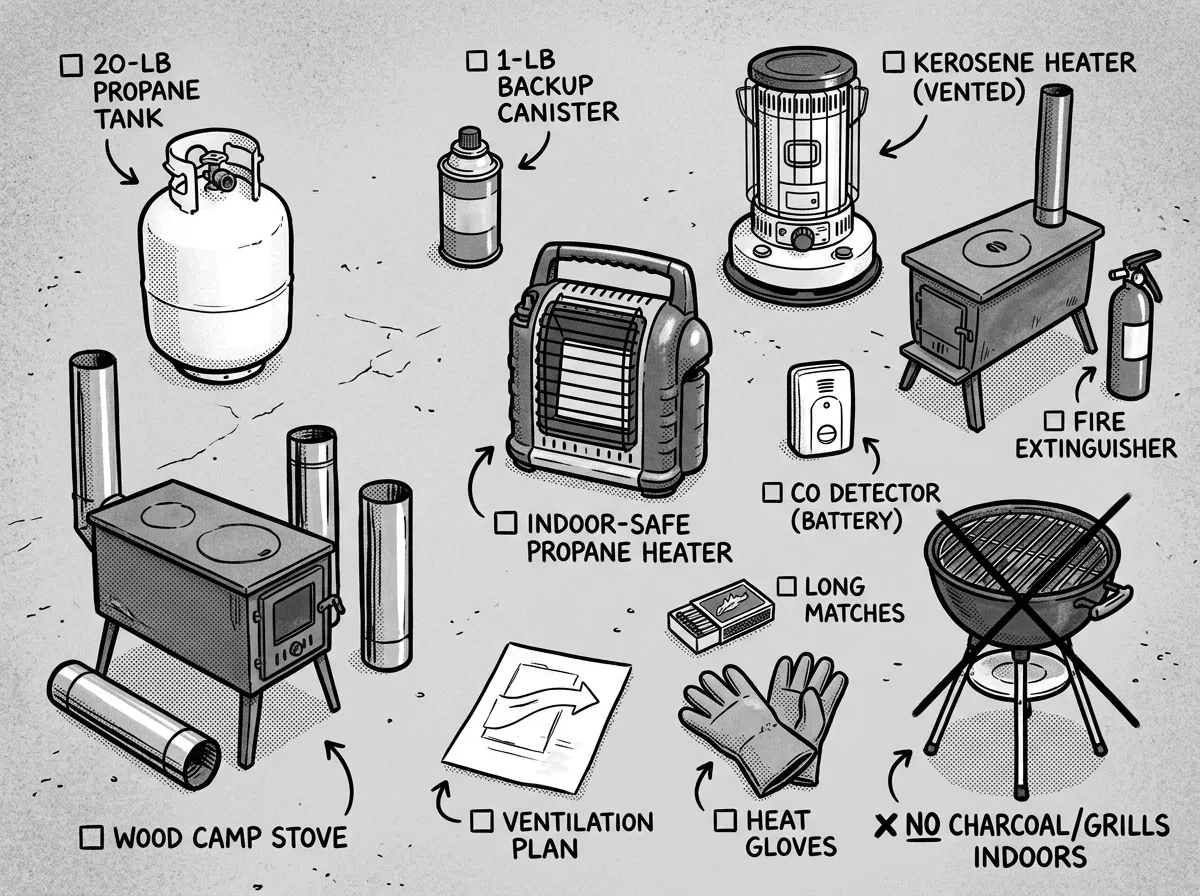 Comparing backup heating options with safety gear side by side
This is the section that can save your life, so I’m going to be specific. Electric space heaters and heat pumps are useless during grid failure — full stop. Here’s what actually works for backup heating without electricity:
Indoor-rated propane heaters are the best option for most households. The Mr. Heater Buddy (4,000–9,000 BTU) heats a single room effectively and runs on one-pound propane canisters or can be adapted to a 20-pound tank with a hose and filter. The Big Buddy (4,000–18,000 BTU) handles larger spaces. At medium output, a 20-pound tank lasts roughly 40 to 50 hours. Three 20-lb tanks provide approximately 120 to 150 hours of heat — enough for a two-week event at moderate use. You’re looking at around $100–$180 for the heater, $20–$30 per tank refill. These heaters have built-in oxygen depletion sensors, but you still need a standalone CO detector. No exceptions.
The Mr. Heater Big Buddy (around $150) is a widely recommended option for indoor propane heating. Its dual-tank adapter setup provides extended runtime, and its built-in oxygen depletion sensor (ODS) is designed to shut the unit off automatically if oxygen levels drop in a sealed space. Lower-cost alternatives often produce uneven heat output or lack reliable safety shutoffs, so verifying ODS functionality and build quality before purchase is worth the effort.
Kerosene heaters produce excellent heat — 10,000 to 23,000 BTU depending on the model — and a single gallon of kerosene burns for roughly 8 to 12 hours. They’re widely used in Japan for home heating and are reliable in extended outages. Downsides: kerosene has a strong odor, requires proper ventilation, and must be stored carefully in approved containers away from your home. Budget $150–$250 for a quality unit and store at least 10 gallons for a two-week scenario.
Wood stoves are the gold standard for extended winter power outage survival if your home has one installed. They produce massive heat output, can be used for cooking and water heating, and run on a fuel source you can often source locally. The limitation is obvious — installation requires proper flue, clearances, and typically a permit. If you already have one, stock a full cord of seasoned hardwood before winter.
Passive methods matter more than you’d think. Thermal mass — stone, brick, concrete, and water jugs — absorbs heat during the day and releases it slowly at night. Hanging heavy blankets over windows after dark adds significant insulation. Mylar emergency blankets taped over windows reflect radiant heat back into the room. Combining passive insulation with a low-output propane heater can significantly reduce fuel consumption.
Critical safety rule: Install battery-operated carbon monoxide detectors in your heated room and in the hallway outside it. Test them monthly. A $25–$35 battery-operated CO detector prevents the second-leading cause of death in every major winter grid failure on record.
When Days Become Weeks
After 72 hours without power in subfreezing conditions, the situation shifts from emergency to endurance. Your stored water supply starts to matter enormously — if pipes have burst and the municipal system has failed, there’s no resupply coming from the tap. During the 1998 Quebec ice storm, some areas went five weeks without power. Think about that timeline. Fuel for heating becomes your most critical resource. If you don’t have multiple propane tanks stored, you’re doing math you don’t want to do.
The systems that break down follow a predictable order: power first, then water, then supply chains, then medical access. Pharmacies can’t operate or restock. Hospitals run on generators, but those generators need diesel, and fuel trucks can’t always get through. People on oxygen concentrators, dialysis, or refrigerated medications face life-threatening gaps within days. Community resilience — neighbors checking on neighbors, sharing fuel and food — becomes the difference between hardship and tragedy. If you’re just starting to think seriously about this kind of planning, beginner’s guide to survival readiness lays out a practical foundation.
How to Know When to Evacuate
This is the decision most people make too late. Families who could’ve driven 30 minutes to a warming shelter often wait until the roads are sheets of ice, and the decision gets made for them. Your winter storm emergency plan needs a clear evacuation trigger, decided in advance — not debated in the moment.
Evacuate if any of the following are true:
- Indoor temperatures drop below 40°F and you have no backup heat source
- A household member depends on powered medical equipment — CPAP, oxygen concentrator, dialysis, or refrigerated medication
- You have infants under 12 months or adults over 75 who can’t tolerate sustained cold
- Structural damage — roof collapse, broken windows, or significant water intrusion — compromises your shelter
- You have less than 24 hours of heating fuel remaining with no resupply path
The critical window for evacuation is before roads ice over. In most major winter storm events, you’ve got a 6 to 12 hour window after the storm warning before road conditions become truly impassable. Once that window closes, you’re committed to sheltering in place.
It’s 2 AM, your indoor temp reads 38°F, and you’ve burned through your last propane tank. The roads iced over six hours ago. Your 78-year-old mother is shivering under every blanket you own. The warming shelter is 12 miles away — a drive that would’ve taken 15 minutes yesterday. Now it might kill you to attempt it. This is why your evacuation trigger has to be a pre-set number, not a feeling.
Pre-position your evacuation setup now: Keep a winter go-bag in your vehicle with warm clothing layers, blankets, water, shelf-stable food, medications, phone charger, and a waterproof container with critical documents. Maintain your fuel tank at three-quarters full from November through March. Identify your destination before the storm: a friend or family member’s home outside the affected area, a hotel along a pre-planned route, or a community warming shelter.
If you need a comprehensive framework for building that evacuation plan, how to build a home emergency plan walks through the decision process step by step.
Extended Grid Failure: What Changes After Week One
Extended winter grid failures have clear historical precedent. The Quebec ice storm left some communities without power for over a month. Daily life fundamentally changed. People relocated to emergency shelters, community centers, and the homes of anyone with a working wood stove.
Once the crisis extends past a week, new threats emerge that weren’t on anyone’s radar during the first few days. Mold from burst-pipe water damage becomes a serious health hazard once temperatures rise. When power returns, run dehumidifiers immediately in any affected area. Remove saturated drywall within 48 hours — don’t wait to see if it dries.
Mental health strain — from isolation, cold, sleep deprivation, and uncertainty — takes a measurable toll. Families who maintain daily routines during extended emergencies tend to fare dramatically better. Assign tasks to children. Eat meals at consistent times. Limit doom-scrolling on phones to preserve both battery life and your sanity. Read books. Play cards. Structure is a survival tool.
In multi-day cold-weather emergencies, morale often collapses not from the cold itself but from the lack of structure — no schedule, no tasks, no sense of progress. Households that maintain a rhythm, such as consistent wake-up times, meal times, chore assignments for children, and a set bedtime, tend to hold together better under sustained stress than those without any routine.
Structural damage from ice accumulation on roofs can make homes uninhabitable even after power returns. The recovery phase of a major winter event often lasts months to years, not days to weeks. Skills you might associate with wilderness survival — fire management, water purification, improvised shelter — become surprisingly relevant. Learning bushcraft skills for emergency preparedness covers why these aren’t just for the backcountry.
Your Winter Storm Preparedness Checklist
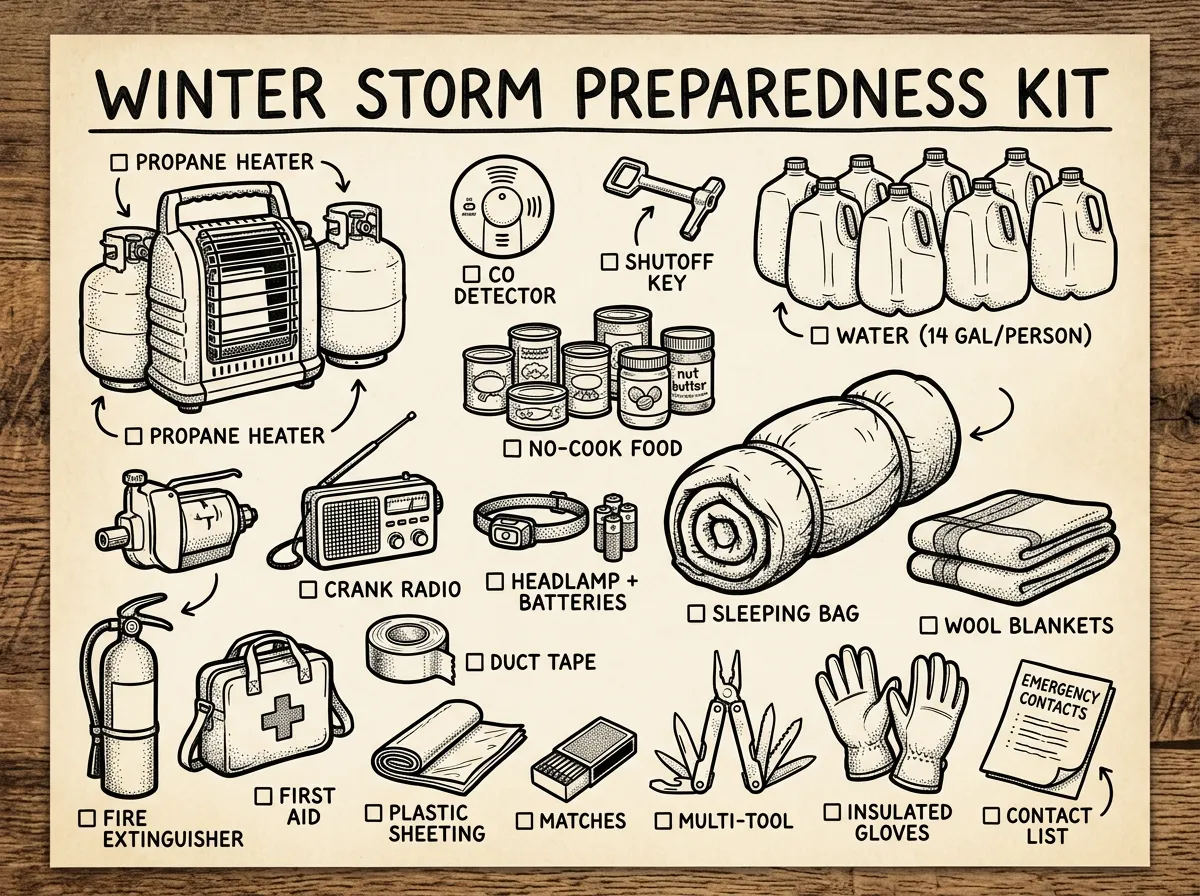 Complete winter storm survival kit laid out and ready to go
- Designate one interior room as your heated survival core
- Store at least 14 gallons of water per person in food-safe containers
- Purchase an indoor-rated propane heater and minimum two 20-lb propane tanks
- Install battery-operated CO detectors in survival room and hallways
- Acquire 0°F-rated sleeping bags and wool/synthetic layers for everyone
- Locate, label, and practice operating your main water shutoff valve
- Stock two weeks of calorie-dense, no-cook food and a non-electric cooking method
- Charge all devices and battery banks; keep a NOAA weather radio accessible
- Insulate exposed pipes in attic, crawlspace, garage, and exterior walls
- Fill prescriptions early — aim for a 30-day supply of critical medications
- Fuel vehicles to full and store additional gasoline in approved containers
- Document your home with timestamped photos and video for insurance
During the Storm
- Consolidate everyone into the survival room. Close doors to all other rooms.
- If power is lost, shut off water if there’s any indication of pipe freezing. Open faucets slightly to relieve pressure if you choose to leave water on.
- Run your indoor-rated propane heater at the lowest effective setting. Ventilate per manufacturer instructions. Never use an unvented heater, grill, camp stove, or generator indoors without proper ventilation.
- Layer clothing on everyone immediately. Thermal base layer, insulating mid-layer, outer shell. Wool socks, hats, gloves — even while sleeping.
- Ration water wisely. Prioritize drinking water. Use melted snow (boiled or purified) for non-drinking needs only.
- Eat calorie-dense foods regularly. Your body burns significantly more energy maintaining core temperature.
- Monitor for hypothermia signs — confusion, slurred speech, excessive sleepiness — even indoors.
- Never run a vehicle in an attached garage, even with the door open.
- Check on neighbors within the first 12 hours.
After the Storm
- Inspect pipes carefully before restoring water. Turn the main valve on slowly and check every exposed section.
- Document all damage with photos and video before cleaning up. Contact your insurance company immediately.
- Check your roof and attic for ice dam damage, leaks, or structural stress.
- Address water damage within 48 hours. Run dehumidifiers, remove saturated drywall, and monitor for mold.
- Restock everything you used. Replace propane, water stores, batteries, food, and medical supplies. The next event won’t send a calendar invite.
- Conduct a household debrief. What worked? What didn’t? What do you need that you didn’t have?
What Most People Get Wrong
The number one mistake in winter storm preparedness is assuming it won’t happen to you because of where you live. Texas proved that thesis catastrophically wrong. Millions of people in a historically warm-climate state had zero cold-weather emergency gear. No sleeping bags. No backup heat. No stored water. “It doesn’t get that cold here” is a statement about averages, and averages don’t keep you alive during outlier events.
The second major mistake is treating the car as a survival plan. During Uri and the Quebec ice storm alike, roads became impassable within hours. If your plan requires driving somewhere, you need to execute it before the storm peaks.
The third — and deadliest — mistake is improper heating. Every major winter grid failure produces a wave of carbon monoxide poisoning deaths. During Uri, people ran generators in garages, charcoal grills in living rooms, and ovens with the door open. A $25–$35 battery-operated CO detector and a heater actually rated for indoor use would’ve prevented the majority of those deaths.
The fourth mistake is failing to plan for communication blackouts. Cell towers run on backup batteries that typically last 4 to 8 hours after grid power fails. After that, your smartphone becomes a very expensive flashlight. A NOAA weather radio with battery or hand-crank power is the most reliable information source during an extended outage. They cost under $30 — buy one now.
Another common mistake is consistently underestimating how much water is actually needed. A family of four needs a minimum of 56 gallons for a two-week outage. That’s more than most people have ever stored. Two 20-lb propane tanks sounds like a lot until you calculate that moderate heater use burns through one in less than 50 hours. Run the math before the storm, not during it. And if you’re a renter — don’t assume your landlord or building management has a backup heating plan. Most don’t. Your preparedness is your responsibility regardless of whether you own or rent.
Frequently Asked Questions
What happened in February 2021 cold weather?
A disrupted polar vortex drove arctic air deep into the southern United States, producing Winter Storm Uri. Texas experienced temperatures well below zero, and the ERCOT power grid collapsed under unprecedented demand. Over 4.5 million homes lost power for up to a week. At least 246 people died from hypothermia, carbon monoxide poisoning, and related causes. Municipal water systems failed, pipes burst in millions of homes, and economic damage exceeded $195 billion. It remains one of the deadliest and costliest winter events in U.S. history.
What was the weather like in February 2021?
February 2021 brought historically extreme cold to regions that weren’t built for it. Texas saw temperatures as low as -2°F in areas that rarely see freezing weather. Ice storms hit the Pacific Northwest and Southeast simultaneously. Over 150 million Americans were under winter weather advisories at the storm’s peak. The cold persisted for over a week — far longer than typical cold snaps — and that sustained duration is what made the infrastructure damage so catastrophic.
How long can power be out during a major winter storm?
During Winter Storm Uri, some Texas homes lost power for nearly a week. The 1998 Quebec ice storm left residents without electricity for up to five weeks. Planning for at least two weeks of energy independence — with backup heating, stored water, batteries, and fuel — is a realistic minimum based on what’s actually happened in recent history.
How to survive a week without power in winter?
Consolidate your household into one interior room and seal it off to retain heat. Use an indoor-rated propane heater with a battery-operated CO detector. Layer wool and synthetic clothing on every person, including while sleeping, and use 0°F-rated sleeping bags. Ration stored water — minimum one gallon per person per day — and eat calorie-dense foods regularly to fuel your body’s heat production. Check on vulnerable household members and neighbors frequently. Have a NOAA weather radio for information when cell towers fail.
Take Action Before the Forecast Forces You To
The single clearest lesson from every winter storm disaster on record is this: the people who were fine had prepared before the storm, and the people who suffered had not. There’s no in-between.
Winter storm preparedness isn’t about fear. It’s about math. You know the grid can fail because it has — repeatedly, catastrophically, in living memory. You know the supplies you need because the list isn’t complicated. You know the timeline because meteorologists will give you days of warning. The only variable is whether you act on that information.
Three 20-lb propane tanks, an indoor-rated propane heater, and 30 gallons of stored water represent a reasonable baseline for a household preparing for extended grid failure. The families who come through these events intact aren’t the ones with the most gear. They’re the ones who thought it through, bought the basics, and practiced using them before the temperature dropped.
Pick one item from the checklist above and do it this week. Then do another next week. By the time the next winter storm watch scrolls across your screen, you won’t be scrambling — you’ll be ready. That changes everything.
The Complete
Prepper's Reference.
149 articles synthesized into one comprehensive PDF — twelve chapters covering water, food, shelter, first aid, comms, and scenario-specific preparedness. Free with your email.
Unsubscribe anytime · We never share your email
You're in. Check your inbox.
Keep Reading
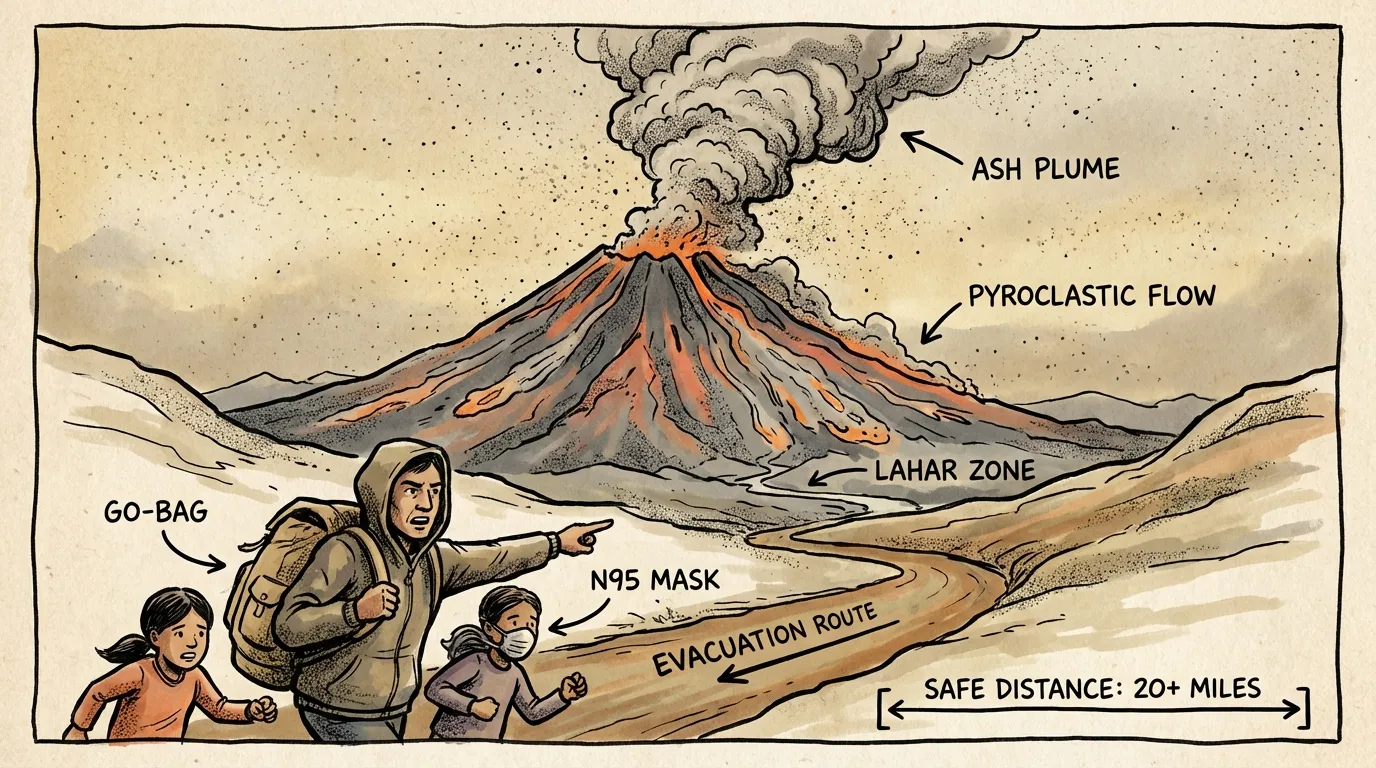
Volcanic Eruption Preparedness: When the Mountain Wakes Up
Mount St. Helens gave scientists 2 months of warning — yet 57 people still died. The 2022 Tonga eruption sent a shockwave around the planet twice. Here's what volcanic eruptions actually threaten, how far danger extends, and how to prepare whether you live near a volcano or not.
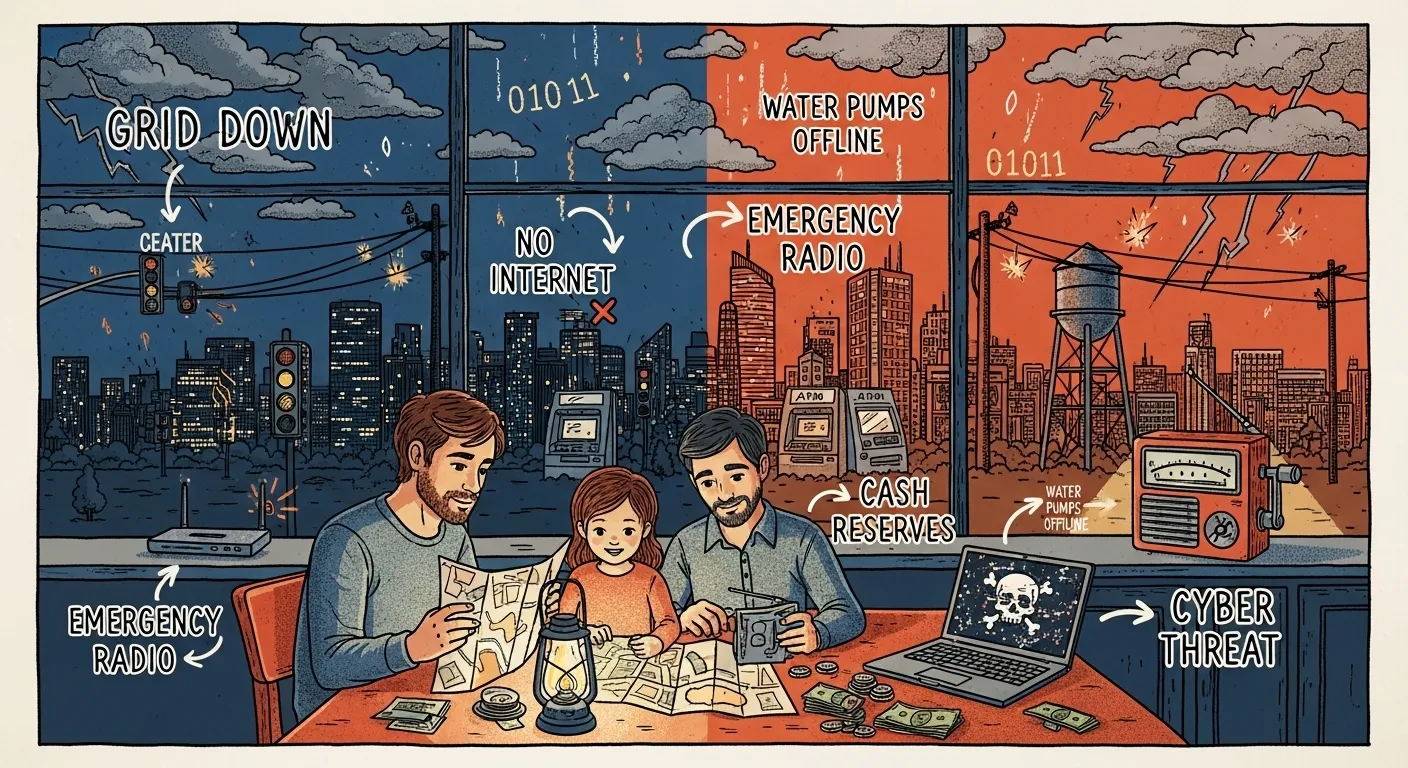
Cyberattack and Infrastructure Failure: The Invisible Emergency
In 2021, a ransomware attack shut down the Colonial Pipeline and caused gas shortages across the Southeast in 6 days. In 2015, hackers turned off power for 230,000 Ukrainians. Digital attacks on physical infrastructure are here — here's how to prepare for when they hit yours.
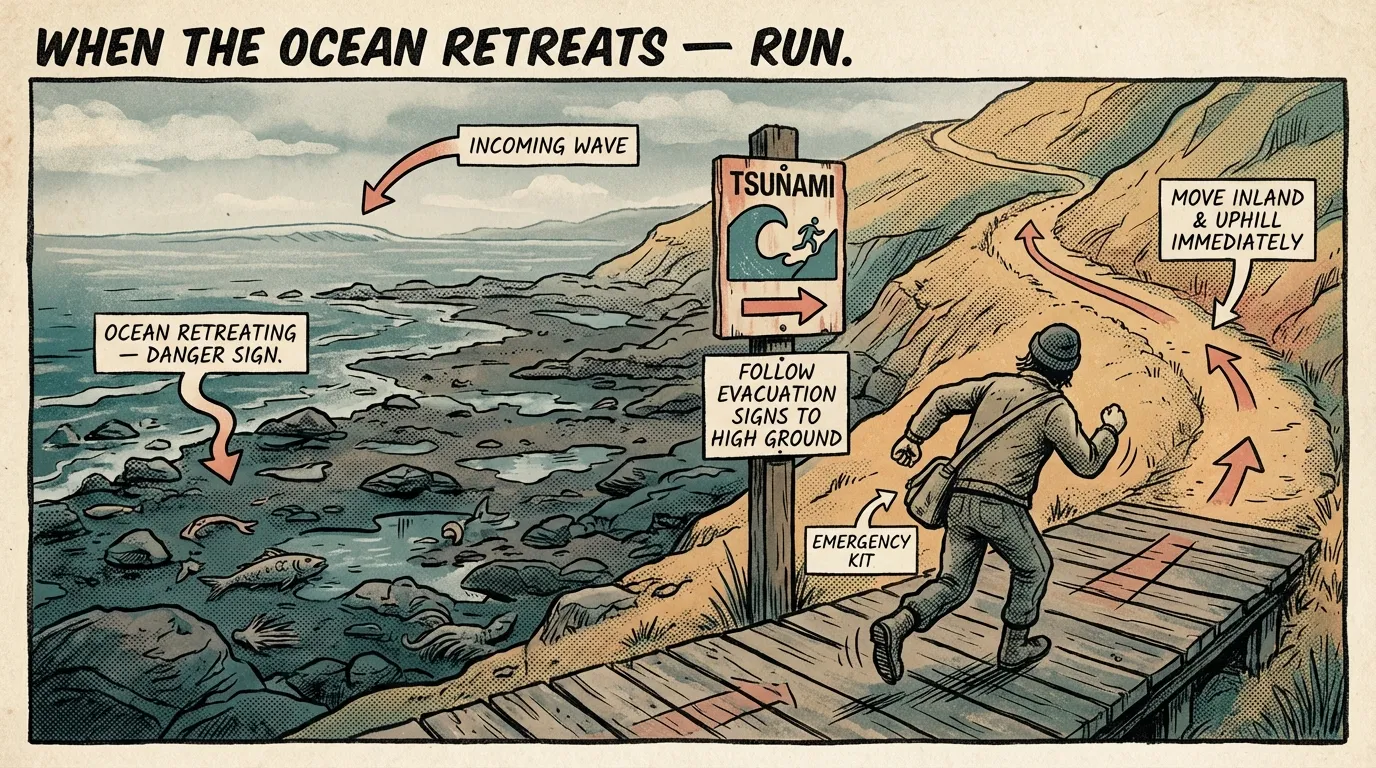
Tsunami Preparedness: What to Do When the Ocean Retreats
The 2004 Indian Ocean tsunami killed 227,000 people in 14 countries in under 8 hours. A 10-year-old girl's geography lesson saved 100 lives on a Thai beach. Here's what tsunamis actually look like — and the knowledge that makes the difference between life and death.