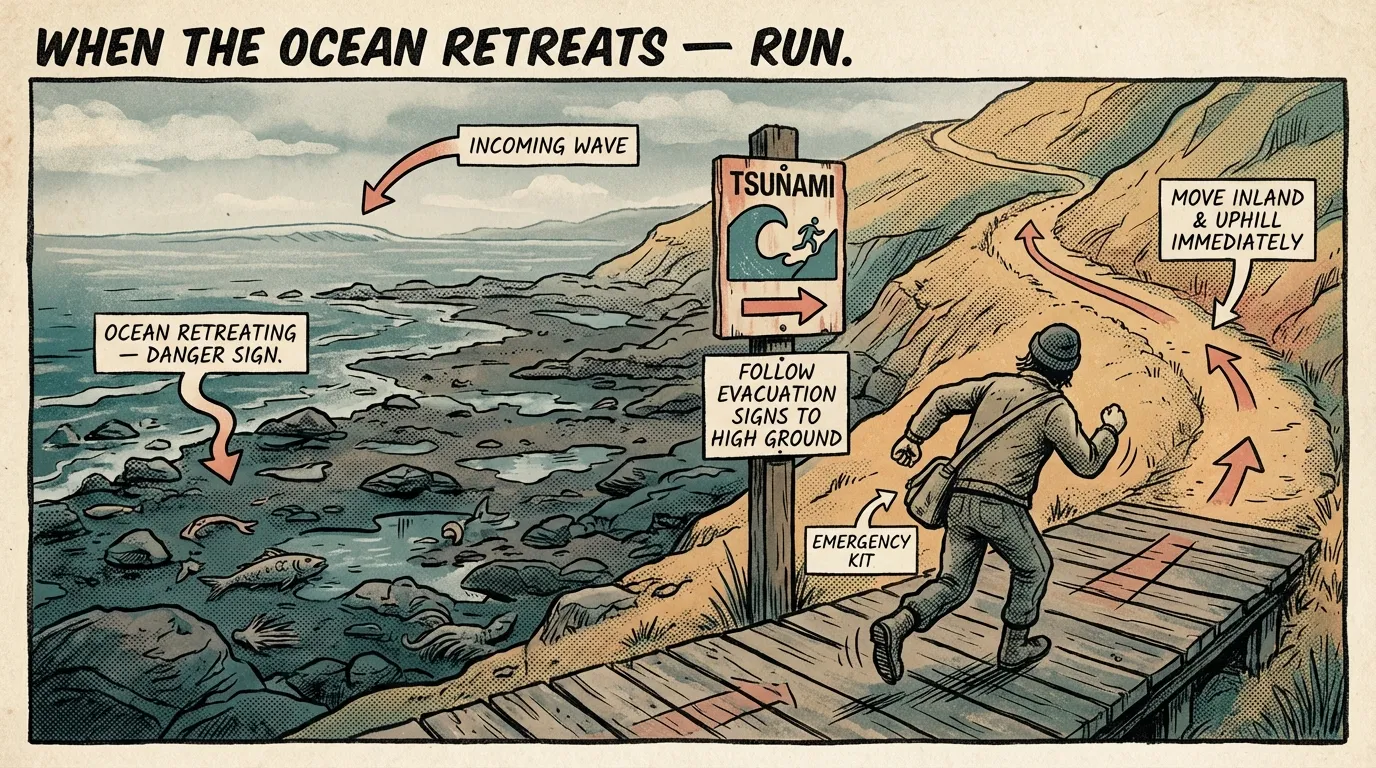
For a distant tsunami, official warnings give 15 minutes to several hours. For a local-source tsunami caused by a nearby earthquake, you may have only 1 to 5 minutes and receive no official alert. The earthquake shaking itself is your warning. Move immediately to high ground at least 100 feet in elevation or 2 miles inland.
Key Takeaways
- Treat any strong coastal earthquake as your warning; move to 100 feet elevation or 2 miles inland immediately.
- Identify at least two tsunami evacuation routes from home and workplace before any emergency occurs.
- Never return after the first wave; subsequent waves arrive for 8 to 12 hours and are often larger.
- Store a minimum 72-hour water supply of one gallon per person per day at your evacuation destination.
- Review your homeowner's insurance now; standard policies never cover tsunami damage without separate flood insurance.
When It Happened Before
On the morning of December 26, 2004, a 9.1 magnitude earthquake ripped open the seafloor off the coast of Sumatra. What followed was the deadliest tsunami in recorded history. Waves reaching up to 100 feet slammed into coastlines across 14 countries, killing approximately 227,000 people in a matter of hours. There was no Indian Ocean tsunami warning system at the time — none. Entire communities were erased before anyone understood what was happening. Tourists on Thai beaches watched the ocean pull back, exposing hundreds of yards of seafloor, and walked toward it out of curiosity. Minutes later, they were dead. But on Maikhao Beach in Thailand, a 10-year-old British girl named Tilly Smith recognized what the receding water meant. She’d learned about tsunamis in her geography class just two weeks earlier. She told her parents, who told the hotel staff, who evacuated the beach. Around 100 people survived because a child paid attention in school. Let that sink in.
Seven years later, Japan — arguably the most tsunami-prepared nation on Earth — was humbled. On March 11, 2011, the Tōhoku earthquake generated waves that reached 40 feet, overwhelming seawalls that had been engineered to handle exactly this scenario. 15,897 people died. The Fukushima Daiichi nuclear power plant lost cooling capability, triggering the worst nuclear disaster since Chernobyl. Japan had the warning systems, the infrastructure, the public education campaigns, and the seawalls. It wasn’t enough. The 2011 disaster proved that infrastructure alone cannot save you — personal preparedness and immediate decision-making are what separate the living from the dead.
And this isn’t just a Pacific Rim problem with distant historical roots. On March 27, 1964, a 9.2 magnitude earthquake — the most powerful ever recorded in North America — struck Alaska’s Prince William Sound. The resulting tsunami didn’t just devastate Alaskan coastal towns; it killed people as far south as Crescent City, California, over 1,700 miles away. Eleven people died in Crescent City, many of them residents who returned to the waterfront after the first wave, not realizing that subsequent waves would be larger and more destructive. That pattern — the false sense of safety between waves — has killed people in every major tsunami event in modern history.
How Much Warning You’ll Actually Get
Let’s be brutally honest here: your tsunami preparedness window depends entirely on where the earthquake originates, and the answer ranges from “some” to “almost none.” For distant-source tsunamis — an earthquake across the Pacific, for example — the Pacific Tsunami Warning Center can give you anywhere from 15 minutes to several hours of advance notice. That’s the good scenario. You’ll get alerts on your phone, sirens will sound in equipped coastal areas, and you’ll have time to grab your bag and move to high ground. For local-source tsunamis — meaning the earthquake happened nearby, close enough that you felt it — you may have 1 to 5 minutes. That’s not a typo. One to five minutes. And in that scenario, you will likely not receive an official warning at all. The ground shaking is your warning.
This is why natural warning signs matter more than any app on your phone. A strong earthquake you can feel while near the coast is warning sign number one. The ocean visibly receding and exposing the seafloor is warning sign number two — and if you’re seeing that, you are already behind. An unusual roaring sound from the ocean, like a freight train, is warning sign number three. You don’t need all three. Any single one of these means you move to high ground immediately, no hesitation, no stopping to grab things you didn’t already have packed. The people who survive local-source tsunamis are the people who treat the earthquake itself as the starting gun. Everyone else is gambling with minutes they may not have.
The First 72 Hours
The first five minutes determine everything in a local-source event. If you felt a strong earthquake near the coast, you move — inland and uphill, immediately. You don’t wait for sirens. You don’t check your phone. You don’t go look at the ocean. You grab your go-bag if it’s within arm’s reach and you get to high ground — at least 100 feet in elevation or 2 miles inland, whichever you can reach faster. If you’re in a designated tsunami zone and can’t reach high ground in time, look for a vertical evacuation building — these are reinforced concrete structures, usually marked, designed to withstand tsunami forces. Know where yours is before this moment arrives. You should already know at least two tsunami evacuation routes from your home, your workplace, and any coastal area you frequent. One route might be blocked by earthquake damage. Two routes means options. If you need a refresher on navigating unfamiliar terrain under pressure, basic orienteering skills are worth developing well before an emergency.
The first hour after impact is chaos. The initial wave may not be the worst — in many historical tsunamis, the second or third wave was the largest and most destructive. This is what killed those residents in Crescent City in 1964. They thought the danger had passed. Waves can continue arriving for 8 to 12 hours after the initial event, each carrying a violent slurry of debris — cars, building materials, fuel, sewage, and anything else the water has collected. This isn’t a clean ocean wave. It’s a wall of contaminated, debris-filled water moving at speeds up to 30 miles per hour through coastal streets. Getting caught in it isn’t like being caught in a flood. It’s like being thrown into a blender filled with concrete and diesel fuel. Survival in the water itself is extremely unlikely.
The first 24 to 72 hours shift from immediate wave survival to dealing with the aftermath. Power will be out. Roads in the inundation zone will be impassable — not just flooded, but physically destroyed or blocked with debris piled stories high. Cell towers may be down or overwhelmed. Municipal water supplies in affected areas will be contaminated with saltwater, sewage, chemicals, and biological hazards. If you didn’t have water stored or a means to purify it, you’re now in a survival situation on top of a disaster situation. This is the window where having solid emergency gear cached at your evacuation point or in your vehicle pays for itself a hundred times over. Don’t count on emergency services reaching you quickly. After the 2011 Japan tsunami, some communities were isolated for days before help arrived, and that was in one of the most organized, well-resourced disaster response nations on the planet.
When Days Become Weeks
After 72 hours, the immediate danger from waves is over, but the crisis is just beginning to unfold. Water contamination becomes the dominant threat. Saltwater intrusion ruins freshwater wells and municipal systems. Floodwaters have deposited sewage, industrial chemicals, fuel, and decomposing organic matter across everything the water touched. Drinking water becomes scarce. If you’re in the affected zone and didn’t evacuate with supplies, you’re now competing with everyone else for limited relief resources. Grocery stores in inundation zones are destroyed — not just closed, physically gone. Supply chains to the broader region may be disrupted for weeks if port facilities and roads were damaged. Fuel becomes scarce. Hospitals in coastal areas may be offline. Medical emergencies that would normally be routine — infections from contaminated water cuts, chronic medication needs, injuries from debris — become life-threatening when the infrastructure to treat them doesn’t exist anymore.
The social dynamics shift too. Shelters fill up fast. Housing in unaffected inland areas becomes extremely competitive. Insurance claims take months or years to process — and many standard homeowner policies do not cover tsunami or flood damage without separate flood insurance. If you haven’t documented your possessions (with photos or video stored in the cloud or in that waterproof document bag you should have), proving your losses becomes a nightmare. Communities that were tight-knit before the event often pull together, but resource scarcity and displacement strain even the strongest bonds. If you’re new to thinking about this level of preparedness, a solid beginner’s guide to prepping can help you build a realistic plan without the overwhelm.
Long-Term: If It Doesn’t Resolve Quickly
History shows that major tsunami events reshape regions for years to decades. After the 2004 Indian Ocean tsunami, entire fishing economies were wiped out. Boats were destroyed, harbors were gone, and the people who knew how to fish were dead. In Aceh, Indonesia, the most heavily impacted region, reconstruction took over a decade, and the psychological scars — particularly among children who lost families — persist to this day. PTSD rates among survivors of the Tōhoku disaster in Japan remain elevated years later, with studies documenting long-term mental health impacts across entire communities. The Fukushima exclusion zone remains partially uninhabitable more than 13 years later.
For individuals, the long-term impact depends heavily on what you did before the event. People who had documented their assets, maintained adequate insurance, stored critical documents in waterproof and offsite locations, and had a financial cushion recovered faster. People who didn’t faced months in temporary housing, legal battles over property, and the grinding stress of rebuilding from nothing with no safety net. The physical rebuilding happens. Roads get fixed. Power comes back. But the personal financial and emotional recovery? That timeline is measured in years, and it starts — or stalls — based on decisions you make long before the ground ever shakes. Tsunami preparedness isn’t just about surviving the wave. It’s about surviving the five years after it.
Your Tsunami Preparedness Checklist
Before — Preparedness
- Know your tsunami evacuation zone. Coastal communities have mapped inundation zones — find yours through your county emergency management office or NOAA. If you live, work, or vacation in a coastal area, know if you’re in a zone.
- Identify at least two tsunami evacuation routes from your home, workplace, and any frequently visited coastal locations. Routes are often marked with standardized blue-and-white tsunami evacuation signs. Drive them. Walk them. Know them.
- Locate your nearest vertical evacuation building if you’re in a flat coastal area where reaching high ground quickly isn’t possible. Not all areas have them — if yours doesn’t, your plan needs to account for that distance to elevation.
- Prepare a waterproof grab bag kept near your door. Include copies of critical documents (IDs, insurance policies, medical records, property deeds), cash in small bills, a battery-powered or hand-crank radio, a flashlight, basic first aid supplies, a water purification method, and at least one day’s worth of medications.
- Store important documents digitally in a secure cloud location accessible from any device.
- Maintain a minimum 72-hour supply of water (one gallon per person per day), non-perishable food, and essential medications at your evacuation destination or in your vehicle if you commute through coastal zones.
- Review and update your flood insurance. Standard homeowner’s insurance does not cover tsunami damage. Period.
- Teach every member of your household — including children — the natural warning signs: strong coastal earthquake, ocean receding from shore, unusual roaring sound from the sea.
- Establish a family meeting point on high ground in case you’re separated when an event occurs.
During — Immediate Response
- If you feel a strong earthquake near the coast, move to high ground immediately. Do not wait for an official warning. The earthquake is your warning for a local-source event.
- If you see the ocean receding or the seafloor exposed, run inland and uphill NOW. This is not a spectacle. This is the wave loading.
- Never go to the beach to watch. This has killed people in every major tsunami event. The receding water is the last warning you’ll get.
- Move to at least 100 feet of elevation or 2 miles inland, whichever is achievable faster.
- If you cannot reach high ground, go to the highest floor of the nearest reinforced concrete building. Avoid wood-frame structures in the inundation zone.
- Expect multiple waves. The first wave is rarely the largest. Waves can continue for 8 to 12 hours.
- Stay in your safe zone until you receive an official all-clear from emergency management authorities. This takes multiple hours at minimum, sometimes longer. Do not self-clear.
- Stay out of the water. Tsunami floodwater is filled with debris, chemicals, sewage, and structural hazards. It is not survivable for swimmers.
After — Recovery
- Do not return to the inundation zone until authorities confirm it is safe. Structural damage, unstable debris, downed power lines, and contaminated water make the area extremely dangerous even after the water recedes.
- Assume all water in the affected area is contaminated. Do not drink tap water until the municipal supply has been tested and cleared. Use stored water or purification methods.
- Watch for secondary hazards: gas leaks, electrical hazards, unstable structures, and sharp debris. Wear sturdy, closed-toe footwear.
- Document all property damage thoroughly with photos and video before any cleanup for insurance purposes.
- Monitor official channels (NOAA Weather Radio, local emergency management) for ongoing advisories, boil-water orders, and road closures.
- Check on neighbors, especially elderly, disabled, or isolated individuals who may not have been able to evacuate effectively.
- Seek medical attention for any wounds sustained in contact with floodwater, even minor cuts. Infection risk from tsunami debris and contaminated water is extremely high.
What Most People Get Wrong
The number one mistake people make with tsunami preparedness is assuming they’ll have time to react when they get a warning on their phone. For distant-source events, maybe. For local-source events — the earthquake-you-just-felt kind — your phone alert may arrive after the wave does. People who survive local tsunamis are people who already had a plan and executed it the moment the shaking stopped. They didn’t Google “what to do in a tsunami” while the ground was still rolling. They moved. The second biggest mistake is returning too soon. The wave pattern of a tsunami isn’t like a storm surge with a single peak. It’s a series of waves that can span half a day, and the intervals between them create a deceptive calm that has lured people back to the coast in every major event. Those people in Crescent City in 1964 weren’t reckless — they just didn’t understand wave mechanics. Now you do.
The third mistake — and this one is insidious — is the belief that seawalls, breakwaters, and engineered coastal defenses will handle it. Japan in 2011 shattered that myth permanently. Their seawalls were among the most advanced in the world. The waves went over them, through them, and around them. Infrastructure buys you time. It does not buy you safety. Your safety comes from elevation, distance, and the decisions you’ve already made about where to go and how to get there. If you haven’t invested in your own baseline of practical survival knowledge, resources like this beginner’s guide to survivalism are a solid starting point for building the kind of preparedness that actually works when systems fail.
“The ocean doesn’t give second chances. But it almost always gives a first one — if you know what to look for.”
Further Reading
- Becoming a Prepper: The Beginner’s Guide to Survival Readiness
- Navigating the Wilderness: Basic Orienteering for New Preppers
- The Best Camping Gear for Emergency Preparedness
- The Beginner’s Guide to Survivalism: Prepping for Dummies
The Complete
Prepper's Reference.
149 articles synthesized into one comprehensive PDF — twelve chapters covering water, food, shelter, first aid, comms, and scenario-specific preparedness. Free with your email.
Unsubscribe anytime · We never share your email
You're in. Check your inbox.
Keep Reading
Volcanic Eruption Preparedness: When the Mountain Wakes Up
Mount St. Helens gave scientists 2 months of warning — yet 57 people still died. The 2022 Tonga eruption sent a shockwave around the planet twice. Here's what volcanic eruptions actually threaten, how far danger extends, and how to prepare whether you live near a volcano or not.
Cyberattack and Infrastructure Failure: The Invisible Emergency
In 2021, a ransomware attack shut down the Colonial Pipeline and caused gas shortages across the Southeast in 6 days. In 2015, hackers turned off power for 230,000 Ukrainians. Digital attacks on physical infrastructure are here — here's how to prepare for when they hit yours.
Nuclear Preparedness: Radiation, Fallout & Survival Guide
Lessons from Chernobyl and Fukushima shaped modern nuclear preparedness. Learn the science of radiation survival, fallout sheltering, and your action plan.