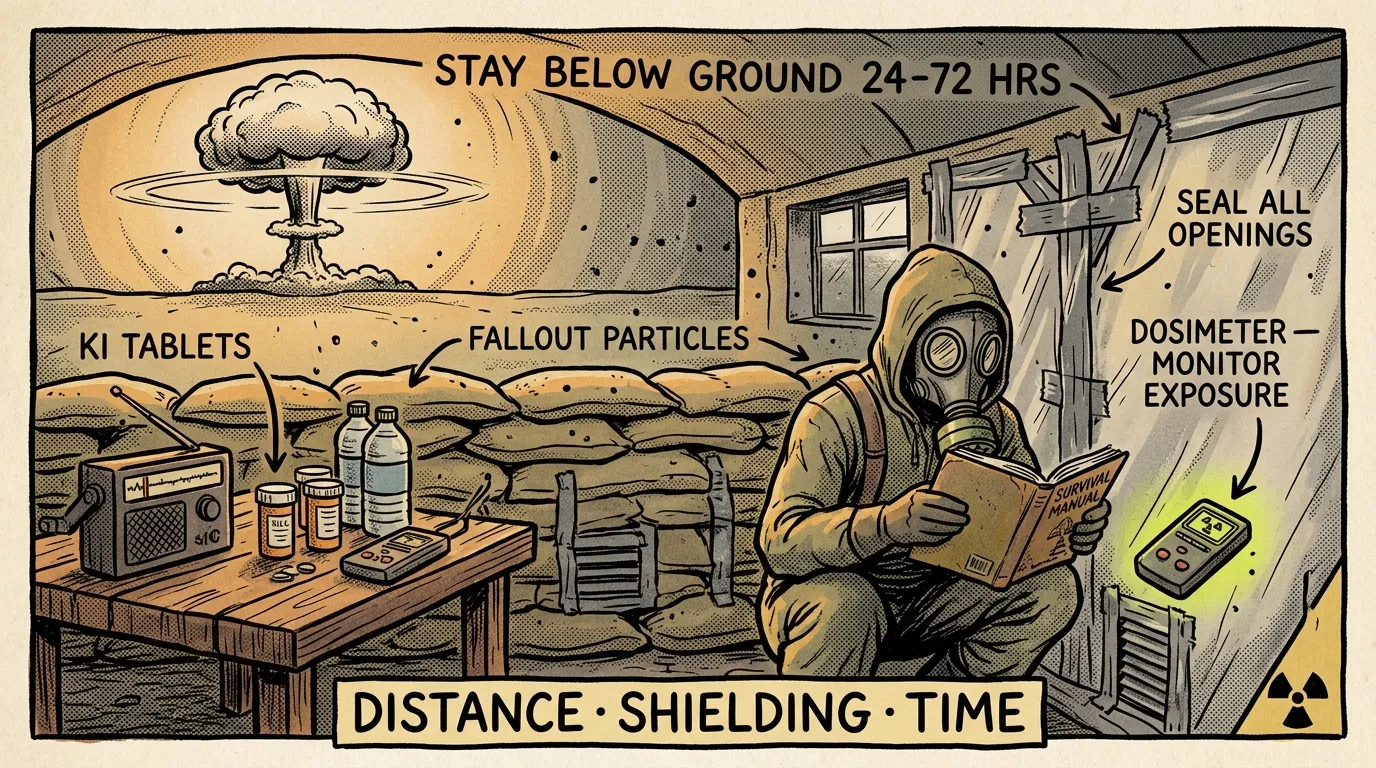
Sheltering inside a solid building is the most effective immediate action after a nuclear event. A concrete basement reduces radiation exposure by up to 200 times compared to outdoors. Removing outer clothing eliminates roughly 90% of external contamination. Fallout radiation drops to about 1% of initial intensity within two weeks, so sheltering 48-72 hours minimum is the core survival strategy.
Key Takeaways
- Get inside a solid structure immediately — a concrete basement cuts radiation exposure by 10x to 200x compared to standing outdoors.
- Remove outer clothing after fallout exposure to eliminate roughly 90% of external radioactive contamination, then shower without conditioner.
- Apply the 7-10 rule: fallout radiation drops to about 1% of initial levels within two weeks, so plan to shelter at least 48-72 hours minimum.
- Potassium iodide protects only your thyroid — pair it with full shelter-in-place measures and proper decontamination for real protection.
- Pre-cut plastic sheeting for your shelter room now — measuring and cutting it during an emergency costs time you will not have.
Quick Summary
- Get inside immediately after any nuclear event — a concrete basement reduces radiation exposure by 10x to 200x, and even a standard brick building provides significant shielding.
- Decontaminate fast by removing outer clothing (eliminates ~90% of external contamination), showering with soap, and avoiding hair conditioner which binds radioactive particles.
- The 7-10 decay rule is your mental anchor: fallout radiation drops to roughly 1% of its initial intensity within two weeks, so plan to shelter 48-72 hours minimum.
- Potassium iodide protects your thyroid only — it’s not a magic anti-radiation pill, so pair it with sealing your shelter room, masking up, and staying put.
- Panicked evacuation kills. Fukushima proved it: over 2,000 deaths came from evacuation stress, not radiation. Shelter first, then wait for coordinated guidance.
- Pre-position your supplies now — pre-cut plastic sheeting, sealed water, KI tablets, N95 masks, and a hand-crank radio in your designated shelter room.
What History Actually Teaches Us
Nuclear preparedness isn’t theoretical. The Pacific Northwest, for example, sits within planning distance of the Hanford Site, the most contaminated nuclear site in the Western Hemisphere. Radiological emergency exercises conducted by FEMA and state emergency management agencies are designed to clarify what ordinary people can actually do when the worst happens.
The history of nuclear accidents isn’t just history. It’s a field manual.
At 1:23 a.m. on April 26, 1986, Reactor 4 at Chernobyl suffered a catastrophic steam explosion during a safety test. The blast blew the 1,000-ton reactor lid off the building and exposed the core directly to the atmosphere. Thirty-one workers and first responders died from acute radiation syndrome within weeks. But the slower devastation was wider: 350,000 people were eventually evacuated, a 30-kilometer exclusion zone was established that remains uninhabitable nearly four decades later, and the economic cost has been estimated at over $235 billion. Here’s the part that matters for you: the 49,000 residents of Pripyat, just three kilometers from the reactor, weren’t evacuated for 36 hours. During that window, those who stayed indoors with windows closed received significantly less exposure than those who went outside to watch the strange glow on the horizon. Shelter worked. Curiosity didn’t.
On March 11, 2011, a magnitude 9.0 earthquake off Japan’s coast triggered a tsunami that disabled cooling systems at Fukushima Daiichi. Three reactors experienced full meltdowns. 154,000 residents were evacuated. But here’s what separates a modern nuclear incident from Cold War nightmares: no one died directly from radiation exposure at Fukushima. Not one person. The deaths — estimated at over 2,000 — were overwhelmingly caused by the stress of evacuation itself, particularly among elderly residents. Panic and disorganized evacuation killed more people than radiation did.
Then there’s the incident most people have never heard of. In September 1987 in Goiânia, Brazil, scrap metal scavengers broke open an abandoned radiotherapy device and found glowing blue powder — cesium-137. Fascinated, they shared it with family and friends. Children rubbed it on their skin like glitter. Over the following days, 249 people were contaminated and 4 died, including a six-year-old girl whose body was so radioactive it required a lead-lined coffin. Goiânia wasn’t a meltdown or a bomb. It was a forgotten medical device and a complete lack of public knowledge about radiation.
Every nuclear disaster in history has taught the same core lesson: what you do in the first 30 minutes determines the next 30 years.
Chernobyl vs. Fukushima: Why the Differences Matter for You
Chernobyl was the worst nuclear accident in history by virtually every measurable metric. While both received the maximum INES Level 7 classification, Chernobyl released roughly ten times more radiation and caused significantly more direct deaths and long-term health consequences.
| Factor | Chernobyl (1986) | Fukushima (2011) |
|---|---|---|
| Date | April 26, 1986 | March 11, 2011 |
| INES Rating | Level 7 (Maximum) | Level 7 (Maximum) |
| Cause | Flawed safety test + design defects | Earthquake + tsunami disabling cooling |
| Radiation Released | ~5.2 million TBq (core exposed to air) | ~520,000 TBq (~10x less) |
| Evacuation Radius | 30 km (delayed 36 hours) | 20 km (expanded over days) |
| Direct Deaths | 31 (acute radiation syndrome) | 0 from radiation; 1 later cancer attribution |
| Exclusion Zone Status | Still active, limited access, tourism permitted | Gradually reopening, some areas still restricted |
For your nuclear preparedness planning, each disaster taught fundamentally different lessons. Chernobyl proved that sheltering in place works — residents who stayed indoors received dramatically less exposure during the critical first 36 hours. It also exposed the deadly cost of government secrecy: Soviet authorities suppressed information while radioactive iodine saturated the thyroids of thousands of children who drank contaminated milk. The WHO documented over 6,000 thyroid cancer cases in exposed children and adolescents — nearly all preventable with timely KI distribution and honest communication.
Fukushima proved that panicked evacuation kills. Over 2,000 deaths came from evacuation stress — elderly patients removed from hospitals without adequate care, nursing home residents transported for hours without medication, families separated in chaos. The radiation itself caused essentially zero civilian casualties.
And don’t forget Three Mile Island (1979) — the worst nuclear accident in US history. The partial meltdown of Reactor 2 caused widespread fear but released minimal radiation. No deaths or injuries resulted. TMI demonstrated that even a significant reactor failure in a Western-designed containment structure can be managed without catastrophic consequences. It also triggered the NRC safety overhaul that still governs US plants today.
How Much Warning You’ll Actually Get
Let’s be direct: your warning time depends entirely on the type of nuclear event, and the range is brutal.
A nuclear power plant accident typically gives you hours to days of escalating warnings. Authorities will know something’s wrong before you do, and there’s usually a window of several hours to shelter or evacuate before significant fallout reaches surrounding communities. You’ll hear it on the news. You’ll get emergency alerts. The problem isn’t time — it’s that governments historically downplay severity in those critical first hours. Soviet authorities waited 36 hours to evacuate Pripyat. Japanese authorities initially set a 3-kilometer radius at Fukushima before expanding to 20 kilometers as things worsened.
If you live within 50 miles of a nuclear power plant — and roughly one in three Americans does — you should already be signed up for that facility’s emergency notification system. Every US plant is required to maintain an Emergency Planning Zone and a public alert system. Find yours through the NRC’s website. This isn’t optional.
A nuclear detonation is a different calculation entirely. An ICBM gives roughly 15 to 30 minutes of warning from launch detection to impact, assuming the alert system works and you see it in time. You’ll receive a Wireless Emergency Alert on your phone through IPAWS — it looks similar to an AMBER Alert but with a distinct header and instructions to seek immediate shelter. Don’t dismiss those emergency alert tests when they pop up on your phone. They confirm your device is connected to the system that might save your life.
A short-range or smuggled device might give you no warning at all — just a flash of light brighter than anything you’ve ever seen. FEMA’s guidance fits on a bumper sticker: “Get inside, stay inside, stay tuned.”
There’s one more scenario that deserves your attention: a dirty bomb (radiological dispersal device). The Department of Homeland Security considers this the most likely form of nuclear terrorism. A dirty bomb combines conventional explosives with radioactive material — it won’t produce a mushroom cloud or massive blast wave. The radiation dispersal is localized, typically affecting a few city blocks. The real danger is panic. There’s usually no advance warning. You’ll hear an explosion, and news reports will eventually confirm contamination. The response principles are identical: get inside, remove exposed clothing, and wait for official guidance.
Register for your nearest nuclear plant’s emergency notification system today — it takes five minutes and connects you to the alert system that’ll give you the earliest possible warning.
The 3 C’s of Nuclear Safety: Cover, Clean, Contact
If you remember nothing else from this guide, remember these three actions. They’re aligned with FEMA and Ready.gov guidance, and they cover the essentials in any nuclear or radiological emergency.
Cover
Get inside a solid structure immediately. Not a car, not a tent — a building with mass. A concrete basement reduces your radiation exposure by a factor of 10 to 200. Even a standard brick building provides significant protection. At Chernobyl, residents who stayed indoors during the first 36 hours received measurably less radiation than those who went outside. At Fukushima, the people who sheltered and waited survived. The people who fled in panic died — not from radiation, but from the evacuation itself.
Cover is always your first action.
Clean
Decontaminate as soon as possible. If you were outdoors during a nuclear event, removing your outer clothing eliminates roughly 90% of external radioactive contamination. Bag those clothes in plastic and leave them outside your shelter area. Shower with soap and water — or wipe down with wet cloths if water’s scarce. Don’t use hair conditioner; it binds radioactive particles to hair. Blow your nose, wipe your eyelids and ears. In Goiânia, contamination spread precisely because nobody cleaned up — people carried cesium-137 on their skin and hands into homes and buses for days.
Decontamination is simple, fast, and dramatically effective.
Contact
Tune into emergency broadcasts. A battery-powered or hand-crank NOAA radio is your lifeline. Cell networks will be overwhelmed or down entirely. You need fallout pattern reports, evacuation corridor information, and “all clear” notifications. Emergency medical protocols treat information as a resource — knowing what’s happening outside your shelter determines every decision about when to move, where to go, and how to protect your family.
Don’t guess. Listen.
The First 72 Hours: Your Nuclear Fallout Shelter Plan
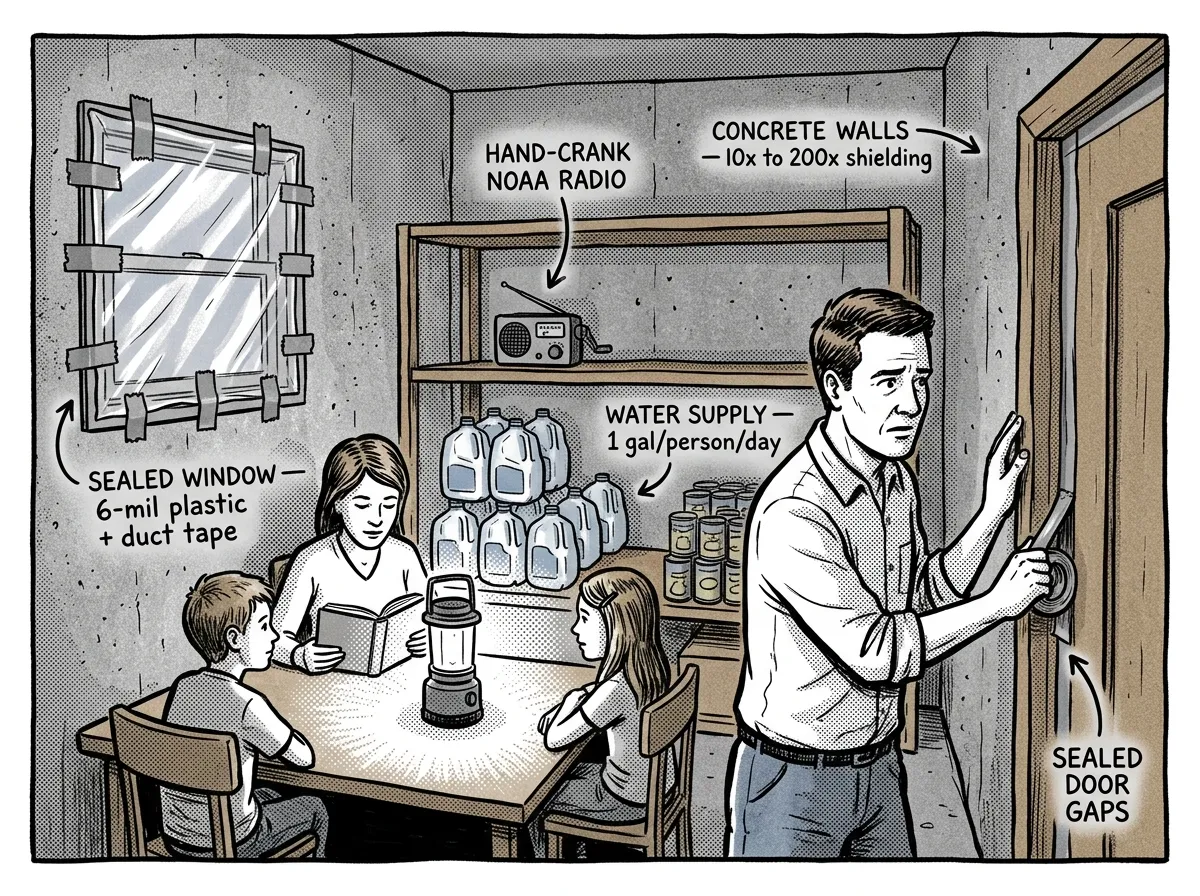 Family sheltering in a sealed basement room during the critical first hours after a nuclear event
The first 15 minutes are the most important of your life if you’re within range of a nuclear detonation. Beyond the immediate blast radius (roughly one mile for a standard weapon), your biggest threat transitions to radioactive fallout — pulverized, irradiated debris that begins descending approximately 15 to 30 minutes after detonation. It looks like sand or fine gray snow. If you’re outside when it lands on you, it irradiates your skin, your clothes, your lungs.
Get inside immediately. Not your car — a building. A shelter in place strategy is almost always your best immediate action. You want the most shielded room in your home — ideally a basement or windowless interior room surrounded by concrete, brick, or packed earth.
In the first hour, seal yourself in that room. Close all windows and doors. If you have plastic sheeting and duct tape, cover the windows, vents, and any gaps — you’re trying to keep radioactive particles out of your breathing air.
Pre-cutting plastic sheeting to fit your shelter room’s windows and vents significantly speeds up sealing time compared to cutting sheets during an emergency. Cut your sheets now, label them with the window or vent they fit, and roll them up with a strip of duct tape attached. It’s one of those tiny prep steps that has an outsized payoff.
Put on an N95 mask — inhaled radioactive particles are far more dangerous than external skin exposure. If you were outside during the event, strip your outer clothing at the door, bag it in plastic, and shower or wipe down. Don’t use conditioner.
Take potassium iodide (KI) tablets if you have them — these saturate your thyroid with stable iodine, blocking uptake of radioactive iodine-131. But KI protects your thyroid and only your thyroid. Adults take 130 mg; children get adjusted doses based on age.
The 7-10 Decay Rule
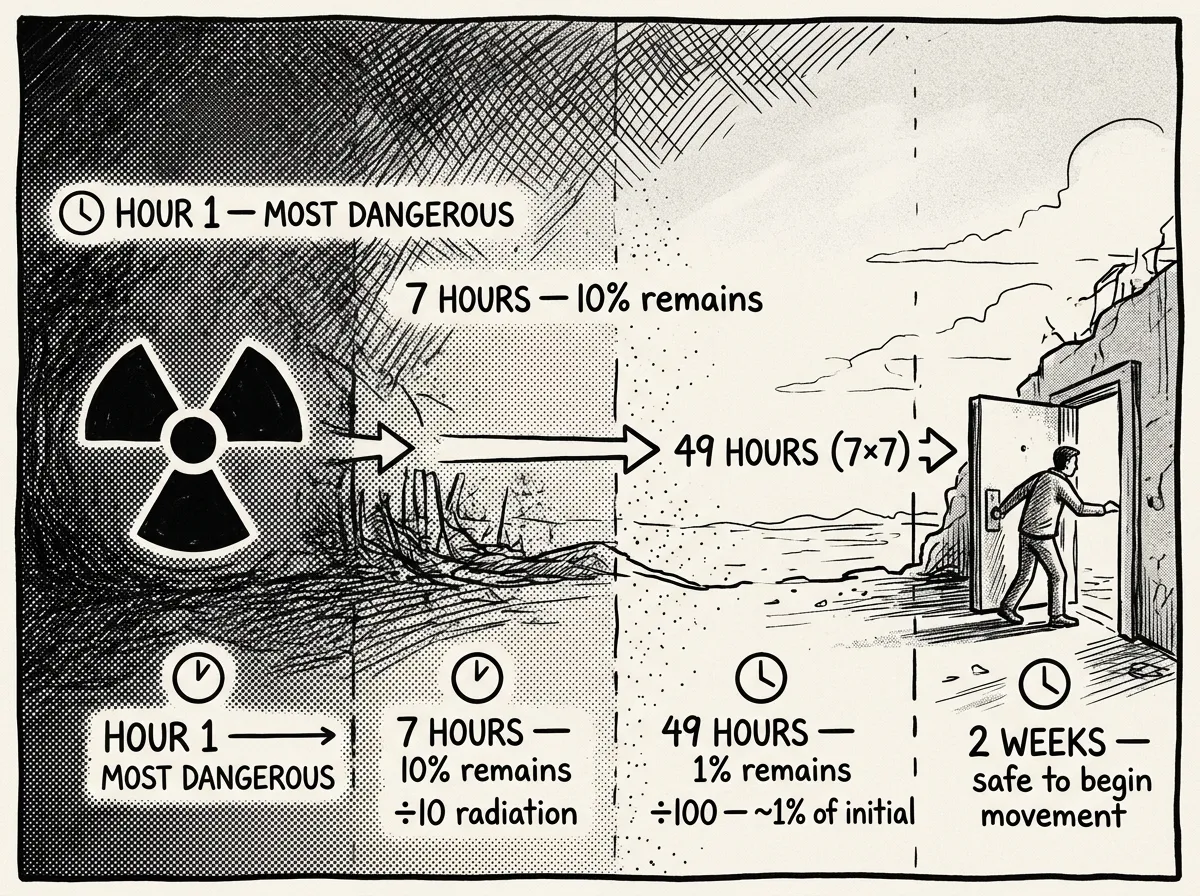 Visual explanation of how fallout radiation intensity drops over time following the 7-10 rule
Over the first 24 to 72 hours, you stay put. This is the hardest part psychologically, but here’s the science that should keep you calm: fallout radiation decays rapidly following the 7-10 rule. For every sevenfold increase in time after detonation, radiation intensity drops by a factor of 10:
- At 1 hour: 1,000 R/hr (immediately lethal with prolonged exposure)
- At 7 hours: ~100 R/hr
- At 49 hours (~2 days): ~10 R/hr
- At 2 weeks: ~1 R/hr (manageable)
The first 48 hours are the most dangerous. Your battery radio is everything during this window.
Understanding Radiation Units
You’ll hear unfamiliar terms in emergency broadcasts. Here’s what matters: roentgen (R) measures radiation exposure in air. Rem and its metric counterpart sievert (Sv) measure biological effect — 1 Sv equals 100 rem. An acute whole-body dose above 100 rem (1 Sv) causes radiation sickness. Above 400 rem (4 Sv), the fatality rate hits 50% without medical treatment. For context, a chest X-ray delivers about 0.01 rem.
A dosimeter or Geiger counter translates the invisible into numbers you can act on. The GQ GMC series — around $100-150 depending on the model — gives real-time readings and is about as user-friendly as consumer-grade Geiger counters get. If that’s more than you want to spend, a RADTriage card (around $5-10) won’t give real-time data but will tell you if you’ve been exposed to a dangerous cumulative dose. Either one transforms you from guessing to making informed decisions.
A mid-range Geiger counter is more useful than an expensive one left unused. Take it outside, read your local background radiation level, and learn what “normal” looks like in your area — you can’t recognize abnormal if you’ve never seen normal. Background radiation typically ranges from about 0.02-0.05 mR/hr depending on location. Knowing your baseline number is the whole point of owning the device.
When Days Become Weeks
After the initial 72 hours, acute radiation danger has dropped substantially, but a new set of problems replaces it. Your 14-day food and water supply becomes the bridge that keeps you alive while the outside world sorts itself out — and that sorting takes time.
Municipal water systems may be contaminated with radioactive particles, especially if they draw from open reservoirs or rivers. Power grids are likely down, which means no refrigeration, no water pumps, no communications beyond battery-powered systems. Supply chains halt. Grocery stores will be emptied within hours by people who didn’t prepare. Hospitals will be overwhelmed not just with radiation casualties but with every routine medical emergency that no longer has infrastructure behind it — dialysis patients, insulin-dependent diabetics, people on oxygen.
If you rely on daily medication, your nuclear preparedness plan needs to include a stockpile. Period.
Water Safety After Fallout
Not all water sources are equal after contamination. Deep wells are safest — groundwater filtered through hundreds of feet of rock is naturally shielded from surface fallout. Municipal systems with covered reservoirs and treatment plants are generally safer than open surface water systems. Open rivers, lakes, and streams are the most vulnerable.
Sealed containers filled before the event are safe. Open containers exposed to fallout-contaminated air aren’t. Standard carbon filters won’t remove most radioactive isotopes, but reverse osmosis systems remove the majority of radioactive particles including cesium-137 and strontium-90. Distillation also works.
Food Contamination
Sealed canned and packaged food from before the event is safe — the container is your shield. Growing food in contaminated soil is a longer-term concern: root vegetables like potatoes and carrots absorb more cesium-137 than above-ground crops. If you’re in an area with confirmed soil contamination, raised beds with imported clean soil or hydroponic growing become practical solutions in the weeks and months after.
So what happens when solidarity fades? In the first days, people are generally cooperative — shared crisis brings that out. But as days stretch into weeks and food and clean water become scarce, the calculus changes. This is especially true in urban areas where population density means more competition for fewer resources. A nuclear event doesn’t stay a radiation problem for long. It becomes a logistics problem, a water problem, a food problem, and a security problem — in that order.
If you’re dealing with fallout contamination and infrastructure collapse, you’ll need to decide whether to shelter long-term or move to areas with functioning systems. That’s where broader preparedness skills matter — understanding basic orienteering skills for navigation without GPS in case satellite systems are down, knowing how to filter water from compromised sources, and having the emergency camping and survival gear to sustain yourself during movement.
Nuclear Preparedness for Families With Children and Elderly Members
Fukushima’s death toll wasn’t caused by radiation — it was caused by evacuation. The victims were overwhelmingly elderly. Over 2,000 people died from evacuation-related stress, many of them nursing home residents and hospital patients moved without adequate medical support, medications, or even basic hydration.
That reality should shape your plan if your household includes children, elderly members, or anyone with mobility limitations.
Potassium Iodide Dosing by Age
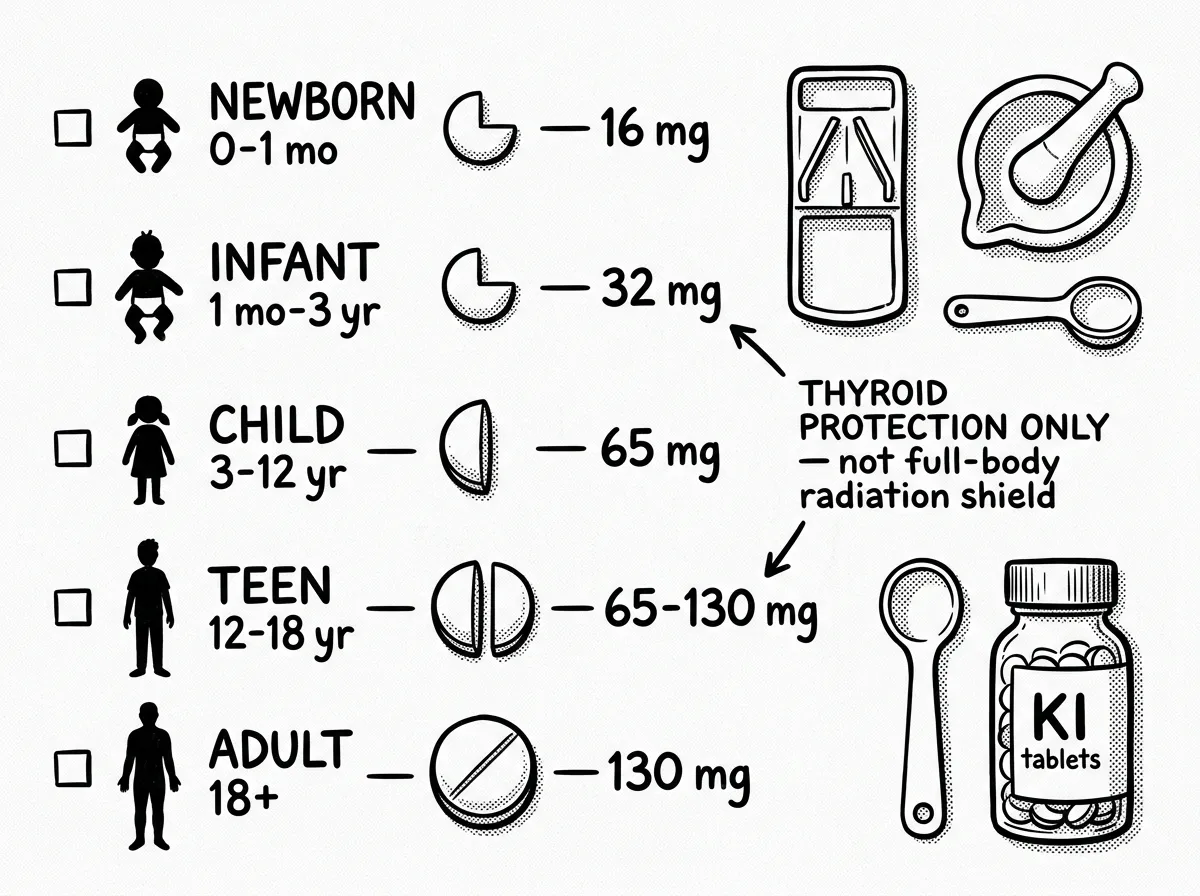 Potassium iodide tablets and dosing reference organized by age group
KI dosing is weight- and age-dependent per FDA guidance:
- Adults and adolescents (12+): 130 mg
- Children ages 3-12: 65 mg
- Children ages 1 month to 3 years: 32 mg
- Newborns (birth to 1 month): 16 mg
Children are more vulnerable to radioactive iodine than adults because their thyroid glands are smaller and more active. During Chernobyl, the WHO documented over 6,000 thyroid cancer cases in children — the majority linked to drinking contaminated milk in the days after the accident. Having correct KI doses pre-measured and accessible for every family member isn’t optional.
Prescription Medication Stockpiling
If anyone in your household depends on daily medication — insulin, blood pressure drugs, anticoagulants, seizure medications — your plan must include at least a 14-day supply stored in your shelter room. During Fukushima’s evacuation, patients were separated from their medications for days. Some died from treatable conditions that became fatal without pharmaceutical support.
Talk to your doctor about maintaining an emergency supply. Most providers will write a prescription for an additional 30-day supply if you explain it’s for emergency preparedness.
Keeping Children Calm in Shelter
Children mirror adult behavior. If you’re calm, they’re calmer. If you’re panicked, they’ll spiral. Prepare them before an event ever happens — explain in age-appropriate terms that your shelter room is the safest place in the house, like a fort. Stock comfort items: a favorite book, a stuffed animal, a deck of cards. Battery-powered audiobook players or pre-downloaded tablets give you hours of distraction that don’t require constant conversation.
Practice the drill at least once so the shelter room feels familiar, not frightening.
Why Mobility-Limited Households Should Plan to Stay
If your household includes someone who uses a wheelchair, walker, or oxygen, or who has dementia or severe anxiety — plan to shelter in place, not evacuate. The Fukushima data is unambiguous: evacuation itself killed vulnerable people. Traffic gridlock, hours in vehicles without climate control, separation from caregivers, and lack of accessible facilities at evacuation centers all contributed to fatalities.
Your shelter plan should account for extended sheltering with adequate medical supplies, comfortable bedding, and sanitation provisions. Evacuation should be a last resort, executed only when coordinated by authorities with accessible transport.
Long-Term: When It Doesn’t Resolve Quickly
History gives us a clear picture of “long-term” after a significant nuclear event, and it’s not the Hollywood wasteland. Chernobyl’s exclusion zone is still active 38 years later, but it’s 30 kilometers in radius — not the entire country. The broader regions of Ukraine and Belarus dealt with elevated cancer rates, contaminated agricultural land requiring years of remediation, and economic strain that contributed to the Soviet system’s collapse.
Cesium-137 has a half-life of about 30 years, meaning the exclusion zone will remain restricted for generations. But for survivors outside the immediate zone, life went on — differently. Food had to be monitored. Water sources had to be tested. Long-term cancer risk became a background anxiety that never fully resolved.
Studies from Hiroshima and Nagasaki survivors — the most thoroughly studied population in radiation science history — showed elevated cancer rates for decades, particularly leukemia in the first 10-15 years and solid tumors later. But they also showed that the majority of survivors lived into old age. Radiation exposure is a spectrum, not a binary.
In a broader scenario — say, a single weapon detonation on a major city — effects extend well beyond the blast zone. EMP from a high-altitude detonation could disable electronics across a wide region. Agricultural contamination could affect food production for one or more growing seasons. Economic disruption would be severe and prolonged.
The long game of nuclear preparedness isn’t about surviving the blast. It’s about navigating the months and years of disrupted systems, contaminated landscapes, and altered daily life that follow.
Your Nuclear Preparedness Checklist
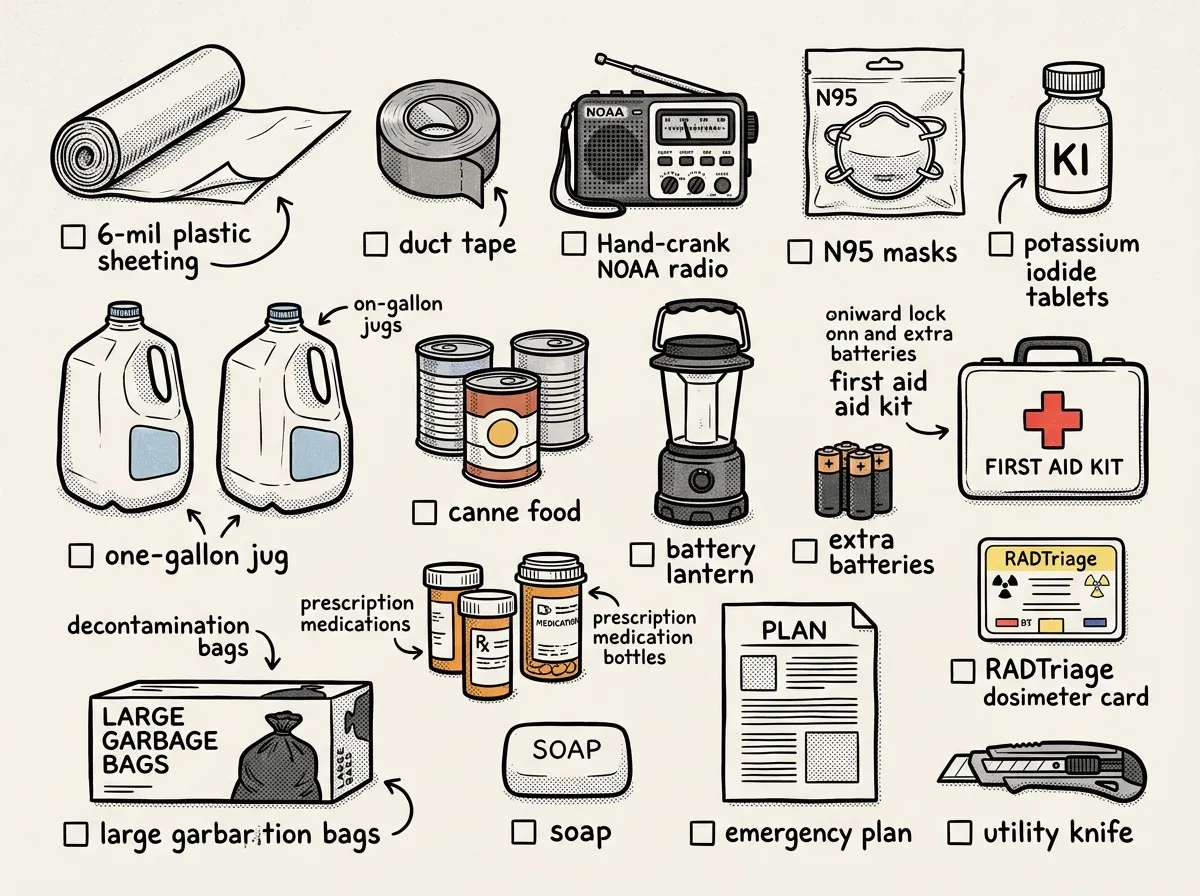 Complete nuclear preparedness kit laid out for inspection
- Identify your shelter room (basement or interior, windowless ground-floor room)
- Stock potassium iodide tablets with age-appropriate doses for every household member
- Store 6-mil plastic sheeting and duct tape — pre-cut to fit your shelter room’s windows and vents
- Maintain a 14-day supply of water (1 gallon per person per day) and shelf-stable food
- Keep a battery-powered or hand-crank NOAA radio with extra batteries
- Acquire a dosimeter or Geiger counter (RADTriage card or GQ GMC series)
- Stock N95 masks for every household member
- Store a change of clean clothes in a sealed bag inside your shelter room
- Keep a first aid kit with a 14-day supply of any prescription medications
- Register for your nearest nuclear power plant’s emergency notification system
During — Immediate Response
- Get inside immediately. The most solid building within a few minutes’ reach. Not your car.
- Go to your pre-identified shelter room. Basement or interior room. Put as many walls and as much mass between you and the outside as possible.
- Seal the room. Plastic sheeting over windows, vents, and door gaps. Duct tape every seam. Shut off HVAC systems — they pull in outside air.
- If you were outside, decontaminate. Remove and bag outer clothing at the door. Shower or wipe down with wet cloths. Don’t use conditioner. Blow your nose, wipe your eyelids and ears.
- Take KI tablets within the first few hours if a reactor incident or fallout is confirmed.
- Put on N95 masks, especially if you can’t fully seal your room.
- Turn on your battery radio. Tune to NOAA or local emergency frequencies.
- Don’t go outside for at least 24 hours. 48-72 hours is significantly safer.
- Ration water and food from the start. Assume 14 days and work backward.
After — Recovery Phase
- Monitor official channels before venturing out. Minimize time exposed, maximize distance from visible fallout deposits, and maintain shielding with an N95 mask and coverings over exposed skin.
- Don’t consume any food or water from unsealed sources until authorities confirm safety.
- Continue monitoring radiation levels if you have a detection device — conditions can vary block to block.
If you’re new to preparedness in general, start with the beginner’s guide to survival readiness and build from there. Nuclear preparedness is general preparedness amplified. If you’ve got water, food, shelter skills, and a plan, you’re already ahead of the vast majority of people around you.
The Complete
Prepper's Reference.
149 articles synthesized into one comprehensive PDF — twelve chapters covering water, food, shelter, first aid, comms, and scenario-specific preparedness. Free with your email.
Unsubscribe anytime · We never share your email
You're in. Check your inbox.
Keep Reading
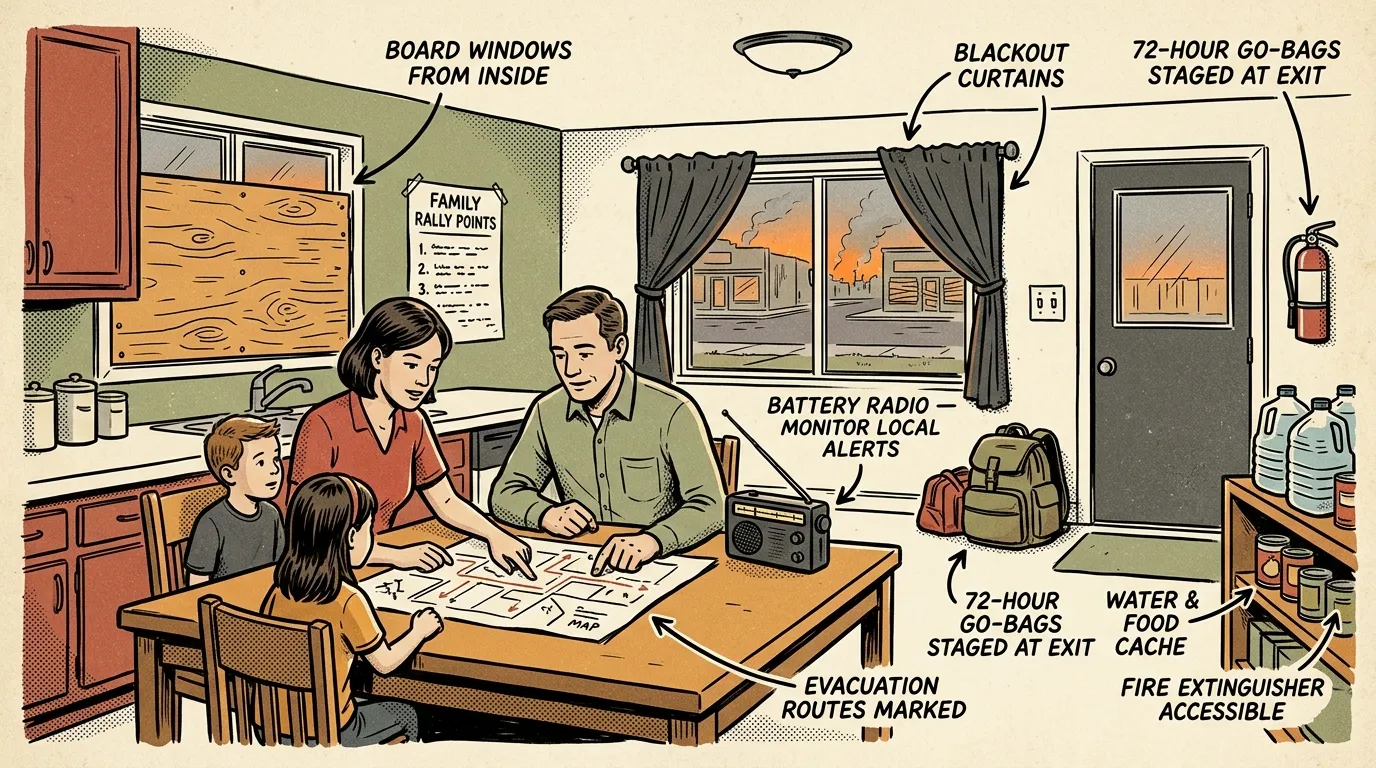
Civil Unrest Preparedness: Protect Your Family Guide
Learn civil unrest preparedness from real events like the 1992 LA riots. Actionable checklists, home hardening tips, and family plans. Start preparing today.
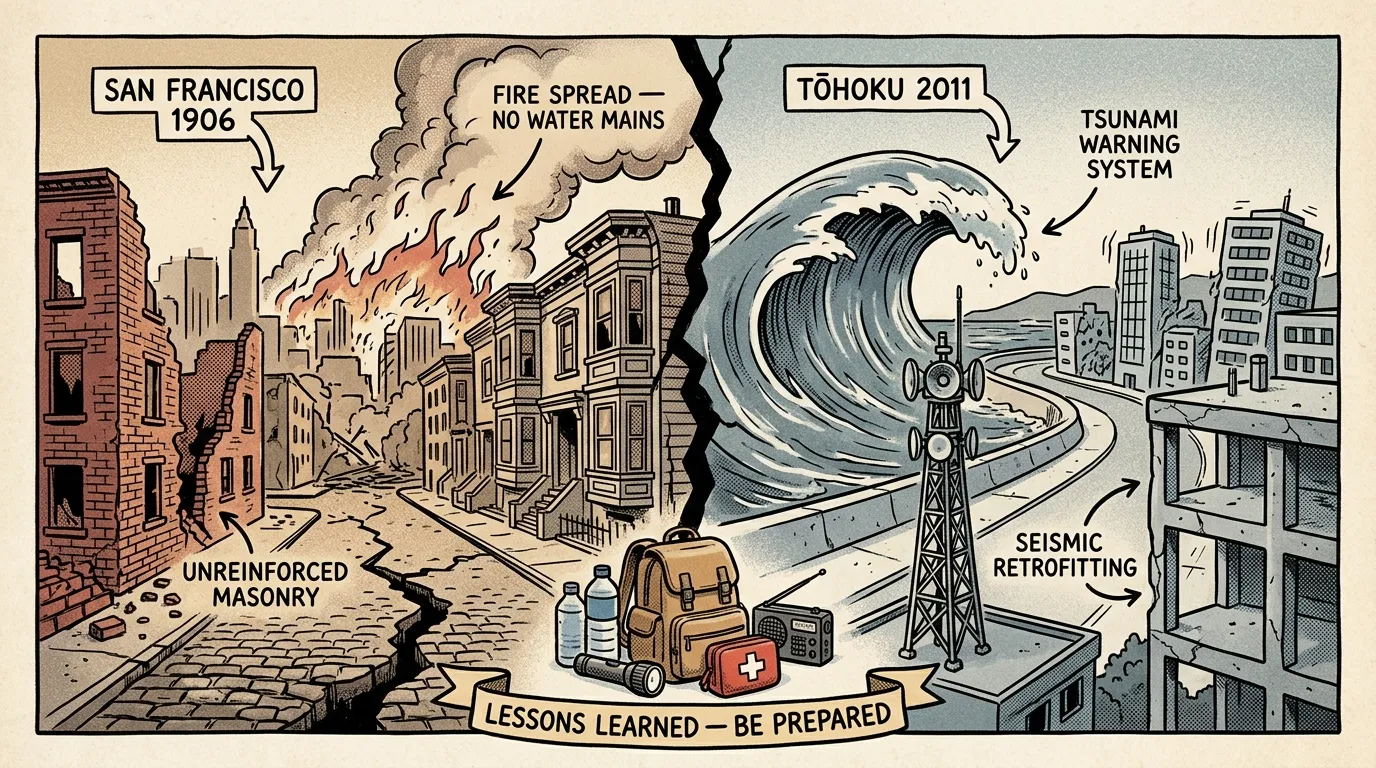
Earthquake Preparedness: Lessons from 1906 & 2011
Learn what the 1906 San Francisco and 2011 Japan earthquakes teach about earthquake preparedness. Complete checklist, survival tips, and expert guidance inside.
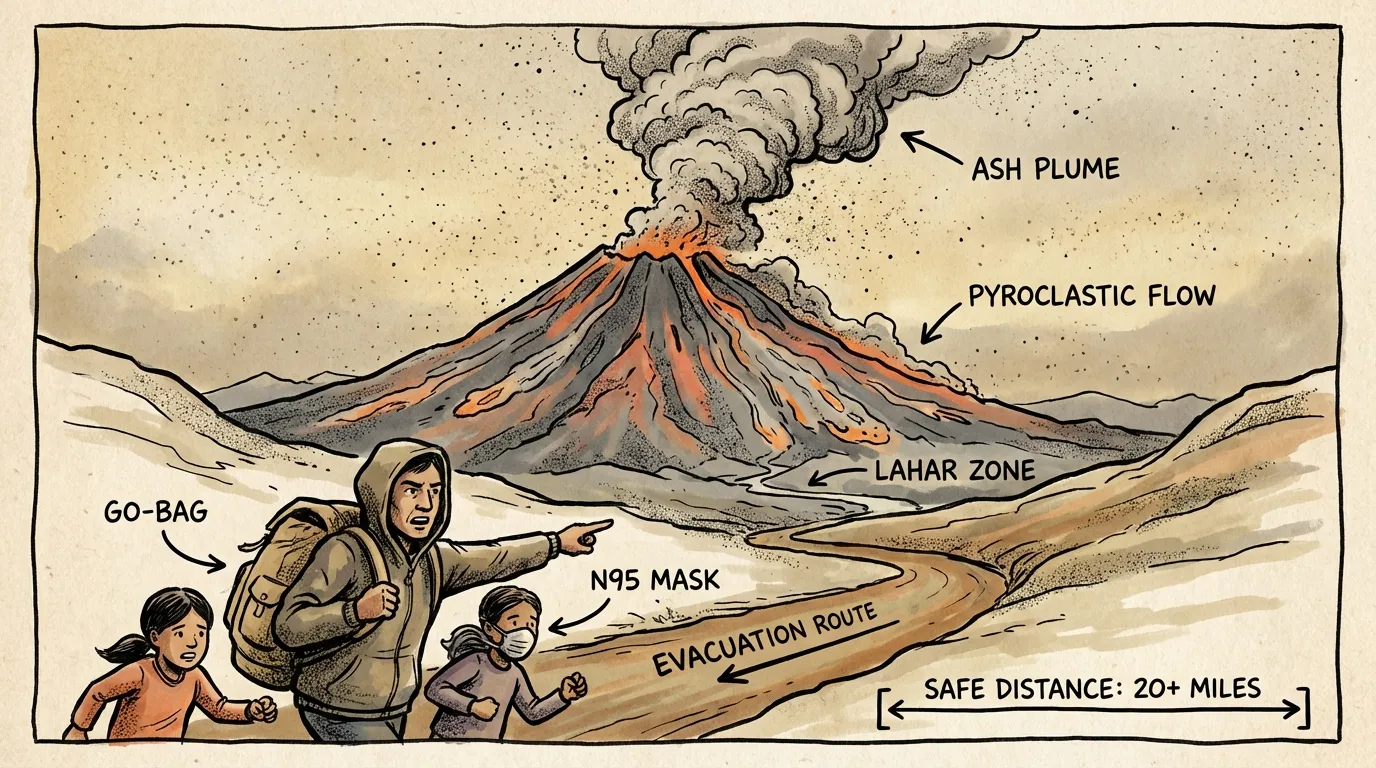
Volcanic Eruption Preparedness: When the Mountain Wakes Up
Mount St. Helens gave scientists 2 months of warning — yet 57 people still died. The 2022 Tonga eruption sent a shockwave around the planet twice. Here's what volcanic eruptions actually threaten, how far danger extends, and how to prepare whether you live near a volcano or not.