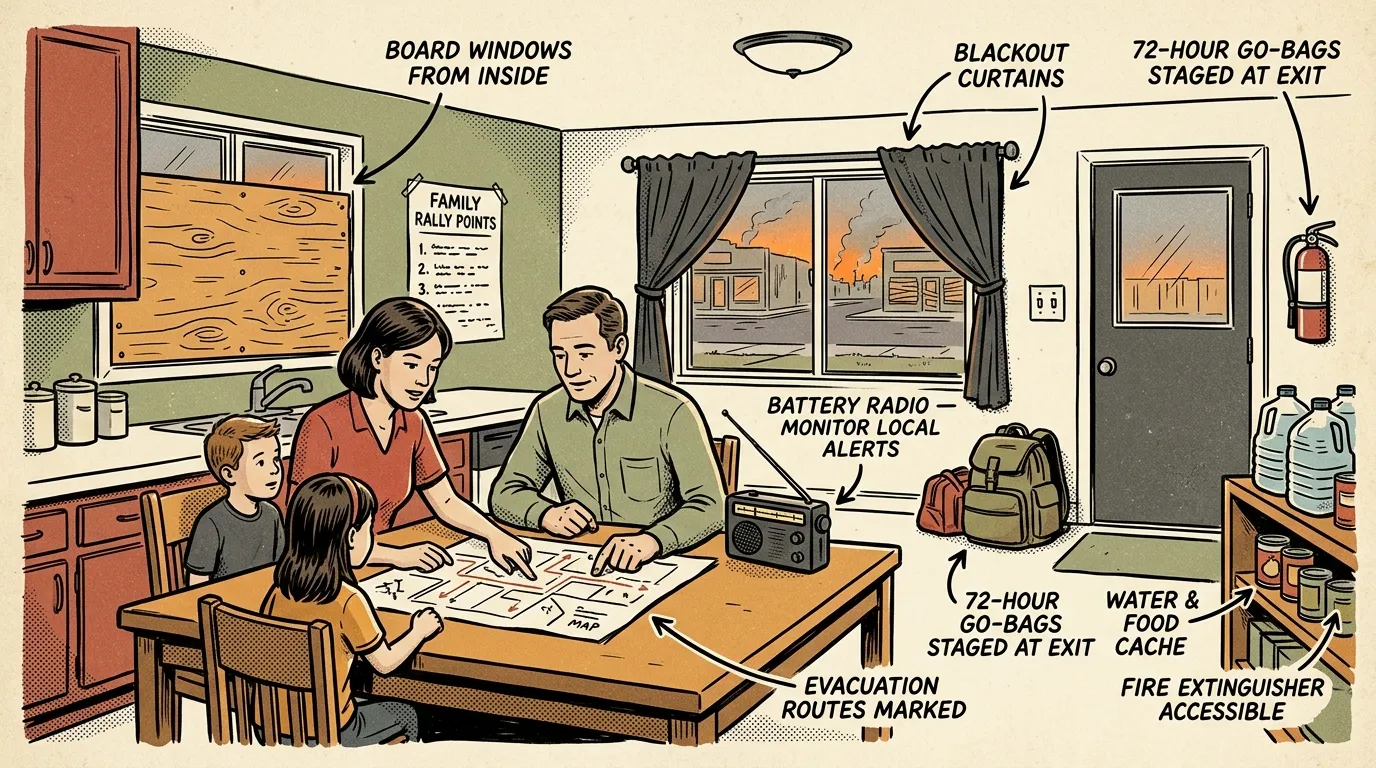
During civil unrest, expect at least 72 hours before any organized government response arrives. Effective preparation includes pre-cut window boards, reinforced doors, one month of stored food and water, a family communication plan, and coordinated neighbor relationships. Community defense consistently outperforms individual defense in historical events like the 1992 LA riots.
Key Takeaways
- Plan for at least 72 hours of total self-sufficiency — the National Guard took 3 full days to deploy during the 1992 LA riots, and your neighborhood will be on its own until then
- Pre-cut and label plywood for every ground-floor window now while hardware stores are stocked — measuring boards during active unrest means you waited too long
- Community defense works; lone-wolf defense gets people killed or imprisoned — meet your neighbors and establish coordination before you need it
- Maintain your vehicle above half a tank whenever political or social tension is elevated, because gas stations empty within hours of unrest breaking out
- Operational security is survival — never advertise your supplies, use blackout curtains if running generators, and adopt a gray man mindset during extended disruptions
Quick Summary
- The National Guard took three full days to deploy during the 1992 LA riots — plan for at least 72 hours of complete self-sufficiency before any organized response arrives.
- Pre-cut plywood, reinforced doors, and visible deterrence are your most effective property defenses. Soft targets get hit first. Every time.
- Community coordination beats lone-wolf defense. Korean business owners in 1992 survived because they organized collectively, not because they were individually armed.
- Store at least one month of food and water to eliminate the need for dangerous supply runs during active unrest.
- Understand your state’s self-defense laws now — people go to prison for things they do during civil unrest, even when they believe they’re acting in self-defense.
- Operational security is non-negotiable in extended scenarios. If people know you have supplies when others don’t, you become a target.
Why Civil Unrest Preparedness Matters Now
Emergency management data shows how fast organized systems buckle under stress — and how civil unrest preparedness fills the gap when they do. During wildfire evacuations, the same pattern holds: families who had go-bags packed and communication plans established were calm and mobile within minutes. The unprepared families were the ones blocking roads and making dangerous last-minute decisions.
Civil unrest follows the exact same dynamics. The threat isn’t fire sweeping down a hillside — it’s the breakdown of social order in your own neighborhood.
This isn’t a political topic. It’s a preparedness topic. The historical record is clear: people who prepare protect their families. People who don’t are at the mercy of events they can’t control.
The Historical Record: When Systems Failed
The 1992 LA Riots
On April 29, 1992, a jury acquitted four LAPD officers in the beating of Rodney King — a Black motorist whose brutal arrest had been captured on videotape by a bystander the year before. The footage had been broadcast nationally, and many considered the verdict a profound miscarriage of justice. Los Angeles erupted within hours.
Over six days, 2,383 people were injured and over 12,000 were arrested. More than 3,000 fires were set. Approximately 1,100 buildings were damaged or destroyed.
What most people remember from the news footage are the fires and the beatings. What they forget is the timeline: the National Guard took three full days to deploy in meaningful numbers. For 72 hours, neighborhoods were essentially on their own. Korean business owners in Koreatown famously stationed themselves on rooftops to protect their livelihoods — their lessons are covered in detail below. The businesses without visible defense were gutted. That contrast — protected vs. unprotected — is one of the starkest lessons in modern civil unrest preparedness.
Hurricane Katrina and the 2020 Unrest
Fast forward to 2005. When Hurricane Katrina hit New Orleans, the natural disaster was catastrophic enough. But what followed was arguably worse: looting began within hours of the storm’s passage, not days. Law enforcement was overwhelmed, scattered, and in some cases simply didn’t show up. Some neighborhoods organized armed watches to protect residents and property. Others were left to fend for themselves.
Then came 2020. Following the killing of George Floyd, protests erupted in Minneapolis and spread nationwide. In Minneapolis alone, over 1,500 buildings were damaged or destroyed, with property damage estimates exceeding $500 million. In Portland, sustained unrest continued for over 100 consecutive days. But here’s the detail worth paying attention to: business owners who boarded up windows, posted security, or otherwise hardened their properties were largely bypassed in favor of softer targets.
That’s not a political statement. It’s a pattern. And patterns are what keep you alive.
Argentina’s 2001 Collapse
Meanwhile, Argentina’s economic collapse of 2001 saw widespread looting of supermarkets and stores hit middle-class neighborhoods particularly hard. Gated communities hired private security. Ordinary families who’d assumed “it can’t happen here” watched their assumptions shatter along with their windows. These examples aren’t ancient history — they’re the operating manual for how to prepare for civil unrest.
Lessons from Korean Business Owners During the LA Riots
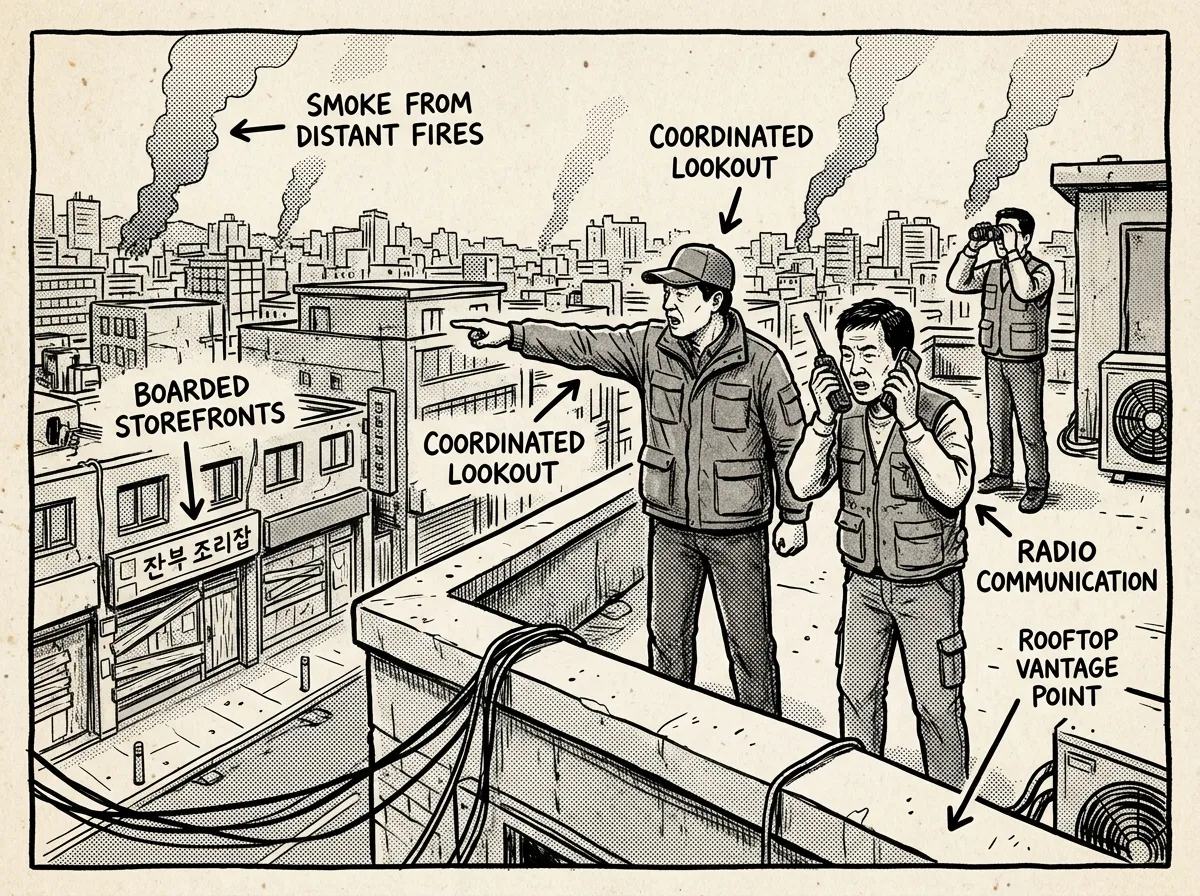 Coordinated community defense on a rooftop during the 1992 LA riots
The Korean American community’s response during the 1992 riots deserves its own section because it’s the most instructive case study in community defense during civil unrest in modern American history.
When the riots erupted, the LAPD established a perimeter around wealthier neighborhoods to the west — effectively abandoning Koreatown. Korean business owners recognized within hours that no help was coming.
What happened next wasn’t a collection of lone gunmen on rooftops. It was organized community defense, and the distinction matters enormously.
They coordinated as a community, not as individuals. Business owners organized through Korean-language radio station Radio Korea (KBLA), which became their real-time communication infrastructure. The station broadcast locations of active threats, coordinated volunteers, and directed resources. When your cell towers are overloaded and official channels have gone silent, having an alternative communication network is the difference between coordinated response and chaos.
Many had military training. South Korea’s mandatory military service meant a significant number of these business owners had actual combat experience — discipline, firearms proficiency, and an understanding of coordinated defense. They established overlapping fields of coverage and rotating watch schedules.
They presented a collective deterrent. A single armed person on a rooftop is a target. Twenty organized people across multiple rooftops with clear communication is a deterrent. Attackers looked at the visible, coordinated defense and moved to easier targets.
The lesson from Koreatown isn’t “buy guns and get on your roof.” It’s that community coordination, communication infrastructure, and visible group deterrence are what actually worked.
Know your neighbors. Establish communication methods. Coordinate before the crisis, not during it. A neighborhood watch during civil unrest isn’t a luxury — it’s the single most effective defense strategy the historical record supports.
Legal Realities of Self-Defense During Unrest
This is not legal advice — consult your state’s self-defense statutes and a local attorney for guidance on use of force. The practical reality is that people go to prison for things they do during civil unrest, even when they believe they’re acting in self-defense.
During the 2020 unrest, multiple individuals across the country faced criminal charges for brandishing or using weapons during protests — including homeowners who pointed firearms at people on their street. The legal landscape varies dramatically by state:
- Castle Doctrine states generally allow lethal force to defend your home against intruders, but specific requirements differ
- Defense of property with lethal force is far more restricted than defense of life in most jurisdictions — in many states, you can’t legally shoot someone for stealing your property
- Duty to retreat laws in some states require you to attempt to flee before using lethal force, even in your own home
- Stand your ground laws in other states remove the duty to retreat but still require a reasonable belief of imminent death or serious bodily harm
Schedule a one-hour consultation with a local attorney who specializes in self-defense law. Do it now, on a calm Tuesday — not after a crisis forces split-second decisions that could result in felony charges.
The Korean business owners in 1992 were largely not prosecuted, but the legal environment has changed significantly since then. Plan your defense within the law, or your survival plan could end with you behind bars instead of behind your barricade.
How Much Warning You’ll Actually Get
Here’s the honest truth: civil unrest can go from simmering tension to street-level danger in a matter of hours. A controversial court verdict, a police shooting caught on video, a sudden economic shock — the trigger events are often sudden, even if underlying tension has been building for months. The 1992 LA riots exploded within hours of the verdict. The 2020 Minneapolis unrest escalated from peaceful protest to structure fires overnight.
If you’re waiting for a formal warning from authorities, you’re already behind. Your real warning system is paying attention: monitor local news, watch social media sentiment in your area, and understand that political instability, economic stress, and high-profile legal proceedings are leading indicators, not background noise.
After-action reviews consistently show a common failure point: people who had all the early signals ignored them because they didn’t want to seem paranoid. During the LA riots, live television coverage of looting with no police response actually accelerated the spread of looting to new areas. Misinformation spreads even faster on social media today. Verify before you act on anything you see online.
Does your location matter? Absolutely. Urban areas see faster escalation and higher intensity, but they also tend to see faster response from law enforcement and National Guard. Rural areas probably won’t see large-scale unrest, but if supply chains get disrupted by urban chaos, small towns with limited grocery inventory can feel the pinch within days. Suburban areas sit in an uncomfortable middle ground — close enough to urban centers to be affected, far enough away that emergency response may be delayed. Your location dictates your strategy, and your strategy needs to be decided before you hear sirens.
The First 72 Hours: Shelter in Place
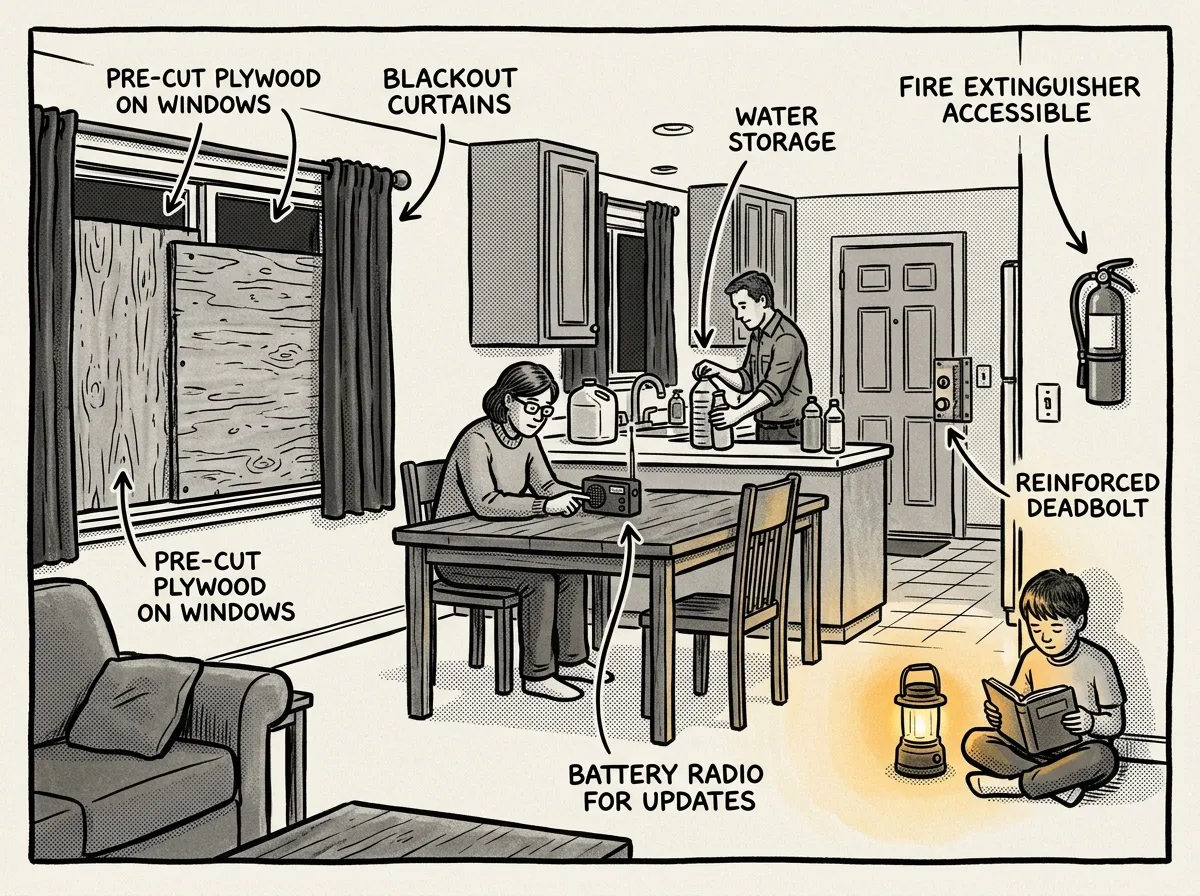 A family sheltering in place with hardened entry points and emergency supplies at the ready
A controversial verdict drops. Your spouse is at work across town. Your teenager is at a friend’s house three miles away. Within 90 minutes, social media is showing fires and blocked intersections along your spouse’s normal commute route. Do you know your family’s rally point? Do your kids know what to do if they can’t get home?
The first hour is about information and decisions, not action-movie heroics. When you become aware that civil unrest is active or imminent, your first move is to account for every family member. Where are your kids? Can your spouse get home, or should they shelter where they are? This is why you need a creating a family emergency communication plan established well before anything happens.
Make your shelter-in-place vs. evacuate decision based on criteria you’ve already established: Is the unrest moving toward your neighborhood? Are roads still passable? Do you have enough supplies to stay put? Hesitation kills. Decide fast, commit fully.
If you’re sheltering in place, the first day is about hardening your home and becoming invisible. Board up ground-floor windows with plywood you’ve already cut to size and stored in your garage — if you’re measuring and cutting while a mob is three blocks away, you waited too long. Kill exterior lights that draw attention. Put interior lights on timers so the house looks normally occupied but not like a supply depot. Close blinds and curtains. Move valuables and critical supplies away from exterior walls.
Do not go outside to watch what’s happening. In the 1992 LA riots, many of the 2,383 injuries were bystanders and people who ventured out to see what was going on. This is not a spectator sport.
During wildfire evacuations, people often stand outside taking phone videos while embers land on their roof. The urge to observe is powerful and deeply human, but it gets people hurt. During civil unrest, that urge is even more dangerous because the threat isn’t predictable like fire moving uphill. Stay inside. Get your information from a battery-powered radio and verified social media, not from your front porch.
In the first 72 hours, the things that kill people are direct violence, fires, and medical emergencies that can’t reach hospitals. The medical skills gap during civil unrest is massive — even basic wound packing and tourniquet application training can save a life when EMS response times spike from 8 minutes to 8 hours. If someone in your household has a medical condition requiring regular treatment — dialysis, insulin, oxygen — you need a 72-hour minimum supply on hand at all times, and ideally much more. Your go-bag should be staged by the door, because conditions can change fast enough that sheltering becomes untenable and you need to execute your evacuation plan immediately.
When Days Become Weeks: Extended Supply Planning
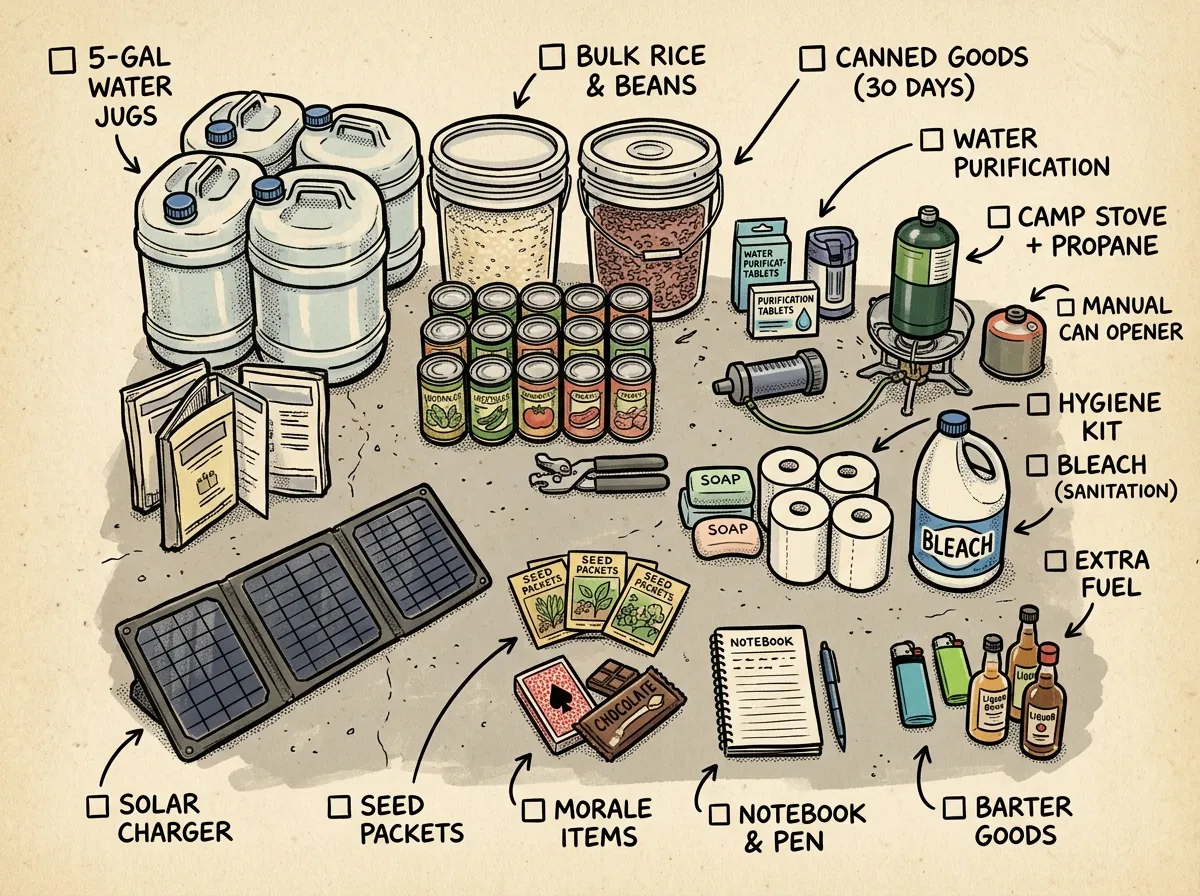 Extended supply stockpile organized for weeks of self-sufficiency
If unrest extends beyond 72 hours, you’re in a fundamentally different situation. The LA riots lasted six days. Argentina’s 2001 crisis saw intermittent looting and instability for weeks. Portland in 2020 saw sustained unrest for over 100 days.
When days become weeks, systems break down in a predictable order. First, retail supply chains fail — grocery stores close, gas stations shut down or run dry, pharmacies are looted or locked. Second, utilities become unreliable — not necessarily because infrastructure is damaged, but because repair crews won’t enter unsafe areas. Third, waste and sanitation degrade, especially in dense urban areas. Fourth — and this is the one people don’t think about — social cohesion in your immediate neighborhood either solidifies or fractures.
The communities that fare best during extended unrest are the ones where neighbors already know each other, have established trust, and can organize watches, share resources, and present a unified front. A neighborhood of strangers behind locked doors is a collection of soft targets.
Your food and water supply becomes the critical variable. A month of food and water stored at home means you don’t have to make supply runs during active unrest — and supply runs are where people get hurt. Water is more critical than food; plan for one gallon per person per day at minimum.
The Sawyer Squeeze — around $30 — is a common recommendation for backup water filtration. According to the manufacturer, it filters up to 100,000 gallons and weighs almost nothing. The LifeStraw is fine for personal use, but the Squeeze offers more volume and works inline with a gravity bag, which matters when filtering for a whole household.
Long-Term Instability: If It Doesn’t Resolve Quickly
Argentina’s 2001 collapse is the cautionary tale. What began as an economic crisis and a few days of intense looting evolved into months of instability, with unemployment exceeding 25%, the peso losing roughly 75% of its value, and crime rates that stayed elevated for years. Venezuela’s more recent collapse followed a similar trajectory — extended instability where medications, batteries, fuel, and hygiene products became the most valuable barter commodities, more useful than the collapsing currency.
In a prolonged scenario, new threats emerge that weren’t present in the acute phase. Organized criminal activity fills the vacuum left by overwhelmed law enforcement. Price gouging and black markets become the primary economy for scarce goods. Neighborhoods can become territorial.
Your operational security becomes paramount. Don’t take all your supplies out at once in view of others — if you’re carrying cases of water into your house while your neighbors are rationing, you’ve just painted a target on yourself. Vary your routine. Avoid discussing supply levels with anyone outside your trusted inner circle. Use blackout curtains if running generators at night — light and sound attract attention when surrounding homes are dark.
The gray man concept — blending in, appearing to be in the same situation as everyone else — isn’t just tactical advice. It’s survival.
Based on historical patterns from Argentina and Venezuela, the items that become most valuable during extended disruption are: prescription medications, batteries, fuel, hygiene products (feminine hygiene products especially), reading glasses, coffee, alcohol, and ammunition.
Your Civil Unrest Preparedness Checklist
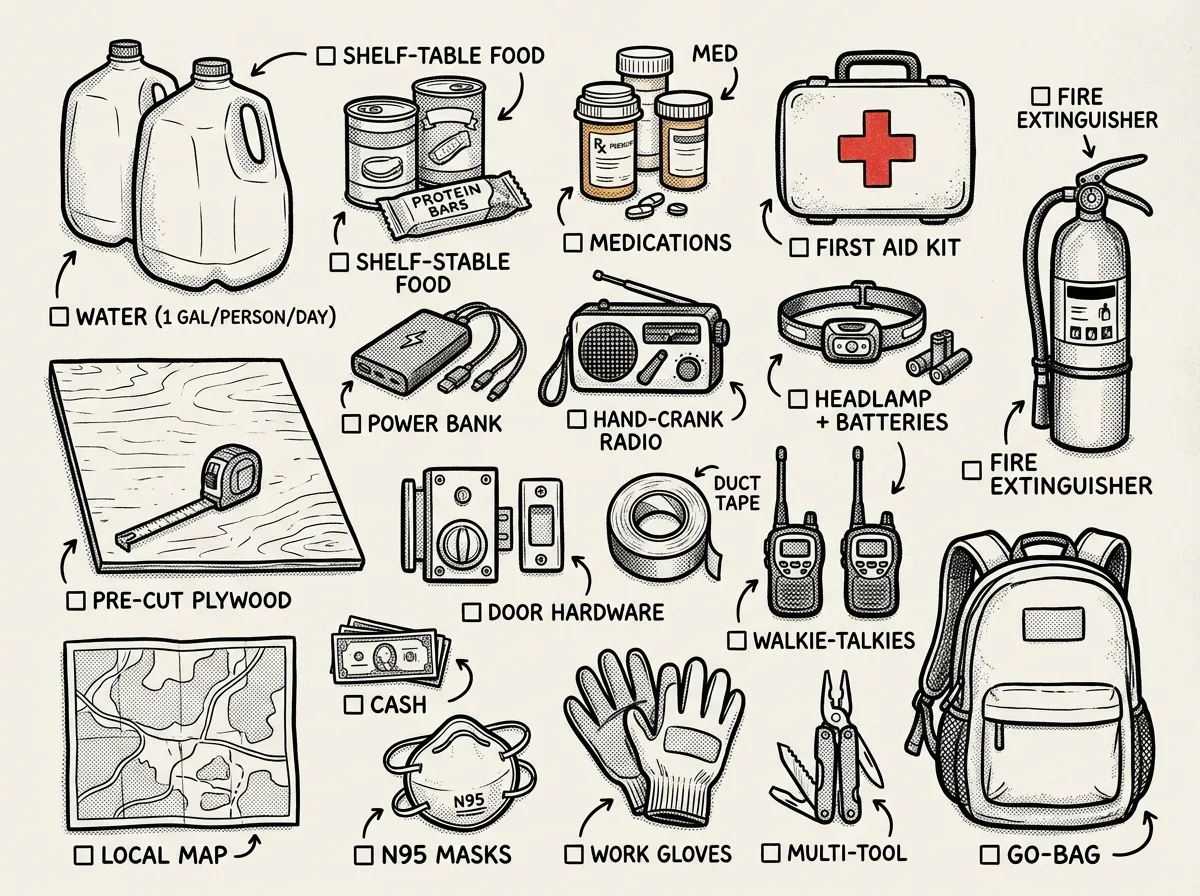 Complete civil unrest preparedness kit laid out and ready to go
Before: The Preparedness Phase
- Store a minimum of one month of food and water for every household member to eliminate dangerous supply runs
- Pre-cut and label plywood for all ground-floor windows — store it with screws and a battery-powered drill for 15-minute installation
- Reinforce all exterior doors with 3-inch screws in strike plates, secondary deadbolts, and security bars on sliding doors
- Build a 72-hour go-bag for every family member including water, food, medications, documents, cash in small bills, and local paper maps
- Establish a family communication plan with an out-of-area contact, a physical rally point, and backup methods
- Meet your neighbors and establish mutual aid agreements — community defense is exponentially more effective than individual defense
- Consult a local attorney about your state’s self-defense laws so you understand legal boundaries before a crisis
Beyond those seven essentials, round out your preparation:
- Install security cameras with cloud-based recording so footage survives even if the camera is destroyed. Position them to cover all entry points.
- Research legal self-defense tools appropriate to your state. Whatever you choose, get trained. An untrained person with a weapon is a liability.
- Maintain a full tank of gas when conditions seem volatile. If your vehicle hits half a tank, fill it. Gas stations empty fast once unrest begins.
- Identify two evacuation routes out of your area — a primary and an alternate. Assume highways may be blocked. Know backroads.
- Photograph all rooms and valuables now — store images in the cloud and on a USB drive in your go-bag for insurance documentation.
- Review your insurance policy’s civil unrest and riot exclusions. Many standard homeowner policies exclude riot damage — verify your coverage today, not after your windows are broken.
During: Immediate Response
- Account for all family members and execute your communication plan
- Make the shelter-or-evacuate decision within the first hour and commit fully
- Board up ground-floor windows if sheltering in place
- Maintain a low profile — lights on timers, curtains closed, no visible signs of stockpiled resources
- Stay off the streets — do not go out to observe or document
- Monitor news and radio for real-time information, verify from multiple sources before acting
- Stage go-bags by the door in case conditions change
- Coordinate with neighbors if you have an established relationship
- Document any property damage with photos and video when safe to do so
After: Recovery Phase
Don’t assume safety prematurely. Unrest can flare again after apparent calm — the LA riots had multiple surges over six days.
Assess your home for structural damage, especially fire damage that may not be immediately visible. Replenish all supplies you used. Restock go-bags, replace plywood if it was installed, refill water stores.
File insurance claims promptly with your photographic documentation. Most policies require notification within 24-72 hours of damage. Keep copies of all correspondence. If civil unrest is accompanied by a federal disaster declaration, you may qualify for additional assistance through FEMA’s Individual Assistance program.
Conduct an after-action review with your family. What worked? What didn’t? What do you need to add, change, or practice?
Check on your neighbors, especially elderly or vulnerable individuals who may have been isolated. And don’t ignore the mental health component. Experiencing civil unrest — even from the relative safety of a well-prepared home — is stressful and can be traumatic, especially for children. Talk about it. Seek professional support if needed. The psychological toll of prolonged instability, as documented after both the LA riots and Argentina’s crisis, can persist long after streets are safe again.
What Most People Get Wrong
The biggest mistake is assuming it’ll never affect you. “I live in a nice neighborhood.” “That only happens in cities.” “This is America, not Argentina.” The residents of Koreatown in 1992 lived in a nice neighborhood too. The homeowners in suburban Minneapolis in 2020 thought the same thing. Unrest doesn’t respect property lines, and it doesn’t check your zip code.
The second biggest mistake is the Rambo fantasy — the idea that one well-armed individual can hold off a mob. You can’t, and if you try, you’ll likely face criminal charges even if you survive. Community defense works. Lone-wolf defense gets people killed or imprisoned. The Korean shopkeepers weren’t effective because they were individually well-armed; they were effective because they were organized, coordinated, and presented a collective deterrent.
The third mistake is waiting until things are bad to start preparing. When unrest is active, stores are already closed or cleaned out. Plywood’s sold out at every hardware store in the region. Ammunition is gone. Gas stations have lines stretching around the block. Everything you need becomes either unavailable or astronomically expensive at the exact moment you need it most.
Civil unrest preparedness is a boring Tuesday afternoon activity. It’s cutting plywood in your garage on a quiet weekend. It’s introducing yourself to the family three doors down. It’s filling your gas tank when it hits the halfway mark. It’s buying an extra case of water every grocery run until you have a month’s supply stacked in the basement. None of this is glamorous. All of it works.
During the 1992 LA Riots, fire departments received over 10,000 emergency calls in the first few days. Many went unanswered. The system wasn’t broken — it was simply overwhelmed by scale. Your preparedness plan is what fills that gap.
Frequently Asked Questions
How much damage did the 1992 LA riots cause?
The 1992 LA riots caused $1 billion in property damage (approximately $2.1 billion adjusted for inflation). The human toll was 63 deaths, 2,383 injuries, and over 12,000 arrests. Over 1,100 buildings were damaged or destroyed, approximately 3,000 fires were set, and roughly 2,280 Korean-owned businesses suffered damage. It remains one of the costliest civil disturbances in American history, second only to the aggregate damage from the 2020 unrest events.
What did the 1992 LA riots accomplish?
The riots led to federal civil rights charges against the officers involved in the Rodney King beating (two were ultimately convicted), the Christopher Commission reforms to LAPD policies and oversight, and billions of dollars in rebuilding investment in South Los Angeles. From a preparedness perspective, they demonstrated that communities must plan for at least 72 hours of self-sufficiency, that organized community defense is effective, and that visible property hardening dramatically reduces the likelihood of being targeted.
How much money did Rodney King get in his settlement?
Rodney King received a $3.8 million settlement from the City of Los Angeles in 1994 for the beating he suffered at the hands of LAPD officers. The settlement was a civil matter separate from the criminal trials. King struggled with the aftermath of his experience for the rest of his life, passing away in 2012 at age 47.
How long does it take the National Guard to respond during riots?
During the 1992 LA riots, the National Guard took three full days to deploy in meaningful numbers — a delay caused by bureaucratic authorization processes, mobilization logistics, and transportation challenges. This timeline has been somewhat improved by post-riot reforms and pre-positioning protocols, but the fundamental lesson remains: plan for a minimum of 72 hours of total self-sufficiency. Even well-coordinated government deployments can face significant delays when the triggering event is sudden.
Start This Weekend
Civil unrest preparedness isn’t about fear. It’s about the same principle behind every form of emergency readiness: the time to prepare is before you need to.
Pick three items from the checklist above and complete them this weekend. Pre-cut plywood for your two most vulnerable windows. Introduce yourself to one neighbor you haven’t met. Fill your gas tank. These small actions compound into a posture that protects your family when systems fail.
The pattern from 1992 LA to 2005 New Orleans to 2020 Minneapolis is consistent: prepared families are safe families. Unprepared families become statistics. Choose which one you’ll be now, while the choice is still easy and the hardware store is still open.
Further Reading
- Becoming a Prepper: The Beginner’s Guide to Survival Readiness
- The Beginner’s Guide to Survivalism: Prepping for Dummies
- Navigating the Wilderness: Basic Orienteering for New Preppers
- The Best Camping Gear for Emergency Preparedness
- Family Emergency Communication Plan
- Emergency Water Purification Guide
The Complete
Prepper's Reference.
149 articles synthesized into one comprehensive PDF — twelve chapters covering water, food, shelter, first aid, comms, and scenario-specific preparedness. Free with your email.
Unsubscribe anytime · We never share your email
You're in. Check your inbox.
Keep Reading
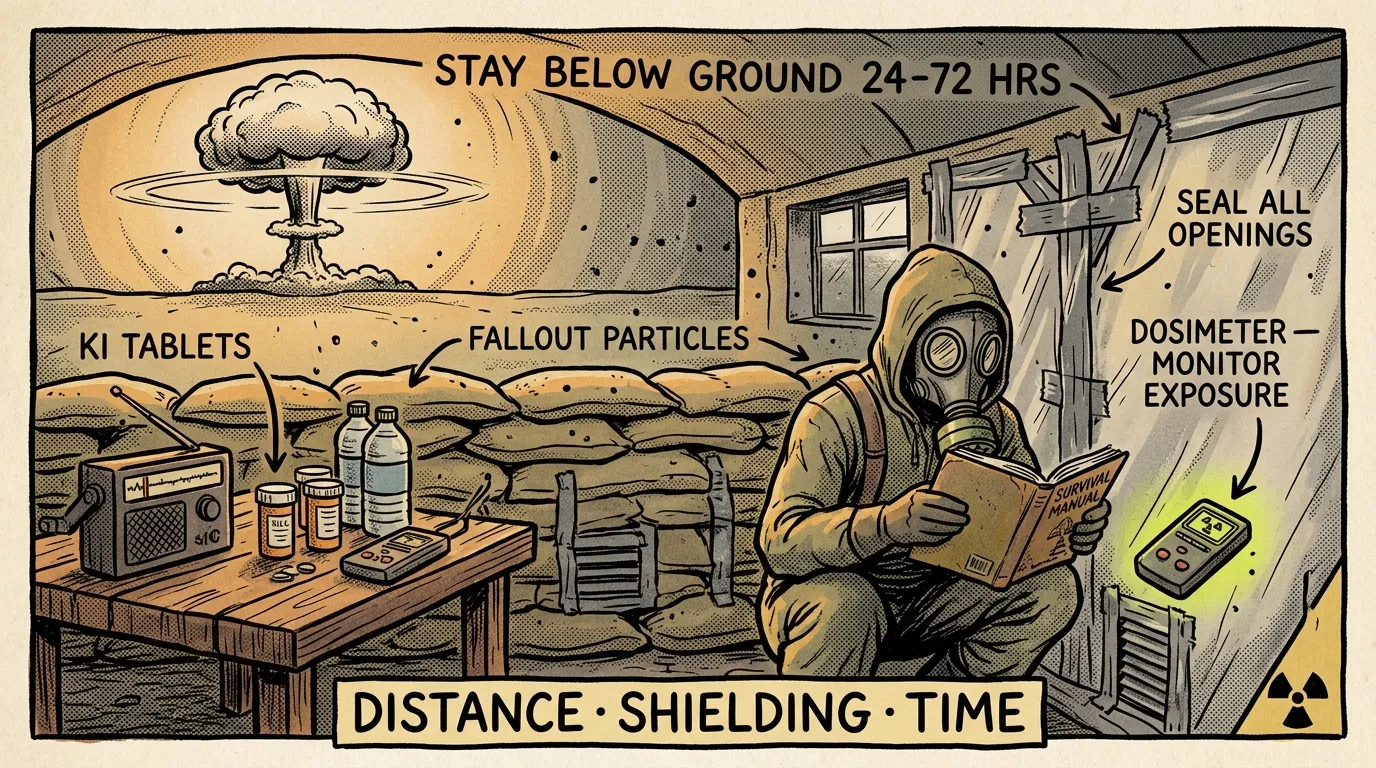
Nuclear Preparedness: Radiation, Fallout & Survival Guide
Lessons from Chernobyl and Fukushima shaped modern nuclear preparedness. Learn the science of radiation survival, fallout sheltering, and your action plan.
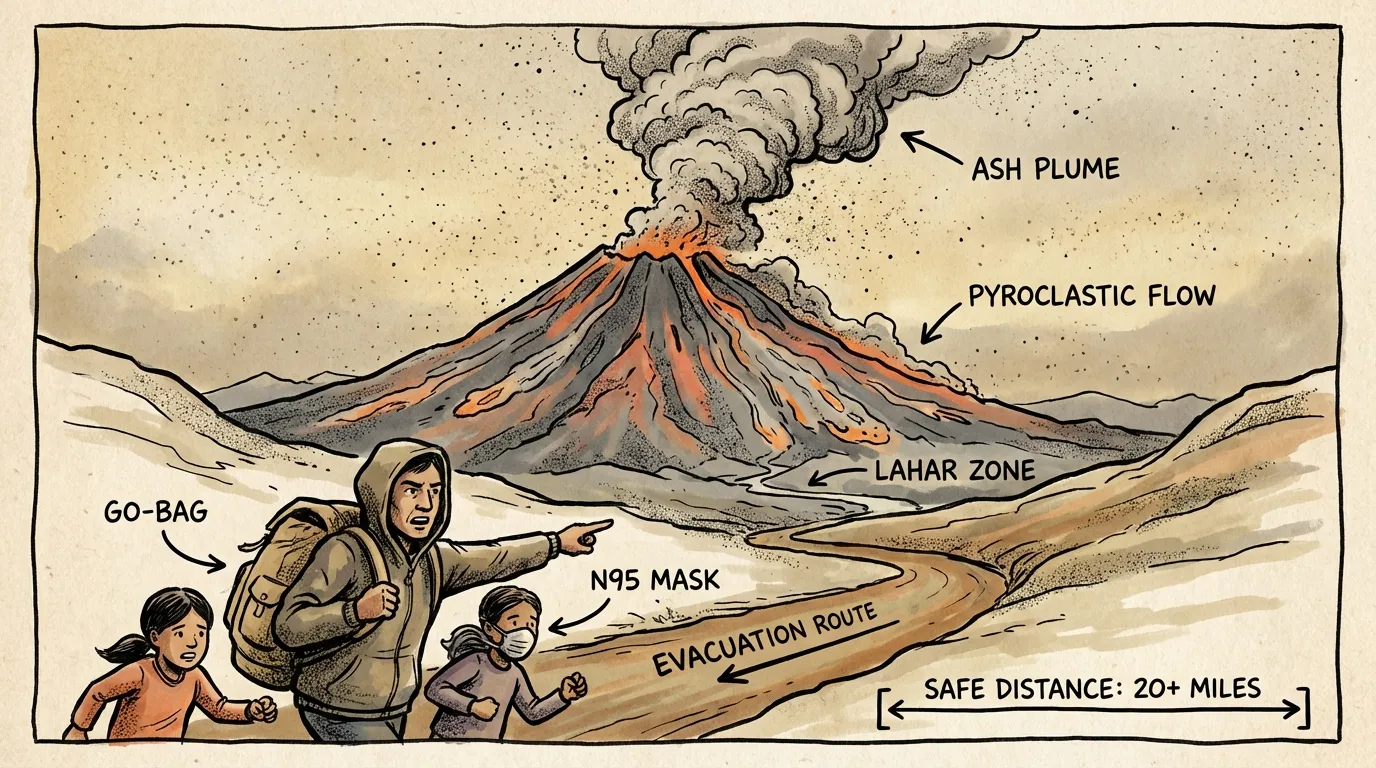
Volcanic Eruption Preparedness: When the Mountain Wakes Up
Mount St. Helens gave scientists 2 months of warning — yet 57 people still died. The 2022 Tonga eruption sent a shockwave around the planet twice. Here's what volcanic eruptions actually threaten, how far danger extends, and how to prepare whether you live near a volcano or not.
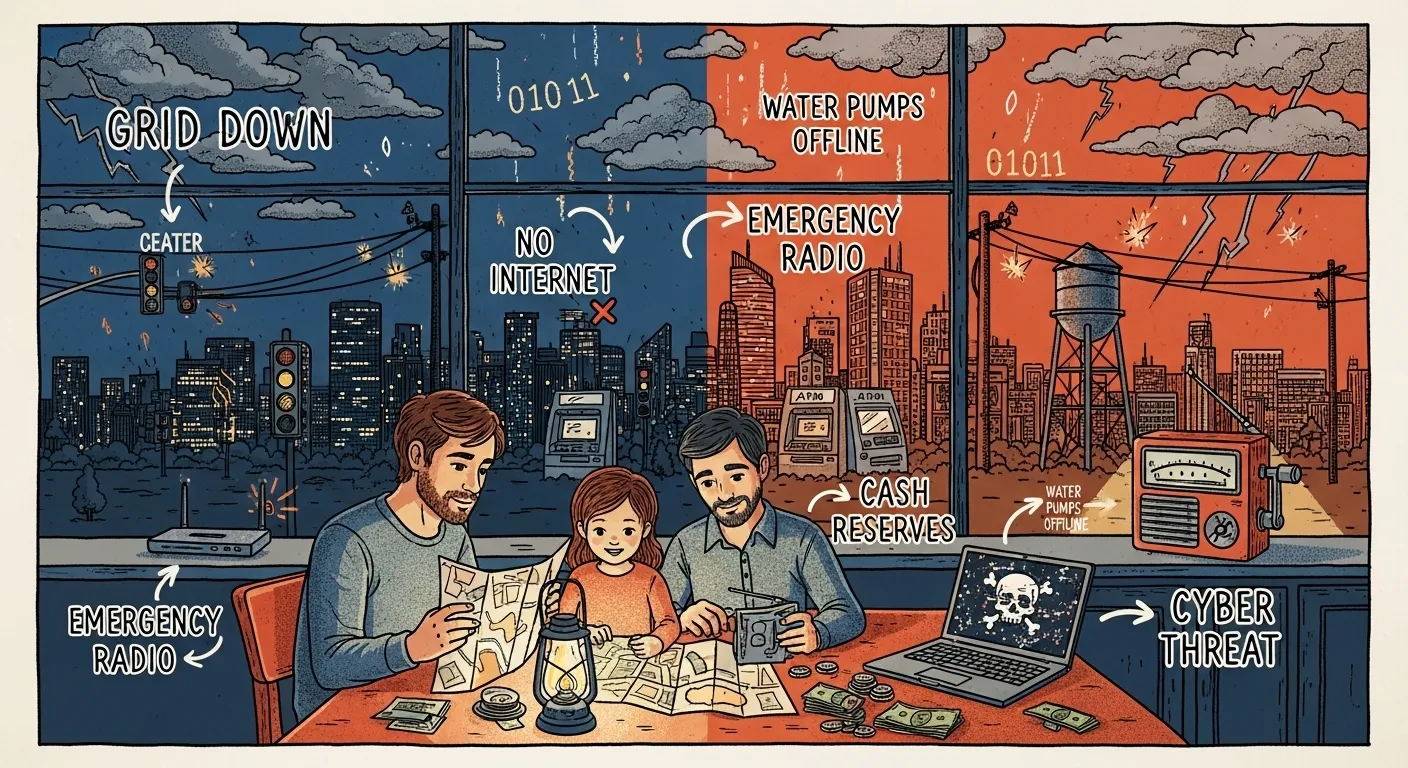
Cyberattack and Infrastructure Failure: The Invisible Emergency
In 2021, a ransomware attack shut down the Colonial Pipeline and caused gas shortages across the Southeast in 6 days. In 2015, hackers turned off power for 230,000 Ukrainians. Digital attacks on physical infrastructure are here — here's how to prepare for when they hit yours.