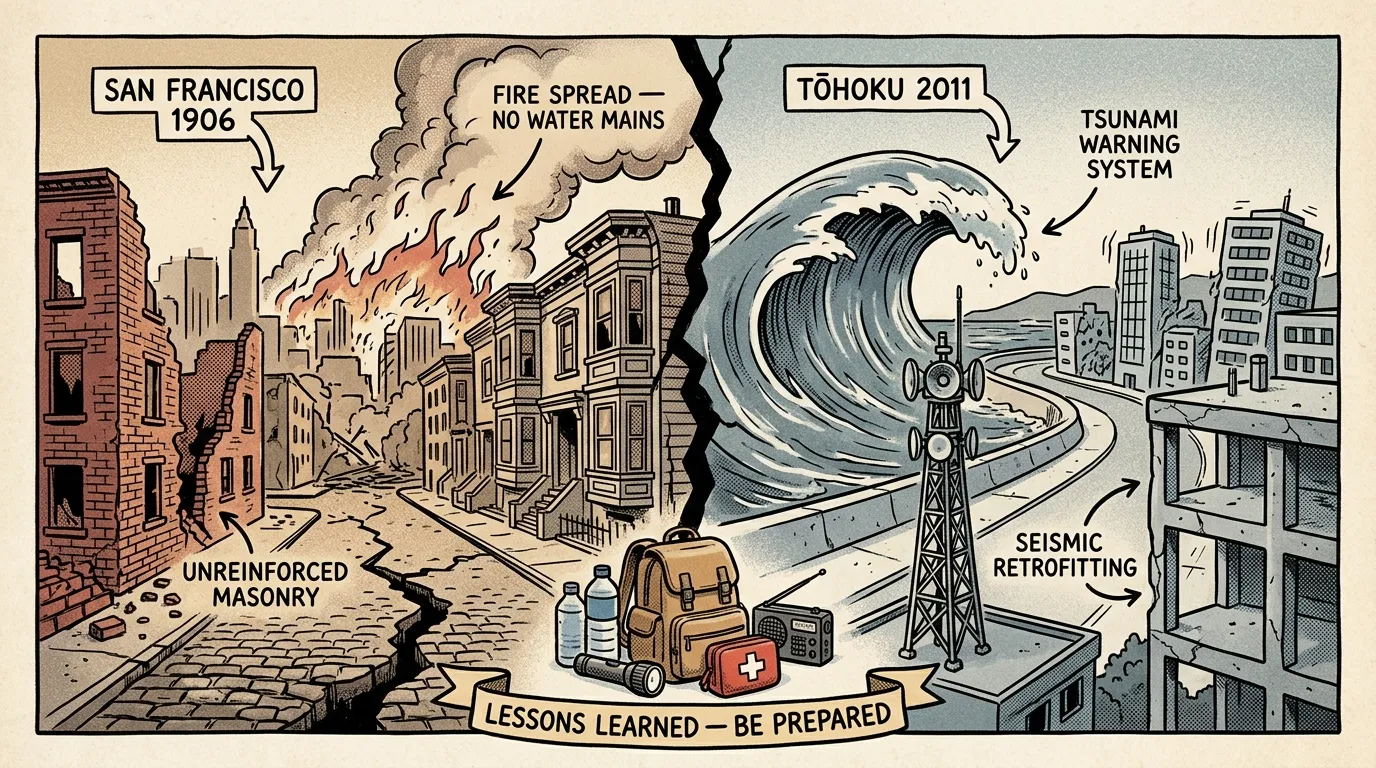
In earthquakes, secondary disasters — fire, tsunamis, building collapse — kill more people than the shaking itself. The 1906 San Francisco earthquake destroyed 80% of the city through fire. Japan's 2011 magnitude 9.0 quake killed nearly 16,000 people mainly through tsunami. Building codes and advance preparation determine survival outcomes more than earthquake magnitude.
Key Takeaways
- Store a minimum of two weeks of water — one gallon per person per day — because water mains fail in virtually every major earthquake.
- Retrofit your home's foundation now: foundation bolting and cripple wall bracing are the highest-return seismic investments you can make.
- Drop, cover, and hold on is the only evidence-based response — doorways, the 'triangle of life,' and running outside are all myths that get people hurt.
- Plan for two weeks of total self-sufficiency, not just 72 hours — federal response to catastrophic events routinely takes longer than official timelines suggest.
- Aftershocks can rival the main quake in power and last for weeks; treat every single one as a new earthquake event.
Earthquake preparedness is the one category of emergency planning where you get zero second chances. No advance warning. No forecast window. Every meaningful action you’ll take to survive an earthquake must be completed before the ground starts shaking.
The 1906 San Francisco earthquake and the 2011 Japan Tōhoku earthquake — two of the most devastating seismic events in modern history — prove this point in starkly different ways. What they share is a single, unavoidable lesson: preparedness infrastructure, not magnitude, determines who lives and who dies.
Quick Summary
- Zero warning time separates earthquake preparedness from every other disaster scenario — your preparation is your warning
- Secondary disasters kill more people than shaking — fire destroyed 80% of San Francisco in 1906; tsunami killed 15,897 in Japan in 2011
- Building codes are the great equalizer — Japan’s magnitude 9.0 quake killed fewer people through structural collapse than Haiti’s 7.0 quake because of strict seismic engineering standards
- Two weeks of water storage is the minimum for serious earthquake readiness — one gallon per person per day, no exceptions
- The Cascadia Subduction Zone shares the exact same tectonic mechanism that produced Japan’s 2011 disaster, and it’s overdue by geologic standards
- Aftershocks can rival the main event and continue for weeks; treat every one as a brand-new earthquake
When It Happened Before
At 5:12 a.m. on April 18, 1906, the San Andreas Fault ruptured beneath San Francisco with a magnitude 7.9 earthquake. The shaking lasted roughly 42 to 60 seconds. What followed lasted three days — not aftershocks, but fire. Ruptured gas mains ignited blazes across the city. Broken water mains left firefighters helpless. By the time the fires died, over 80% of the city was destroyed, approximately 3,000 people were dead, and 225,000 residents — more than half the city’s population — were homeless.
People who survived the shaking died because the infrastructure meant to save them had been shattered in the same moment they needed it most.
Fast-forward to January 12, 2010. A 7.0 magnitude earthquake struck near Port-au-Prince, Haiti. The magnitude was actually lower than San Francisco’s 1906 quake, but the death toll was catastrophically higher — estimated between 100,000 and 300,000 people. The difference wasn’t geology. It was infrastructure. Unreinforced concrete buildings pancaked. Hospitals collapsed. The national palace crumbled.
The earthquake doesn’t kill you — the building does.
Just over a year later, Japan demonstrated the opposite end of the spectrum. The 2011 Tōhoku earthquake hit at magnitude 9.0 — releasing roughly 30 times more energy than the 1906 San Francisco earthquake, according to USGS seismologist Lucy Jones. Japan’s strict building codes meant most structures survived the shaking itself. What killed 15,897 people was the tsunami that followed, with some waves reaching 133 feet. The disaster triggered the Fukushima Daiichi nuclear crisis and caused an estimated $235 billion in damage, making it the costliest natural disaster in recorded history.
Even with the most prepared nation on Earth, the scale overwhelmed the plan.
Then there’s the 1994 Northridge earthquake — the one that hits close to home for a lot of Americans. A 6.7 magnitude event struck at 4:31 a.m. on a holiday, which is likely the only reason the death toll was 57 rather than hundreds. Freeway sections collapsed entirely. Sixteen thousand buildings were damaged. The economic toll reached $40 billion. Timing was the only buffer between a bad day and a catastrophe — and timing isn’t a preparedness strategy.
What 1906 and 2011 Teach Us Together
The 1906 San Francisco earthquake (magnitude 7.9) and the 2011 Japan Tōhoku earthquake (magnitude 9.0) are two of the most studied seismic events in history. Separated by over a century, they occurred on different fault types, in different eras of engineering, on opposite sides of the Pacific. Yet they deliver the same core lesson.
| Category | 1906 San Francisco | 2011 Japan (Tōhoku) |
|---|---|---|
| Magnitude | 7.9 | 9.0 |
| Duration of Shaking | ~42–60 seconds | ~6 minutes |
| Death Toll | ~3,000 | 15,897 |
| Primary Cause of Death | Fire (ruptured gas/water mains) | Tsunami |
| Energy Released | Baseline (1x) | ~30x greater than 1906 |
| Economic Damage | ~$10 billion (adjusted) | ~$235 billion |
| Building Code Era | Pre-seismic code | Post-1981 seismic code (updated 2000) |
| Key Lesson | Infrastructure failure kills more than shaking | Building codes save lives; secondary disasters are the real threat |
Both quakes prove that the primary shaking is rarely what kills the most people. In San Francisco, it was fire. In Japan, it was water. Secondary disasters caused the majority of fatalities — and the level of preparedness infrastructure determined the scale of the catastrophe.
Tectonic Plates and Fault Lines: Why These Earthquakes Happen
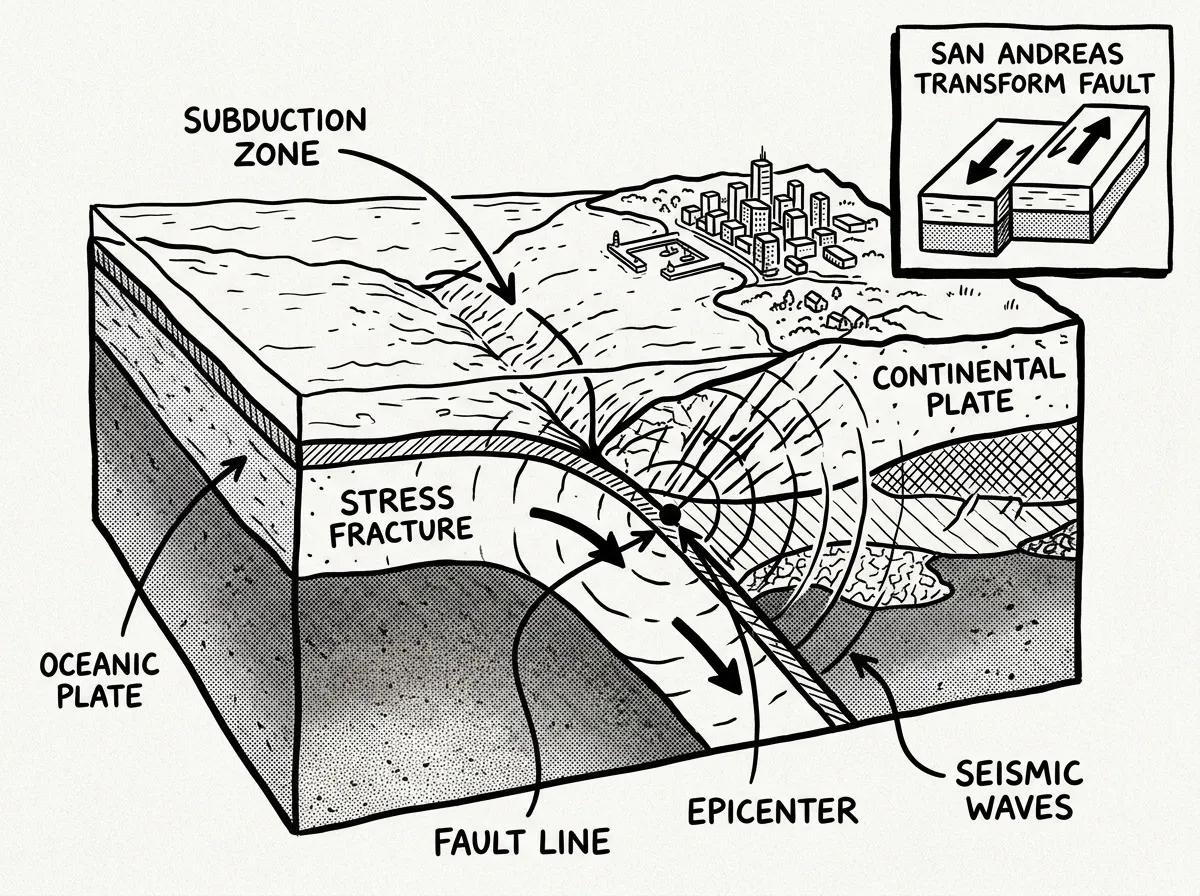 How subduction zones and transform faults generate devastating earthquakes
Why do these disasters happen at all? It’s not just academic — understanding the tectonic mechanism tells you what secondary threats you’re actually facing.
The 1906 San Francisco earthquake occurred along the San Andreas Fault, a transform boundary where the Pacific Plate and the North American Plate slide laterally past each other. This strike-slip motion produces intense, localized shaking but doesn’t typically generate tsunamis because the ground moves horizontally rather than vertically displacing the ocean floor.
The 2011 Japan earthquake was fundamentally different. It occurred along the Japan Trench, a convergent boundary where the Pacific Plate subducts beneath the North American Plate. Subduction zone earthquakes can reach much larger magnitudes because the fault contact area is enormous. When those locked plates finally release, the sudden vertical displacement of the ocean floor generates devastating tsunamis.
The Cascadia Subduction Zone — stretching from Northern California to British Columbia — shares the exact same tectonic mechanism that produced Japan’s 2011 disaster. The last Cascadia megathrust earthquake struck on January 26, 1700, at an estimated magnitude 9.0. It generated a tsunami that crossed the Pacific and was recorded in Japan. Geologic evidence suggests these events recur roughly every 200 to 500 years. We’re 325 years into that cycle.
For residents of the Pacific Northwest, this isn’t theoretical. It’s preparation for a specific, well-documented threat with a 100% probability of recurring — we just don’t know when. For those in the coastal PNW, tsunami preparedness and evacuation planning isn’t optional.
How Much Warning You’ll Actually Get
Zero. Let me say that again: functionally zero.
There’s no earthquake season. No weather pattern that precedes it. The USGS doesn’t issue earthquake forecasts the way the National Weather Service issues hurricane warnings five days out. The ShakeAlert system used along the West Coast can detect P-waves and send notifications seconds before the more damaging S-waves arrive — but we’re talking 10 to 60 seconds at best, and often less. Japan’s more mature early warning system managed to send alerts approximately 8 seconds before shaking reached Tokyo in 2011 — enough for automated systems to slow bullet trains, but not enough for most people to do more than brace.
This is what makes earthquake preparedness fundamentally different from almost every other disaster scenario. With hurricanes, you get days. With winter storms, hours. With wildfires, usually minutes to hours. With earthquakes, you get the time it takes to read this sentence.
Your preparation is your warning.
And a note on prediction apps: despite decades of research, no scientist, algorithm, or app can reliably predict when an earthquake will occur. The USGS is explicit on this. Don’t let a false sense of prediction replace actual preparedness.
How Building Codes Save Lives
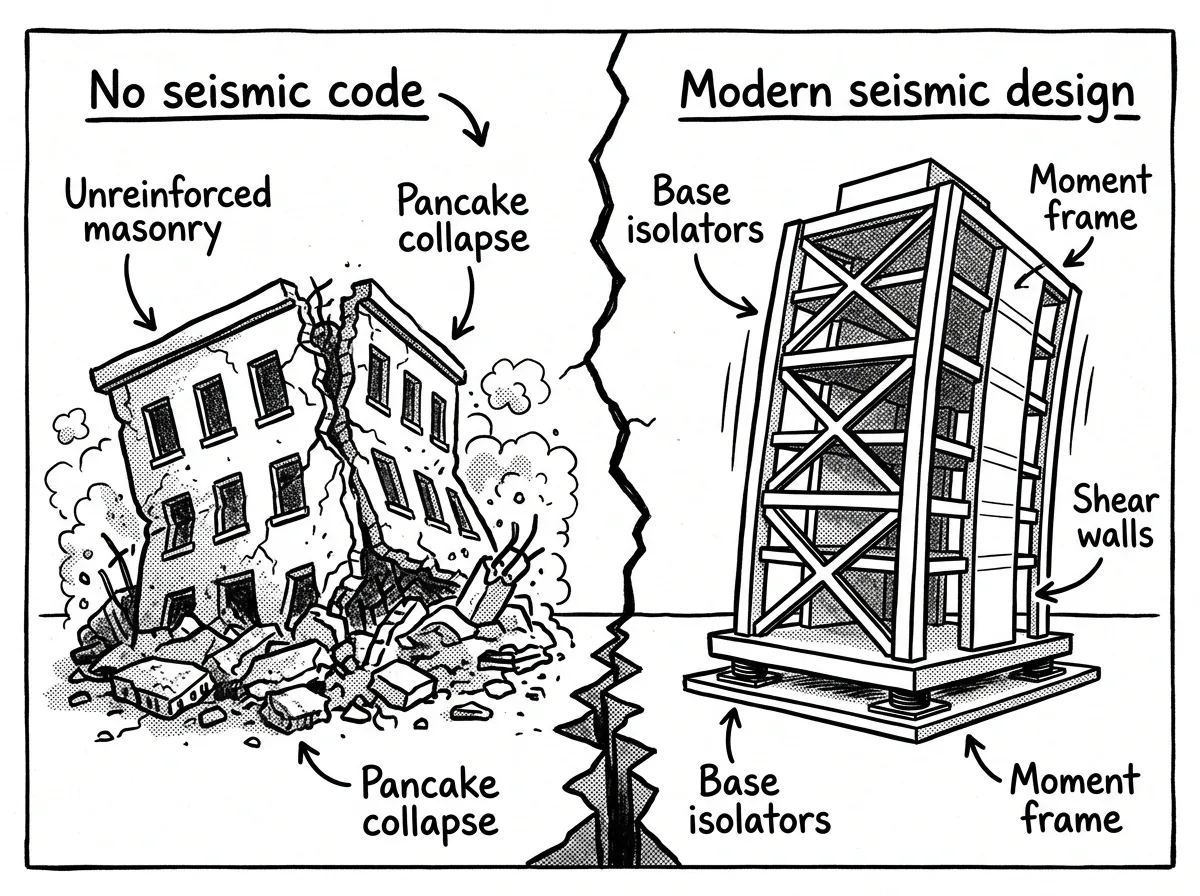 The same magnitude quake produces vastly different outcomes depending on construction standards
So can you actually earthquake-proof a building? Not completely — but you can engineer it to flex instead of snap, and that distinction saves thousands of lives.
The contrast between the 2010 Haiti earthquake (magnitude 7.0, up to 300,000 dead) and the 2011 Japan earthquake (magnitude 9.0, 15,897 dead) is the single most powerful argument for seismic building codes in existence. Japan’s post-1981 Building Standards Law required structures to withstand intense shaking through techniques like base isolation (buildings resting on flexible pads that absorb seismic energy), moment-resisting frames (designed to flex rather than snap), and shear walls (reinforced walls that resist lateral forces). The result: structural collapse from shaking was remarkably rare in 2011. The buildings held.
San Francisco in 1906 had no seismic building codes whatsoever. Haiti in 2010 had codes on paper but virtually no enforcement.
What This Means for Your Home
- Pre-1980 homes in seismic zones are the highest priority for retrofitting. Many older homes in California, Oregon, and Washington sit unbolted on their foundations — they can literally slide off during moderate shaking.
- Foundation bolting secures your home’s wood frame to its concrete foundation. Cost: typically $3,000–$7,000.
- Cripple wall bracing reinforces the short wood-framed walls between the foundation and first floor. Cripple wall failure is one of the most common causes of homes collapsing off their foundations.
- Soft-story retrofits address buildings with weak ground floors — typically open parking areas beneath living spaces. These are collapse-prone in even moderate quakes.
- California’s Earthquake Brace + Bolt program (earthquakebracebolt.com) offers grants up to $3,000. If you’re in California and haven’t looked into this, do it today.
Many homes in older Pacific Northwest neighborhoods have sat unbolted on their foundations for a century, often without the owners’ knowledge. A seismic retrofit is one of the highest-return preparedness investments available — it’s not glamorous, but it can be the difference between a house staying on its foundation or sliding off it during strong shaking.
The First 72 Hours: A Survival Timeline
The First 60 Seconds
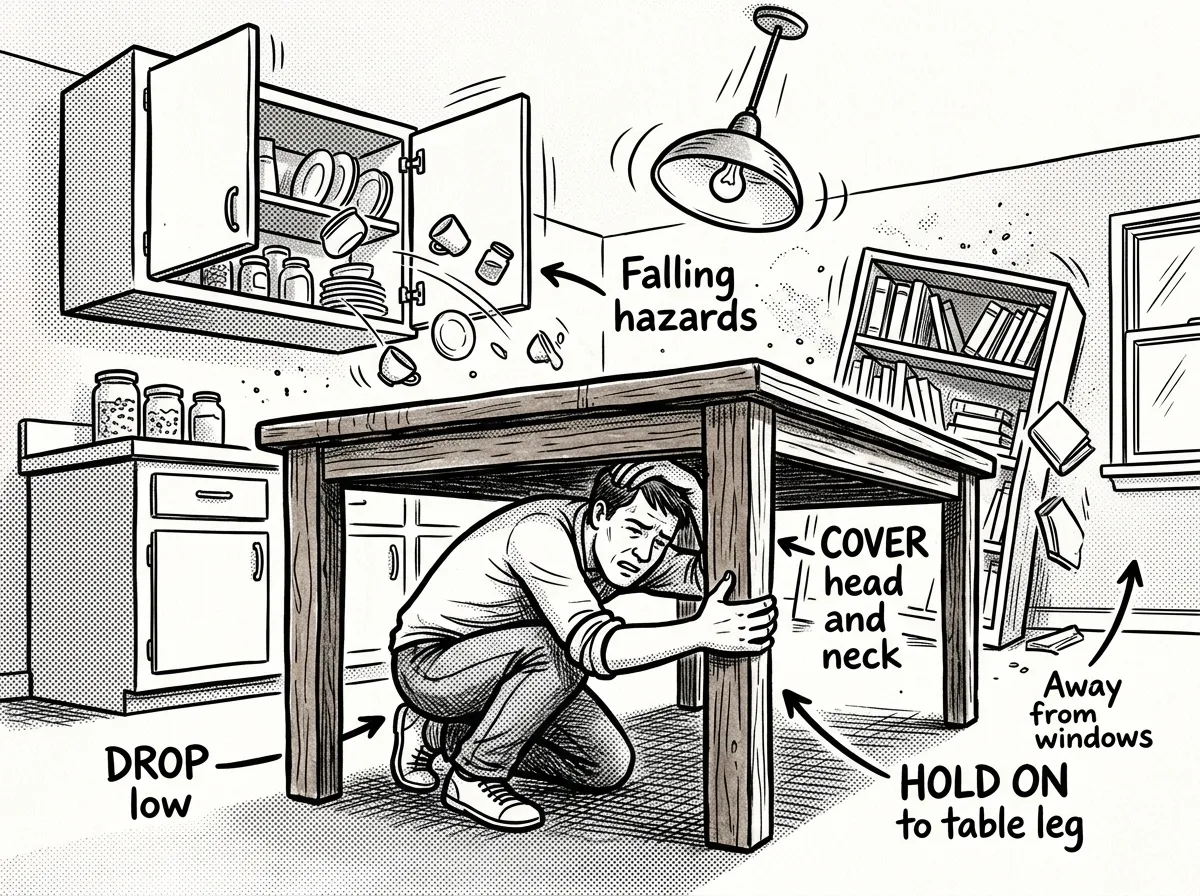 Drop, cover, and hold on — the only evidence-based response when shaking starts
This window determines whether you live or die. During shaking, the immediate threats are structural collapse, falling objects, shattered glass, and your own panicked decision-making.
- Drop to your hands and knees — this prevents you from being knocked down
- Cover your head and neck under a sturdy table or desk, grabbing the leg so it doesn’t shake away from you
- Hold on until the shaking completely stops — don’t move, don’t run, don’t guess when it’s over
- If there’s no table, crouch against an interior wall and protect your head with your arms
If you’re in bed, stay in bed. Pull the pillow over your head and neck, ride it out. Then — and this is critical — reach under the bed for the shoes you’ve staged there, because the floor between you and the exit is now a carpet of broken glass.
You do not run outside. Falling debris from building facades kills people in the street. You do not stand in a doorway.
The First Hour
After shaking stops, it’s about immediate hazard assessment. Check yourself and household members for injuries. Smell for gas — if you detect it, shut off the main gas valve with the wrench you’ve kept strapped to the meter and get everyone outside. Don’t flip light switches or use open flames if you suspect a leak.
Check for structural damage: cracked foundations, leaning walls, chimney damage. If your home looks compromised, get out. If it’s intact, it’s your best shelter. Turn on a battery-powered radio for emergency information. Send a brief text to your out-of-area contact — texts often get through when voice calls can’t because they require less bandwidth. If you’ve established a family emergency communication plan in advance, this is when it pays off.
Do not call 911 unless someone has a life-threatening emergency.
Hours 2 Through 72
Now it’s resource management and aftershock preparedness. Aftershocks are virtually guaranteed. Some will be powerful enough to bring down structures weakened by the initial quake. The 2011 Tōhoku earthquake produced a magnitude 7.7 aftershock within 30 minutes. Treat every aftershock like a new earthquake: drop, cover, hold on.
Water is your most critical supply during this window. Earthquakes rupture water mains with remarkable consistency — the Northridge earthquake broke over 1,400 water main segments in Los Angeles. If you haven’t stored water in advance, you’re already behind. One gallon per person per day is the minimum. For a family of four, that’s 12 gallons just for the initial 72-hour window, and that’s a bare minimum that doesn’t account for heat, exertion, or medical needs.
This is why serious earthquake preparedness always starts with how to store water for emergencies.
When Days Become Weeks
After 72 hours, the situation doesn’t improve — it just changes character. Municipal water may be offline for days to weeks. The 1906 San Francisco earthquake destroyed the city’s water supply system so thoroughly that it contributed directly to the uncontrollable fires. In a modern major earthquake, expect water service disruptions, boil-water notices, closed roads, and gas station pumps that don’t work without electricity.
Power restoration follows a triage pattern: hospitals and critical infrastructure first, then major corridors, then residential areas. After Northridge, some areas waited over a week for power. Grocery stores — if they’re still standing and accessible — will be stripped within hours, not days.
It’s been five days since a magnitude 9.0 earthquake along the Cascadia Subduction Zone. Power is still out in your neighborhood. The bridge you normally use to get to work collapsed, and the detour adds two hours — assuming roads are passable. Your neighbor ran out of water yesterday and knocked on your door at 6 a.m. The pharmacy three blocks away has a handwritten sign: “CLOSED — STRUCTURAL DAMAGE.” Your kid’s school is shut down indefinitely. This isn’t a Hollywood disaster movie. It’s the realistic aftermath that emergency planners across the Pacific Northwest prepare for every single day.
The social dynamics shift around day four or five. Neighbors who were helping each other on day one start getting anxious about their own supplies. If roads are impassable — and after a major earthquake, they often are — outside aid may be slow to arrive. FEMA’s own guidance acknowledges that large-scale disasters can delay federal response for 72 hours or more, and that’s an optimistic estimate for a truly catastrophic event.
Medical supplies become critical for anyone with chronic conditions: insulin, blood pressure medication, inhalers, psychiatric medications. Pharmacies may be damaged, closed, or out of stock. Sanitation becomes a genuine health hazard — with water mains broken, sewer systems often fail simultaneously. This isn’t glamorous preparedness. It’s the unsexy reality of earthquake survival.
If you’re just starting your preparedness journey, our beginner’s guide to survival readiness covers the fundamentals of building a supply cache for exactly this kind of timeline.
Long-Term Recovery: If It Doesn’t Resolve Quickly
History shows that major earthquakes don’t “resolve” — they reshape communities for months to years. After the 2010 Haiti earthquake, a cholera outbreak killed an additional 10,000 people over the following years. The Fukushima exclusion zone displaced 154,000 people, many permanently. Insurance claims after Northridge took months to process, and many homeowners discovered their policies didn’t cover earthquake damage — it’s a separate and often expensive rider that most people skip.
You might be living in a tent in your backyard because your home is standing but red-tagged by inspectors. You might be commuting three hours because the direct route no longer exists. Schools could be closed for weeks. Your workplace might not exist anymore.
Long-term actions most people miss:
- Maintain a two-week supply of prescription medications at all times. Talk to your doctor about getting an extra supply authorized for emergency storage.
- Keep physical cash on hand — $200 to $500 in small bills. ATMs, card readers, and digital payment systems all require electricity and network connectivity.
- Document your home contents with a video walkthrough before disaster strikes. Open every drawer, closet, and cabinet. Upload to cloud storage. This single step can save you tens of thousands in insurance disputes.
- Establish a family reunification plan that accounts for bridge and highway closures. Reunion plans often assume road infrastructure that won’t exist after a major quake. Plan walking routes. Identify multiple rally points.
- Invest in a secondary water filtration method for sustained use beyond your initial stored supply.
- Build relationships with your neighbors now. Community resilience after an earthquake is the single most underrated preparedness factor.
The Sawyer Squeeze (around $30) is a compact option for portable water filtration. For sustained home-based use after an earthquake, a gravity-fed filter like a Berkey (around $250–$350 depending on size) is designed to process larger volumes without manual pumping, making it well-suited to filtering water for a family over multiple days. Keeping a Squeeze in a go-bag and a gravity filter at home covers both mobile and shelter-in-place scenarios.
Knowing basic self-reliance skills becomes genuinely valuable in extended disruptions, and resources like The Beginner’s Guide to Survivalism can help you build that foundation before you need it.
Your Earthquake Preparedness Checklist
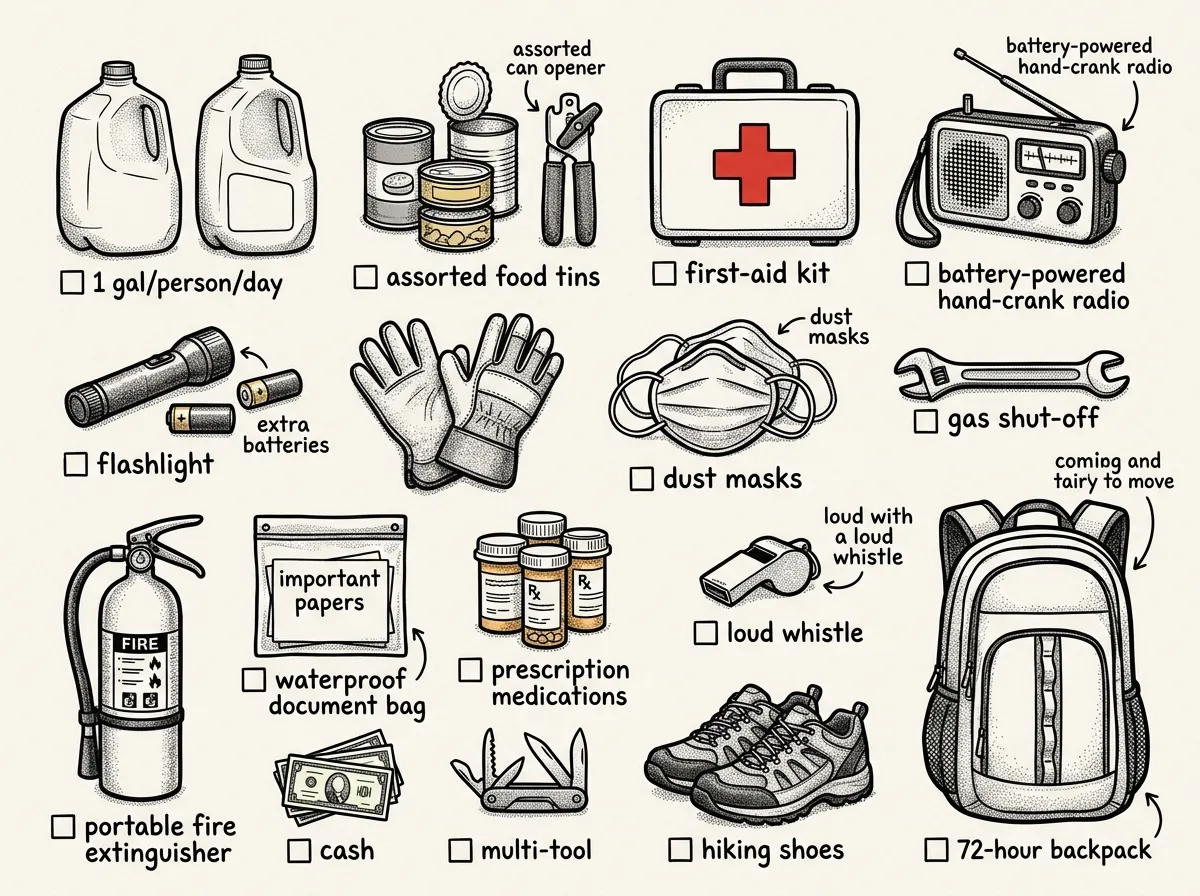 Complete earthquake preparedness kit — everything you need before the ground shakes
Before the Quake — Do This Now
- Secure heavy furniture to wall studs with L-brackets and toggle bolts — not adhesive strips
- Strap your water heater to the wall (40-gallon units weigh 300+ lbs full — kits run under $20)
- Locate your gas shutoff valve and strap a wrench to the meter — practice turning it
- Store shoes and a flashlight under every bed in the house
- Identify safe spots in every room and make sure every family member knows them
- Store a minimum of two weeks of water per person — one gallon per person per day
- Build a 72-hour food supply of non-perishable, no-cook items with a manual can opener
- Keep a crowbar or pry bar accessible — not buried in the garage
- Establish a family meeting point outside your immediate neighborhood reachable on foot
- Prepare a waterproof document bag with insurance policies, IDs, medical records, and digital backups
- Get earthquake insurance — standard homeowner’s policies don’t cover earthquake damage
- Bolt your home to its foundation if it’s an older raised-foundation structure
- Conduct a seismic vulnerability assessment — hire a structural engineer or use FEMA’s online checklist
During — Immediate Response
- Drop, Cover, and Hold On. Get under sturdy furniture, protect your head and neck, hold onto the furniture leg.
- If in bed, stay in bed. Pillow over your head and neck.
- If outdoors, move to an open area away from buildings, power lines, and trees. Drop to the ground.
- If driving, pull over away from overpasses, bridges, and buildings. Stay in the vehicle.
- Do not run outside during shaking — falling glass and facade debris are more dangerous than most interior spaces.
- Do not use elevators after an earthquake, even if they appear functional.
After — Recovery Actions
- Put on shoes immediately. Glass everywhere.
- Check for gas leaks (smell, hissing sound). Shut off gas if suspected. No open flames or electrical switches.
- Check for structural damage before moving through your home — cracked foundation, shifted walls, chimney damage.
- Send a text to your out-of-area emergency contact. Keep it brief. Avoid voice calls.
- Turn on a battery-powered or hand-crank radio for emergency broadcasts.
- Photograph all damage for insurance claims before moving or cleaning anything.
- Prepare for aftershocks. Treat each one as a new event: drop, cover, hold on.
- If near the coast and you felt strong shaking lasting 20+ seconds, move to high ground immediately — don’t wait for an official tsunami warning. The 2011 Japan tsunami arrived in some coastal areas within 30 minutes.
- Do not re-enter red-tagged buildings for any reason.
What Most People Get Wrong
A common instinctive reaction during earthquake drills is for people to run for doorways. That myth — that doorframes are the safest spot — dates back to observations of adobe structures in early California, where the frame was often the only part left standing. In a modern wood-frame or steel-frame building, the doorframe is no stronger than any other part of the structure, and you’re exposed to a swinging door that can break fingers or knock you off your feet.
Drop, cover, hold on. Under a table, away from windows. The science is settled.
The second major mistake? Underestimating the water problem. People stock food but neglect water, or they buy a case of water bottles and call it done. A case of 24 half-liter bottles is about 3 gallons — that’s not even one day’s supply for a family of four. You need real earthquake water storage: multiple 5-gallon jugs, a WaterBOB bathtub bladder, or larger capacity containers, plus a quality water filter for supplementing from secondary sources.
Third, people assume help will arrive quickly. After large-scale disasters, fire and rescue services are immediately overwhelmed, roads may be impassable, and organized response is triaged to the most critical areas first. Your neighborhood may not see official help for days. Having solid camping and outdoor gear — the kind covered in best camping gear for emergency preparedness — can turn an uncomfortable situation into a manageable one.
Fourth: the “triangle of life.” This theory — that you should lie in a fetal position next to a large object rather than getting under it — has been debunked by FEMA, the American Red Cross, and every major emergency management agency worldwide. In real earthquake collapses, objects shift unpredictably. The “triangle” space is unreliable. Don’t fall for it.
Fifth, people assume California is the only earthquake risk in the United States. That’s dangerously wrong. The New Madrid Seismic Zone in the central U.S. produced a series of magnitude 7.0+ earthquakes in 1811–1812 that rang church bells in Boston. The Wasatch Fault threatens Salt Lake City. The Cascadia Subduction Zone puts the entire Pacific Northwest at risk for a magnitude 9.0+ event. Earthquake preparedness isn’t a California problem.
And finally, people dramatically underestimate aftershocks. The 1994 Northridge earthquake was followed by thousands of aftershocks, including several above magnitude 5.0. Aftershock sequences can last weeks to months. Buildings weakened by the initial quake can collapse in an aftershock that would normally cause zero damage on its own. Just because the main event is over doesn’t mean the danger has passed.
Keep a pair of thick-soled shoes and a headlamp under every bed in your house. Broken glass barefoot in the dark is one of the most common — and most preventable — earthquake injuries. A $12 headlamp frees both hands when you need them most.
Frequently Asked Questions
How long did the San Francisco earthquake last?
The 1906 San Francisco earthquake’s main shaking lasted approximately 42 to 60 seconds, with the most violent shaking concentrated in a 25- to 30-second window. Compare that to the 2011 Japan Tōhoku earthquake, which shook for approximately six minutes — one of the longest-duration earthquakes ever recorded. Even the shorter San Francisco event caused catastrophic damage, which is exactly why your earthquake response needs to be automatic and practiced before it matters.
What earthquake killed 830,000 people?
The 1556 Shaanxi earthquake in China is the deadliest earthquake in recorded history, killing an estimated 830,000 people. The massive death toll was primarily due to the collapse of “yaodongs” — cave dwellings carved into loess cliffs. The loess soil liquefied during shaking, causing cliff dwellings to collapse and bury their inhabitants. It’s the same lesson we see in 1906 and 2011: building design and material quality are the single greatest determinants of earthquake survival, regardless of the century.
Build Your Earthquake Preparedness Plan Today
If you’ve read this far, you know more about earthquake preparedness than the vast majority of people living in seismic zones. But knowledge without action is just anxiety fuel. The gap between “I should prepare” and “I am prepared” is measured in a few weekends of work, a few hundred dollars in supplies, and the discipline to follow through.
Start with three high-impact actions: bolt your home to its foundation if it isn’t already, store two weeks of water for your household, and establish a family communication and reunification plan that doesn’t depend on working infrastructure. Those three steps alone put you ahead of 90% of the population. Then work through the checklist above, one section at a time.
Few people regret being over-prepared for an earthquake; many regret the opposite.
The ground will shake again — in California, in the Pacific Northwest, in the central U.S., in places that haven’t felt a major quake in generations. The only question is whether you’ll be ready when it does. Don’t wait for a warning that won’t come.
This guide is reviewed and updated annually based on the latest USGS and FEMA guidance. Last updated: May 2026.
Sources and Further Reading
- United States Geological Survey (USGS) — Earthquake Hazards Program: earthquake.usgs.gov
- FEMA — Earthquake Preparedness: ready.gov/earthquakes
- NOAA Center for Tsunami Research: nctr.pmel.noaa.gov
- California Earthquake Authority — Earthquake Brace + Bolt Program: earthquakebracebolt.com
- USGS ShakeAlert Earthquake Early Warning System: shakealert.org
- Pacific Northwest Seismic Network (PNSN): pnsn.org
- Building Seismic Safety Council — FEMA P-154 Rapid Visual Screening: fema.gov
The Complete
Prepper's Reference.
149 articles synthesized into one comprehensive PDF — twelve chapters covering water, food, shelter, first aid, comms, and scenario-specific preparedness. Free with your email.
Unsubscribe anytime · We never share your email
You're in. Check your inbox.
Keep Reading
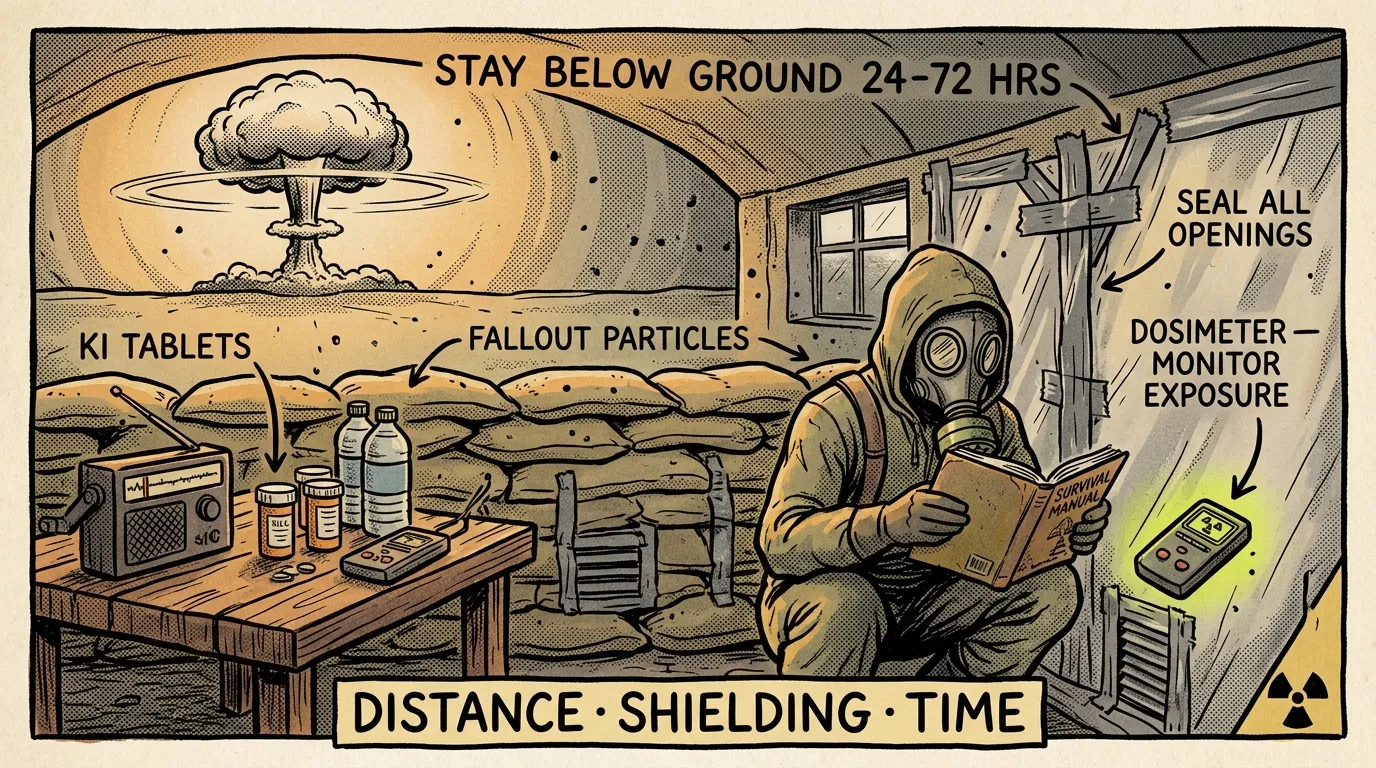
Nuclear Preparedness: Radiation, Fallout & Survival Guide
Lessons from Chernobyl and Fukushima shaped modern nuclear preparedness. Learn the science of radiation survival, fallout sheltering, and your action plan.
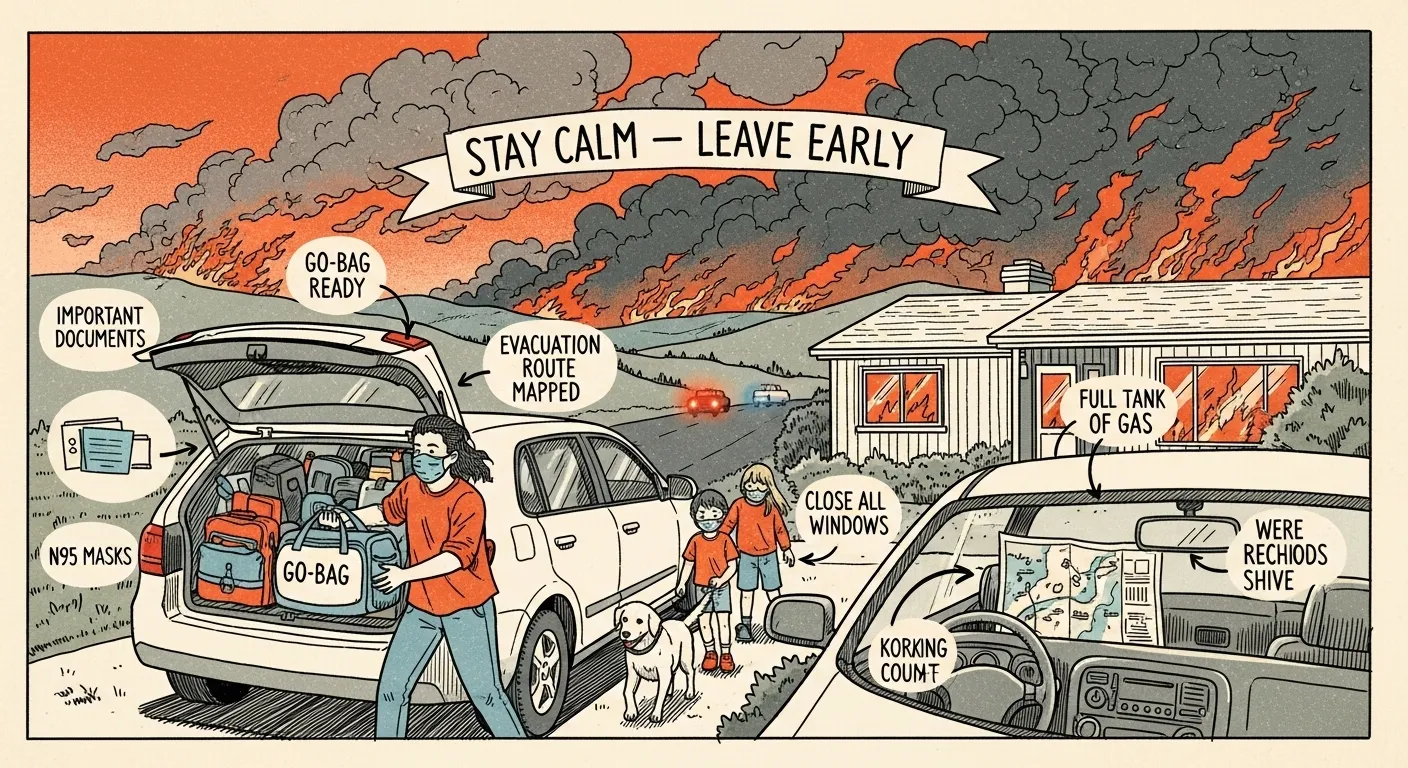
Wildfire Preparedness: Evacuation Guide & Survival Plan
Learn wildfire preparedness from real disasters like the 2018 Camp Fire. Evacuation plans, go-bags, defensible space & checklists to protect your family.
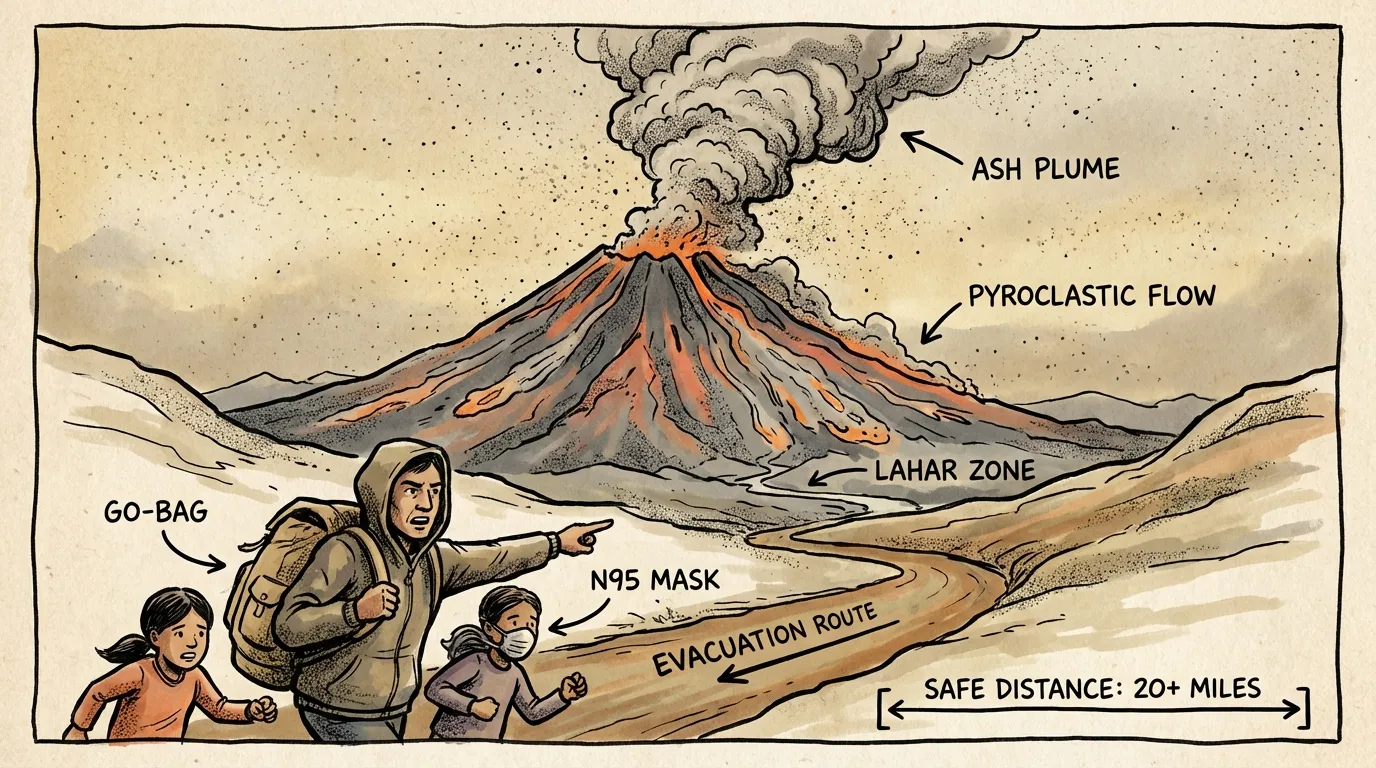
Volcanic Eruption Preparedness: When the Mountain Wakes Up
Mount St. Helens gave scientists 2 months of warning — yet 57 people still died. The 2022 Tonga eruption sent a shockwave around the planet twice. Here's what volcanic eruptions actually threaten, how far danger extends, and how to prepare whether you live near a volcano or not.