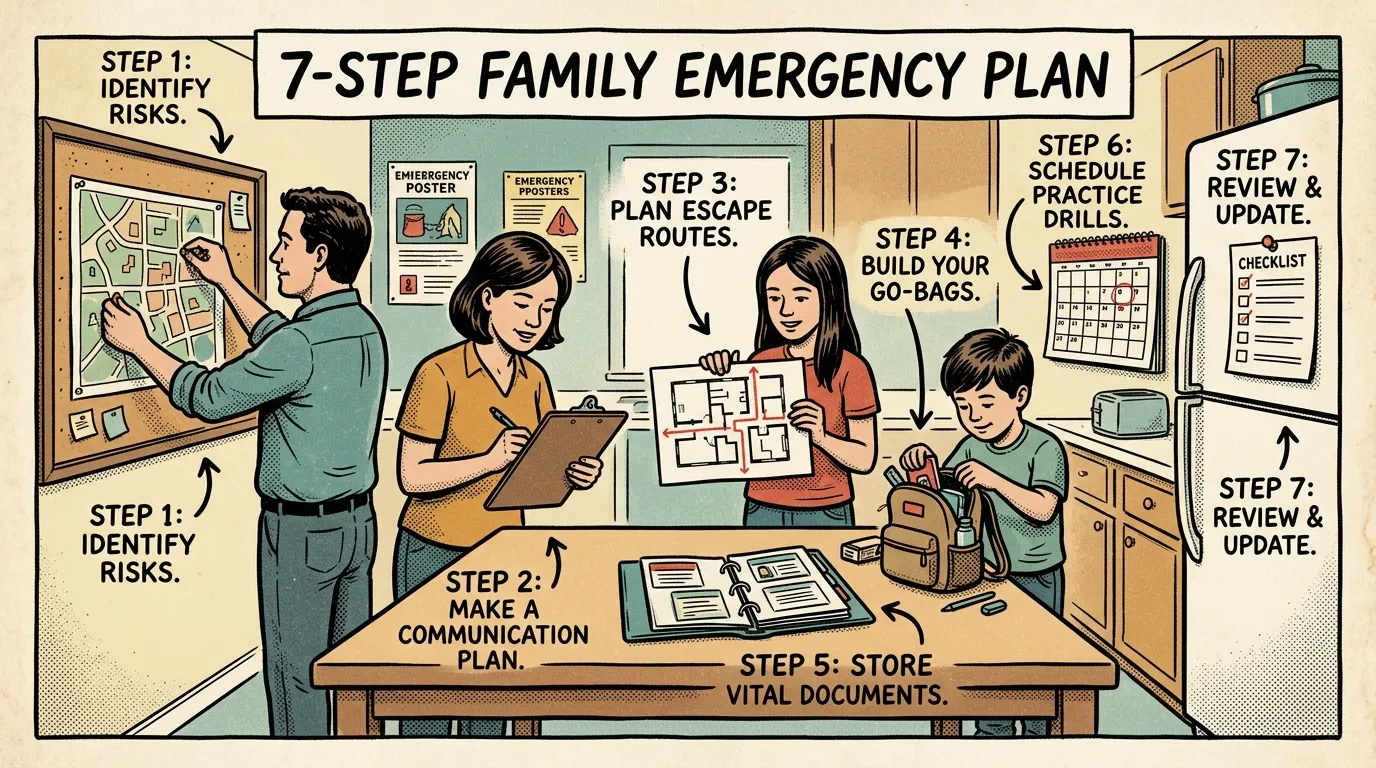
This article walks readers through building a comprehensive written emergency preparedness plan step by step, covering hazard assessment, evacuation routes, meeting points, role assignments, supply inventory, critical document organization, and ongoing plan maintenance — with practical templates and advice.
Key Takeaways
- Block two hours this weekend to write your emergency preparedness plan — a rough plan on paper beats a perfect plan stuck in your head
- Start with a zip-code-specific hazard assessment, then build evacuation routes, meeting points, and role assignments around your top three threats
- Assign every household member one clear role during an emergency — specific tasks eliminate the freeze response under stress
- Organize critical documents in a grab-and-go binder with insurance policies, IDs, and medical records — this single step can accelerate recovery by weeks
- Drill your plan twice a year on daylight saving time changes and update immediately after any major life change
In the fall of 2017, the Tubbs Fire tore through entire neighborhoods in Santa Rosa, California, in a matter of hours. Many residents had less than 15 minutes to evacuate. Some had a plan. Most didn’t. The difference in outcomes was staggering — and it’s why a real, written emergency preparedness plan matters more than a vague idea before disaster forces improvisation.
A written plan isn’t a vague idea floating in the back of your head. It’s a physical document — pages you can grab off a shelf at 2 a.m. when the power’s out and adrenaline is hijacking your ability to think clearly. Disaster response data consistently shows what separates families who recover quickly from those who struggle for months: whether they had a plan written down before the event hit.
This guide walks you through building that plan from scratch. Not a gear list — we cover that in our essential prepper checklist. Not just communication strategies — that’s in our family communication plan guide. This is the full planning process: hazard assessment, evacuation routes, meeting points, supply inventory, insurance documents, role assignments, and a maintenance schedule to keep everything current.
Quick Summary
- A written plan beats a mental plan every time — stress, noise, and chaos degrade your decision-making, and paper doesn’t forget
- Start with a hazard assessment specific to your location — earthquakes in the Pacific Northwest demand different planning than hurricanes along the Gulf Coast
- Define two meeting points minimum — one immediately outside your home and one outside your neighborhood in case you can’t return
- Assign roles to every capable household member — who grabs the go-bags, who secures the pets, who accounts for the kids
- Organize critical documents in a single grab-and-go binder — insurance policies, IDs, medical records, and financial account info
- Drill twice a year and update after every major life change — a plan you’ve never practiced is just a document
What Is an Emergency Preparedness Plan?
An emergency preparedness plan is a written document that identifies local hazards, establishes evacuation routes and meeting points, assigns roles to household members, inventories emergency supplies, and organizes critical documents — all designed to guide your decisions during a crisis when stress makes clear thinking nearly impossible.
Here are the core components every plan needs:
- Hazard assessment — the specific threats relevant to where you live
- Evacuation routes — primary, alternate, and on-foot routes away from danger
- Meeting points — predetermined locations where your household regroups
- Role assignments — specific tasks for each person
- Supply inventory — what you have, where it’s stored, when it expires
- Document organization — critical paperwork consolidated for rapid retrieval
- Maintenance schedule — regular drills and updates to keep everything current
Why does the “written” part matter so much? A common exercise in community preparedness workshops asks participants to close their eyes and mentally walk through their evacuation plan, then write it down step by step. The gap between what people think they know and what they can actually put on paper is often enormous. Under real disaster stress — adrenaline flooding your system, kids crying, zero visibility — that gap becomes dangerous.
A plan you can’t articulate on paper is a plan you won’t execute under stress.
FEMA, the Red Cross, and OSHA all recommend written plans for homes, families, and workplaces. Not because bureaucracies love paperwork, but because decades of disaster response data show that written plans outperform mental plans every single time.
Why Most Households Don’t Have a Plan
The 2023 FEMA National Household Survey found that only about 48% of American households have developed an emergency plan. Even fewer have it written down in a format the whole family can access. You probably know you should have one. You just haven’t gotten around to it. It feels like a big, abstract project with no immediate deadline.
The families who recover fastest after a disaster aren’t necessarily the ones with the most supplies — they’re the ones with a plan everyone in the household understood, including insurance documentation, an out-of-area contact, and a predetermined meeting point already in place before the event.
The 80-20 rule applies here powerfully. That initial 20% of effort — sitting down for two hours to write a basic plan — delivers 80% of the preparedness benefit. You don’t need a 50-page binder to start. You need a clear, actionable document that answers the critical questions before the crisis asks them.
Step 1: Assess Your Hazards
Every disaster preparedness plan starts with understanding what you’re actually planning for. This isn’t generic. It’s specific to where you live, where you work, and the routes between them.
Identify Your Local Threats
Pull up your area’s hazard map. FEMA’s Community Resilience Estimates tool measures a community’s ability to bounce back from a disaster, and it’s a solid starting point. Your county emergency management office will have specific risk assessments too.
Top hazards for the Pacific Northwest include:
- Cascadia Subduction Zone earthquake (catastrophic, low frequency) — our earthquake preparedness guide covers this in depth
- Wildfire and smoke events (seasonal, increasing frequency)
- Flooding and landslides (winter storms)
- Extended power outages (ice storms, wind events)
- Volcanic ashfall (low probability, high impact)
Your list will look different. If you’re in Oklahoma, tornadoes jump to the top. Coastal Florida means hurricanes and storm surge. An urban apartment dweller needs to think about building fires and infrastructure failures.
Rank by Likelihood and Impact
Don’t give equal weight to every threat. A simple 2x2 matrix can help:
- High likelihood, high impact — plan for these first (e.g., wildfire in fire-prone areas)
- High likelihood, low impact — build resilience (e.g., short power outages)
- Low likelihood, high impact — have a basic plan (e.g., major earthquake)
- Low likelihood, low impact — acknowledge but don’t obsess
Write down your top three to five hazards. These drive every decision that follows.
Tailor Your Plan to Your Top Threat
Let me show you what hazard-specific planning actually looks like. If wildfire is your top threat — as it is for much of the western U.S. — your plan adjustments include: maintaining a pre-packed vehicle during fire season, monitoring fire weather watches daily, setting up CAL FIRE or local alert notifications, creating defensible space around your home, and planning evacuation triggers based on fire proximity rather than waiting for an official order. Our wildfire evacuation checklist breaks this down further. The point is that your hazard assessment doesn’t just inform what you plan for — it changes how you plan.
Step 2: Map Your Evacuation Routes
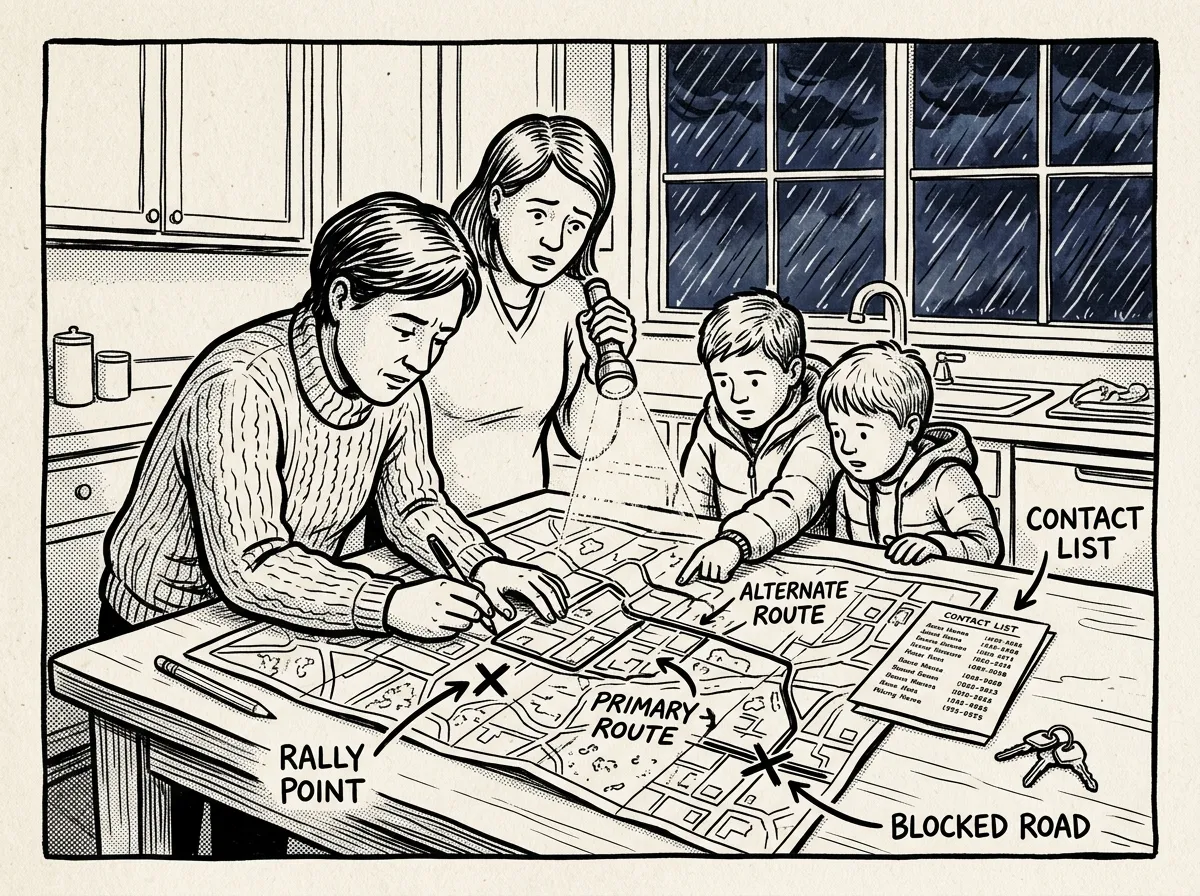 Family reviewing primary and alternate evacuation routes on a kitchen table map
This is where most emergency response plans fall apart. People assume they’ll “figure it out” when the time comes.
This assumption often fails in practice. In community preparedness workshops, participants asked to write alternate evacuation routes from memory frequently struggle to complete the exercise. In a real disaster, cell networks are often the first thing to go — you can’t rely on GPS to improvise your way out.
Primary and Alternate Routes
For each major hazard scenario, identify:
- Primary evacuation route — the fastest, most direct path away from danger
- Alternate route — a completely different direction, in case Route A is blocked
- Walking route — assume roads are impassable and you’re on foot
Drive these routes. Then drive them again during rush hour. Note potential chokepoints: bridges, tunnels, narrow roads, areas prone to flooding or landslides. A primary route that crosses a bridge likely to fail in a major earthquake, for example, should prompt reconsidering the whole route.
Plan for Separated Families
Most emergencies won’t happen conveniently when everyone’s home together. Your plan needs to address what happens when family members are scattered across work, school, and errands:
- Who picks up children from school or daycare — designate a primary and a backup person
- What each person does independently if they can’t reach the rest of the family
- A reunification timeline — how long each person waits at each meeting point before moving to the next
- Alternate pickup routes for schools that avoid the same bottlenecks as your home evacuation
If one parent works 30 miles away and roads are compromised, they need their own route plan and a clear understanding that the other parent handles child pickup. Don’t leave this to a panicked phone call.
Households Without Vehicles
Not everyone can jump in an SUV and drive. If your household doesn’t have reliable vehicle access, your plan should include: identifying public transit evacuation routes, pre-arranging rides with neighbors through a mutual aid agreement, and registering with your local emergency management office for evacuation assistance if any member has mobility limitations. Many counties maintain registries specifically for this purpose — contact yours before you need it.
Document the Details
In your written plan, include:
- Street-by-street turn directions (don’t rely on GPS)
- Estimated travel times under normal and congested conditions
- Gas station locations along each route (keep your tank above half)
- Predetermined stopping points if you need to rest or regroup
Print physical maps. A laminated county map in each vehicle, with routes highlighted in different colors for different scenarios, provides a reliable backup when digital devices fail.
Step 3: Establish Meeting Points
FEMA and the Red Cross both recommend at least two meeting places. This guide recommends a third.
Three-Tier Meeting Point System
Tier 1 — Immediate (outside your home): For sudden events like a house fire. Pick a specific spot — the mailbox, the big oak tree, the neighbor’s driveway. Every household member must know this location without being told.
Tier 2 — Neighborhood (within walking distance): Use this when you can’t return home or need to regroup after scattered evacuation. A school, church, park, or community center works well. Choose somewhere easily identifiable, even in the dark.
Tier 3 — Out of area (a trusted contact’s home): If your entire area is affected, you need somewhere to converge outside the disaster zone. This might be a trusted relative’s or friend’s home far enough away to be outside the disaster zone — confirmed in advance as willing and able to serve as a rally point.
For each meeting point, specify:
- Exact address and physical description
- How long to wait before moving to the next tier
- What to do if no one shows up within the designated window
Communication Plan Essentials
Your meeting points work best paired with a solid communication plan. Include these directly in your written document:
- Designate an out-of-area contact — someone 200+ miles away who can serve as a central relay, since long-distance calls often connect when local lines are jammed
- Text before you call — texts require less bandwidth and get through when voice calls can’t
- Program ICE (In Case of Emergency) contacts into every family member’s phone
- Agree on a social media check-in method as a backup
- Keep a written contact card in every go-bag with key phone numbers — your phone may be dead
Our full family communication plan guide covers this in greater depth, but these five elements should be embedded directly in your emergency preparedness plan.
Step 4: Assign Roles to Every Household Member
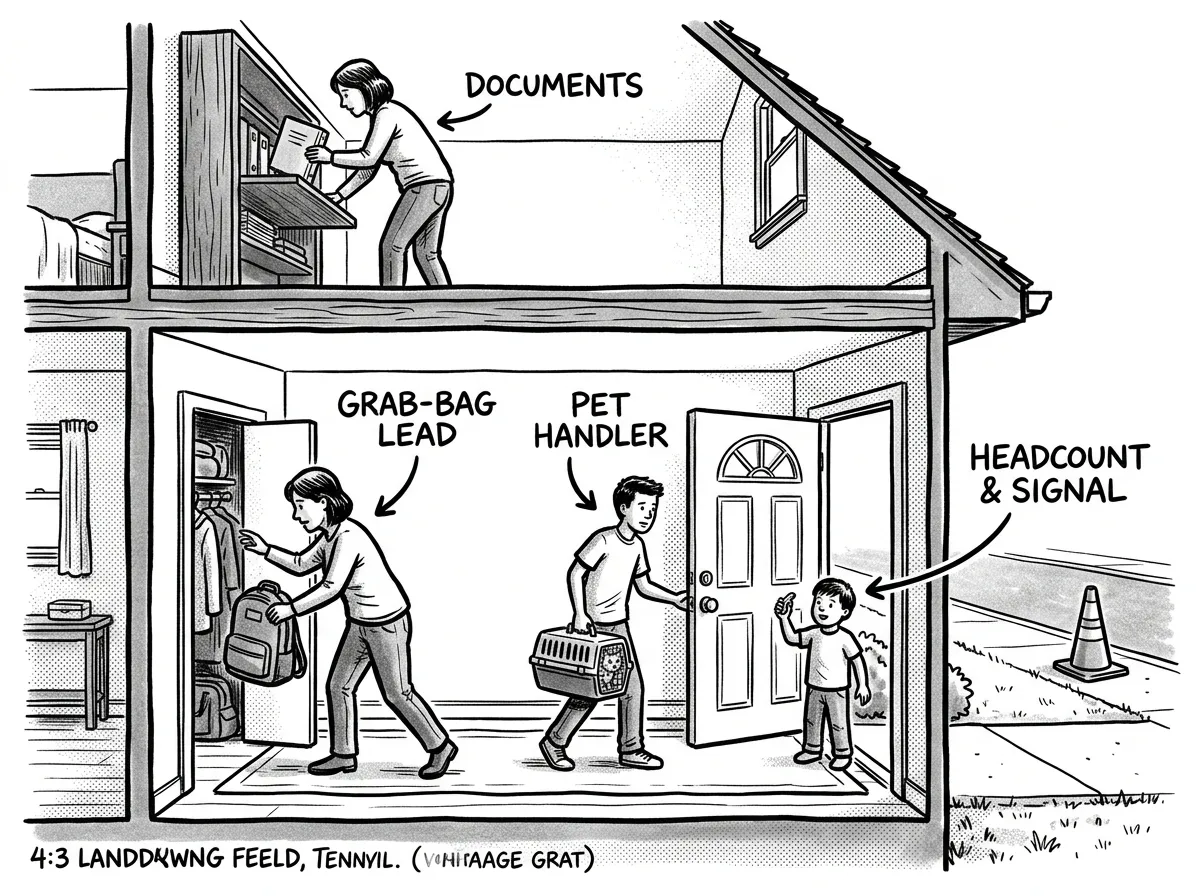 Each household member executing their assigned emergency role during a drill
This step transforms a plan from a document into an action system. In family preparedness workshops, the single biggest improvement often comes from role assignments. You perform dramatically better under stress when you’ve got one clear job rather than a vague sense of shared responsibility.
Assigning a single clear task — like putting on shoes, grabbing a coat, and going directly to a meeting point — can eliminate the “what do I do?” spiral for children during drills and gives them a sense of agency instead of fear. Kids as young as six can handle age-appropriate roles, and it makes a real difference.
Sample Role Assignments
Lead Coordinator (you or your partner):
- Makes the go/no-go evacuation decision
- Confirms headcount at meeting points
- Carries the emergency binder and primary communication device
Supply Manager:
- Grabs go-bags from their designated location
- Loads critical supplies into the vehicle
- Responsible for water containers
Dependent Care:
- Secures children, elderly family members, or anyone with mobility challenges
- Grabs specialty items (medications, mobility aids, comfort items for kids)
Pet and Property:
- Leashes and crates pets
- Shuts off gas/water if directed
- Locks doors (if time allows)
Members with Disabilities or Medical Needs
If anyone in your household uses a wheelchair, walker, oxygen concentrator, or other medical device, your plan needs specific accommodations: identify wheelchair-accessible evacuation paths, keep backup batteries or manual alternatives for powered devices, maintain a written list of equipment serial numbers and suppliers, and pre-identify accessible shelters in your area. Don’t assume general shelter facilities will meet specialized needs.
Adjust roles based on your household. A single person assigns priorities rather than delegates. A family with teenagers can distribute more responsibility. The critical point: write it down and practice it.
Step 5: Build Your Supply Inventory
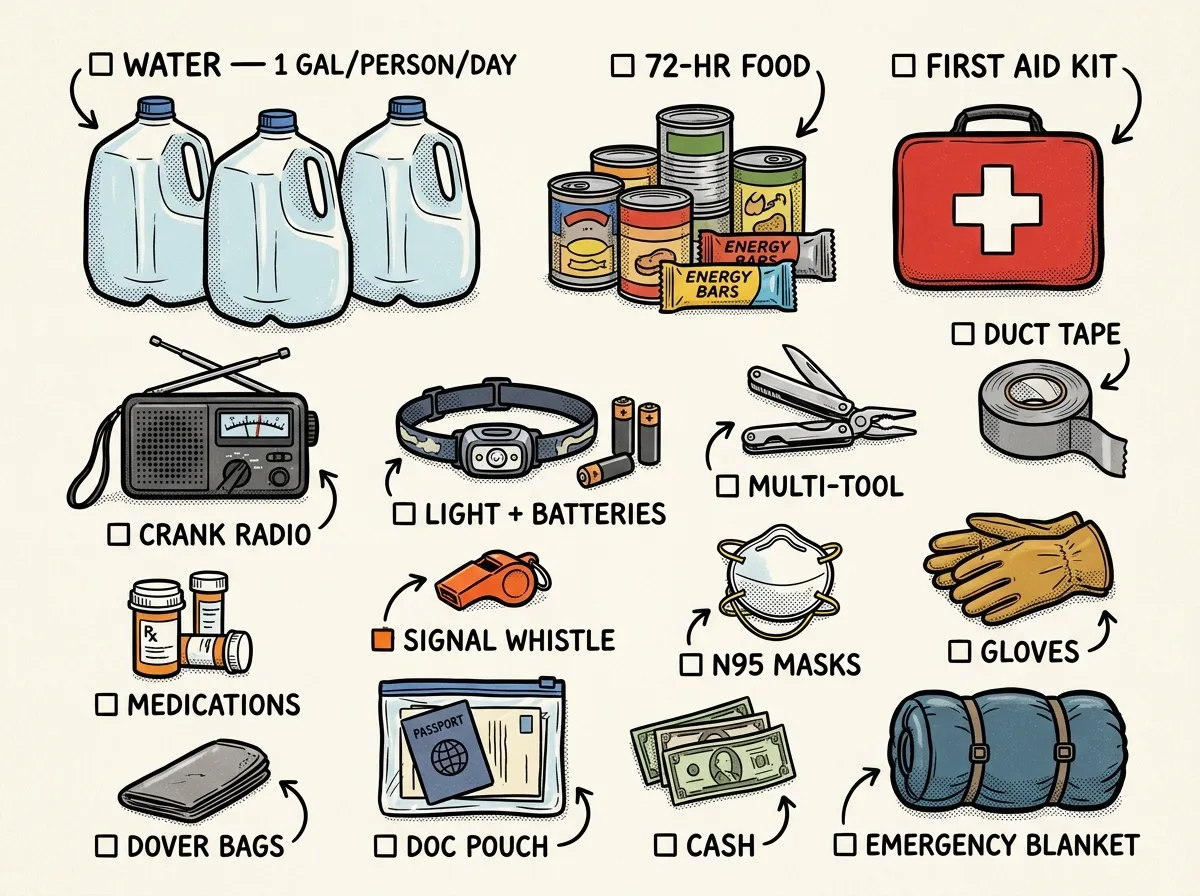 Complete emergency supply inventory laid out for inspection
This isn’t a full gear list — our essential prepper checklist handles that. But your emergency preparedness plan needs a supply inventory section that answers three questions:
- What do we have and where is it stored?
- What’s the rotation schedule for perishable items?
- Who is responsible for maintenance?
Start with building a 72-hour kit as your foundation, then scale up. A solid baseline is 10 days of food per person, 10 days of drinking water (one gallon per day — our guide on how to store water for emergencies covers this), an emergency weather radio for receiving alerts when the power’s out, flashlights with fresh batteries, a first aid kit, and any critical medications with at least a 30-day supply.
The Midland ER310, priced around $35–40, is a commonly recommended option for household emergency kits. According to the manufacturer’s specifications, it includes hand-crank charging, solar charging, and a built-in flashlight. Cheaper models often have battery doors prone to cracking within a year, so a more durable unit is generally worth the extra cost.
A disciplined annual audit of a medical kit, paired with the same review of a household supply inventory, helps catch problems before they become emergencies. Your plan document should include a table listing every supply category, the quantity on hand, its storage location, and its expiration date. Reviewing this quarterly takes about 20 minutes and can prevent discovering expired supplies exactly when they’re needed most.
Food Consumption Priority
If a disaster hits and you’re sheltering in place, eat your fresh food first — breads, fruits, vegetables, and food from the refrigerator while it’s still cold. Next, move to frozen food. Your shelf-stable emergency supplies are the last line. Write this consumption order into your plan so nobody opens the freeze-dried meals on day one while fresh food spoils in the fridge.
Step 6: Organize Critical Documents
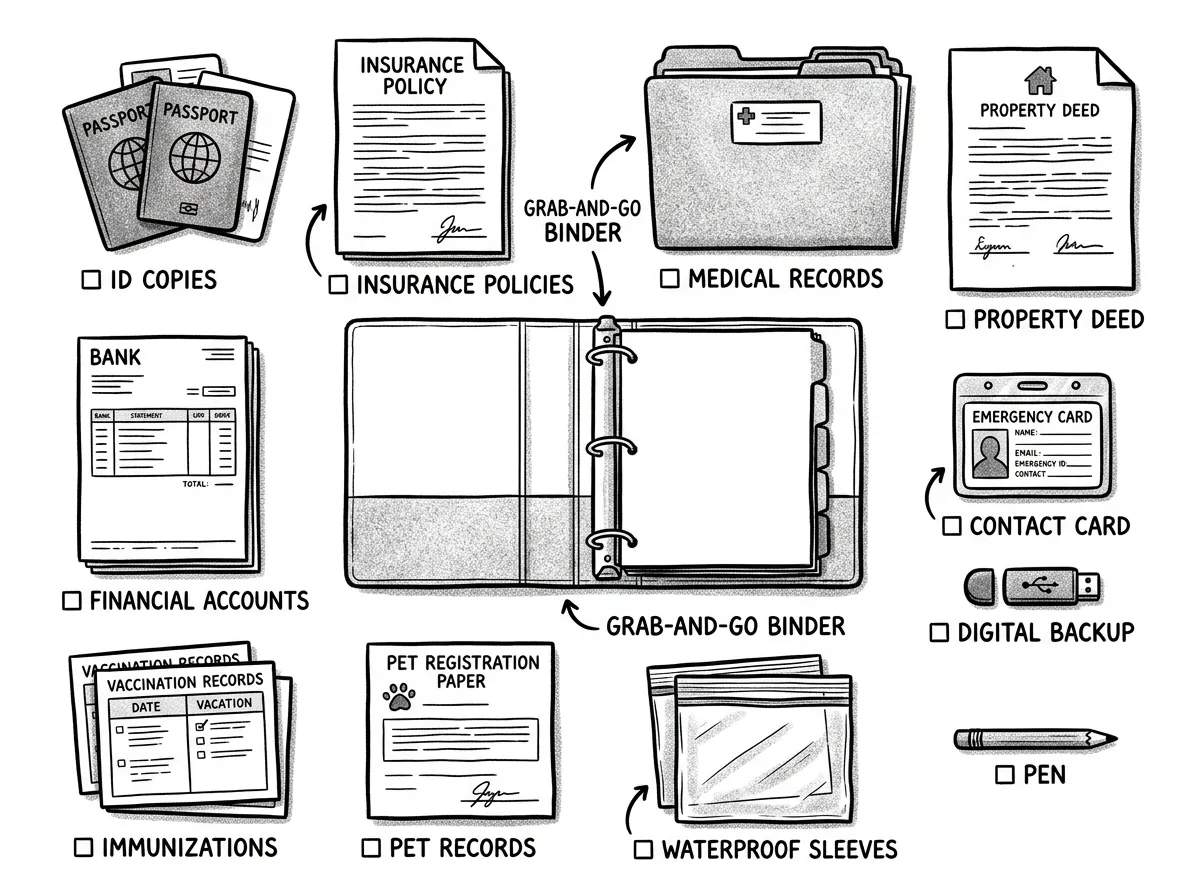 Emergency document binder contents spread out for grab-and-go readiness
After a disaster, your physical possessions may be gone. Your ability to recover financially depends almost entirely on documentation. Families who can’t prove what they owned often struggle for months with insurance claims.
The Emergency Document Binder
Create a single binder (and a digital backup on an encrypted USB drive) containing:
- Insurance policies — homeowners/renters, auto, health, life, flood (with agent contact info)
- Identification — copies of driver’s licenses, passports, birth certificates, Social Security cards
- Medical records — current medications, allergies, immunization records, doctor contacts
- Financial accounts — bank account numbers, credit card companies, investment accounts
- Property documentation — home inventory with photos/video, vehicle titles, mortgage info
- Emergency contacts — local and out-of-area, including your family communication plan contacts
- Legal documents — wills, powers of attorney, guardianship designations
Store the physical binder in a fireproof safe or a location you can grab quickly during evacuation. Keep the USB drive somewhere separate, such as an everyday carry bag.
Take a full video walkthrough of your home once a year, narrating the contents of each room as you go. Store it on your encrypted USB drive. This single step can dramatically speed up an insurance claim.
Update this binder whenever you change insurance, add a family member, move, or make a major purchase.
Step 7: Practice, Drill, and Update
A plan you’ve never practiced is just paperwork. The gap between “knowing the plan” and “executing the plan under stress” is enormous. Practice closes that gap.
- Run a full evacuation drill twice a year — time it, execute role assignments, debrief afterward on what worked and what confused people
- Review your supply inventory quarterly — check expiration dates, rotate stock, update your inventory table
- Do a complete plan review annually — account for life changes, new hazard info, changes in household composition
- After any significant event — a near-miss, a local disaster, even a friend’s emergency — use it as a prompt to review
Tie your biannual drills to daylight saving time changes. You’re already adjusting clocks and checking smoke detector batteries — add a 30-minute evacuation drill and it becomes routine.
The 5 Steps as a Continuous Cycle
People often ask about “the five steps” of emergency preparedness. Here’s how they break down:
- Identify and assess — Know your hazards (Step 1 above)
- Plan and document — Write the plan with routes, roles, and resources (Steps 2–6)
- Equip and supply — Build your inventory to support the plan
- Train and practice — Drill until execution is automatic
- Review and improve — Update continuously based on new information
These aren’t a one-time checklist. They’re a cycle. Each drill teaches you something that improves the plan, which changes your supply needs, which drives the next drill.
The 4 Pillars of Disaster Risk Reduction
If you’re building a truly robust plan, it helps to understand the broader framework. The four pillars of disaster risk reduction (DRR) are:
- Prevention and mitigation — Reducing risk before disaster strikes (clearing brush, reinforcing structures, buying flood insurance)
- Preparedness — Building capability to respond (your plan, supplies, training)
- Response — Immediate actions during and after the event (evacuation, first aid, shelter)
- Recovery — Returning to normalcy (insurance claims, rebuilding, emotional support)
Your written plan should address all four. Most people focus entirely on response — what to do when it happens. But prevention (like maintaining defensible space around your home) and recovery planning (like having organized insurance documentation) are often where the most suffering is avoided.
Planning for Renters and Apartment Dwellers
Most emergency planning advice is written for homeowners with houses, garages, and yards. If you rent — especially in an apartment or high-rise — your challenges are fundamentally different.
Know Your Building
Walk your building’s fire escape routes and stairwell locations before you need them. Count the doors between your unit and the nearest stairwell so you can navigate in total darkness or heavy smoke. Elevators are unusable during fires and earthquakes — never include them in your plan. If you live above the sixth floor, understand that fire department ladder trucks may not reach your level, making early self-evacuation critical.
Ask your building manager these questions: Does the building have a written emergency plan? Where are gas and water shutoffs? Are fire suppression systems inspected regularly? Is there a building-wide notification system? Many renters skip planning because they assume the landlord handles everything — but personal evacuation, supply planning, and document organization are still entirely on you.
Apartment-Specific Adjustments
- Go-bags live near the front door, not in a garage you don’t have — a hall closet or a hook right by the entry works
- Supplies are smaller and more portable — you may not have space for 20 gallons of water, so focus on water purification options and a smaller stored water rotation
- Renters insurance belongs in your document binder — it’s affordable, often required by the lease, and covers your belongings when the building owner’s policy doesn’t
- Shared egress means shared risk — know your neighbors, at least enough to knock on a door during an evacuation to confirm they’re aware and mobile
- Shelter-in-place may be your primary option for some hazards like chemical spills, so keep plastic sheeting and duct tape available to seal windows and doors
You’ve got every bit as much reason to plan as homeowners — arguably more, since you’ve got less control over the structure you live in.
Free Templates and PDF Downloads
So where do you actually start writing? Here’s both a quick-reference version and links to the best official resources.
One-Page Quick-Reference Plan
A simplified version of your plan, taped inside a kitchen cabinet where every family member can find it, works well as a quick reference. Copy this structure onto a single sheet:
| Category | Details |
|---|---|
| Top 3 Hazards | (List your ranked hazards) |
| Evacuation Route A | (Street-by-street directions) |
| Evacuation Route B | (Alternate directions) |
| Meeting Point — Tier 1 | (Address/landmark near home) |
| Meeting Point — Tier 2 | (Address within walking distance) |
| Meeting Point — Tier 3 | (Out-of-area contact name, address, phone) |
| Out-of-Area Contact | (Name, phone, relationship) |
| Roles | (Name → assigned task for each person) |
| Go-Bag Location | (Exactly where each bag is stored) |
| Utility Shutoffs | (Gas valve location, water main, electrical panel) |
| Insurance Agent | (Name, phone, policy number) |
| Medical Needs | (Medications, allergies, equipment for each person) |
| Pet Plan | (Carrier location, vet contact, pet-friendly shelter) |
This isn’t your full plan — it’s the cheat sheet you grab when there’s no time to flip through a binder.
Official Templates Worth Downloading
- Ready.gov Family Emergency Plan PDF — The most widely used template, printable and straightforward
- FEMA CPG 101 — Comprehensive Preparedness Guide for developing emergency operations plans (geared toward planners but excellent for understanding the framework)
- Red Cross Emergency Preparedness Plan worksheets — Available at redcross.org, with versions for families, seniors, and people with disabilities
Download any of these as a starting point, then customize using the 7 steps above. A generic template becomes powerful when you fill it with your hazards, your routes, and your family’s roles.
Workplace and School Coordination
Workplace Plans
If you’re responsible for a workplace emergency preparedness plan, the structure mirrors a family plan but requires additional rigor. OSHA’s Emergency Action Plan standard (29 CFR 1910.38) mandates that most employers have a written plan covering evacuation procedures, reporting procedures, and employee alarm systems. Beyond compliance, a strong workplace plan includes:
- Designated floor wardens on every level, responsible for sweeping their zone and confirming evacuation
- A muster point outside the building with a headcount system — companies use various methods, from simple clipboard rosters to badge-scan systems
- ADA-compliant evacuation procedures including evacuation chairs for stairwells
- A communication tree for after-hours emergencies
- Shelter-in-place protocols for hazards where evacuation increases risk
- Annual drills with documented lessons learned
If your workplace doesn’t have a plan, raise it with management. If they do, make sure you’ve read it and know your role.
Daycare and School Coordination
If your children attend daycare or school, their facility’s emergency plan directly affects yours. Most states require licensed daycares to maintain written emergency procedures, but the quality varies enormously. Ask these questions:
- Does the facility have shelter-in-place and lockdown plans?
- Where’s the off-site evacuation location if the building can’t be occupied?
- How will parents be notified — text, email, phone tree, app?
- What’s the policy if a parent can’t reach the facility during an emergency?
- Who are the authorized pickup persons, and how is identity verified during chaotic reunification?
Make sure the facility has your current emergency contacts and that your plan accounts for picking up children during different scenarios — including when roads are compromised. Designate a backup pickup person who lives closer to the school than you do.
Your Plan Starts This Weekend
Here’s a challenge: block two hours this weekend. Sit down with everyone in your household. Work through these seven steps and produce a written document — even if it’s rough. A basic emergency preparedness plan written on notebook paper beats a perfect plan you never get around to creating.
Start with your hazard assessment and evacuation routes. Add meeting points and role assignments. Build out the supply inventory and document binder over the following weeks. Then drill it. Twice a year, minimum.
Families who recover best from wildfires, earthquakes, floods, and extended power outages all have one thing in common: they did this work before the event. Not because they were paranoid — because they understood that preparation turns a disaster into a disruption instead of a catastrophe.
Download a Family Emergency Plan PDF from Ready.gov as your starting template, then customize it using the steps in this guide. Print your one-page quick-reference version and tape it inside a kitchen cabinet. Put the full plan somewhere accessible. And then go live your life with the confidence that comes from having a real, tested family emergency preparedness plan ready when it matters most.
Sources and Further Reading
- FEMA Emergency Planning Resources — Comprehensive preparedness guides and community planning tools
- Ready.gov Make a Plan — Federal family emergency plan templates and preparedness materials
- American Red Cross Emergency Preparedness — Disaster-specific planning guides and downloadable worksheets
- OSHA Emergency Action Plan Standard (29 CFR 1910.38) — Workplace emergency plan requirements
The Complete
Prepper's Reference.
149 articles synthesized into one comprehensive PDF — twelve chapters covering water, food, shelter, first aid, comms, and scenario-specific preparedness. Free with your email.
Unsubscribe anytime · We never share your email
You're in. Check your inbox.
Keep Reading
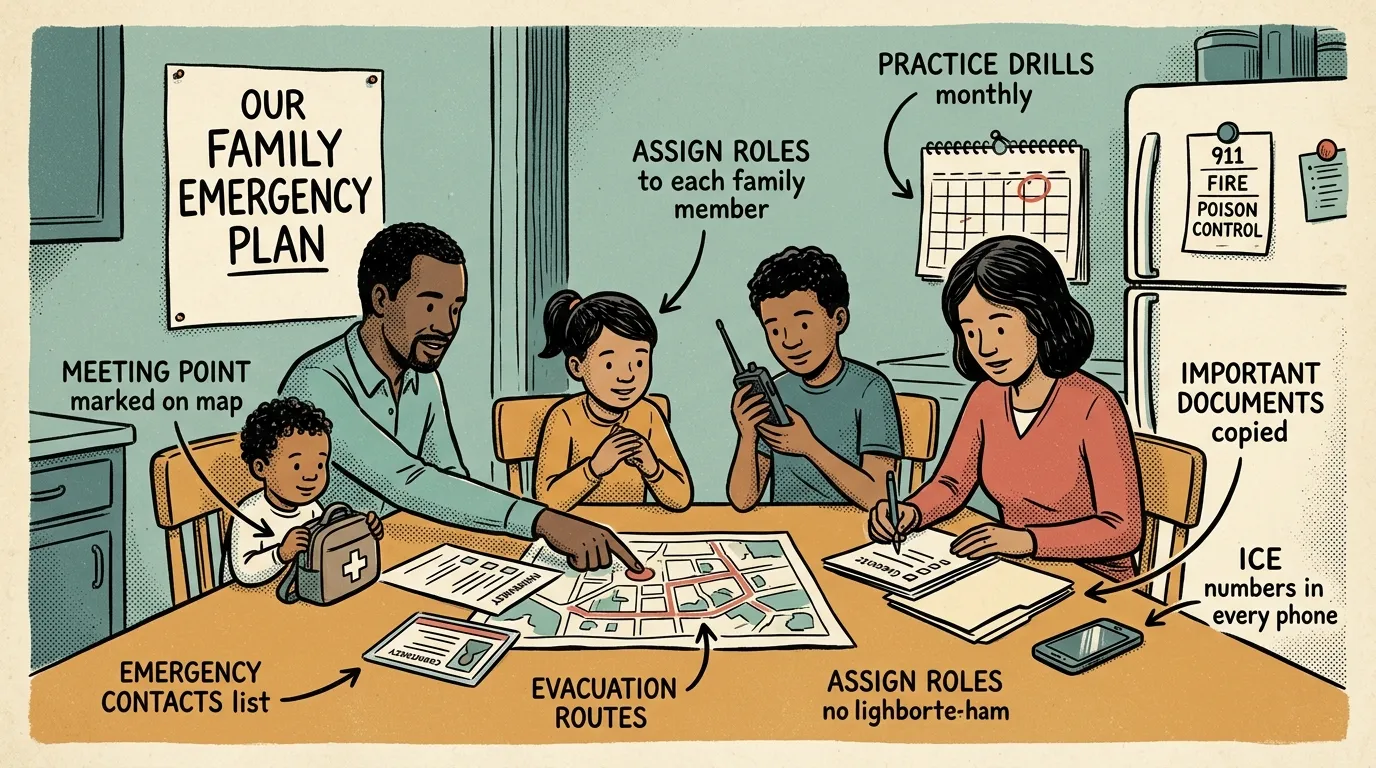
Family Emergency Plan: A Practical Step-by-Step Guide
Build a practical family emergency plan with step-by-step communication, supply kit, and drill guidance. Start today.
Zombie Apocalypse Survival Preparedness: FEMA Pro's Guide
Zombie apocalypse survival preparedness teaches real disaster skills. Here's a breakdown of the exact steps. Start today.
Alien Invasion Preparedness: A Practical Survival Guide
Alien invasion preparedness uses proven survival skills that work for any disaster. Build your kit, plan your routes, and get ready for anything.