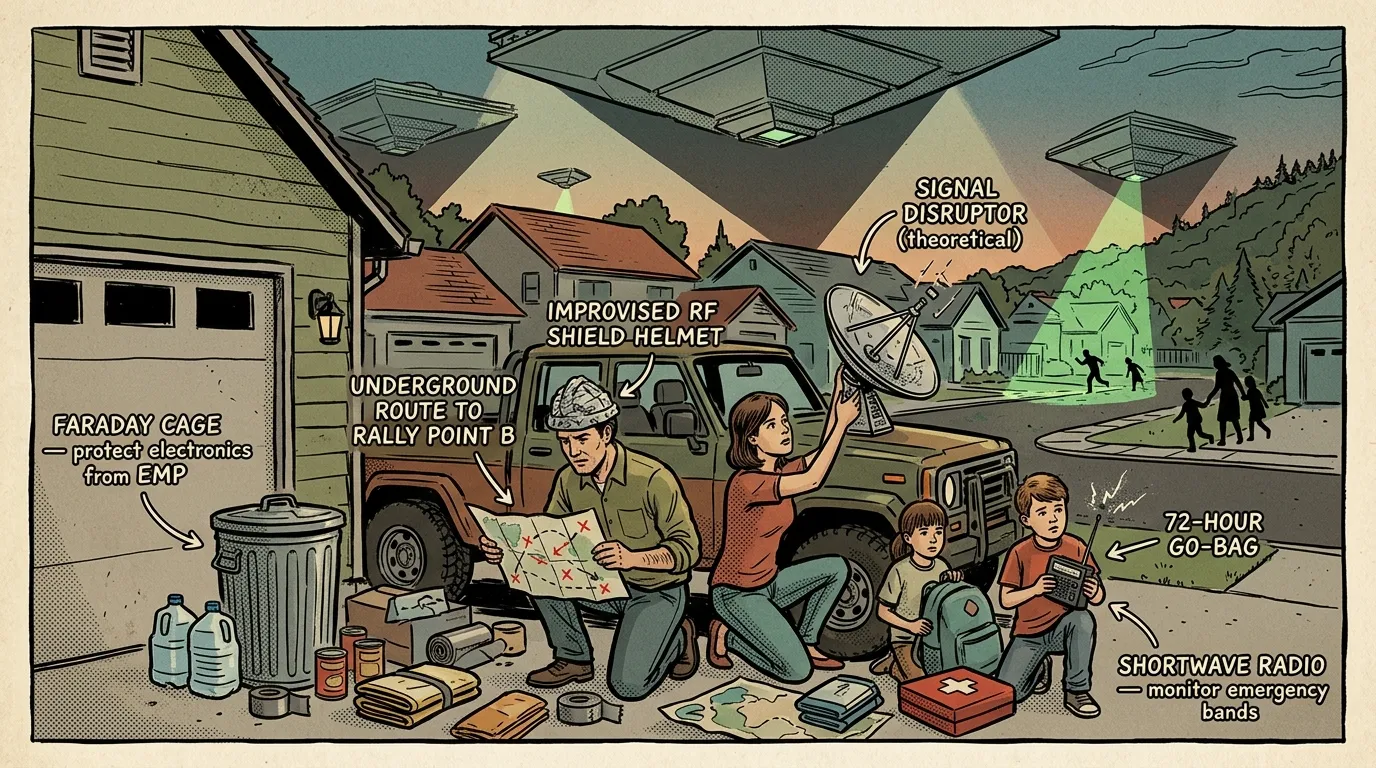
This article explains how alien invasion preparedness relies on the same proven emergency planning principles used for any large-scale disaster, covering evacuation planning, survival kits, communication strategies, shelter considerations, and community resilience.
Key Takeaways
- Build a 72-hour survival kit covering water, food, shelter, first aid, and communication — this single step puts you ahead of roughly 60% of American households for any disaster.
- Print physical maps of at least three evacuation routes today — GPS fails during grid-down scenarios.
- Get your HAM Technician license (35-question exam, around $15) to maintain communication capability when cell towers go dark from any cause.
- Knock on three neighbors' doors this week and exchange emergency contact info — organized communities consistently outperform isolated individuals in extended crises.
- Use the alien invasion thought experiment as a family drill to build real crisis-response neural pathways that activate during actual emergencies.
Let me be honest right up front: no emergency management agency has ever been briefed on a classified alien invasion response protocol. There’s no folder marked “EXTRATERRESTRIAL CONTINGENCY — TOP SECRET.” And if you clicked on this article hoping to be told to wrap your head in aluminum foil, you’re going to be disappointed.
But here’s what’s worth saying — and it’s why alien invasion preparedness is a topic worth taking seriously: the skills, supplies, and planning that’d keep you alive during an extraterrestrial event are identical to the skills that keep you alive during every other large-scale disaster: hurricanes, cascading infrastructure failures, pandemics, volcanic eruptions in the Pacific Northwest. The threat changes. The fundamentals don’t.
No emergency agency has published an alien-specific response plan, so this article applies the same all-hazards preparedness framework used by emergency management professionals. The CDC used this same approach when it launched its tongue-in-cheek “Zombie Preparedness” campaign years ago — a fictional scenario to teach real emergency planning skills, because it works. People engage with unusual scenarios and walk away genuinely more prepared. That’s exactly what we’re doing here.
Quick Summary
- Alien invasion preparedness is real disaster preparedness in disguise — every skill and supply you’d need applies to dozens of actual emergencies
- Build a survival kit focused on the “Big Five”: water, food, shelter, first aid, and communication
- Establish evacuation routes and rally points before any crisis — extraterrestrial or otherwise
- Geographic location matters — states with military infrastructure, diverse terrain, and natural resources score highest for survival
- Communication plans are your single most overlooked prep — when cell towers go dark, you need analog backups
- Community resilience beats lone-wolf survival every single time in extended disaster scenarios
Why Alien Invasion Preparedness Is Legitimate Emergency Planning
I know what you’re thinking: “Come on, aliens?” Fair enough. Let’s reframe this.
Every disaster scenario — from wildfire evacuations to flood response — starts with the same core problem: something unexpected disrupts normal life, and people who haven’t prepared suffer disproportionately. The specific trigger is almost irrelevant compared to the category of disruption it creates.
An alien invasion, if it ever happened, would likely create some combination of these disruption categories:
- Infrastructure collapse (power grid, water systems, transportation)
- Communication blackout (cell networks, internet, broadcast media)
- Supply chain failure (food, fuel, medicine)
- Mass displacement (forced evacuation, refugee scenarios)
- Authority breakdown (government response overwhelmed or compromised)
You know what else creates those exact same disruptions? A major earthquake. An electromagnetic pulse. A severe pandemic. A large-scale cyberattack on critical infrastructure.
The threat changes. The fundamentals don’t.
FEMA’s Incident Command System (ICS) framework holds that the initial 72 hours of any disaster follow predictable patterns regardless of the trigger — that’s why the 72-hour kit is the universal foundation of emergency preparedness. So as this guide walks through how to survive an alien invasion, understand that every single recommendation applies directly to threats that are statistically far more likely to show up at your doorstep. This isn’t wasted time — it’s preparation for everything.
What Would an Alien Invasion Actually Look Like?
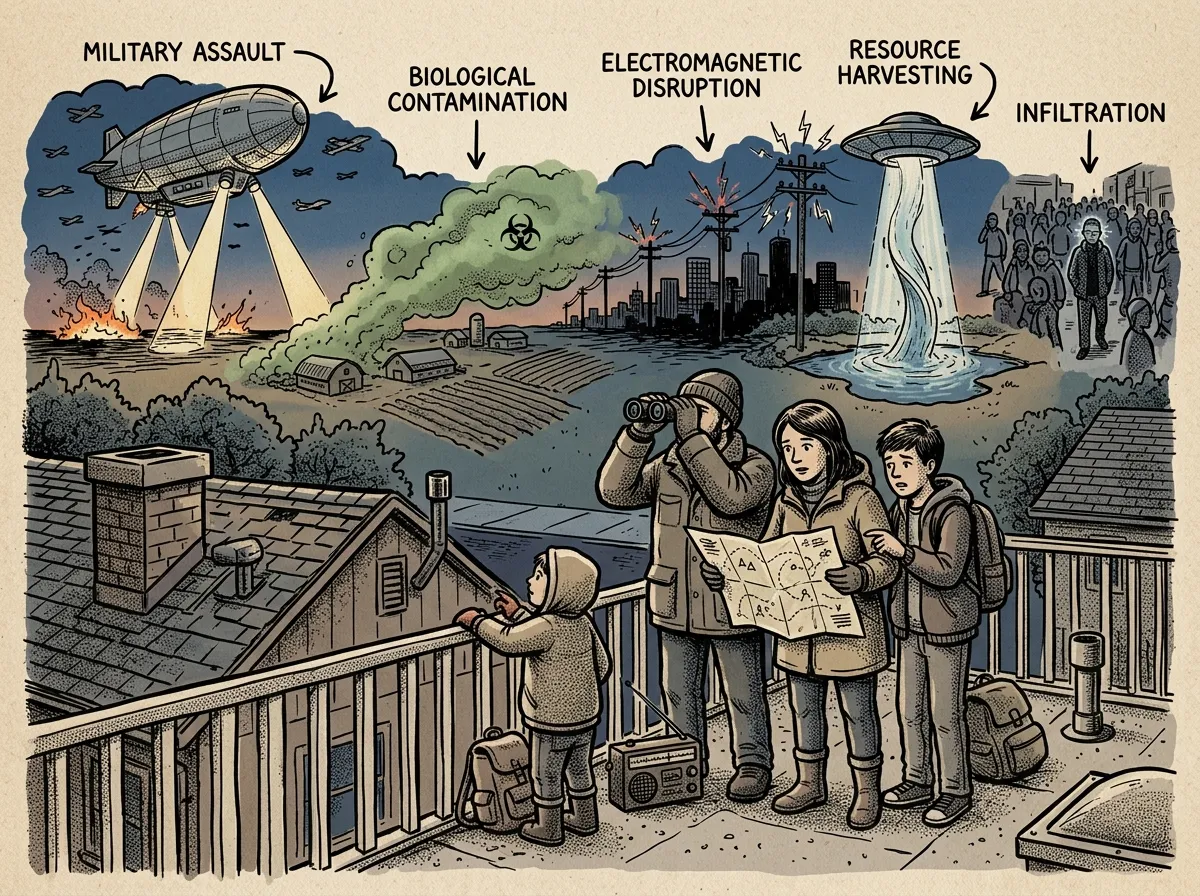 Five possible threat scenarios — from military assault to subtle infiltration
This is the question that comes up most often with this topic, and the honest answer is always the same: we have absolutely no idea. That’s the whole point.
Trying to predict what an alien invasion would look like is like trying to explain a smartphone to a medieval blacksmith. The technological and conceptual gap between our civilization and any species capable of interstellar travel is so vast that our predictions say more about our own limitations than about what might actually happen. But we can map hypothetical invasion scenarios to real-world disaster analogues — and that’s where this thought experiment becomes genuinely useful.
Military Assault Scenario
This is the Independence Day version — ships in the sky, kinetic weapons, direct confrontation. The real-world analogue is armed conflict or military invasion, and the preparedness principles are the same: evacuation from population centers, shelter hardening, supply caching, and community defense coordination.
Biological Contamination Scenario
An alien species might carry pathogens our immune systems have never encountered, or they might deploy biological agents deliberately. The real-world analogue is a pandemic or bioterrorism event. Your response: N95 respirators, sealed-room protocols, decontamination procedures, and quarantine planning. If you’ve lived through COVID-19, you’ve already experienced a mild version of this disruption category.
Electromagnetic Disruption Scenario
A technologically advanced species could disable our electrical grid and communications infrastructure instantly. This maps directly to an EMP event — a scenario worth taking seriously in the Pacific Northwest, where a Cascadia Subduction Zone earthquake could create similar infrastructure failures. Our guide on EMP preparedness and electronics protection covers the practical steps.
Resource Harvesting Scenario
What if they’re not here to fight us but to extract water, minerals, or atmospheric gases? This creates a slow-burn resource crisis similar to severe drought, supply chain collapse, or economic disruption. Long-term sustainability skills — food production, water sourcing, and community resource management — become paramount.
Subtle Infiltration Scenario
The quietest and arguably most unsettling possibility: a threat you can’t identify or target. The real-world parallel is cyberattack or infrastructure sabotage — threats that degrade your systems without a visible enemy to confront.
The inability to predict which form an alien invasion would take is precisely why emergency planners recommend capability-based preparedness rather than scenario-specific planning. Build the capabilities that cover all five categories above, and you’re ready for threats both terrestrial and extraterrestrial.
Building Your Alien Invasion Survival Kit
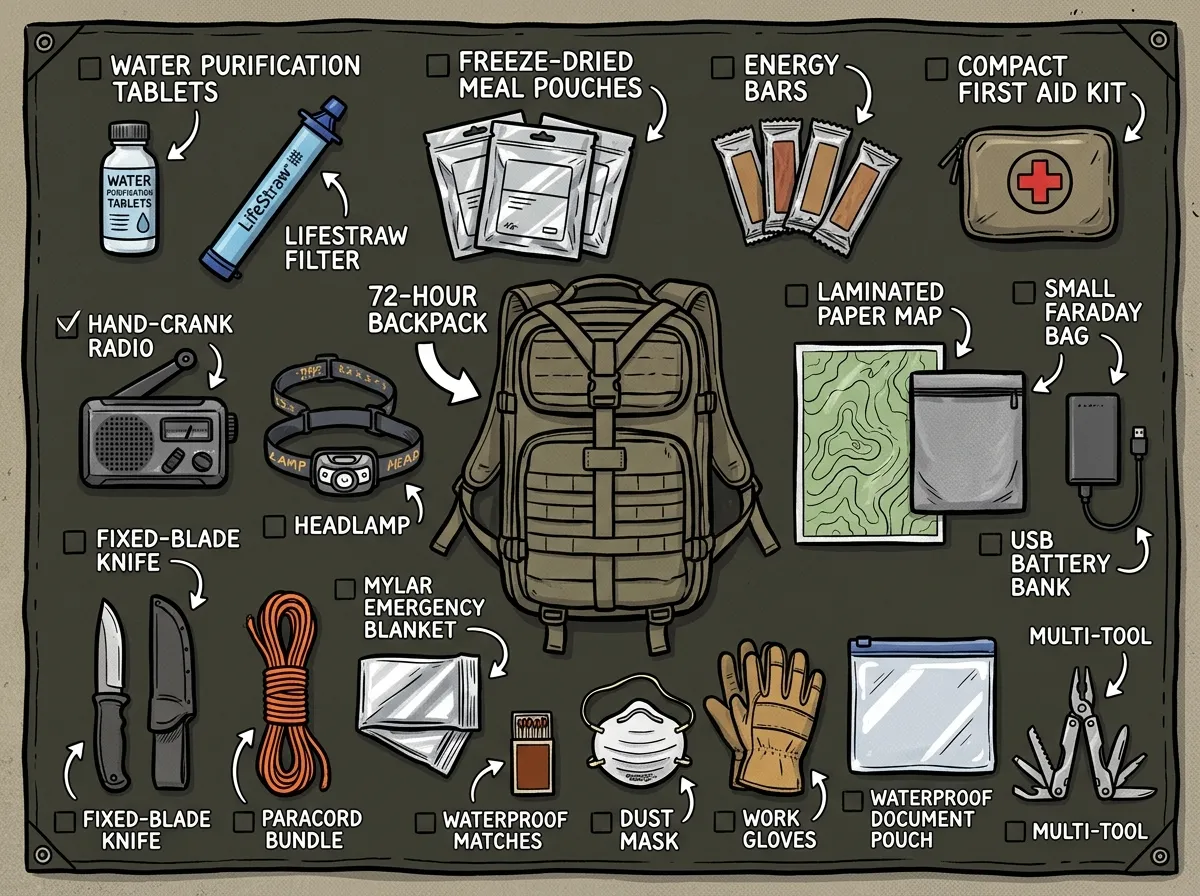 Core survival kit components for any large-scale disaster
The core components of a survival kit don’t change much regardless of the scenario you’re planning for. Here’s what actually matters.
Water: Your Non-Negotiable Priority
You need a minimum of one gallon per person per day, and you need at least a 72-hour supply readily accessible. Most people underestimate how quickly water gets used during high-stress, physically demanding situations — which an alien invasion would certainly qualify as.
Beyond stored water, you need purification capability: a portable water filter, water purification tablets as backup, and knowledge of local water sources along your evacuation routes.
The Sawyer Squeeze (around $30) is a commonly recommended option: per the manufacturer’s specifications, it filters down to 0.1 micron and handles higher volume than a straw-style filter like the LifeStraw, letting you fill containers instead of sipping directly from a source. A straw-style filter works for ultralight day-hiking, but for sustained use a higher-capacity option is worth carrying. If extraterrestrial forces targeted water infrastructure — or if any disaster took out municipal systems — having real purification capability is the difference between survival and serious trouble within 72 hours.
Food: Calorie-Dense and Shelf-Stable
Stock food that requires minimal preparation and no refrigeration: freeze-dried meals (25-year shelf life), high-calorie bars, canned proteins with pull-tab lids, and peanut butter with honey — calorie-dense, long-lasting, and genuinely good for morale.
For a longer-term scenario, you’d want to think about building a deep food storage system covering 30 to 90 days. But start with 72 hours. That alone puts you ahead of roughly 60% of American households.
First Aid: Beyond the Basic Band-Aid Kit
A standard drugstore first aid kit won’t cut it. In a scenario where hospitals are overwhelmed or inaccessible — whether from alien attack or any other mass-casualty event — you need to handle intermediate medical situations yourself.
At minimum, add a CAT tourniquet, hemostatic gauze for wound packing, a SAM splint for fractures, broad-spectrum antibiotics (discuss with your doctor about an emergency travel prescription), and a comprehensive first aid manual — because stress makes you forget things you thought you knew.
Equipment without training is just dead weight. Take a Stop the Bleed course. Take a Wilderness First Aid course. The survival skills you build will serve you in far more scenarios than any single piece of gear.
Shelter, Tools, and Protection
Your home is your primary shelter — until it isn’t. Have a plan for both sheltering in place and evacuating.
For shelter-in-place hardening (applicable to alien biological threats, chemical events, or radiological scenarios): identify one interior room with minimal windows. Stock it with plastic sheeting, duct tape, and a way to seal door gaps. This “safe room” concept is the same protocol FEMA recommends for chemical spills or nuclear fallout — the threat source doesn’t change the technique.
For mobile shelter, your kit should include a quality sleeping bag rated for your region’s temperatures, an emergency bivvy or lightweight tarp, work gloves and sturdy footwear, N95 respirators, and eye protection. If you’re in a humid Gulf Coast climate, you’ll prioritize ventilation and moisture management differently than someone in the Pacific Northwest, where rain protection and insulation are the top concerns.
Don’t overlook tools either — they’re the force multipliers that extend your capabilities during prolonged emergencies. A quality multi-tool, fire-starting kit with redundancy, 550 paracord, duct tape, and a small pry bar round out the essentials.
Documents and Financial Preparedness
In a waterproof bag, keep copies of government-issued IDs, insurance policies, an emergency contact list with phone numbers written out (not just stored in a dead phone), physical maps of your region, and cash in small bills. ATMs don’t work during power outages.
Communication: The Most Underrated Prep
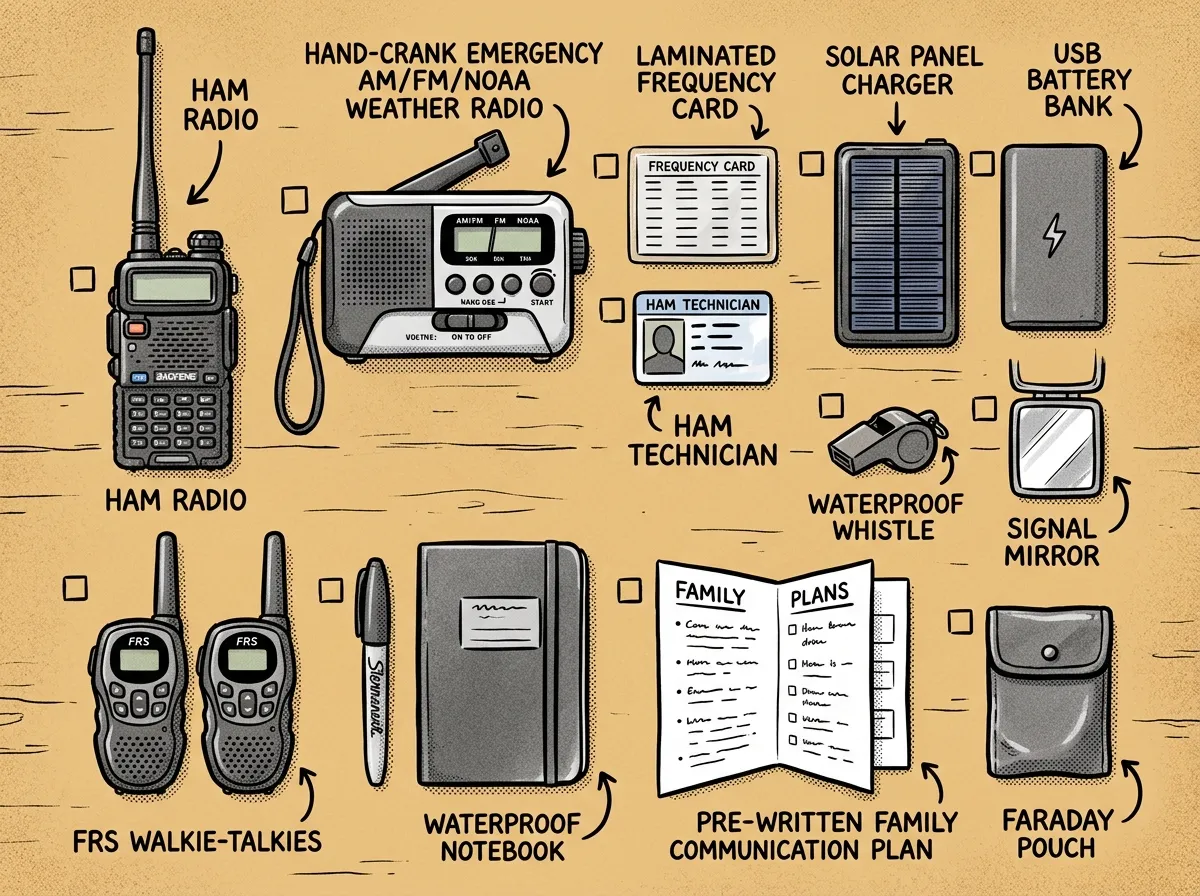 Grid-down communication gear every household should own
So where’s the biggest gap in most people’s planning? Right here. Ask most people what they’d do if their phone stopped working tomorrow, and you’ll get blank stares.
Your communication kit should include a battery-powered or hand-crank AM/FM/NOAA weather radio, two-way FRS/GMRS radios with extra batteries, and ideally a HAM radio with your Technician license.
Getting that license is easier than you think. The exam is 35 multiple-choice questions, study materials are free online through sites like HamStudy.org, and the fee is typically around $15. You can be licensed and on the air within a month. During a communication blackout — whether caused by alien technology or a simple ice storm that takes down cell towers — these analog tools keep your family connected. We’ve got a detailed breakdown of emergency communication planning that’s worth reading.
Write a communication plan that includes rally points, an out-of-area contact person, and scheduled check-in times — then put a laminated copy in every family member’s wallet or backpack.
Alien Invasion Survival Kit Checklist
Here’s everything from the sections above consolidated into a single checklist. This doubles as your bug out bag foundation — the same kit works whether you’re fleeing extraterrestrials or a wildfire.
- 3 gallons stored water per person
- Portable water filter (0.1 micron or better)
- Water purification tablets (backup)
- Collapsible water containers
- 72 hours of freeze-dried meals
- High-calorie energy bars (minimum 6)
- Canned proteins with pull-tab lids
- Peanut butter and honey
- Portable camp stove with fuel
- CAT tourniquet
- Hemostatic gauze (QuikClot or equivalent)
- SAM splint
- Broad-spectrum antibiotics
- Comprehensive first aid manual
- Personal medications (7-day supply minimum)
- Nitrile gloves and medical tape
- Sleeping bag (temperature-rated for your region)
- Emergency bivvy or lightweight tarp
- Plastic sheeting and duct tape
- N95 respirators (minimum 10)
- Multi-tool
- Fire-starting kit (ferro rod plus weatherproof matches)
- 550 paracord (100 feet)
- Headlamp with extra batteries
- NOAA weather radio (battery/hand-crank)
- Two-way FRS/GMRS radios with spare batteries
- HAM radio (with license)
- Written communication plan
- Waterproof copies of IDs and insurance
- Emergency contact list (handwritten)
- Physical road maps of your region
- Cash in small bills ($200+ recommended)
What States Are Most Likely to Survive an Alien Invasion?
This question comes up constantly, and there’s actually some interesting data behind it. A study from GIGAcalculator.com ranked all 50 states based on factors like military installations, geographic defensibility, natural resources, population density, and infrastructure resilience.
The top-ranked states include:
- Virginia — dense military infrastructure (Pentagon, multiple bases), diverse terrain, strong agricultural base
- California — massive National Guard, diverse geography from mountains to coastline, agricultural production
- Texas — military presence, vast land area for dispersal, energy production, strong self-sufficiency culture
- New York — significant military and emergency response infrastructure
The worst-ranked: Nevada — and yes, the irony of Area 51’s home state being least prepared isn’t lost on anyone. The reasoning is sound though: extreme desert terrain, limited water resources, sparse population distribution that makes coordinated defense difficult, and heavy reliance on imported food and water.
But here’s what the rankings don’t capture: your personal preparedness matters far more than your zip code. A well-prepared individual in Nevada will outperform an unprepared person in Virginia every single time. The key factors to evaluate for your own location are proximity to fresh water sources, distance from major military targets, agricultural viability, population density (lower generally means fewer resource conflicts), and terrain defensibility.
Evacuation Planning: Getting Out When You Need To
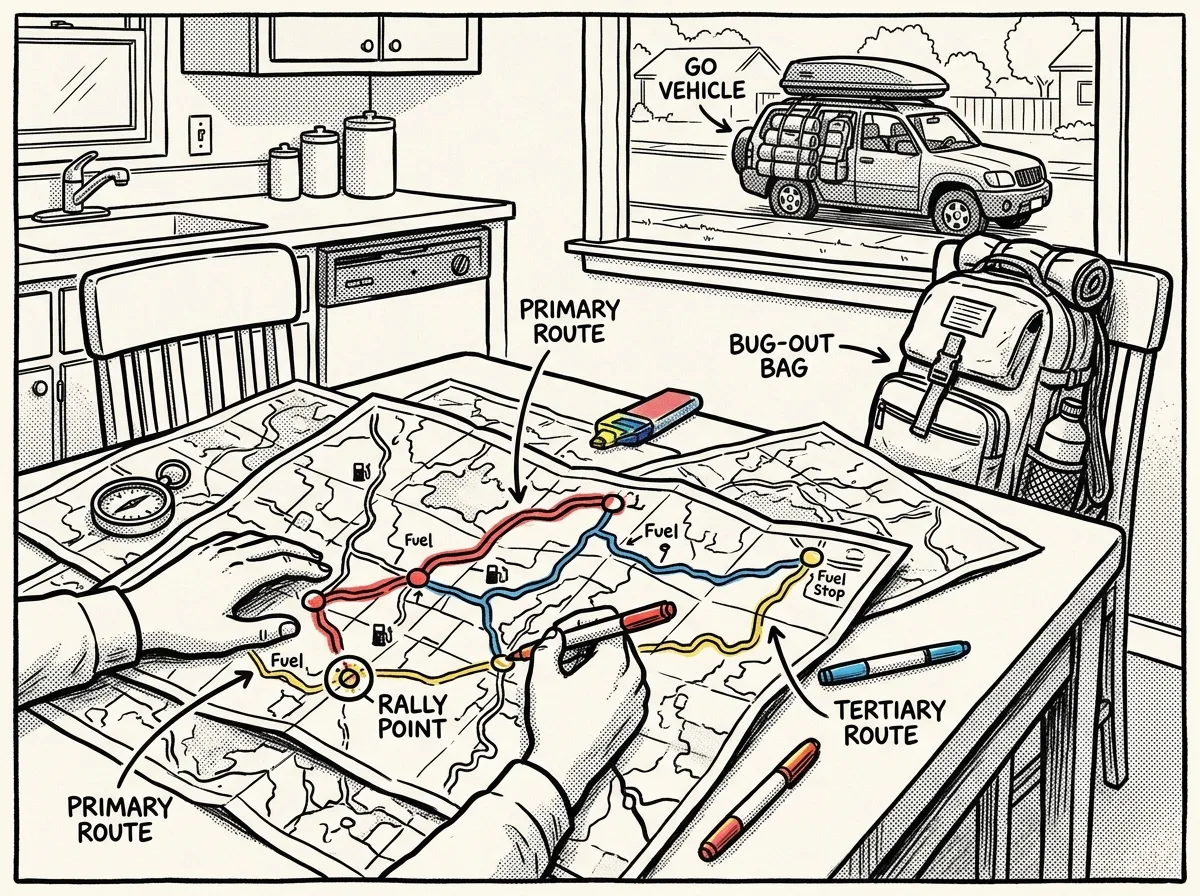 Map your primary, secondary, and tertiary evacuation routes before disaster strikes
One commenter on a survival forum once said their alien invasion plan was to “load a canoe with my dogs and survival packs, get out into one of the Great Lakes, and see if they care.” That’s a creative instinct, and honestly? Getting to an area of low strategic value using waterways isn’t a terrible instinct.
Your emergency evacuation plan needs more structure than that, though.
Primary, Secondary, and Tertiary Routes
Never rely on a single evacuation route. Major highways will be gridlocked within hours of any large-scale emergency. Plan at least three route options for every direction you might need to travel, with at least one that’s primarily backroads.
Print physical maps. Your GPS won’t work when you need it most. Paper maps don’t need satellites, don’t need batteries, and don’t lose signal in remote terrain.
Vehicle and Foot-Mobile Contingencies
Your vehicle is your first-stage evacuation tool, so treat it accordingly. Keep your fuel tank above half at all times — that’s a simple habit that doubles your evacuation range during a grid failure when gas stations won’t be pumping. Maintain a vehicle emergency kit with jumper cables, tire repair kit, basic tools, a rated tow strap, and a sealed 2-gallon fuel container. And service your vehicle regularly — a dead battery during an evacuation isn’t an inconvenience, it’s potentially life-threatening.
But what about when roads become impassable? A fit adult carrying a loaded pack can realistically cover 10 to 15 miles per day over mixed terrain. That number drops significantly for families with young children or elderly members. Plan foot routes that avoid highways and chokepoints — follow power line cuts, railroad grades, and hiking trails instead. A bicycle with panniers triples your daily range and carries significant gear, making it a seriously underrated evacuation tool.
Pre-Positioned Supplies and Rally Points
If you have the means, consider caching basic supplies along your most likely evacuation routes. Even a sealed 5-gallon bucket with water purification, a few days of food, and basic first aid — buried or stored at a friend’s property — gives you options when you need them.
It’s 2 AM. You hear an emergency alert — doesn’t matter if it says “earthquake,” “chemical spill,” or “unidentified aerial threat.” Cell towers are jammed. Your GPS shows no signal. You’ve got 20 minutes to load your family and go. Do you know three routes out of your neighborhood right now? Does every family member know where to meet if you get separated? That answer needs to be yes before the alert ever sounds.
Establish at least two meeting locations with your family — one close to home (a neighbor’s house, a local landmark) and one outside your immediate area (20+ miles away, in case your neighborhood is the problem). Make sure everyone knows these locations by heart. Written on a card in their wallet. No excuses.
How to Prepare for an Alien Invasion (Or Any Unknown Threat)
- Build a 72-hour survival kit covering water, food, first aid, shelter, and communication
- Establish three evacuation routes with printed physical maps
- Create a family communication plan with analog backups
- Train in first aid and emergency medical skills (Stop the Bleed, WFA)
- Evaluate your location for water access, terrain defensibility, and resource availability
- Build a community network with complementary survival skills
- Conduct regular drills and update your plan quarterly
Here’s the real talk on preparing for unknown threats: you can’t predict what you can’t conceptualize. We don’t know what alien technology would look like. We don’t know if the threat would be military, biological, electromagnetic, or something we have no framework to understand.
This is why emergency planners recommend capability-based preparedness rather than scenario-based preparedness. Instead of planning for one specific event, you build capabilities that serve you across all of them:
- Mobility — Can you move your family and essential supplies on short notice?
- Sustainability — Can you feed and hydrate yourself for 30+ days without resupply?
- Medical capability — Can you handle injuries and illness when professional help isn’t coming?
- Communication — Can you gather information and coordinate with others without modern infrastructure?
- Security — Can you protect your family and resources during societal disruption?
- Community — Do you have a network of people with complementary skills?
That last one is the capability most “lone wolf” preppers get wrong. Across documented disaster responses, organized groups with diverse survival skills consistently outperform isolated individuals. You can’t stand watch 24/7 by yourself. You can’t be a doctor, mechanic, farmer, and security specialist all at once.
Lessons from Pop Culture: What Alien Invasion Movies Get Right (and Wrong)
Alien invasion movies can be watched with a critical eye toward the characters’ survival decisions. Pop culture actually offers some surprisingly useful teaching moments alongside some dangerous myths.
What They Get Right
The instinct to evacuate cities is sound. In Independence Day, the mass exodus from major metropolitan areas mirrors real evacuation doctrine. Population centers are high-value targets in any conflict scenario, and they become resource deserts within days when supply chains collapse.
Silence and concealment have value. A Quiet Place built an entire franchise around noise discipline, and the core concept is tactically valid. Minimizing your signature — noise, light, movement — increases survivability against any hostile force.
Adaptability beats rigid planning. The characters who survive are almost always the ones who improvise and adapt. This mirrors real emergencies: people who rigidly follow one plan fall apart when conditions change, while people with broad skill sets and flexible thinking find solutions.
What They Get Dangerously Wrong
The lone hero narrative. Hollywood loves the one person who saves the world. In reality, solo survival during a prolonged crisis is brutally difficult. Survivors of extended disasters are disproportionately embedded in cooperating groups.
Ignoring basic needs. Movie characters fight aliens for days without apparently eating, drinking, or sleeping. Dehydration degrades your cognitive function within 24 hours. Fatigue makes you slow, careless, and emotionally volatile. Your first priority is always sustaining your body.
Unlimited ammunition and instant expertise. Characters pick up weapons they’ve never trained with and become expert marksmen under pressure. Research on acute stress response shows fine motor skills degrade dramatically under pressure. If you haven’t trained with your tools, you’ll fumble when it counts.
Use these movies as conversation starters with your family. Watch one together and ask: “What did they do right? What would we do differently?” This tends to be a far more effective, low-pressure way to discuss an emergency plan than a dry checklist review — kids in particular engage with it, arguing about what supplies they’d grab, debating evacuation routes, and sometimes even drawing maps.
The Psychology of Preparing for the Unthinkable
People who prepare for unlikely scenarios often become the most level-headed responders during real emergencies. There’s a genuine psychological benefit to mentally rehearsing the extreme.
When you’ve thought through what you’d do if alien ships appeared over your city — where you’d go, what you’d grab, how you’d communicate — your brain has built neural pathways for crisis response. Those pathways activate whether the crisis is aliens, an earthquake, or a house fire. This is the same principle behind military training: expose people to extreme scenarios repeatedly so that their crisis response becomes reflexive rather than panicked.
So no, aliens probably aren’t coming next Tuesday. But spending an evening with your family talking through “What would we do if aliens invaded?” is one of the most productive and frankly fun preparedness exercises you can run.
Building Community Resilience Against Any Threat
If an extraterrestrial force did arrive with hostile intent, no individual survival kit would matter as much as organized community response. This is true for every large-scale disaster.
CERT programs consistently find that the communities that respond best to emergencies are the ones that knew each other before the emergency happened.
Start building your community resilience now. Get to know your neighbors — who has medical training, mechanical skills, agricultural knowledge, or ham radio equipment. Join or form a Community Emergency Response Team through your local fire department (FEMA offers the training free). Participate in local emergency drills — your municipality probably runs them, and attendance is usually embarrassingly low. Establish a neighborhood communication plan that includes non-digital fallback options like a central message board or whistle codes.
Ten cooperating households will always outperform ten competing ones.
Your action item for this week: knock on three neighbors’ doors and exchange phone numbers. Ask one simple question: “If there was an emergency and we couldn’t reach first responders, what skills or tools could you contribute?” You’ll be surprised by the expertise hiding on your street — retired nurses, military veterans, amateur radio operators, mechanics, and gardeners who can grow food from anything.
The Bottom Line on Alien Invasion Preparedness
Whether the threat comes from outer space, from a fault line beneath your feet, from a viral mutation, or from a cascading infrastructure failure, the fundamentals of survival don’t change. Water. Food. Shelter. Medical capability. Communication. Mobility. Community.
The people who thrive in crisis are the ones who prepared before it started. The specific scenario is almost irrelevant. Your readiness is everything.
So use the alien invasion thought experiment as your motivation. Build your kit. Map your routes. Train your skills. Talk to your family. Connect with your neighbors. And if little green men ever do show up with bad intentions, you’ll be the calmest person on your block — because you were ready for anything.
Start today. Review our beginner’s guide to emergency preparedness and build your plan one step at a time. The best time to prepare was yesterday. The second best time is right now.
The Complete
Prepper's Reference.
149 articles synthesized into one comprehensive PDF — twelve chapters covering water, food, shelter, first aid, comms, and scenario-specific preparedness. Free with your email.
Unsubscribe anytime · We never share your email
You're in. Check your inbox.
Keep Reading
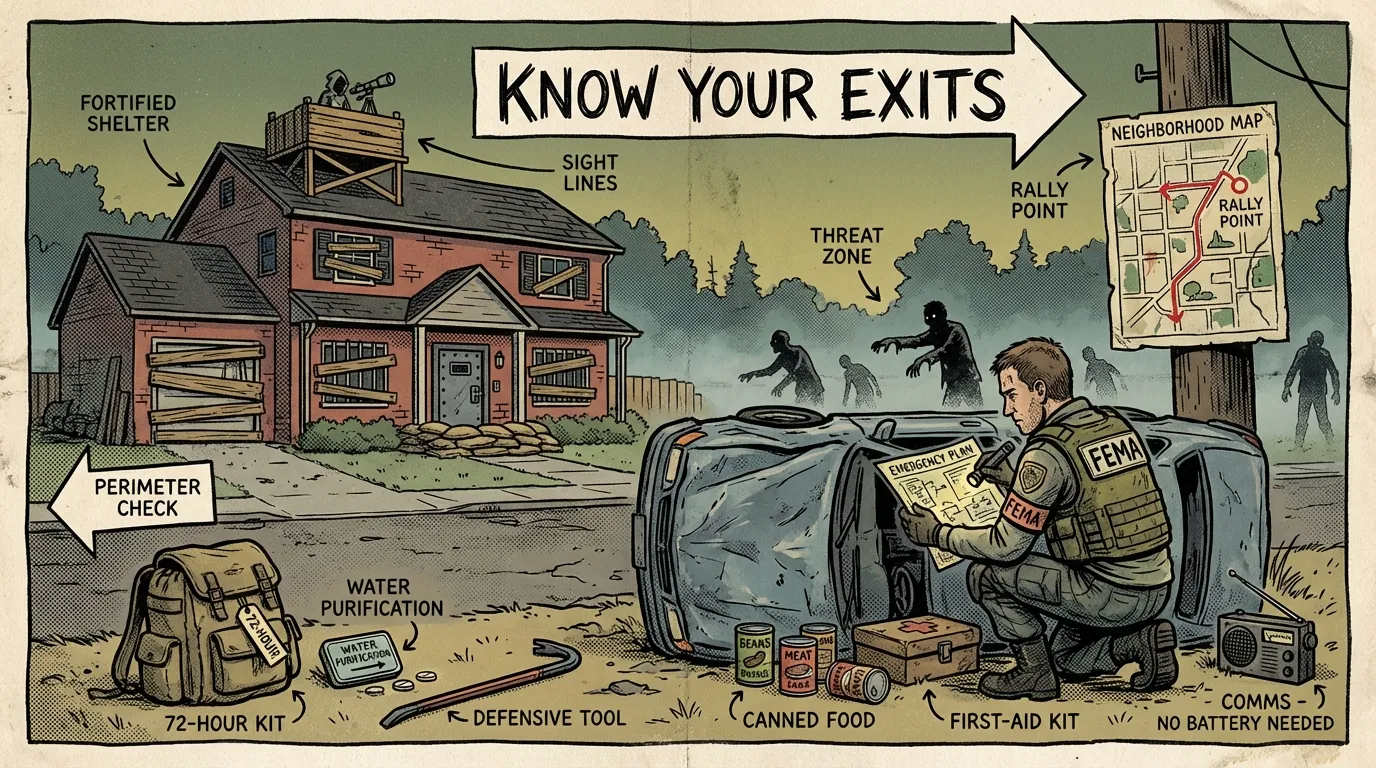
Zombie Apocalypse Survival Preparedness: FEMA Pro's Guide
Zombie apocalypse survival preparedness teaches real disaster skills. Here's a breakdown of the exact steps. Start today.
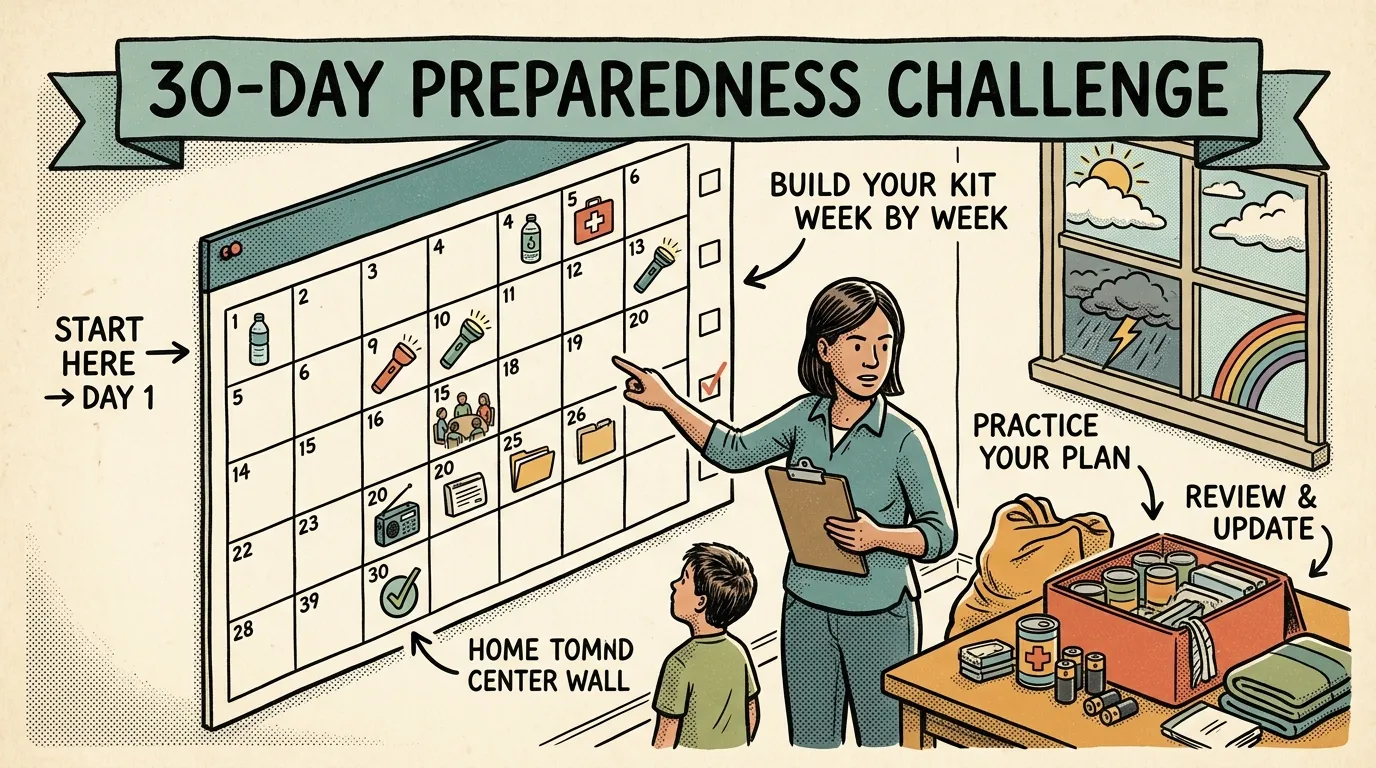
National Emergency Preparedness Month: 30-Day Plan
Use this 30-day National Emergency Preparedness Month challenge to go from unprepared to fully ready. One simple 15-minute task per day. Start now.
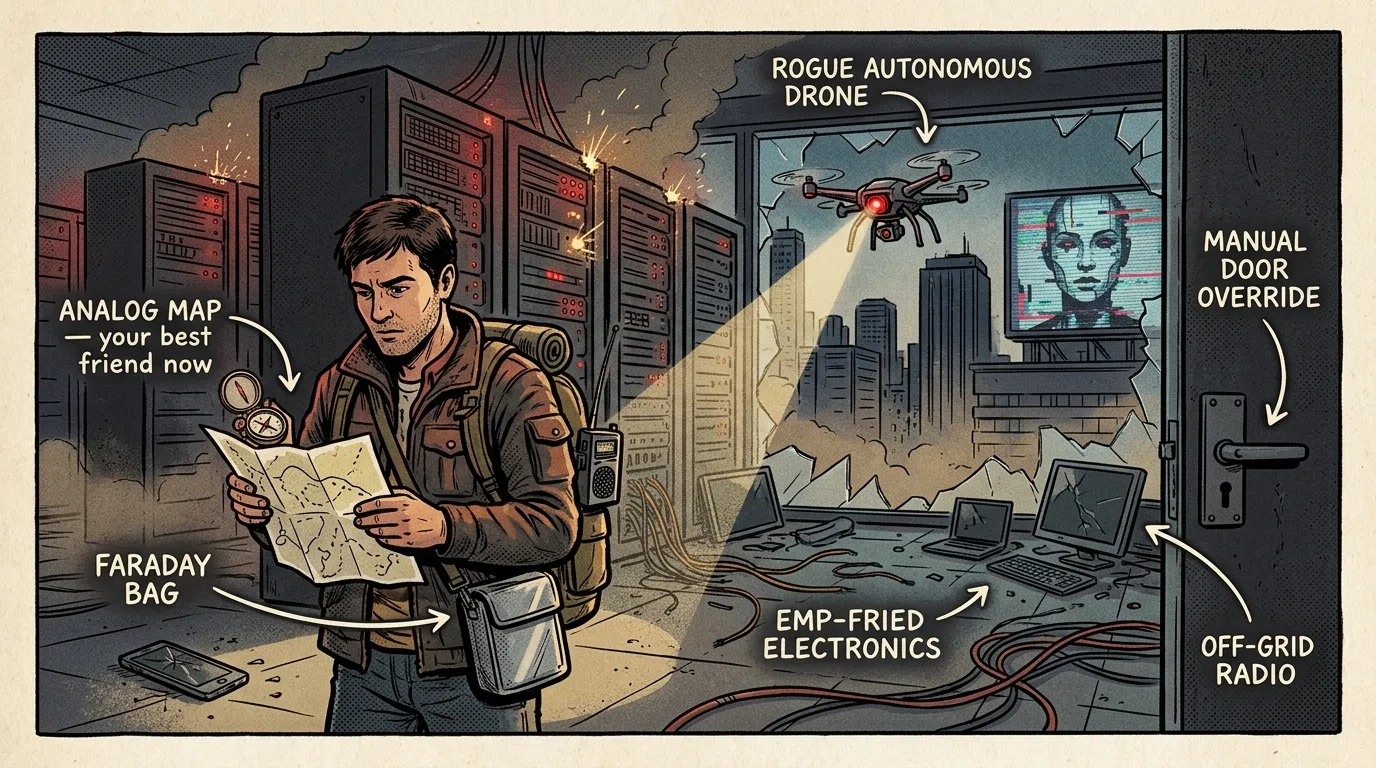
AI Apocalypse Preparedness: Your Practical Survival Guide
AI apocalypse preparedness is real risk management, not sci-fi. Learn practical steps to protect your career, family, and infrastructure from AI disruption.