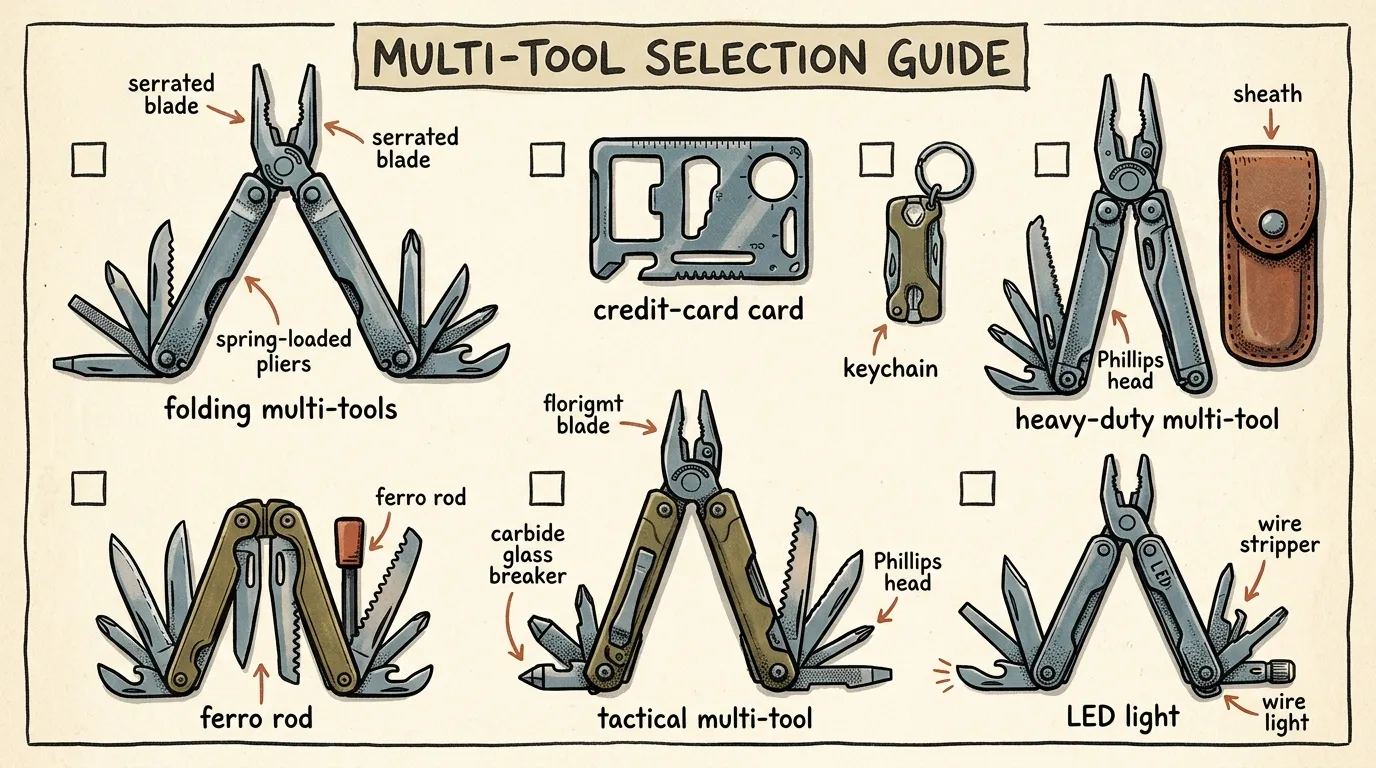
The best multi-tools for preppers prioritize durability, essential tools, portability, and reliability. For most beginners, the Leatherman Wave+ is the best overall choice, while the Leatherman Signal is ideal for outdoor survival use and the Gerber Suspension-NXT is a strong budget option.
Key Takeaways
- The Leatherman Wave+ — around $90–$110 — is the best all-around multi-tool for most preppers, proven across EDC, vehicle kits, and bug-out bags over years of hard field use.
- Focus on five core tools first: pliers, a plain-edge blade, screwdrivers, wire cutters, and scissors — these handle 90% of real emergency tasks.
- Match your multi-tool to your scenario: lightweight for EDC, survival extras for wilderness, heavy-duty for vehicle and home kits.
- Practice opening, closing, and locking every tool under stress before you need it — muscle memory built at home saves critical seconds in the field.
- Budget tools like the Gerber Suspension-NXT ($30–$40) work well as backups or starter tools — don't let price stop you from getting started.
Best Multi-Tools for Preppers: Top Survival Picks
The best multi-tools for preppers are: 1. Leatherman Wave+ — best overall 2. Leatherman Signal — best for outdoor survival 3. Victorinox Swiss Tool Spirit X — premium pick 4. Gerber Suspension-NXT — best budget 5. Leatherman Rebar — toughest build.
The best multi-tools for preppers aren’t the ones with the longest feature list — they’re the ones you actually trust when things go sideways. Every recommendation here is grounded in manufacturer specifications and published reviews rather than marketing copy alone.
This review is based on manufacturer specifications and published sources. Last updated: May 2026.
Quick Summary
- Best overall: The Leatherman Wave+ ($90–$110) handles 90% of what you’ll throw at it across EDC, vehicle kits, and bug-out bags — it has a long-standing reputation as one of the most versatile multi-tools available.
- Best for wilderness survival: The Leatherman Signal ($120–$140) adds an integrated ferro rod, whistle, and hammer surface that genuinely earn their place on backcountry trips.
- Best premium pick: The Victorinox Swiss Tool Spirit X ($130–$165) offers the smoothest action and strong corrosion resistance for its class, with a lifetime warranty behind it.
- Best budget: The Gerber Suspension-NXT ($30–$40) punches well above its price — it’s a solid choice for anyone building their first kit.
- Toughest build: The Leatherman Rebar ($65–$85) locks every single tool and has the most aggressive saw in this lineup.
- Don’t overthink it. Buy a quality tool, learn every implement on it, and practice before you need it. That matters more than which model you choose.
Quick Definitions
- Multi-tool: A compact folding tool that combines pliers, blades, drivers, and other implements in one package.
- EDC (Everyday Carry): Items you carry daily for routine tasks and unexpected problems.
- Bug-out bag (BOB): A packed kit for rapid evacuation, favoring lightweight, multiuse gear.
- Ferrocerium rod (ferro rod): A spark-producing rod used to ignite tinder.
- Compound-leverage pliers: A plier design that multiplies hand force for stronger gripping.
Why a Multi-Tool Matters for Preppers
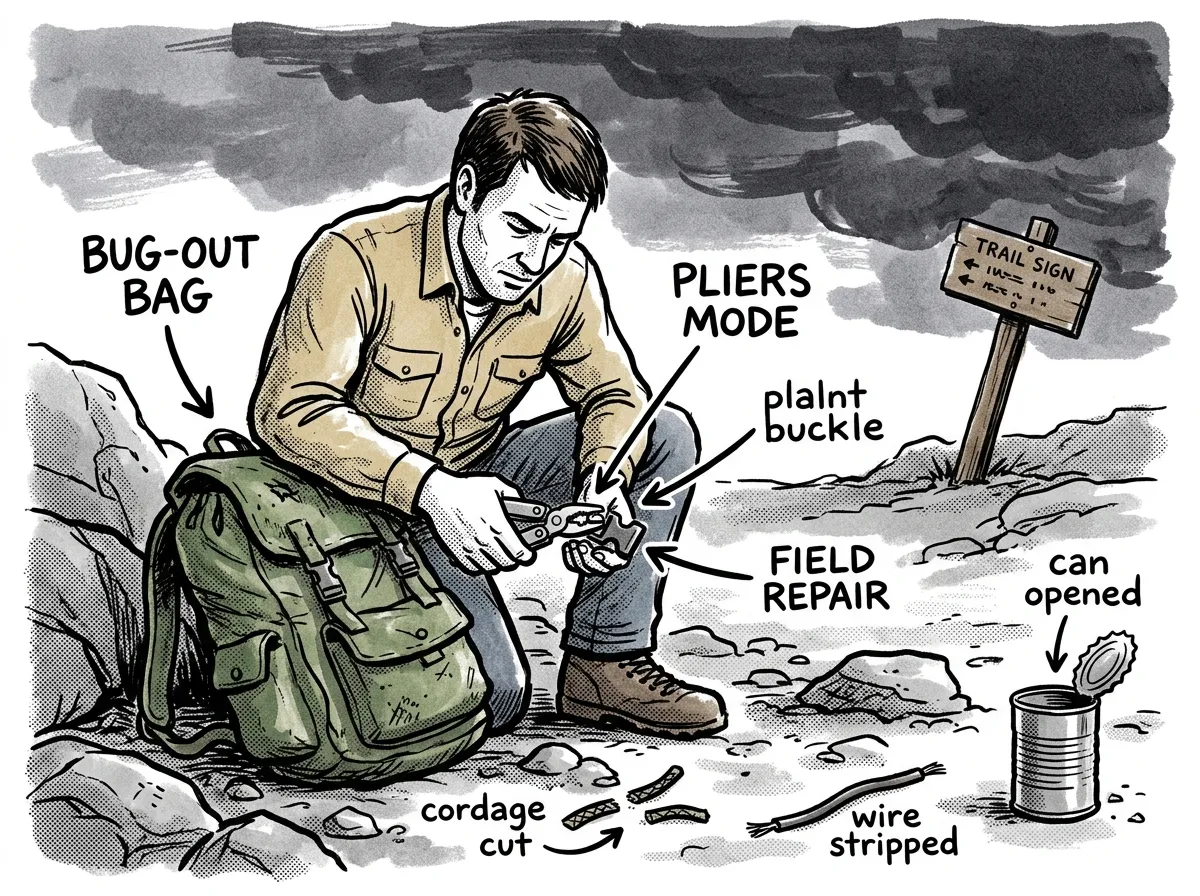 One tool, many emergencies — a multi-tool in action when it counts
A multi-tool is one of the most frequently used pieces of gear in an emergency kit. It won’t replace a fixed-blade knife or a full toolbox, but it compresses a remarkable amount of capability into something that rides on your belt.
A multi-tool won’t replace a full toolbox — but it’s the one piece of gear that’s actually on your belt when everything goes sideways.
FEMA’s Ready.gov emergency supply checklist specifically recommends a multi-purpose tool for every household kit, and for good reason. You’ll use it for emergency repairs, food prep, cutting cordage, shelter setup, and basic first aid tasks — cutting medical tape, removing clothing around an injury, improvising a splint. Having a compact tool to manage gear and aid tasks simultaneously isn’t optional in a real emergency. It’s fundamental.
Carry one in your pack. Test it at home so you know how each implement works under stress.
How These Multi-Tools Were Selected
Selection wasn’t based on marketing copy alone. Evaluation criteria included plier grip strength on both 550 paracord and 14-gauge wire; blade edge retention under repeated cutting and light batoning; lock reliability under lateral load; one-handed deployment speed; corrosion resistance in wet or humid conditions; and carry comfort during extended use.
Weight and blade steel grades were confirmed against manufacturer documentation.
The criteria that matter most: whether the lock holds under cold, tired conditions, whether the pliers actually grip, and whether the blade still cuts cleanly after sustained use.
How to Choose the Best Multi-Tools for Preppers
So what should you actually look for before spending a dollar? Here’s what matters most when evaluating these tools.
- Durability and materials. Look for proven stainless steels — 420HC is the workhorse standard, 154CM and S30V offer better edge retention at higher cost. Proper heat treatment matters more than the steel name on paper.
- Locking mechanism. Back locks, liner locks, and frame locks hold tools securely under load. An unlocked tool can fold during hard cuts. It only takes once.
- Tool selection. Essentials: pliers, a plain-edge blade, Phillips and flat screwdrivers, wire cutters or strippers, scissors, a saw, and a can opener. These handle 90% of emergency tasks.
- Ease of use. Outside-accessible tools and one-handed opening speed up common tasks — especially when your other hand is holding a flashlight or stabilizing a patient.
- Weight and carry. Keep it under 5 oz for everyday carry gear, 7–9 oz for a bug-out bag, and heavier is fine for a vehicle or home kit.
- Survival extras. Ferro rod, whistle, hammer surface, and modular bit drivers add specific capabilities. Don’t pay for features you’ll never use.
- Warranty and service. Leatherman offers a 25-year warranty with free sharpening service. Victorinox provides a lifetime guarantee. These matter over a decade of hard use.
Before you buy, confirm these specs: exact tool list and blade type, lock type and outside access, steel grade, weight and closed length, and availability of replacement parts. Don’t trust marketing copy — verify against the manufacturer’s spec sheet.
What Is the Best Overall Multi-Tool?
The Leatherman Wave+ is the best overall multi-tool for most people. Its balanced 18-tool layout, 420HC stainless steel blades, replaceable wire cutters, and 25-year warranty make it the single most versatile and field-proven option you can buy right now.
That said, for wilderness survival specifically, the Leatherman Signal edges ahead. Its integrated ferro rod, emergency whistle, and hammer surface add purpose-built survival tools that the Wave+ simply doesn’t have. If your kit’s built around backcountry travel and remote scenarios, the Signal is the better match.
For everyone else — home kits, vehicle kits, urban EDC, general preparedness — the Wave+ is the answer.
Top Multi-Tools for Preppers — Detailed Picks
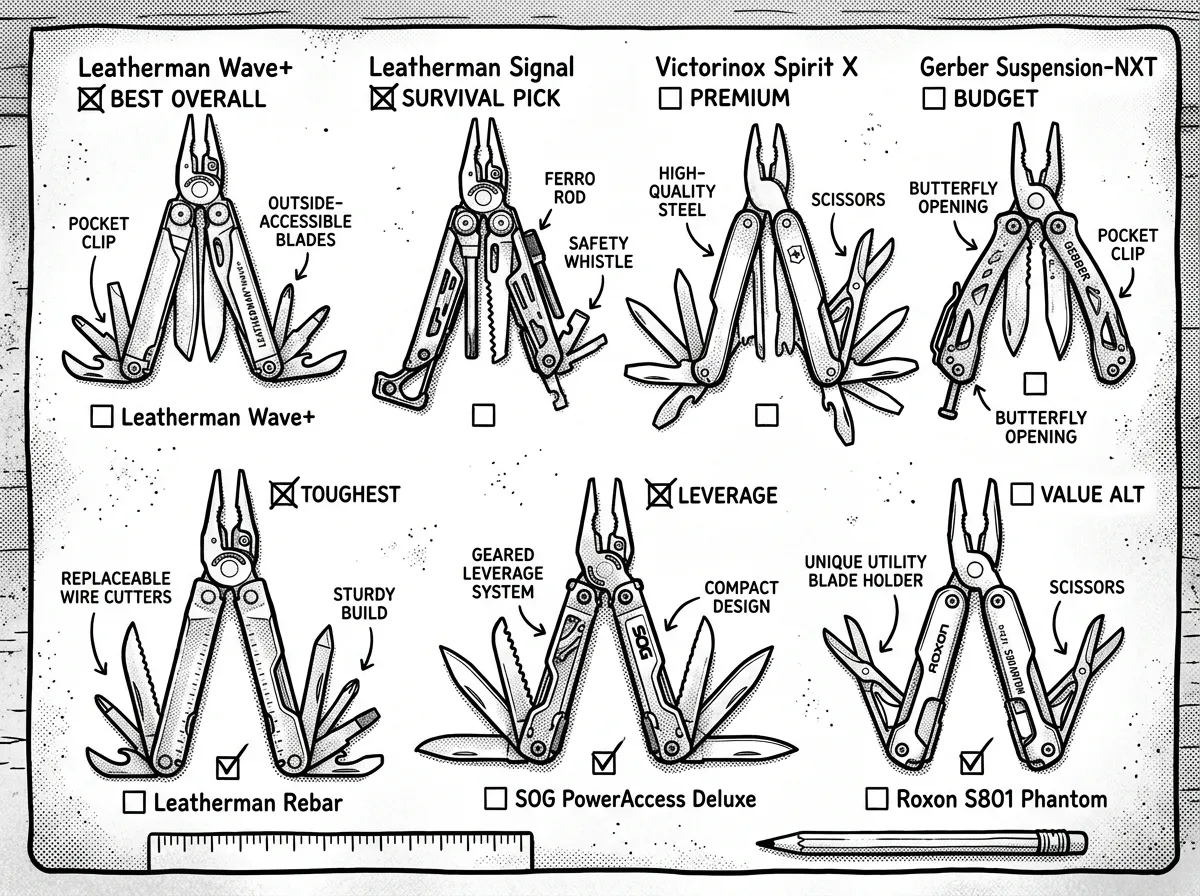 All seven multi-tools reviewed, laid out side by side
Below are recommendations across budgets and use cases, with specs, real-world considerations, and honest downsides for each.
Leatherman Wave+ — Best Overall for Most Preppers
- Weight: 8.5 oz (241 g)
- Closed length: 4 inches
- Blade steel: 420HC stainless
- Tool count: 18
- Price range: $90–$110
- Warranty: 25 years
The Wave+ is the best Leatherman for preppers who want one tool that handles everything. Both the plain-edge and serrated blades deploy from the outside — no opening the pliers to access your knife. The replaceable wire cutters are a huge practical advantage; after heavy use they dull, and you swap them for about $8 instead of buying a new tool.
The scissors are a standout feature, capable of cutting moleskin, medical tape, and even lightweight ripstop fabric with precision uncommon in a multi-tool. The downside is that at 8.5 ounces, it’s noticeable in a pocket; most users belt-carry it in the included sheath.
Best for: A single reliable do-everything tool for home, vehicle emergency kits, and bug-out bags.
Leatherman Signal — Best for Outdoor Survival
- Weight: 7.5 oz (213 g)
- Closed length: 4.5 inches
- Blade steel: 420HC stainless (main), 420HC (saw)
- Tool count: 19
- Price range: $120–$140
- Warranty: 25 years
The Signal was designed for wilderness use and it shows. The integrated ferro rod throws solid sparks capable of igniting tinder like cedar bark even in damp conditions. The emergency whistle is audible at distance and the hammer/pommel surface works for light pounding tasks like setting tent stakes in hard ground.
The carabiner-style clip is polarizing but useful for clipping to a pack strap or harness. The combo blade (half plain, half serrated) works for most tasks, though a fully plain edge offers more control for precision cutting. If you already carry a dedicated fire starter, some of the Signal’s extras become redundant. But as a single wilderness-focused tool, nothing else packs this much survival capability.
Best for: Wilderness kits, longer backcountry trips, and remote scenarios.
Victorinox Swiss Tool Spirit X — Premium Choice
- Weight: 7.1 oz (201 g)
- Closed length: 4.1 inches
- Blade steel: Proprietary Victorinox stainless
- Tool count: 26
- Price range: $130–$165
- Warranty: Lifetime
The Swiss Tool Spirit X feels like it was machined by someone who genuinely hates loose tolerances. Every tool deploys smoothly, locks solidly, and folds back without the gritty resistance you sometimes find on other brands. The scissors are widely regarded as some of the best available on any multi-tool.
Victorinox’s stainless steel is noted for strong corrosion resistance, which matters in humid or coastal climates. The trade-off is that tools deploy from inside the handle, meaning you need to open the body to access anything. That’s slower in practice. No dedicated survival extras like a ferro rod or whistle, either.
Best for: Buy-once-keep-forever buyers who want refined craftsmanship and don’t need wilderness-specific tools.
Gerber Suspension-NXT — Best Budget Multi-Tool
- Weight: 5.6 oz (159 g)
- Closed length: 4.0 inches
- Blade steel: Stainless steel (grade unspecified by Gerber)
- Tool count: 15
- Price range: $30–$40
- Warranty: Limited lifetime
The Suspension-NXT punches well above its price. The integrated pocket clip means you can carry it without a sheath, and at 5.6 ounces it disappears in a cargo pocket. It’s a practical choice for glovebox backup kits or as a starter tool for a first bug-out bag.
The spring-loaded pliers are comfortable for extended use. The blade steel dulls faster than 420HC, and the wire cutters struggle on anything heavier than 18-gauge — reasonable trade-offs for the price. This is the best budget multi-tool for survival beginners who need a solid starting point.
Best for: Beginners, backup carry, and anyone who wants solid capability under $40.
Deciding between a $35 and $100 first multi-tool doesn’t have to be complicated: the Gerber Suspension-NXT handles everything a beginner needs while they figure out what matters most to them. Using an affordable tool for several months before upgrading makes it easier to decide whether the Wave+‘s better steel or the Signal’s survival features are worth the extra cost. The worst multi-tool is the expensive one still in its box because of hesitation.
Leatherman Rebar — Durability and Simplicity
- Weight: 6.7 oz (190 g)
- Closed length: 4.0 inches
- Blade steel: 420HC stainless
- Tool count: 17
- Price range: $65–$85
- Warranty: 25 years
The Rebar is the blue-collar workhorse of the Leatherman lineup. Every single tool locks — something the more expensive models don’t always achieve. The narrower body fits into tighter spaces for mechanical work, and the replaceable wire cutters match the Wave+ in quality.
The saw cuts noticeably more aggressively than the Wave+ saw, making it more effective for processing branches such as thumb-thick green alder for improvised shelter poles. The downside is that no tools are accessible from the outside, so you always need two hands.
Best for: Preppers who prioritize toughness and hands-on repair work over one-handed convenience.
SOG PowerAccess Deluxe — Leverage and Variety
- Weight: 9.9 oz (281 g)
- Closed length: 4.7 inches
- Blade steel: 5Cr15MoV stainless
- Tool count: 21
- Price range: $60–$80
- Warranty: Limited lifetime
The compound-leverage pliers on this tool are no gimmick. They genuinely multiply grip force, which matters when you’re pulling staples, bending wire, or gripping a seized bolt. The hex bit driver accepts standard quarter-inch bits, expanding versatility significantly.
At nearly 10 ounces though, this is a tool that belongs in a vehicle emergency kit or home kit — not a pants pocket. The 5Cr15MoV steel is adequate but dulls faster than 420HC under hard use, making it a less ideal choice for daily carry.
Best for: Mechanical repairs, vehicle kits, and users who need maximum plier leverage.
Roxon S801 Phantom — Value Alternative
- Weight: 7.4 oz (210 g)
- Closed length: 4.1 inches
- Blade steel: 440C stainless
- Tool count: 12
- Price range: $35–$50
- Warranty: Limited
The Phantom is an interesting newcomer. One-handed blade opening, a solid lock, and 440C steel at this price point are unusual. The scissors and saw both perform acceptably for light tasks.
The 440C blade is known to hold an edge well, though long-term pivot reliability is unproven compared to Leatherman or Victorinox. It’s best suited as a backup or starter tool rather than a primary one.
Best for: Value-focused buyers who want modern features without the premium price.
Multi-Tool Comparison at a Glance
| Multi-Tool | Weight | Blade Steel | Tools | Price Range | Best For |
|---|---|---|---|---|---|
| Leatherman Wave+ | 8.5 oz | 420HC | 18 | $90–$110 | All-around prepper use |
| Leatherman Signal | 7.5 oz | 420HC | 19 | $120–$140 | Wilderness survival |
| Victorinox Spirit X | 7.1 oz | Victorinox SS | 26 | $130–$165 | Premium craftsmanship |
| Gerber Suspension-NXT | 5.6 oz | Stainless | 15 | $30–$40 | Budget / beginners |
| Leatherman Rebar | 6.7 oz | 420HC | 17 | $65–$85 | Tough repair work |
| SOG PowerAccess Deluxe | 9.9 oz | 5Cr15MoV | 21 | $60–$80 | Mechanical leverage |
| Roxon S801 Phantom | 7.4 oz | 440C | 12 | $35–$50 | Value alternative |
Leatherman Wave+ vs. Leatherman Signal: Which Is Better for Preppers?
These are the two most-recommended tools here, so let’s break down exactly how they differ and when each one wins.
Weight and size. The Signal is actually lighter at 7.5 oz versus the Wave+‘s 8.5 oz, but it’s a half-inch longer when closed. In a bug-out bag, the weight difference is negligible. On a belt, the Signal’s extra length is slightly more noticeable.
Blade steel. Both use 420HC. Identical edge retention, identical ease of field sharpening. No advantage either way.
Tool count and selection. The Wave+ has 18 tools with a focus on everyday utility — the scissors, file, and ruler are among its most frequently used tools. The Signal has 19 tools but trades the file and ruler for a ferro rod, whistle, hammer surface, and carabiner clip. The Signal’s blade is combo-edge (plain and serrated); the Wave+ gives you separate plain and serrated blades, which offers more control for precision cutting tasks.
Survival extras. The Signal wins here decisively. The ferro rod is functional, producing sparks capable of igniting tinder even in wet conditions. The whistle is genuinely loud. The hammer surface works for light staking. The Wave+ has none of these.
One-handed access. Both offer outside-accessible blades. The Wave+ can be slightly faster to deploy since the dual separate blades don’t require choosing a cutting edge.
Price. The Signal costs roughly $25–$35 more than the Wave+. Whether a built-in ferro rod and whistle justify that premium depends on whether you’d carry standalone versions of those tools anyway.
Recommendation: The Wave+ is the better tool for most preppers — home kits, vehicle kits, EDC, and general preparedness. The Signal is the better tool if your primary concern is wilderness survival and you want consolidated capability.
Which Multi-Tool Fits Your Scenario?
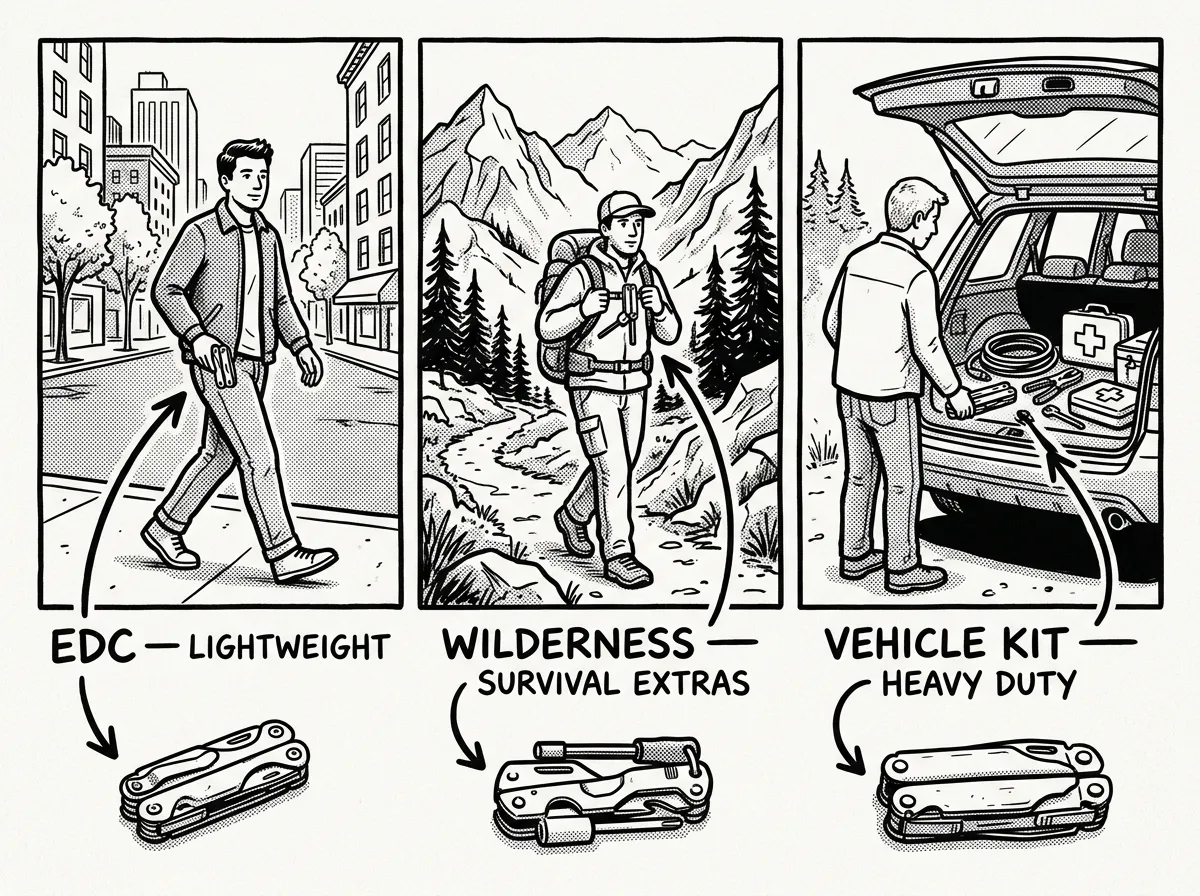 Different kits, different needs — matching your multi-tool to the mission
Not sure where to start? Match the tool to how you’ll actually use it:
- Bug-out bag (wilderness): Leatherman Signal or Leatherman Wave+ — both proven, both light enough. Build your first bug-out bag here.
- Home emergency kit: Leatherman Wave+, Leatherman Rebar, or Victorinox Swiss Tool Spirit X.
- Vehicle kit: Leatherman Rebar or SOG PowerAccess Deluxe — the compound leverage pliers earn their weight when you’re dealing with roadside repairs.
- EDC / everyday carry: Gerber Suspension-NXT or Leatherman Wave+ with belt sheath.
- Beginner on a budget: Gerber Suspension-NXT or Roxon S801 Phantom.
- Buy-once, keep-forever: Victorinox Swiss Tool Spirit X or Leatherman Wave+.
Care and Maintenance
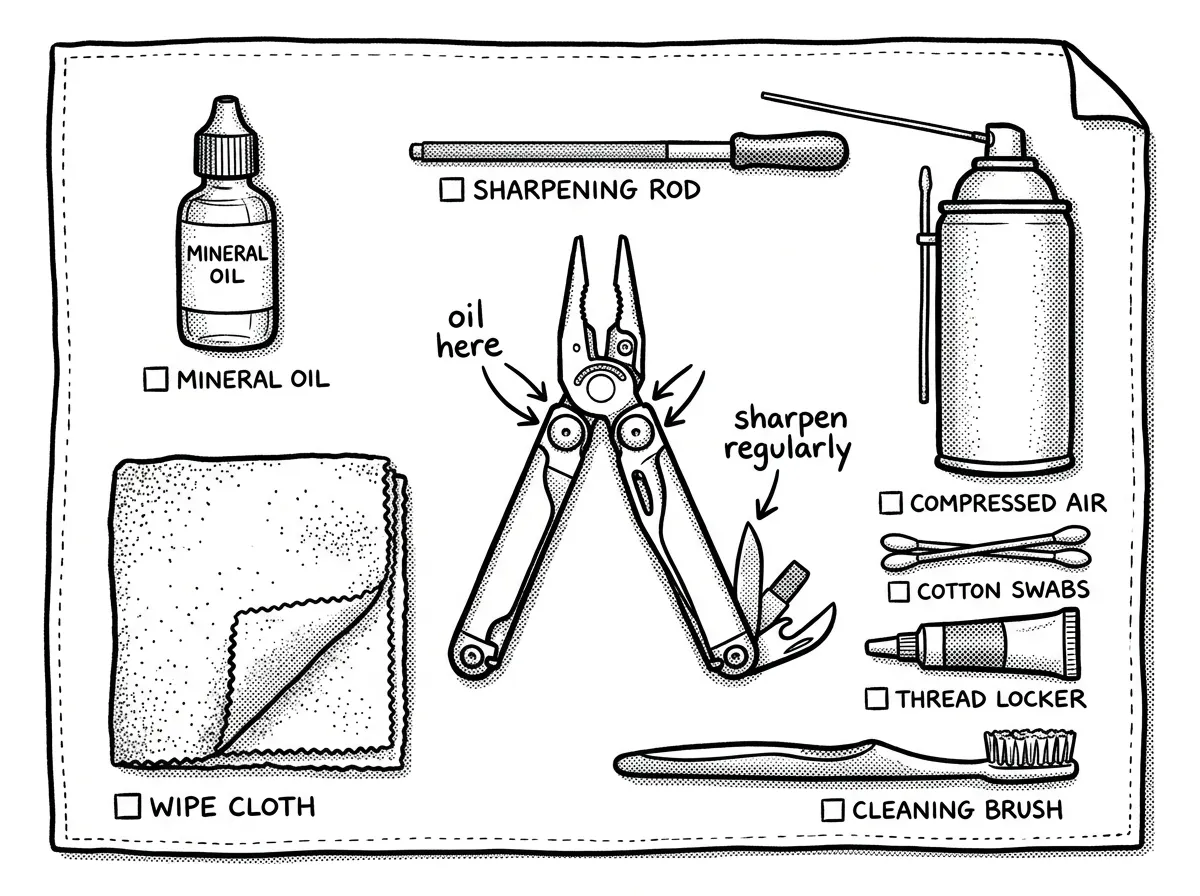 Everything you need to keep your multi-tool field-ready
Proper maintenance is the difference between a tool that works in year ten and one that seized up in year two. Here’s a recommended maintenance routine:
- Clean after every use — remove grit and residue with warm water and a stiff brush, then dry thoroughly, especially in the pivot areas where moisture hides.
- Lubricate pivots regularly with Benchmade BlueLube or food-grade mineral oil (one drop per pivot, work open and closed ten times, wipe excess).
- Sharpen 420HC blades at 20–25 degrees per side with a fine ceramic rod or diamond stone; for serrations, use a tapered round rod on the beveled side only.
- Inspect torx screws and test each lock under gentle pressure monthly — tighten with the correct bit, never improvise.
- Store dry in a sheath with a silica gel packet for long-term kit storage — moisture in a sealed bag corrodes steel faster than open air.
A common maintenance oversight is neglecting saltwater exposure. If a tool gets saltwater on it — along the PNW, Gulf Coast, or Eastern seaboard, for example — rinse it thoroughly with fresh water within 24 hours. Saltwater left on pivots can cause rust that requires full disassembly and an oil soak to resolve.
And a general rule that’ll save you money: never pry with a blade. Never use pliers as a hammer unless you truly have no other option. Multi-tools are versatile, but they aren’t indestructible.
Leatherman’s free sharpening service, included with its 25-year warranty, is an underrated benefit for anyone who doesn’t want to learn to sharpen a blade themselves — especially for serrated edges, which are harder to restore at home. Turnaround is typically a couple of weeks; budget for the cost of shipping the tool in.
Safety and Legal Considerations
Knife and multi-tool carry laws vary significantly by state, county, and municipality. Some jurisdictions restrict locking blades, blade lengths over a certain threshold, or concealed carry of any knife. Check local and travel regulations before you buy or carry any tool daily. This is especially important for air travel — multi-tools are prohibited in carry-on luggage under TSA rules.
Frequently Asked Questions
What is the best overall multitool?
The Leatherman Wave+ is the best overall multi-tool for most people. Its 18-tool layout, 420HC stainless blades, replaceable wire cutters, outside-accessible knives, and 25-year warranty make it the most versatile and proven option available. For wilderness-specific survival, the Leatherman Signal edges ahead with its built-in ferro rod and whistle.
Can a multi-tool replace a fixed-blade knife?
No. A multi-tool blade handles light to moderate cutting well — cordage, packaging, food prep, medical tape — but it can’t safely replace a fixed-blade knife for batoning, heavy carving, or demanding bushcraft work. The folding joint is a structural weak point under lateral stress. Carrying both — a multi-tool for precision tasks and a fixed blade for anything that requires force — is a common practice among experienced preppers.
What tools should a prepper multi-tool have?
Prioritize strong pliers, a plain-edge blade, Phillips and flat screwdrivers, wire cutters or strippers, scissors, a saw, and a can opener. These core tools handle 90% of emergency repair and survival tasks. Survival extras like a ferro rod, whistle, and hammer surface add real capability for wilderness scenarios but aren’t essential for urban or home preparedness.
What is the best budget multi-tool for preppers?
The Gerber Suspension-NXT at around $30–$40 is the best budget multi-tool for survival beginners. Its 15 tools, pocket clip, and 5.6-ounce weight make it a practical entry point. It won’t match the Wave+ in steel quality or longevity, but it works reliably for light to moderate use and makes an excellent backup tool in any kit.
How many functions should a prepper multi-tool have?
Quality matters far more than quantity. A practical range is 10 to 20 well-executed functions. Fifteen tools that lock solidly and perform cleanly are more valuable than 30 tools where half are flimsy or redundant. Focus on the tools you’ll actually use in your most likely scenarios.
Should I get survival extras like a ferro rod on my multi-tool?
If your primary scenario is wilderness-based, yes — the Leatherman Signal’s integrated ferro rod and whistle consolidate gear and reduce weight. For urban preparedness or home kits, money is often better spent on core tool quality. A backup fire-starting option on a multi-tool can be valuable if a primary fire starter is lost or inaccessible in a pack.
The Bottom Line on Choosing the Best Multi-Tools for Preppers
The advice here is simple: buy a quality tool, learn every implement on it, and maintain it like your safety depends on it — because someday it might.
For most preppers, the Leatherman Wave+ is the best multi-tool for preppers. It balances capability, durability, and repairability better than anything else at its price. Choose the Leatherman Signal if your plans center on wilderness survival. Pick the Victorinox Swiss Tool Spirit X if you want heirloom-quality craftsmanship. Start with the Gerber Suspension-NXT if budget’s tight — there’s no shame in a $35 tool that actually works.
It’s 11 PM, the power’s been out for three hours, and you discover the tarp you rigged over a broken window is pulling loose from its paracord ties. You need to cut new cordage, tighten a screw on an improvised bracket, and bend a wire hook to hold everything in place — all by flashlight, with one hand holding the tarp. That’s the moment you’ll be glad you practiced with your multi-tool last weekend instead of just tossing it in a drawer.
Whatever you choose, do these three things before you stash it in a kit: open and close every tool so you know how the locks engage, cut 20 feet of cordage so you understand the blade’s behavior, and use the pliers on something real so you know their limits. Build that muscle memory now. Emergencies don’t give you time to read the manual.
Confirm current model specifications, verify local blade-length and locking-knife laws, and then go practice. Preparedness isn’t about owning gear — it’s about knowing how to use it when it counts.
The Complete
Prepper's Reference.
149 articles synthesized into one comprehensive PDF — twelve chapters covering water, food, shelter, first aid, comms, and scenario-specific preparedness. Free with your email.
Unsubscribe anytime · We never share your email
You're in. Check your inbox.
Keep Reading
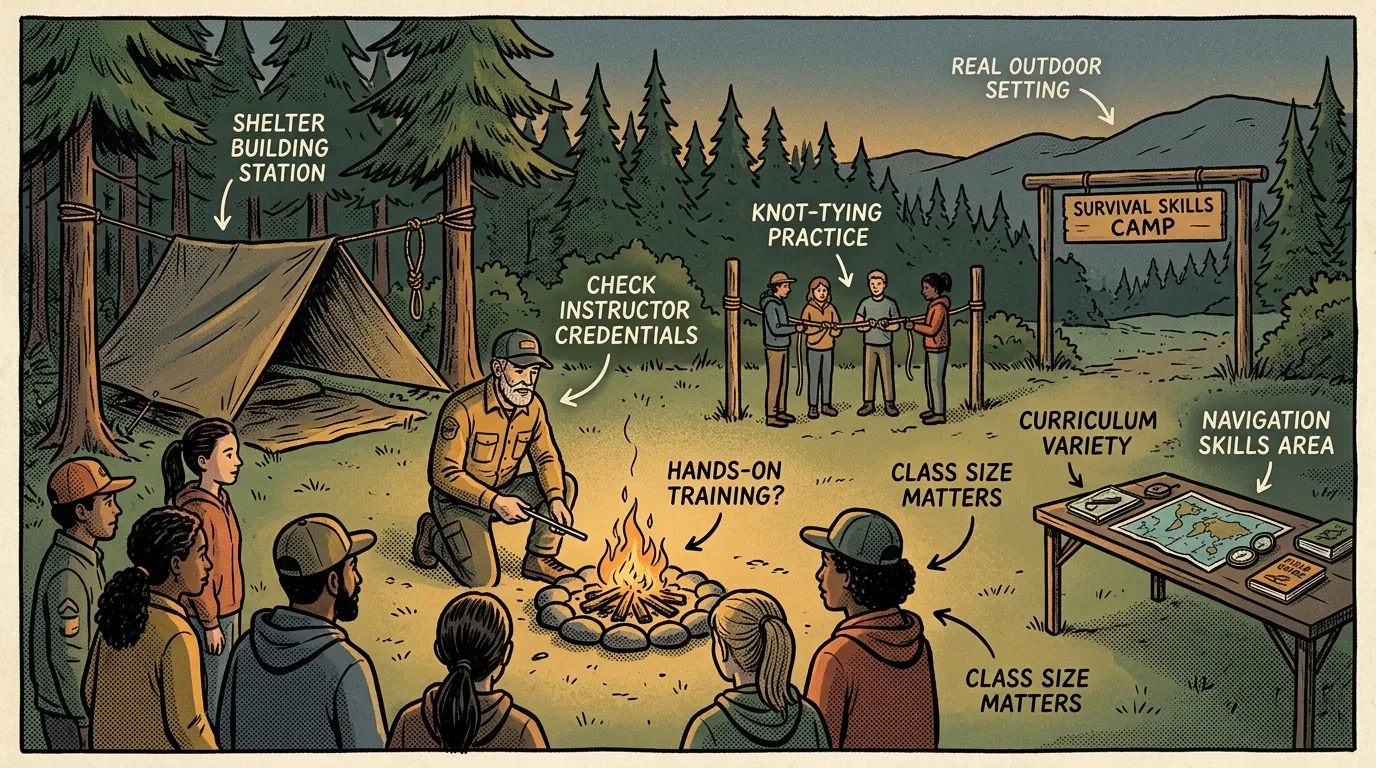
Survival Skills Camp: How to Choose the Right One
Choosing a survival skills camp? Here's what to look for, red flags to avoid, and what real training teaches you.
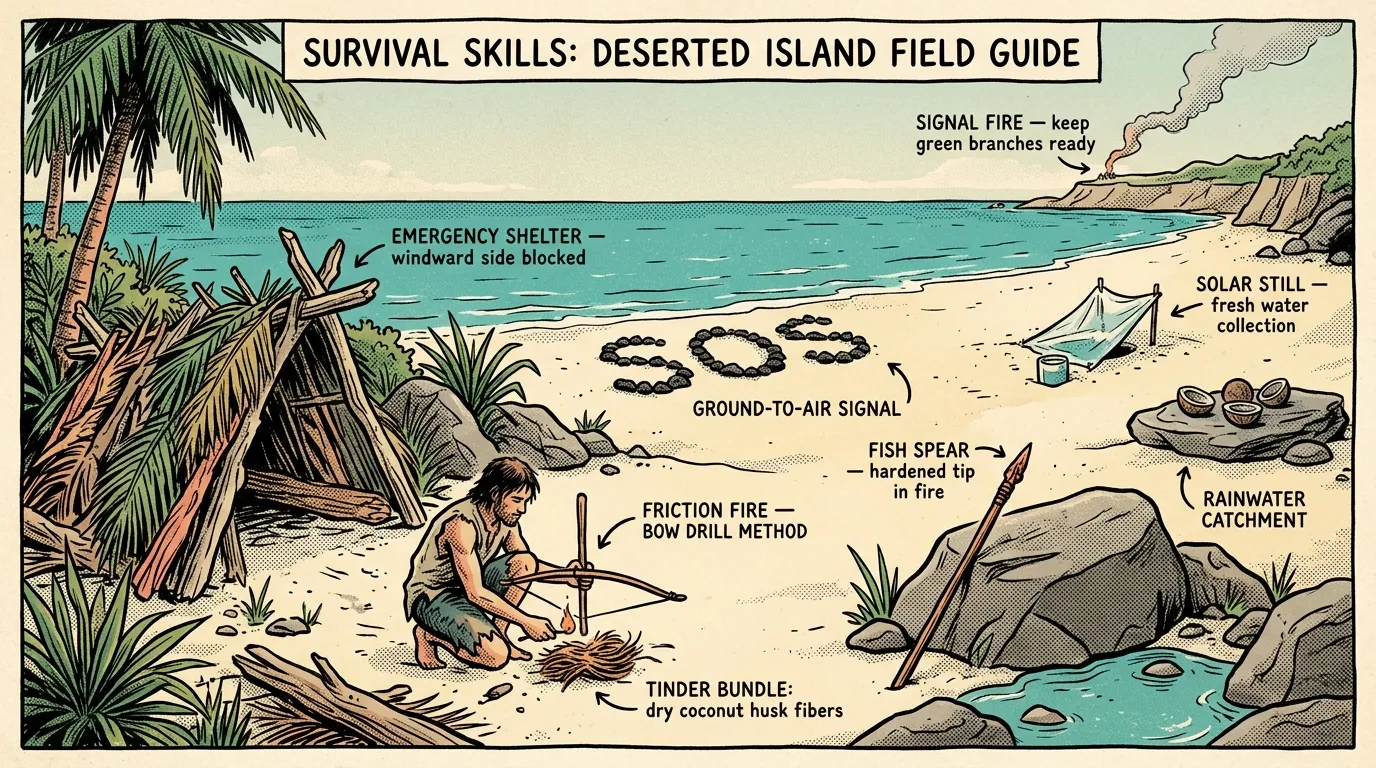
Survival Skills on a Deserted Island: Field Guide
Master survival skills on a deserted island — water, shelter, fire, food, and rescue signaling. Start learning now.
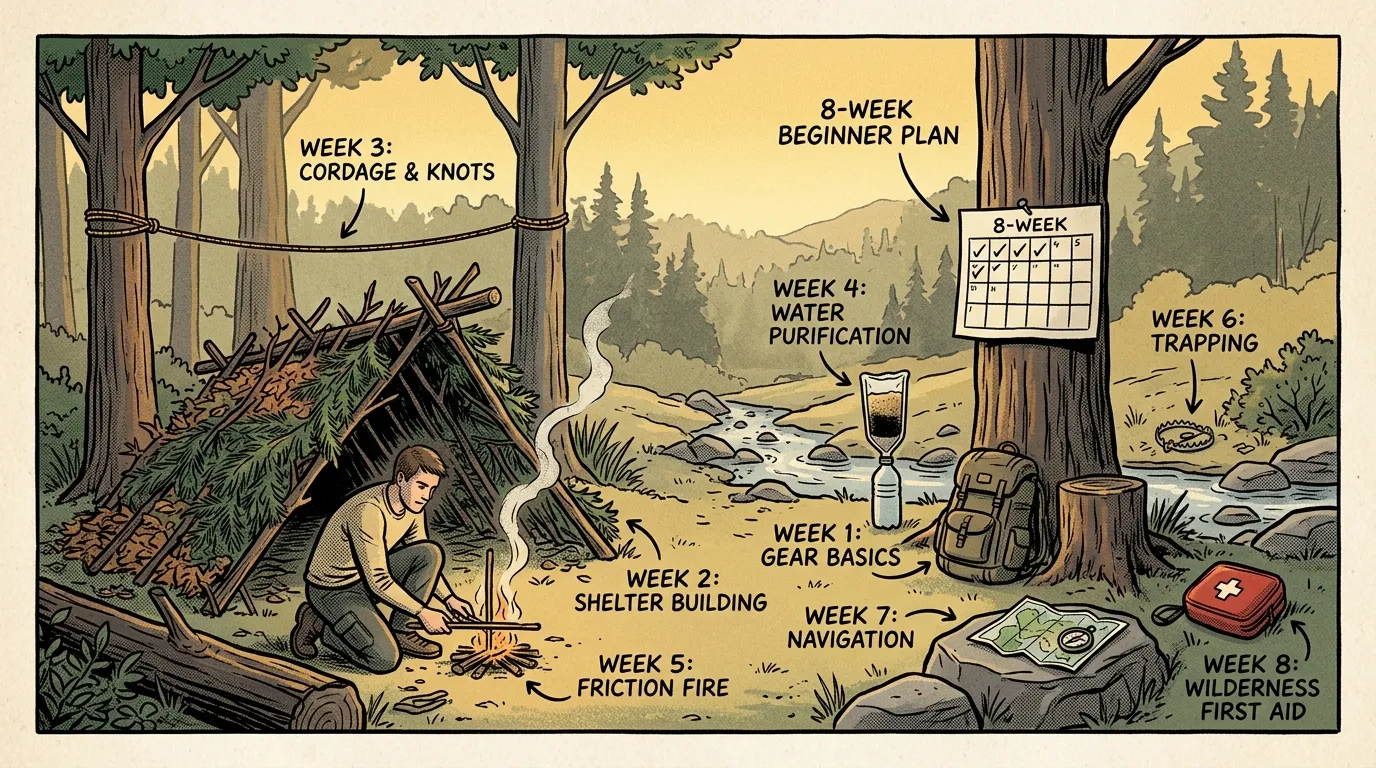
Survival Skills Training: 8-Week Plan for Beginners
Follow this 8-week survival skills training plan to master shelter, fire, water, navigation & first aid. Start this weekend.